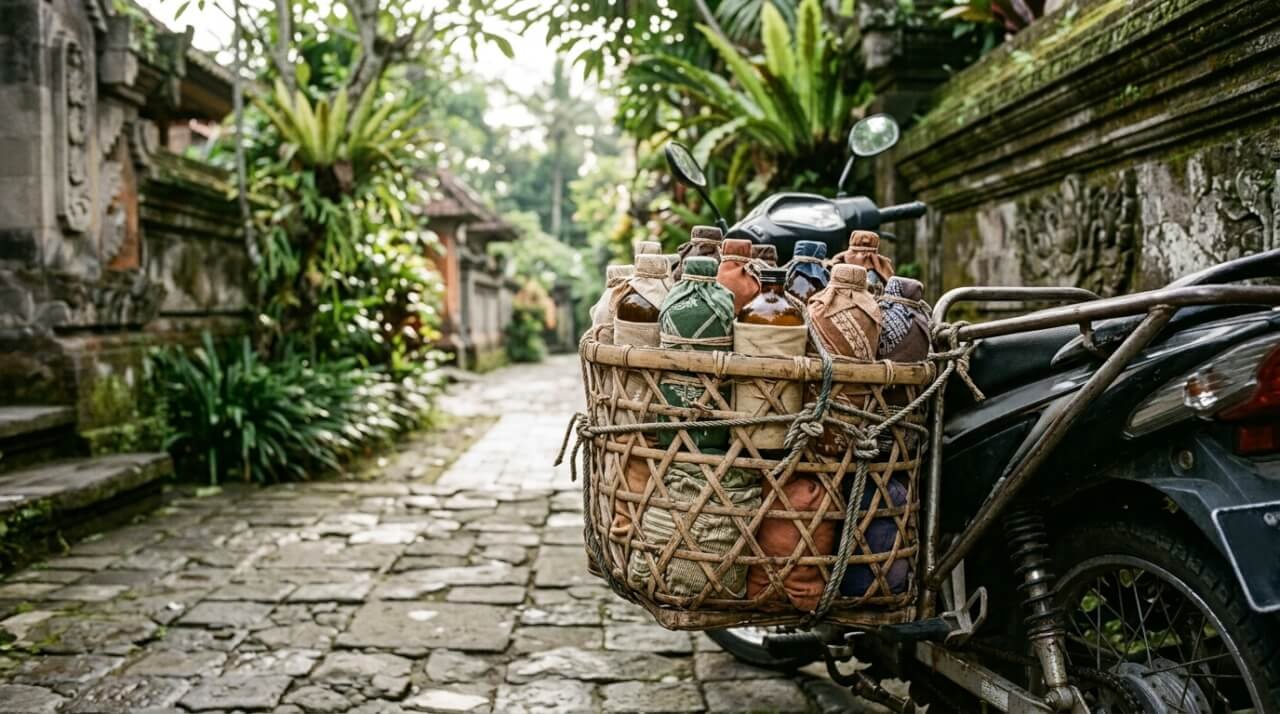
Connection Thursday: the rider who carries your refill through Ubud’s back lanes
Before a refill order reaches your door, it usually passes through someone’s hands twice more than you would guess: once at the counter where it is weighed and poured, and once more on the back of a motorbike, riding narrow stone lanes that a delivery van could never fit through.
In Ubud, this is Made’s route six mornings a week. He knows which gate sticks, which family keeps a dog that barks but never bites, and which customers prefer their bottles left in the shade of the carport rather than the sun. None of this is written down anywhere. It lives in his memory of the town, built one delivery at a time.
Refill culture asks something unusual of a supply chain: patience with small, local, human-scale logistics instead of the speed of mass distribution. A rider with a woven basket of glass bottles cannot move as fast as a fleet of vans, but he can notice a cracked seal before it becomes a spill, and remember that the bottle needs to sit upright, wrapped in cloth so the glass does not knock against itself on the cobblestones.

We think about this every time we describe refill as a system, because a system is not just stations and bottles. It is also the person who bridges the gap between the counter and the customer’s kitchen, learning a town’s geography by heart so that the loop actually closes.
The takeaway: the parts of refill culture that scale slowest, like a rider who knows a neighborhood, are often the parts holding the whole practice together. We would rather grow at the pace those relationships can hold than outrun them.
Read more about how these small, local touchpoints add up in the refill stations that became neighborhood meeting places.