Slow Saturday: the short afternoon rest, and why 10 minutes is enough
Across Indonesia, the hours after lunch have a name. Tidur siang, the midday sleep, is something many of us grew up with. The heat climbs, the street goes quiet, and the household lies down for a while. It was never treated as laziness. It was simply part of the day.
This Saturday, we want to suggest bringing it back, in a small and deliberate form. Not a long afternoon lost to sleep. A short rest with a clear beginning and a clear end.
What the research says about a short nap
In 1995, a NASA team led by Mark Rosekind studied long-haul pilots on transpacific routes. Some crews were given a 40-minute rest window in the cockpit seat. Those pilots fell asleep in about six minutes on average and slept for about 26. Compared with crews who did not rest, they showed a 34% improvement in performance and a 54% improvement in physiological alertness. That is where the phrase “NASA nap” comes from.
A later study adds a useful detail about length. In 2006, Amber Brooks and Leon Lack at Flinders University compared afternoon naps of five, 10, 20, and 30 minutes. The 10-minute nap gave the clearest benefit straight away. The longer naps helped too, but they came with a groggy spell on waking, known as sleep inertia. Five minutes made almost no difference.

So the wisdom of tidur siang holds, with one adjustment. Shorter is kinder to the rest of the day.
A short Saturday rest, in four steps
- Choose the early afternoon. Most of us feel a natural dip in alertness after lunch. Resting then works with the body’s rhythm. A nap late in the day can make night sleep harder to find.
- Set a gentle alarm. Ten to 20 minutes of rest is enough. Allow a few extra minutes to drift off. The alarm is what lets the mind let go.
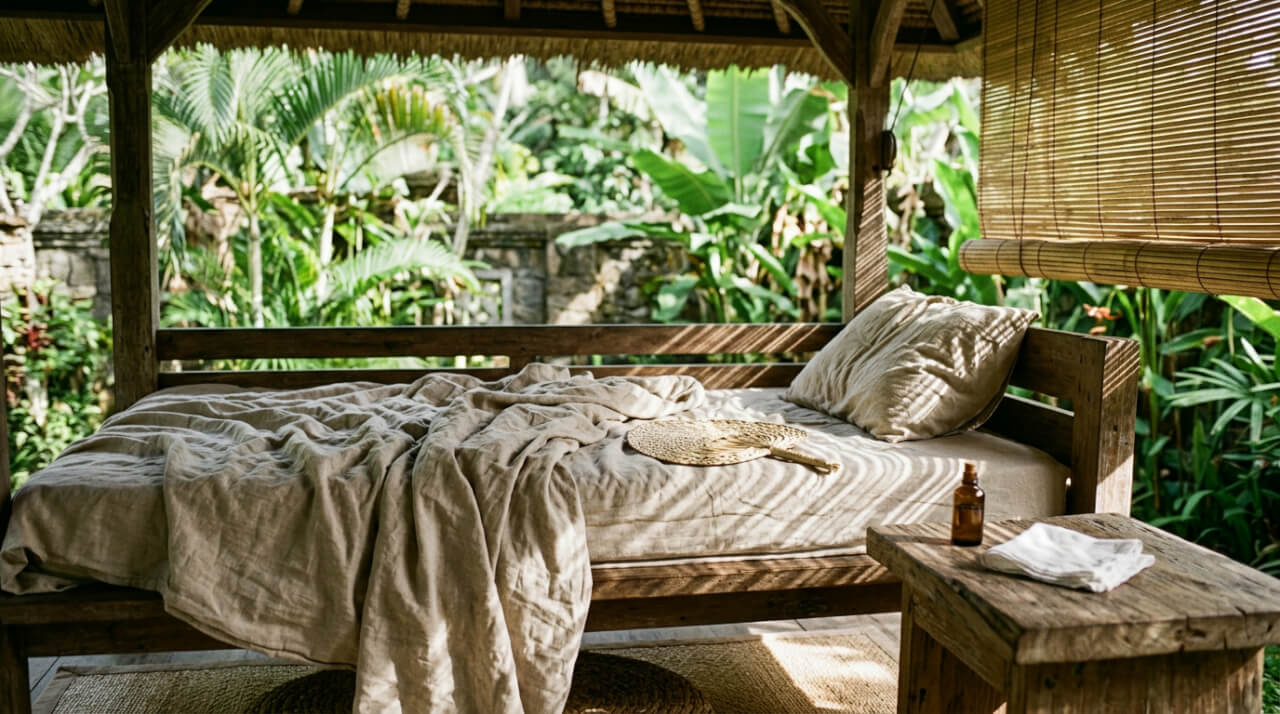
- Give the room a cue. Draw the blind, loosen anything tight, and put the phone face down out of reach. If you like scent, place one drop of essential oil on a cotton handkerchief and set it beside the pillow, not on your skin.
- Wake slowly. Sit up, drink a glass of water, and step into daylight for a minute before picking up the next task. This is the part most of us skip.
If sleep does not come, that is fine. Lying still with your eyes closed for 15 minutes is still a pause. The ritual is the rest, not the score.
What we reach for
Our Lavender Essential Oil is our usual choice for this, one drop on cloth near the pillow. We use it as a familiar cue rather than a sleep remedy: the same quiet scent, at the same time, tells the body that this is the resting part of the day. For a softer, rounder blend, our Deep Calming Essential Oil Blend pairs lavender with rose geranium, cananga, and orange. It also contains bergamot, so keep it on cloth or in a diffuser rather than on sun-exposed skin. Keep all essential oils away from eyes, young children’s bedding, and cats.
Our recent note on why we stop smelling our own scent explains why one drop is plenty. If you would rather mark the rest by time than by alarm, a single stick of incense burned in another room works as a gentle clock.
Lie down. Set the alarm. Let the afternoon wait for you.