Slow Saturday: let a clay mask set the length of your pause
Most care asks us to do something. A clay mask asks the opposite. Once it is on, there is nothing left to do but wait, and that waiting is the part we tend to rush. We scroll, we tidy the bathroom, we answer a message with one hand while the clay sets on our face.
This Saturday, we suggest treating those minutes as the ritual itself. The clay sets the length of the pause. Our only job is to sit with it.
Why the clay already keeps time for you
A clay mask changes as it rests. It goes on cool and damp, then slowly lightens in colour from the edges inward as the water leaves it. You can feel it happen: a gentle tightening across the cheeks, a stillness around the mouth that makes talking feel like effort. That is a quiet signal to stop talking anyway.
There is also a practical truth here. Clay works best while it is still slightly damp. Left to dry until it cracks, it can pull more moisture than skin wants to give, leaving it feeling tight and thirsty afterward. So the mask carries its own gentle end point. When most of the surface has lightened but it still feels a little cool, it is time to rinse. For most of us that is somewhere around 10 to 15 minutes, never a timer’s exact second.
A ten-minute clay pause for a slow Saturday
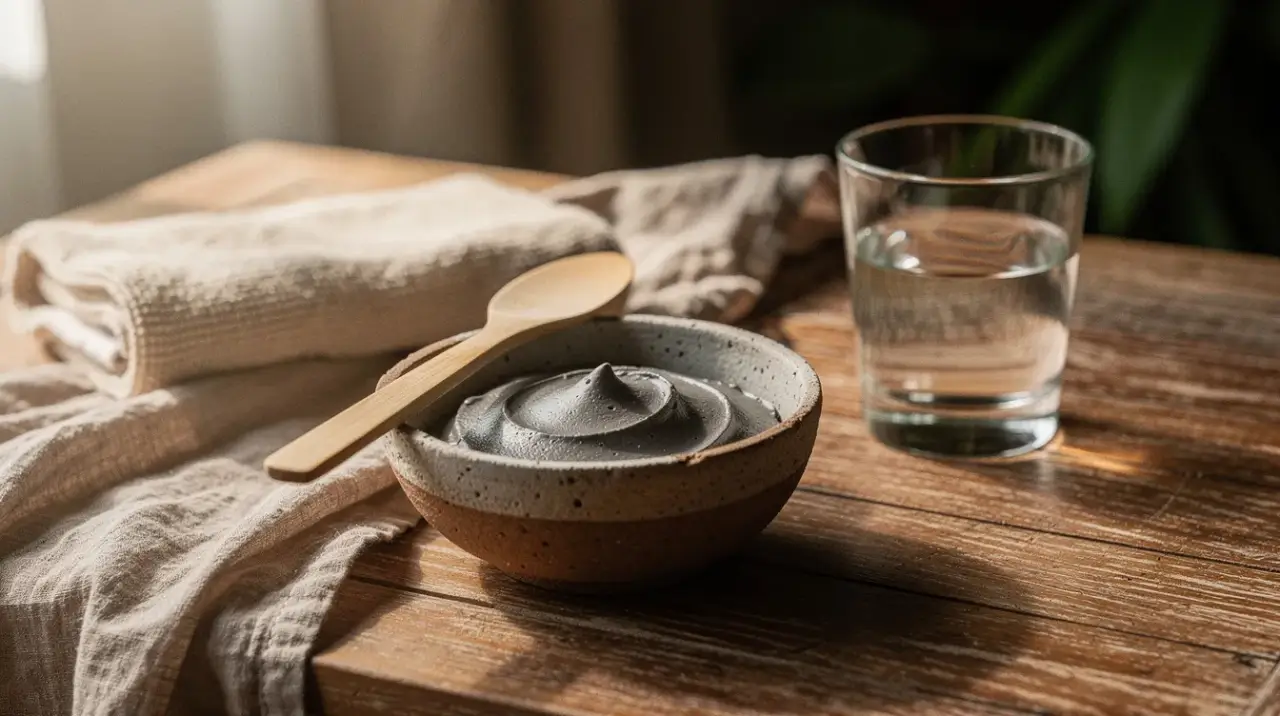
- Mix only what you need. A teaspoon or two of clay with a little water, stirred into a smooth paste in a small bowl. Slowly, with a wooden spoon, the way you might stir tea.
- Apply with your fingertips. An even layer across the face, avoiding the eyes and lips. Notice the temperature and the weight of it.
- Sit somewhere other than the bathroom. A chair by a window, a step outside, a corner with a little light. Leave the phone in another room.
- Let your face go still. The clay will make this easy. Soften the jaw, breathe through the nose, and watch whatever is in front of you: a plant, the sky, steam rising from a cup.
- Rinse with warm water before it cracks. Use slow circles and a soft cloth, then pat dry. Follow with a few drops of face oil or serum while the skin is still a little damp.
If your skin is sensitive or new to clay, try a small patch on the inside of your arm first, and keep the mask to once or twice a week. Clay is a reset, not a daily habit.
What we reach for
Our Face and Body Clay is pure volcanic clay, the kind Indonesian families have used on skin for generations. It arrives as a fine powder, so you mix only what you will use, and it works on the face or anywhere on the body that wants a reset. Any natural clay you already trust will hold the same pause. The ritual asks for your stillness, not a particular jar.
If you want to understand why rinsing before the crack matters, our guide to clay masks for oily skin explains the over-drying mistake in detail, and mud mask vs clay mask helps you choose between the two. For the wider tradition this practice belongs to, see our guide to Balinese beauty rituals.
One bowl, one stillness, no rush. Let the clay keep time today.