Best essential oil diffuser: how to choose the right one for your aromatherapy practice
Finding the best essential oil diffuser is rarely about picking the prettiest object on a shelf. It is about understanding how a small machine asks an oil to move from liquid to air, and what that journey costs (or preserves) in the oil itself. Most guides will hand you a top-ten list and call it done. We want to do something different here, because the diffuser you choose shapes the aromatherapy you actually receive.
At Utama Spice, we have been working with Balinese botanical oils since 1989. Long before the modern aromatherapy diffuser existed, our makers were using oil warmers, burning sandalwood incense, and dabbing wild-harvested resins on warm temple stones. The intent was always the same: invite a scent into a room so it could meet a body, a breath, a mood. That tradition has something to teach a modern home, even when the technology looks very different. This guide pulls the science and the heritage together, so you can choose a diffuser that matches both the oils you love and the way you want to live with them.
What actually happens when you diffuse an essential oil
Essential oils are not simple liquids. Each one is a cocktail of dozens, sometimes hundreds, of volatile aromatic compounds: monoterpenes, sesquiterpenes, esters, alcohols, aldehydes, phenols. These molecules are tiny, lightweight, and built to travel. When the oil sits in a closed bottle the molecules stay quiet. When you open the bottle, or apply gentle energy, the lightest ones lift off first and head for your nose.
This is what diffusion really is, in plain language: a controlled release of those volatile compounds into the air around you, in a concentration low enough to be pleasant and high enough to register. From there the molecules enter the respiratory tract, dock with olfactory receptors high in the nose, and trigger signals that move directly into the limbic system, the part of the brain that handles mood, memory, and stress response. The route is unusually direct. Scent reaches the emotional brain before the thinking brain has a chance to filter it.
What matters for choosing the best essential oil diffuser is this: not every method of releasing those molecules is equal. Some methods keep the oil’s chemistry intact. Some heat it, oxidize it, or break it apart before it ever reaches you. A good diffuser is, in essence, a delivery system that respects the molecule. If you want to go deeper on the chemistry behind specific scents, our guide to essential oils benefits walks through the major compound families and what each one offers.
Four types of diffusers and how each one works
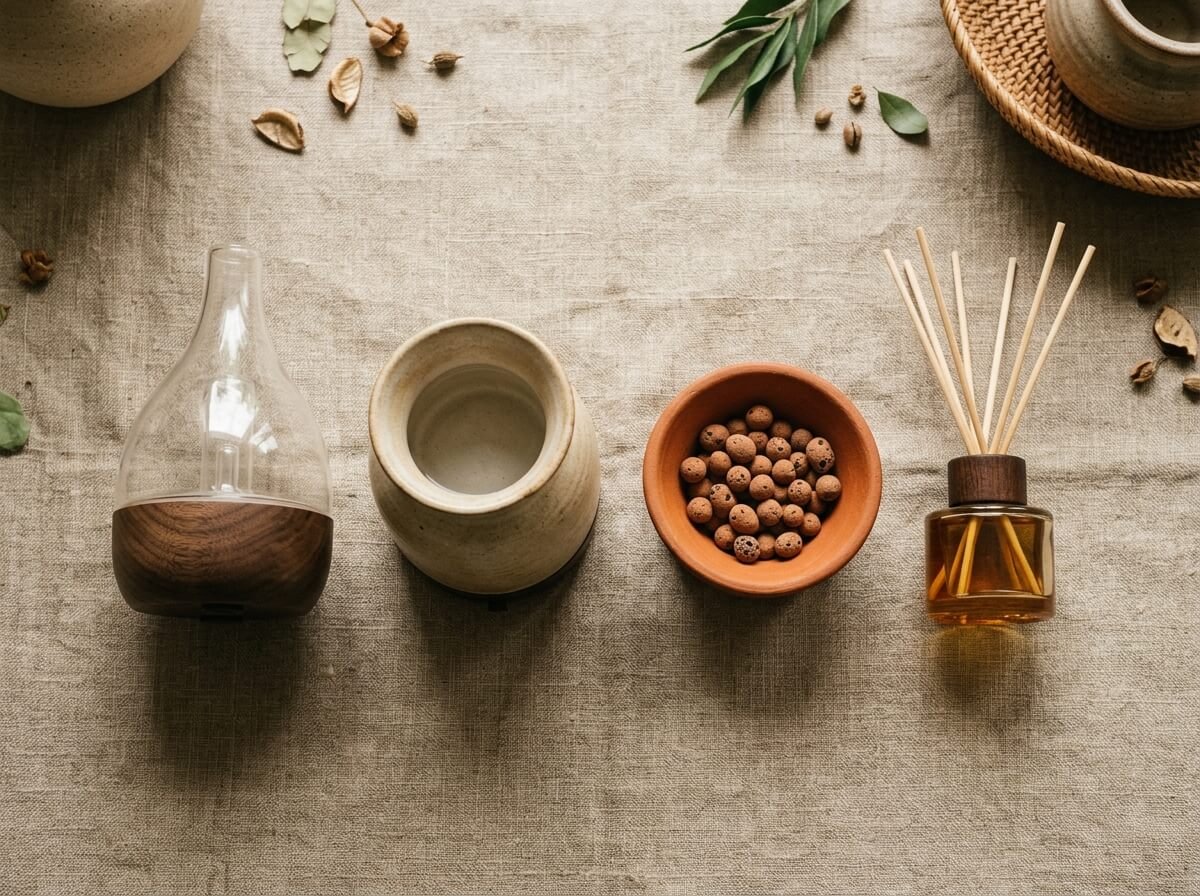
The diffuser category looks crowded, but it really only contains four working methods. Once you know the four, every product on the market becomes easy to read.
Nebulizing diffusers
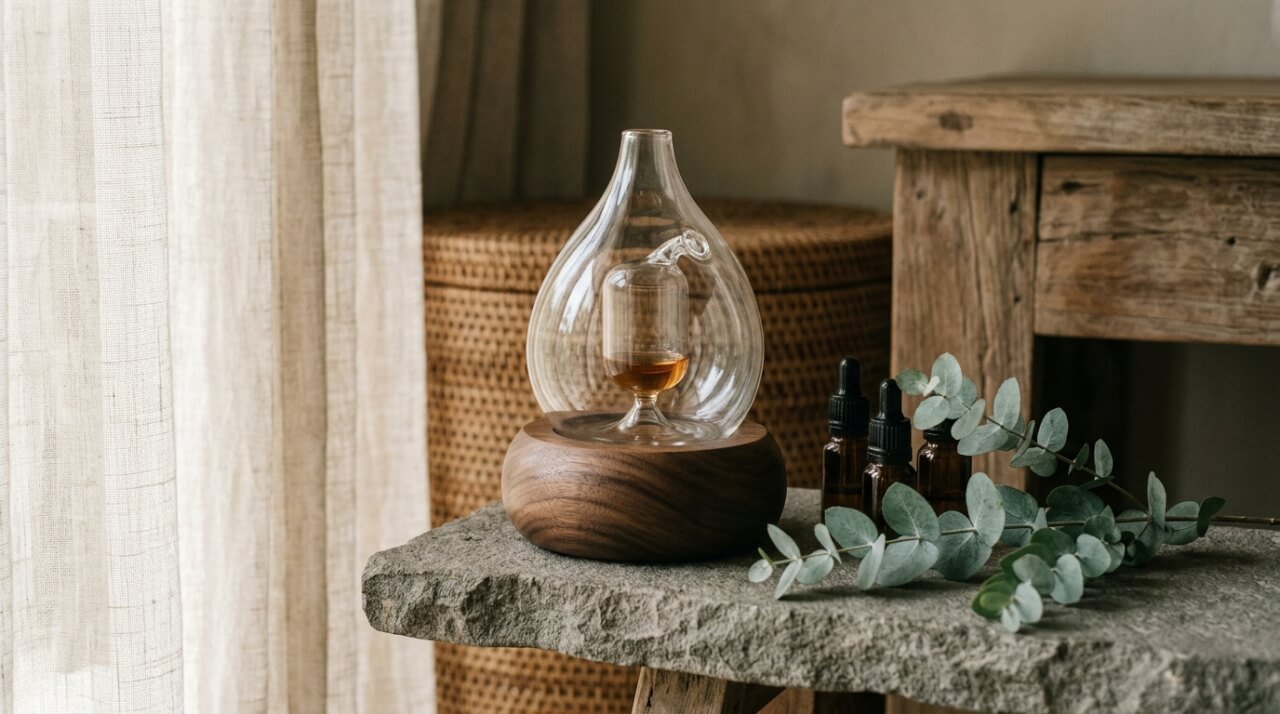
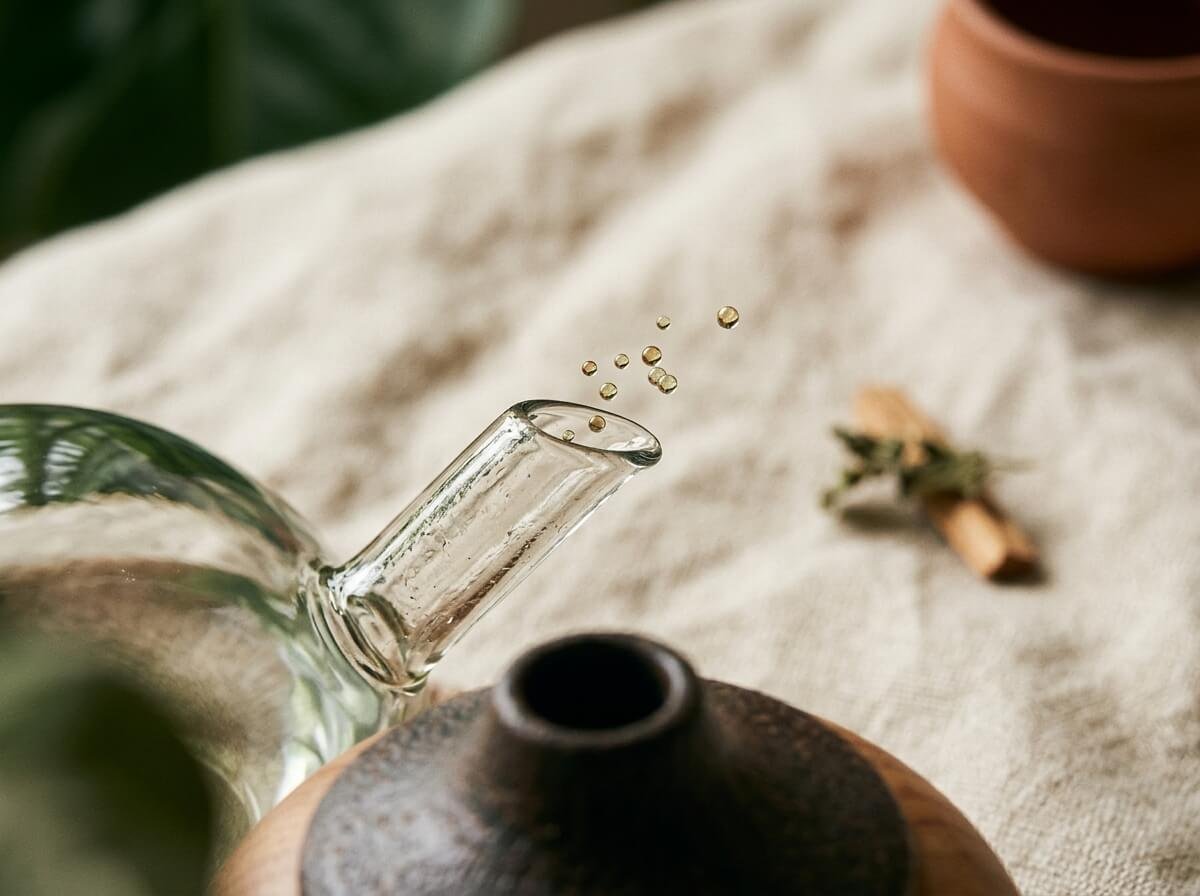
A nebulizer uses pressurized air to atomize undiluted essential oil into a fine mist of micro-droplets, no water, no heat. The oil is broken into pieces small enough to hang in the air, which keeps the original chemistry intact. Nebulizing diffusers tend to be made of glass and wood, run intermittently, and deliver the strongest therapeutic concentration of any diffusion method. They are also the most efficient with the oil itself: nothing is diluted, nothing is degraded.
Ultrasonic diffusers
Ultrasonic units sit a small ceramic disc beneath a water reservoir and vibrate at a frequency the ear cannot detect. The vibration breaks the surface tension of the water, lifting a fine mist that carries the essential oil droplets you have added (a few drops per fill is plenty). Because the oil is suspended in water, the room receives a much gentler concentration, and the unit doubles as a humidifier. The trade-off is dilution: each session delivers less of the active compound, and the water in the reservoir can begin to oxidize the oil if left sitting between uses. Our deeper look at the essential oil diffuser humidifier covers when this trade-off works for you.
Heat diffusers
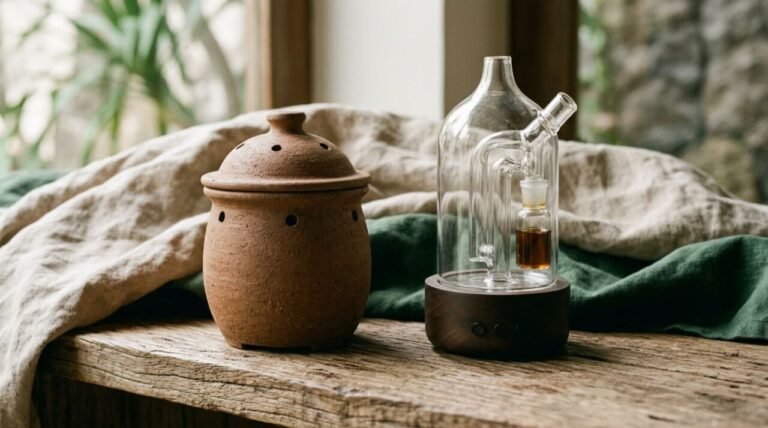
Heat diffusers are the oldest family in the category, from candle-warmed ceramic dishes to electric tea-light warmers. They release scent reliably, but heat is a chemistry-changer. Many of the most fragile and therapeutic compounds in citrus oils, mint oils, and lighter florals begin to break down above roughly 40 to 50 degrees Celsius. You will still get a beautiful aroma, but the molecular profile that reaches the air is no longer the molecular profile you bought. Heat diffusers are best treated as scent tools, not therapeutic tools.
Evaporative diffusers
This family includes passive reed diffusers, terracotta pendants, and small fan diffusers. They rely on natural evaporation, sometimes nudged along by airflow, to move scent into a room. Evaporative diffusion is uneven, because the lightest compounds lift first and the heavier ones lag behind, so the scent profile shifts across hours and days. For ambient background scent or quiet bedroom corners, evaporative methods are lovely. For focused aromatherapy, they are slower and less precise.
Why a nebulizer is often the best essential oil diffuser for therapeutic use
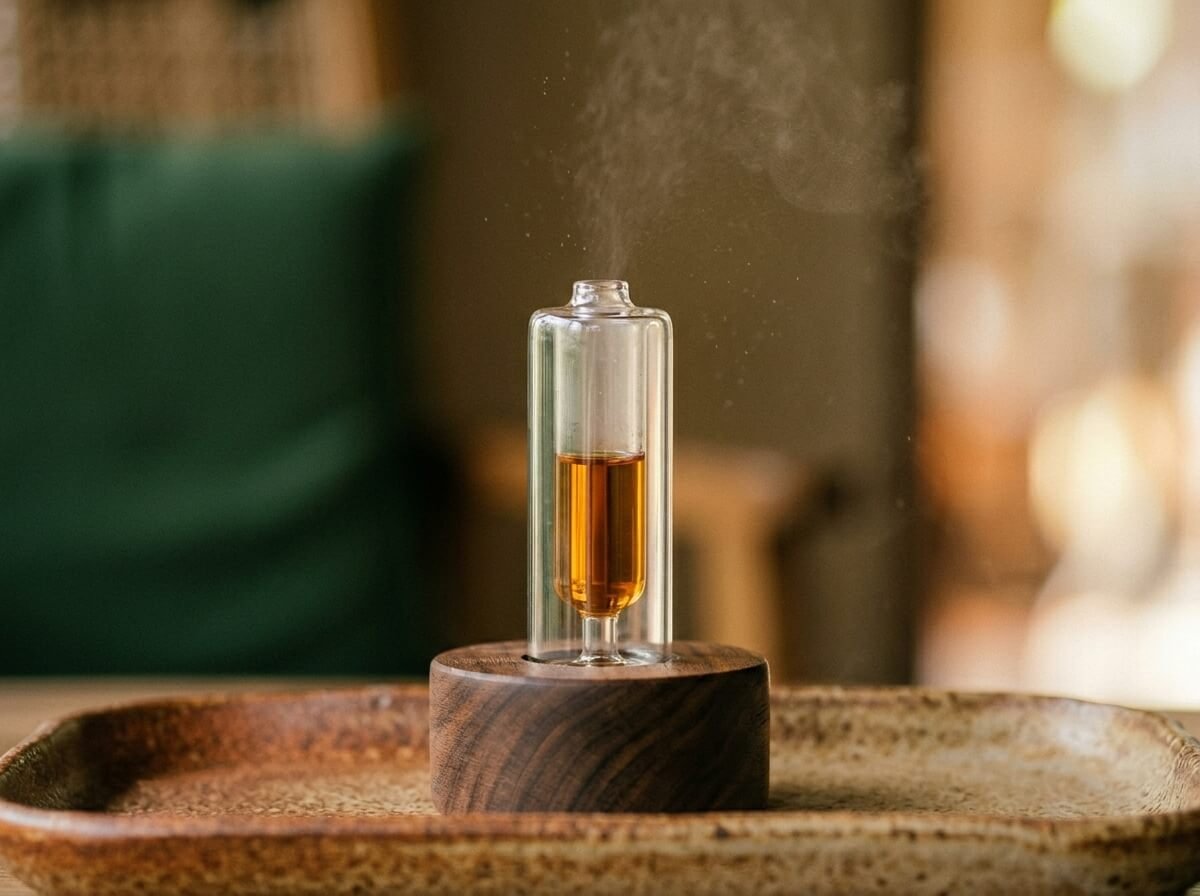
When practitioners talk about therapeutic aromatherapy, they are usually talking about delivering enough of an essential oil’s active chemistry into the air that the body can respond to it. The honest answer is that nebulizing is the only common diffusion method built around that goal.
Three things make nebulizing different. First, it uses no water, so there is no dilution between the oil and the air you breathe. Second, it uses no heat, so the molecules you bottled are the molecules you receive. Third, it works by mechanical atomization, which means the oil is broken into droplets of about one to three microns: small enough to behave like a gas in the room, and small enough to enter the upper respiratory tract efficiently. The result is a true therapeutic concentration in a small space over a short period of time.
This is also why nebulizing diffusers are run intermittently, on a five-minute-on, ten-minute-off cycle, rather than continuously. The concentration is high enough that the body benefits from rests, and the oil is used efficiently rather than wasted into a saturated room. A modest 5 ml bottle can carry a careful user through many weeks of evening sessions. Pair a nebulizer with a single-note oil or a thoughtful blend, and you have something closer to a daily ritual than a household appliance. For the rituals where we use scent for mood or for sleep, our piece on essential oils for stress and anxiety goes through the compounds that the research consistently points to.
How to choose the best essential oil diffuser for your space

The best essential oil diffuser for one home is rarely the best for another. The right choice is a conversation between the room, the oil, and the moment you want to create. A few honest questions will narrow it down quickly.
How large is the space, and how often will it be used? A small bedroom or a corner of a working studio is comfortable with a nebulizer or a compact ultrasonic. An open living space with high ceilings benefits from a higher-capacity ultrasonic with a wide water reservoir, or a nebulizer placed on intermittent cycles. A whole apartment is too much for any single diffuser to do well; two smaller units placed thoughtfully will always outperform one giant one.
Is your goal therapeutic or ambient? For sleep support, focus rituals, mood lifts, or specific seasonal use (think a respiratory blend in cooler months), a nebulizer delivers the cleanest signal. For day-long background scent, gentle humidification through a dry climate, or a quiet bedside presence, an ultrasonic is more forgiving and more atmospheric. For a guest bathroom or a hallway entrance, a passive reed or terracotta diffuser is often the right answer.
What does the room sound like? Nebulizers are quiet but distinctly mechanical, a soft, regular hiss. Ultrasonics are nearly silent and add a low water-fountain texture. Reed diffusers are silent. If a diffuser will live next to your meditation cushion or your bed, the sound matters as much as the scent.
What about the oils you already own? If your collection leans toward heavier base notes, woods, resins, sandalwood, vetiver, patchouli, you will hear them best through a nebulizer that can lift those heavier molecules. If your collection skews bright and floral, an ultrasonic carries those notes beautifully and forgives a little overuse. A balanced cabinet is best served by owning one of each, used for different parts of the day. Our overview of aromatherapy diffuser oils matches specific oils to specific diffusion methods in more detail.


Danau Dua nebulizing diffuser
Hand-finished in Bali, the Danau Dua is a compact, glass-and-ceramic nebulizer designed for the way we actually use aromatherapy at home: quiet evenings, focused mornings, and ritual corners that ask for a small, beautiful object as much as a working one. No water, no heat, just pure essential oil meeting air the way the molecule prefers.
Best essential oils and blends for diffusing
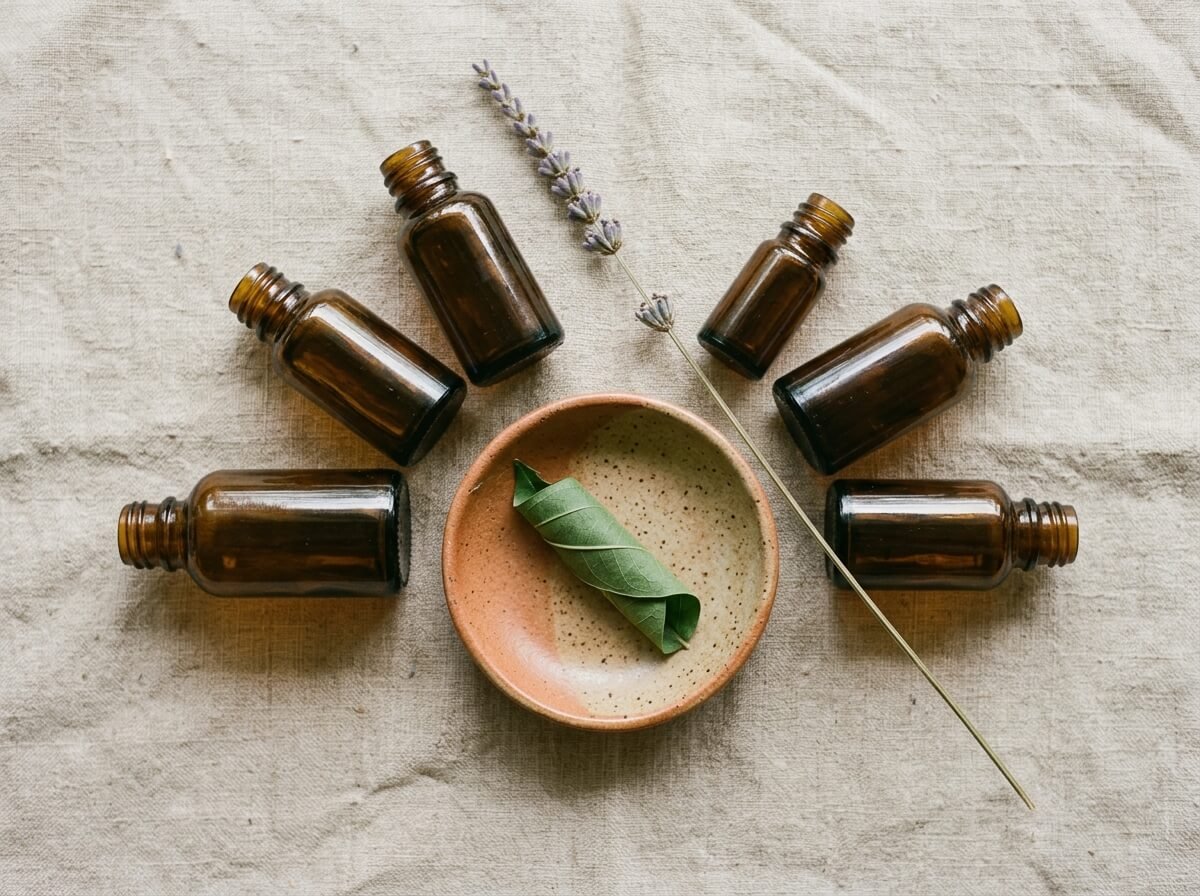
Oils respond differently to different diffusion methods. A short pairing map will save many bottles from being misused.
For nebulizers, choose oils that hold their character at full strength. Sandalwood, vetiver, patchouli, frankincense, cedarwood, and Balinese nilam all open beautifully when they meet air directly. Bright citrus oils (sweet orange, kaffir lime, bergamot) are also superb in a nebulizer for short bursts; just expect to use them sparingly because their lightness travels fast. Our Kaffir Lime Essential Oil Blend is a favourite of ours for nebulizing in working hours, sharp, quiet, and instantly clearing.
For ultrasonic diffusers, choose oils that benefit from a softer hand. Lavender, geranium, ylang ylang, chamomile, and gentle citrus blends suit ultrasonics well, and the added humidity helps florals carry across larger rooms. Our Bliss Essential Oil Blend was formulated to behave gracefully in either method, but it is at its most generous in an ultrasonic on a long evening.
For heat diffusers and passive reeds, choose oils that you love for their scent more than their precise chemistry. Heavier resins (myrrh, benzoin), woods, and warm spice blends are forgiving in these methods because the aroma profile is what you want, even if some of the lighter therapeutic notes drop away. Our Bali Night Essential Oil Blend is built for exactly this kind of evening atmosphere.
By mood, a few starting points. For sleep, lavender and chamomile alone, or a sandalwood-lavender pairing. For focus, rosemary with peppermint or kaffir lime. For an open, social room, sweet orange with cedarwood or frankincense. For a respiratory lift in colder months, eucalyptus with a touch of tea tree. If you want to study oils by their use cases more systematically, we keep a deeper essential oils uses chart as a reference.
Common diffuser mistakes that waste your essential oils
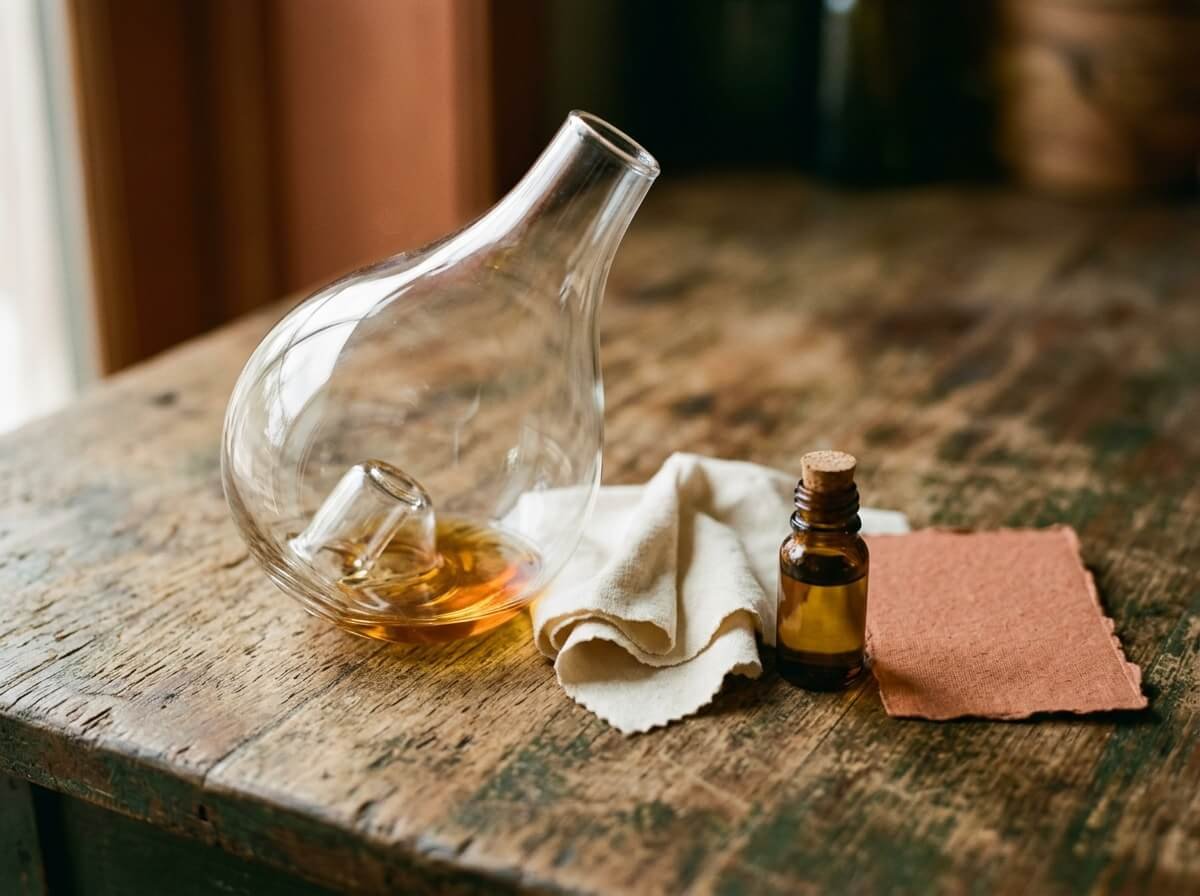
The most expensive mistake in aromatherapy is not buying the wrong diffuser. It is using a good diffuser badly. A few patterns we see often:
- Running the diffuser continuously. Your nose adapts to a constant scent within roughly twenty minutes, and the room saturates. Intermittent cycles, five on, ten off, or half-hour bursts a few times a day, give your nervous system room to actually receive the scent.
- Overloading an ultrasonic reservoir. Three to five drops of oil per 100 ml of water is plenty. More oil simply oxidizes faster and coats the inside of the unit, shortening its life.
- Mixing oils in the reservoir and leaving them. Once oil meets water, the clock starts. Empty, rinse, and dry between sessions, especially if you change blends.
- Skipping cleaning. A nebulizer should be rinsed with a small splash of high-proof alcohol every week or two; an ultrasonic should be wiped dry and rinsed every few uses. Residue dampens scent and breeds bacteria.
- Using fragrance oil instead of essential oil. Fragrance oils are synthetic and often petroleum-derived. They can damage the seals on a nebulizer, leave waxy residue on ultrasonic discs, and they do not deliver the therapeutic profile of a true essential oil. The label should say only the species, the part of the plant, and the extraction method.
- Diffusing strong oils around pets and small children without thought. Cats in particular metabolize many monoterpenes poorly. Tea tree, peppermint, eucalyptus, and citrus oils call for ventilation and a closed-door room when a pet is present.
Each of these mistakes is easy to fix once you know it is happening. The diffuser then becomes what it was meant to be: an efficient, quiet partner in your aromatherapy, not a slow drain on a bottle you paid attention to choosing.
Building an aromatherapy ritual at home
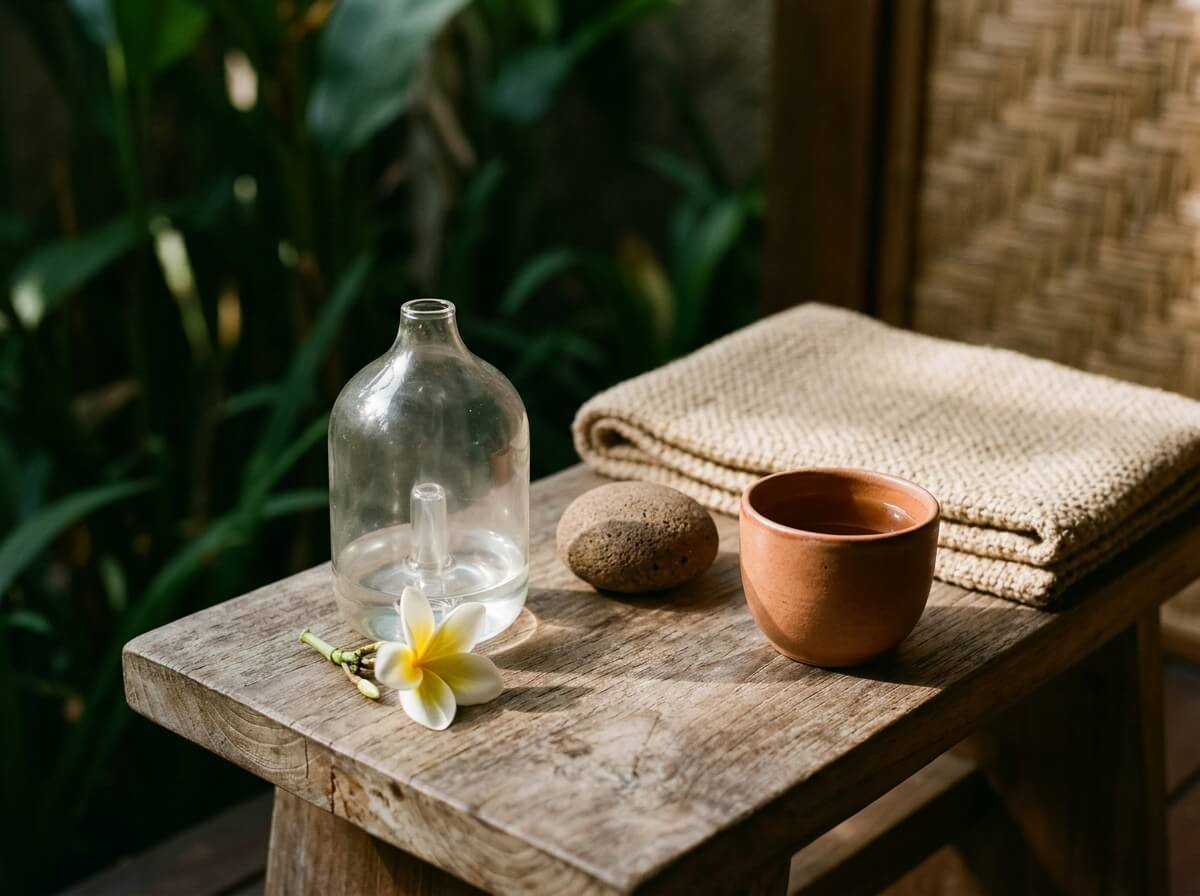
The Balinese tradition that shaped our company has always treated scent as a marker of intention. When a temple offering is laid, frangipani is folded into the woven basket. When a healer prepares a body for massage, warmed oil is brushed on first so the room itself shifts before the hands begin. Scent says: a different kind of time begins now. A diffuser at home can do the same work, on a quieter scale.
A simple ritual to try this week: choose one room and one moment, the corner of a bedroom at the end of the workday, the kitchen window for a Sunday morning, the bathroom counter before a long bath. Place your diffuser there, where its presence becomes a small visual cue. Pick one oil or one blend for the season and stay with it for two weeks. Run the diffuser as a five-minute prelude to whatever you are about to do, then turn it off. You are training your nervous system to associate that scent with that moment. Over a few weeks the association becomes a reliable cue: the scent itself will start the regulation before the diffuser even warms up.
This is the small, repeatable version of what Balinese ritual has always known: scent is a doorway. The diffuser is just the frame that holds the doorway open at the moment you choose to walk through it. For a broader read on how scent and ceremony work together in the home, our companion piece on aromatherapy oils covers the daily ritual layer in more depth, and our notes on natural incense sticks trace the same instinct through a much older medium.
Frequently asked questions about essential oil diffusers
How long should you run an essential oil diffuser each day?
For ultrasonic diffusers, two or three sessions of thirty to sixty minutes is generous for most rooms. For nebulizers, a single intermittent session (five minutes on, ten off) for thirty to forty-five minutes total is plenty. The body responds best to scent it does not adapt to, and the room responds best to a clean dispersal followed by quiet air. Running a diffuser continuously, all day, every day, is the most common over-use we see.
Can you use a humidifier as an essential oil diffuser?
Only if the manufacturer specifies that the unit is rated for essential oils. Standard humidifiers are built for water and water only; the plastics, tubing, and ultrasonic disc in most household humidifiers are not made to hold up against the solvent action of essential oils. A purpose-built ultrasonic essential oil diffuser uses oil-safe materials and is the safer choice.
Are nebulizing diffusers safe to use overnight?
We do not recommend overnight nebulizing for most people, because the concentration is high and uninterrupted exposure offers no benefit over a focused pre-sleep session. A short, intentional nebulizer session twenty minutes before bed, with a calming oil such as lavender, sandalwood, or vetiver, will settle the nervous system more reliably than an all-night diffusion.
How do you know if an essential oil is real or synthetic?
Read the bottle for three things. First, the botanical name in Latin (lavender should be Lavandula angustifolia, not simply “lavender”). Second, the country of origin or the harvest region. Third, the extraction method, usually steam distillation, cold expression for citrus, or solvent-free CO2 extraction. A bottle that lists none of these is almost certainly a fragrance oil, regardless of how the label describes it. Pure oils also vary slightly batch to batch, because growing seasons and harvests are not identical. Perfect uniformity is a warning sign, not a quality marker.
Can children and pets be near a diffuser?
Children: yes, with ventilation and shorter sessions, and using oils that are well-tolerated at low concentrations such as lavender, mandarin, sweet orange, and chamomile. Avoid eucalyptus and peppermint with children under six. Pets: cats are the most sensitive group, because they metabolize many monoterpenes slowly; tea tree, peppermint, citrus, and pine deserve real caution. Dogs tolerate more oils but still benefit from a ventilated, open room rather than a closed one. When in doubt, give your pet a way to leave the room before the diffuser starts.
Final thoughts on choosing your diffuser
Choosing the best essential oil diffuser, in the end, is not about chasing a feature list. It is about pairing a tool to a chemistry, a chemistry to a room, and a room to a habit. Start with how your nose works, listen to the oils you already love, and the right diffuser tends to choose itself. A nebulizer for the rituals that matter, an ultrasonic for the ambient hours, and perhaps a passive reed by a doorway for the in-between moments: that is the small, considered collection that an aromatherapy practice grows into over time.
What we hope you take away is that this small object, well chosen, becomes more than a household appliance. It becomes a way of marking your own time, of noticing the seasons, of caring for a body and a room with the same quiet attention. That is the spirit of Balinese ritual, scaled to a small lamp on a teak table. From our hands, with Bali’s wisdom, we hope it serves you well.