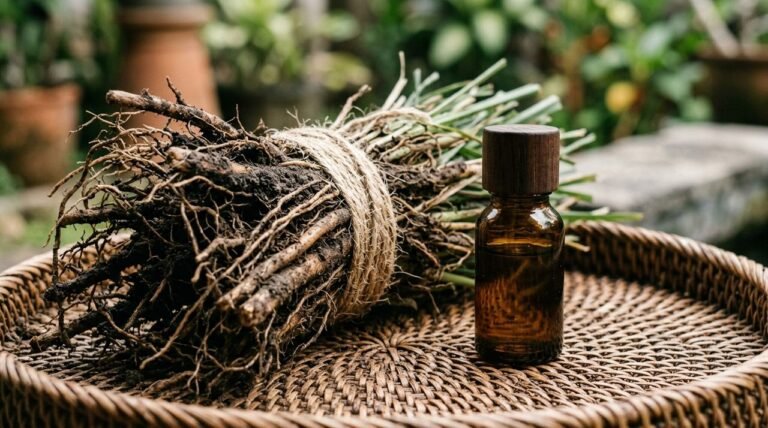
Balinese skincare: the heritage, the ingredients, and the rituals
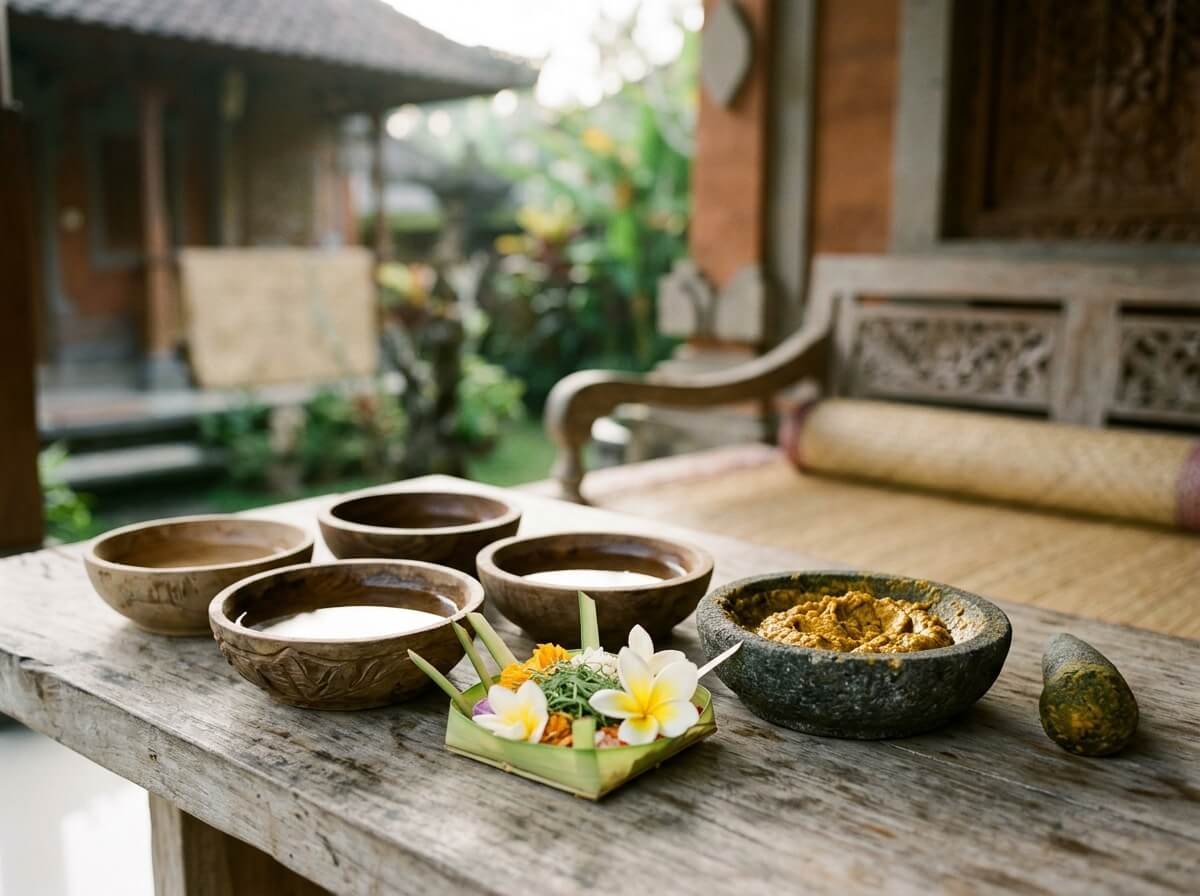
Balinese skincare is not a product category. It is a living tradition rooted in Usada Bali, the island’s centuries-old healing system, and carried forward by the growers, healers, and small workshops who still make care from the plants that grow around them. When the words “Balinese skincare” appear on a label in a Western shop, they are often marketing. When you stand in a kitchen or a temple courtyard in Ubud and watch someone grind turmeric and rice into a paste called boreh, you are seeing the real thing.
This guide is an honest one. It explains what Balinese skincare actually is, the five foundational ingredients the tradition is built on, the rituals that hold it together, and how a modern reader anywhere in the world can practice elements of it at home. We have been crafting natural body and face care from Balinese plants since 1989, and most of what we share here comes from working alongside Balinese growers, healers, and the women of the Munti Gunung program. Our aim is to give you a framework, not a sales pitch.
What Balinese skincare actually means
To understand Balinese skincare, set the marketing aside for a moment. The phrase refers to a layered tradition with three pillars that have nothing to do with packaging.
The first pillar is Usada Bali, the indigenous medical and wellbeing system of the island. It is recorded in palm-leaf manuscripts called lontar, passed from teacher to student across generations, and practiced today by balian (traditional healers) and jero mangku (temple priests). Usada Bali treats the skin as a meeting point between body, breath, and offering. Care is timed to the day, the moon, and the ceremonial calendar. It is not separated from cooking, prayer, or rest.
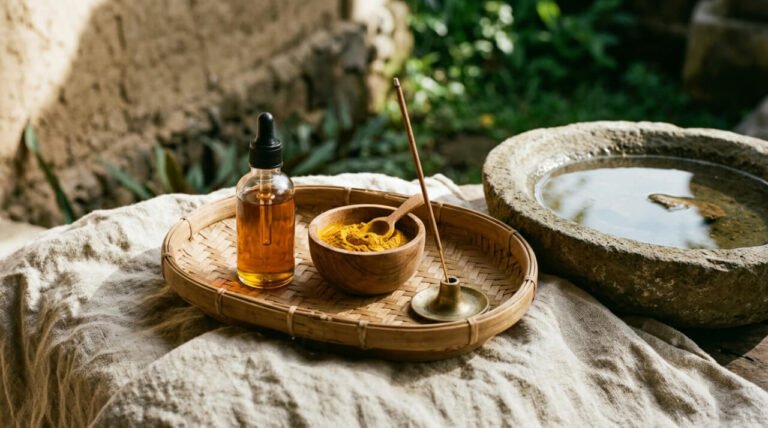
The second pillar is boreh, the ground-spice body paste used to warm the body, ease aches, and ritually cleanse before ceremony. Recipes vary by village and family. Some are weighted toward turmeric and ginger for warmth; others lean on sandalwood and rice powder for cooling. A grandmother might mix one for a child with a cold. A bridal preparation might involve seven women grinding spices for hours. The form is humble; the meaning is layered.
The third pillar is jamu, the herbal drink tradition. Jamu is technically a beverage rather than a topical, but in Balinese practice the line between what you drink and what you put on your skin is thin. Turmeric, ginger, tamarind, and coconut all move freely between the kitchen and the body. If you have ever had a jamu kunyit asam handed to you on a banana-leaf tray after a temple visit, you have already touched part of the tradition.
Modern Balinese skincare, the kind sold in bottles, descends from these three pillars when it is honest. When it is not, it borrows the word “Balinese” as a mood. The difference matters, because the tradition is generous but specific. Treating it as a generic spa aesthetic flattens both the science and the people behind it.
The five foundational Balinese skincare ingredients
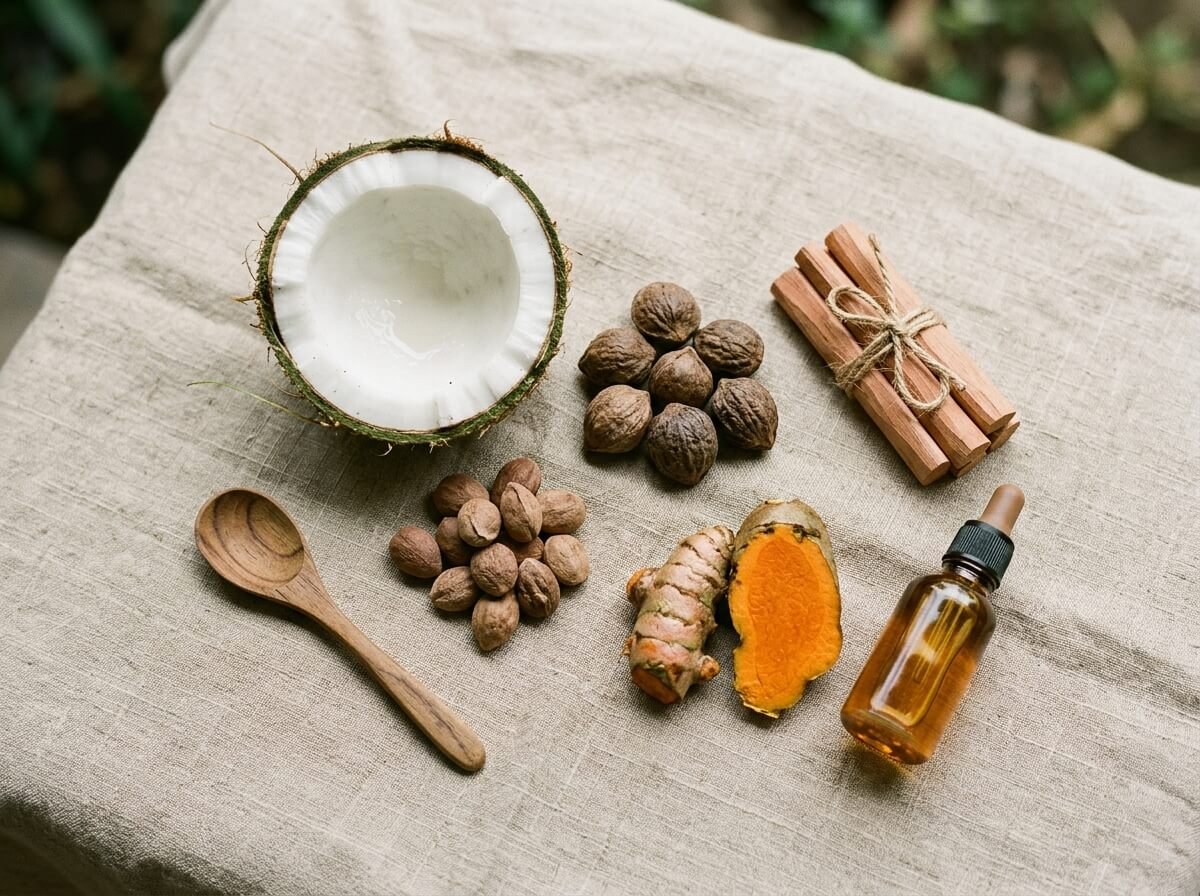
If you trace the recipes that recur across boreh, oil massage, and aromatherapy in Bali, five ingredients keep appearing. They are not the only ones, and several of them grow on neighbouring islands rather than Bali itself, which we will be honest about in the sourcing section. But these five form the backbone of the tradition.
1. Coconut (kelapa)
Coconut is the quiet centre of Balinese skincare. The flesh becomes oil. The water becomes a drink. The husk is woven and burned. Cold-pressed virgin coconut oil moisturises, supports the skin barrier through medium-chain fatty acids, and carries the aroma of toasted nut and warm afternoon. In the Balinese kitchen, oil massage with coconut is the most common act of care a parent gives a child or a grandchild gives a grandparent. We package our own version as virgin coconut oil, but a fresh coconut in a market in Klungkung does the same job.
2. Illipe butter
Illipe is the nut of the Shorea tree, native to Kalimantan (Borneo), and traded into Balinese formulation for centuries. Pressed into a butter, it has the texture and the cocoa-cousin scent of true cacao butter, with even higher melting stability against the skin. Balinese body butter recipes lean on illipe for richness without greasiness. The wild-harvest is significant: when villages in Kalimantan can sell the nut at a fair price, they have less reason to clear the forest for palm. Restoration begins at the pricing sheet. We cover this in more depth in our guide to natural body butter.
3. Kukui (candlenut)
Kukui is called kemiri in Indonesian and travels through both kitchen and skincare. Pressed into a clear, fast-absorbing oil, it is rich in linoleic acid and a known soother of dry, inflamed, and post-sun skin. In Bali it is rubbed on babies for cradle cap, on adults after long days in the sun, and into hair as a strand-by-strand conditioning ritual. Where coconut is the warm everyday, kukui is the lighter touch.
4. Cendana (sandalwood)
Sandalwood is called cendana in Indonesian and grows in the dry forests of Nusa Tenggara. In Bali it is the temple wood: ground, burned, distilled, carried in offerings. On the skin its essential oil is calming, gently anti-inflammatory, and historically used for hyperpigmentation, eczema, and minor cuts. Few aromas anchor a room more completely than warm cendana. We have written more about its specific aromatic and skin behaviour in our cendana ingredient note, and there is more on its blending behaviour in our essential oils reference.
5. Turmeric (kunyit)
Turmeric is the gold thread that runs through everything. It is in the soup, in the offering, in the boreh paste, in the bridal preparation. Curcumin, its primary active compound, has long-documented anti-inflammatory behaviour, and the warm yellow stain it leaves on the skin is part of the ritual rather than a flaw. In Balinese skincare, turmeric is not a trend ingredient. It is the household one.
Other ingredients matter, of course. Tamanu, frangipani (kamboja), ylang-ylang (kenanga), and rice powder are all part of the tradition. But if you build a face and body care practice on the five above, you are working within the heritage and not outside of it.
Boreh: the ground-spice ritual body scrub
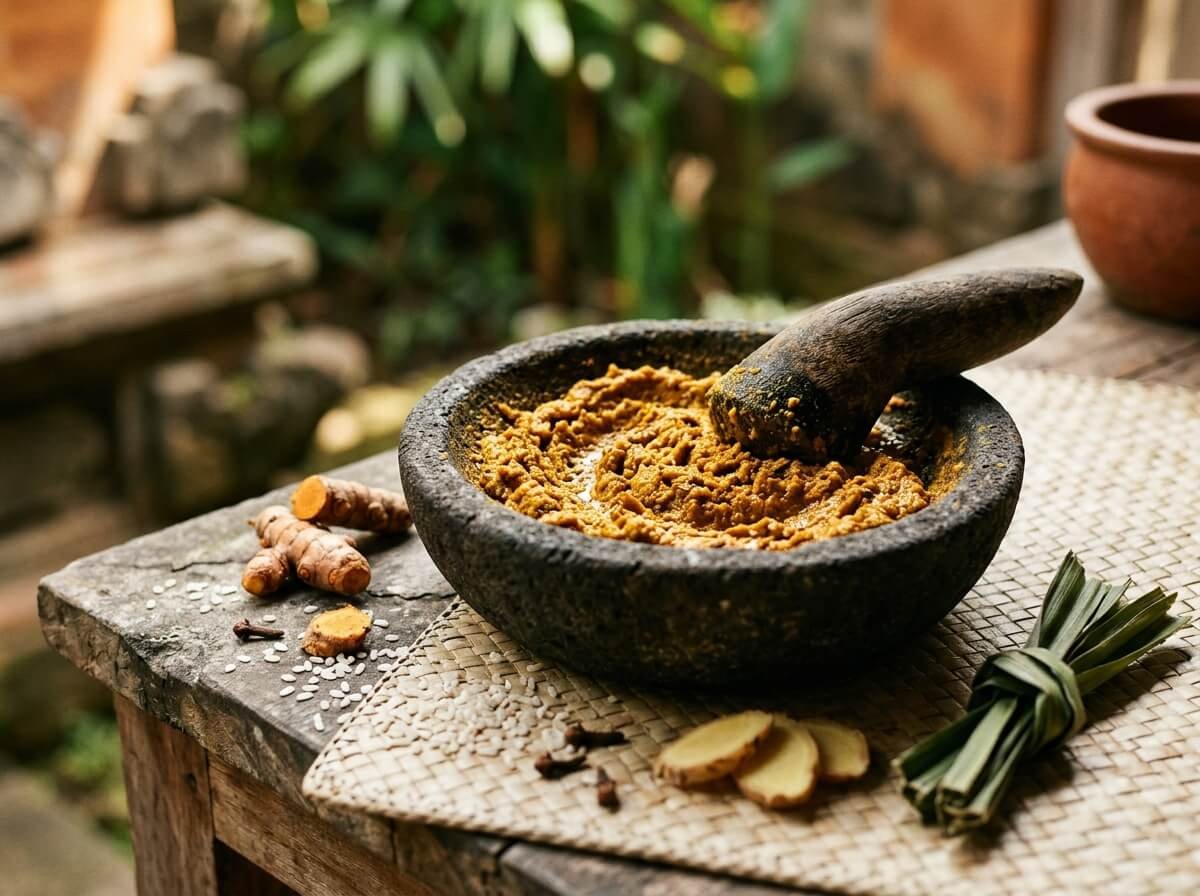
If there is one Balinese skincare ritual to know by name, it is boreh. The word refers to a warm spice paste applied to the body, left on the skin until it dries, and then rubbed off. It exfoliates, it warms, it eases muscle ache, and it has a long ceremonial role in preparing the body for important moments: childbirth recovery, bridal cleansing, the period after harvest.
The classic warming boreh recipe varies by family, but the core stays consistent.
- Two parts ground turmeric (kunyit)
- One part ground ginger (jahe)
- One part ground cloves (cengkeh)
- One part rice powder, finely milled, as the binder
- A small portion of ground sandalwood for steadiness
- Enough water or rosewater to bring the powder to a soft, spreadable paste
The paste is applied to the limbs and torso, allowed to dry in warm air for ten to twenty minutes, and then rubbed off with the palms in firm, downward strokes. The skin afterwards is warm, lightly stained gold (this fades), and softened from the gentle exfoliation of the rice powder. Cooling boreh recipes, used in hot weather, substitute mung-bean powder for the ginger and cloves and lean more heavily on sandalwood and rice. The principle, warm or cool, is the same: you are not just cleaning the skin, you are bringing the body into balance for what comes next.
A few rules that come from the tradition and matter more than they might sound. Use boreh on a calm evening, not in a rush. Drink water before and after. Do not apply to broken skin. Pregnant readers should use a cooling boreh only, and check with their carer first. And do not put boreh on white clothing, because turmeric stains everything it touches.
If grinding spices is not the season of life you are in, a rich Balinese-style body butter after a warm shower captures part of the same logic: warming, softening, marking the close of the day.
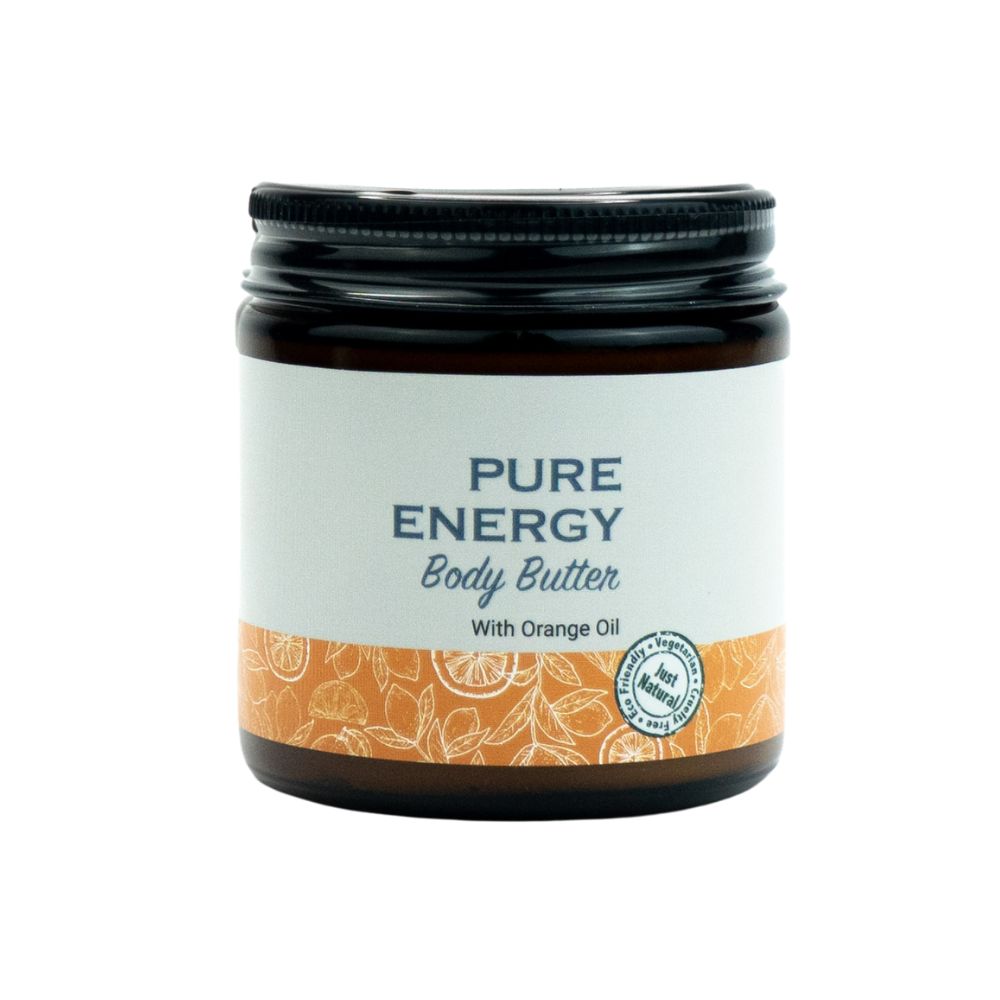
Pure Energy body butter
An illipe and coconut-based body butter formulated in our Bali workshop. Warming spice notes echo the closing-of-the-day quality of a traditional boreh, in a form that takes a minute, not an evening.
Aromatherapy in the Balinese tradition
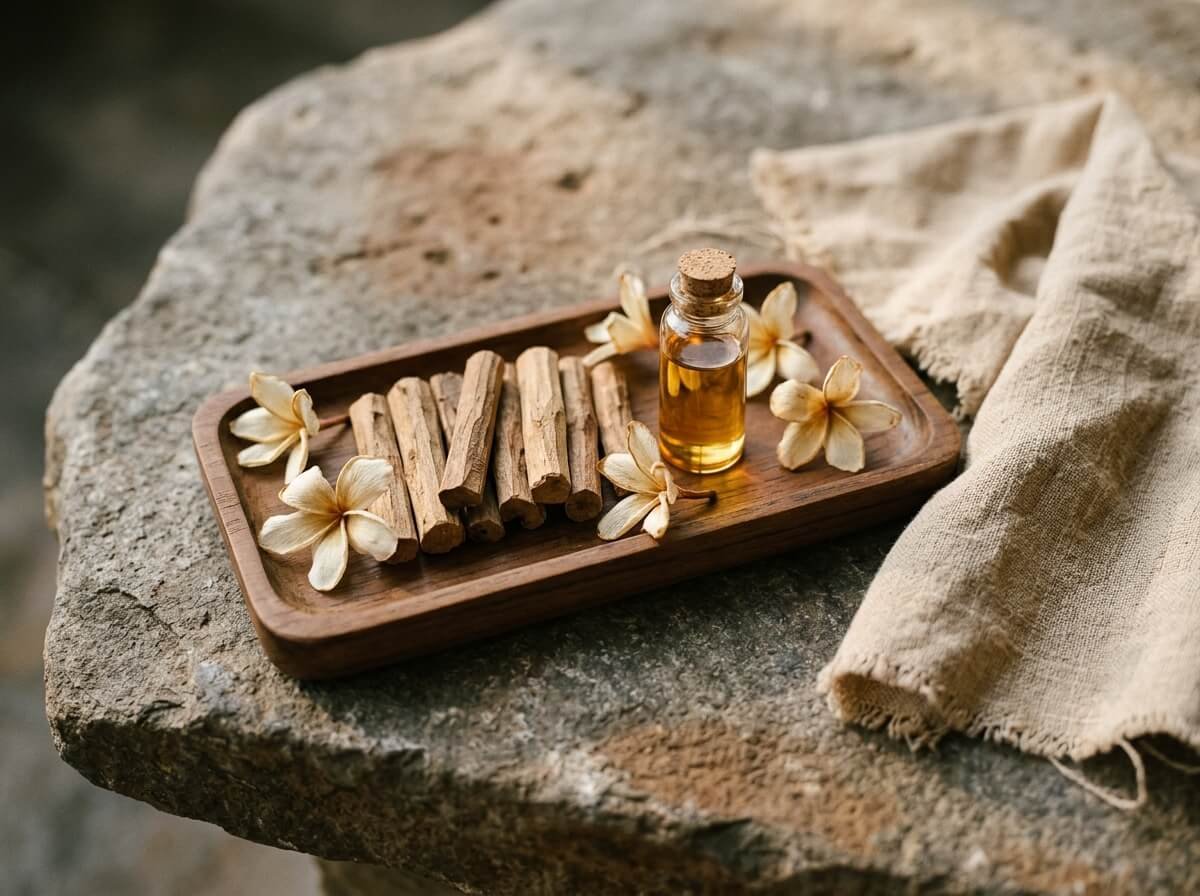
Aromatherapy in Bali is not a wellness add-on. It is woven into daily and ceremonial life. Three aromatic threads matter most.
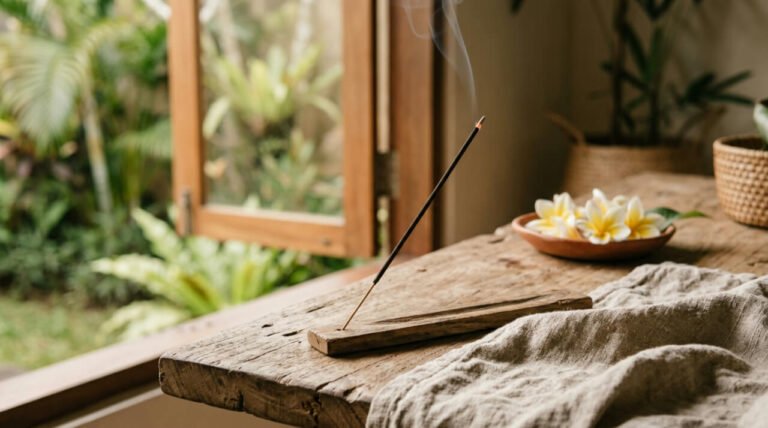
Cendana for prayer and stillness. Sandalwood is the temple wood, burned in dupa incense sticks and offered in the small woven palm-leaf trays called canang sari. On the skin and in the air, cendana settles a room. We use it in our blends for the same reason a balian uses it in a healing session: it slows the breath without making the mind dull.
Kamboja (frangipani) for offering and welcome. Walk any street in Ubud and you will see frangipani petals tucked behind ears, set in offerings, and floating in stone water bowls. Its scent is sweet and round, neither floral-perfume nor floral-girlish. In Balinese skincare it features in floral baths, bridal preparations, and the soft aftermath of a long day in the sun.
Kenanga (ylang-ylang) for ritual and rest. Ylang is the heady evening one. It blends naturally with cendana, with coconut oil, with vanilla and a little lime. It belongs in a bath at the end of a long week. Our Bali Night essential oil blend draws on this triangle of cendana, kamboja, and kenanga, and gives an honest sample of the Balinese evening aroma to anyone living far from the island.
If you want to go deeper on aromatic blending across the Indonesian archipelago, our guide to aromatherapy oils for massage covers the same territory through the lens of bodywork.
How to build a Balinese-inspired ritual at home
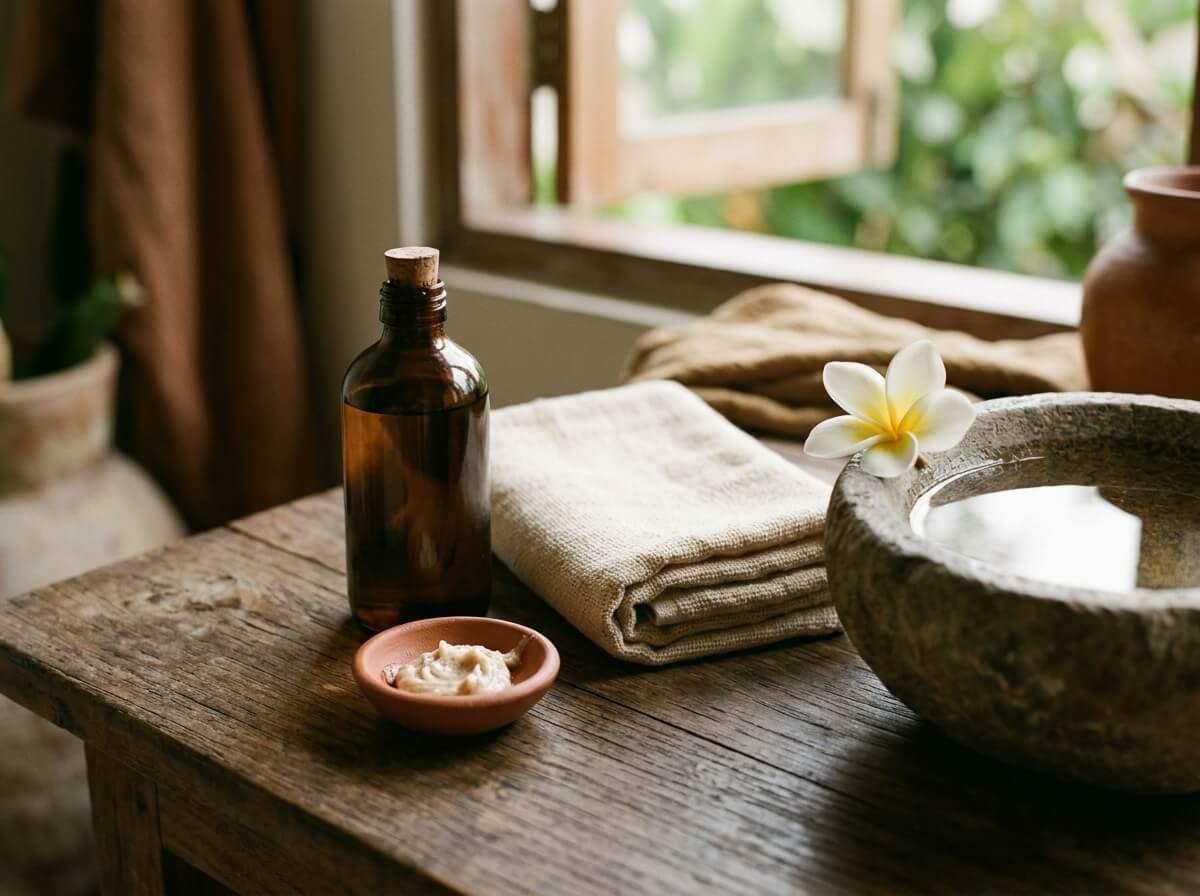
You do not need to live in Bali, or even to source every ingredient from Indonesia, to practice the heart of Balinese skincare. The form is portable. What follows is a weekly outline that holds the shape of the tradition while fitting into a normal life.
Morning: oil before water
Before showering, warm a small pool of coconut or kukui oil between your palms and apply it to the face, neck, and chest. Let it sit for two to five minutes while you brush your teeth or drink water. Then shower with warm water. The skin barrier benefits from this small layer of slip, and the ritual sets a quieter tone for the morning. A simple natural face moisturizer applied after the shower seals the day in place.
Evening: cleanse, then return
At the end of the day, cleanse gently. A second oil pass on the face removes sunscreen and the residue of the day. Follow with a mild cleanser, pat dry, and apply a small amount of facial oil or moisturiser. The evening cleanse is not aggressive in the Balinese tradition. It is closer to a return to neutral than to a stripping back.
Once a week: boreh or its modern echo
Choose one evening a week to slow down. Either make a true boreh paste (recipe above) or, if you prefer, take a warm shower and apply a generous layer of body butter on still-damp skin. The point is the marking. A weekly slowness signal does more for skin and mood than any single product.
Daily: a single aromatic anchor
Choose one scent that means evening to you. Cendana, kenanga, or a Bali Night-style blend can all do the job. Dab a drop on the wrists, or use a small diffuser at the kitchen table during dinner. The scent becomes a household marker for the close of the working day. A simple essential oil diffuser is enough; the equipment matters less than the consistency.
If you want a deeper read on building a daily body-care practice that travels with this, our guide to natural body oils goes section by section through the carriers, the aromatics, and the practical routines.
Sourcing honestly: actually Balinese versus marketing-Balinese
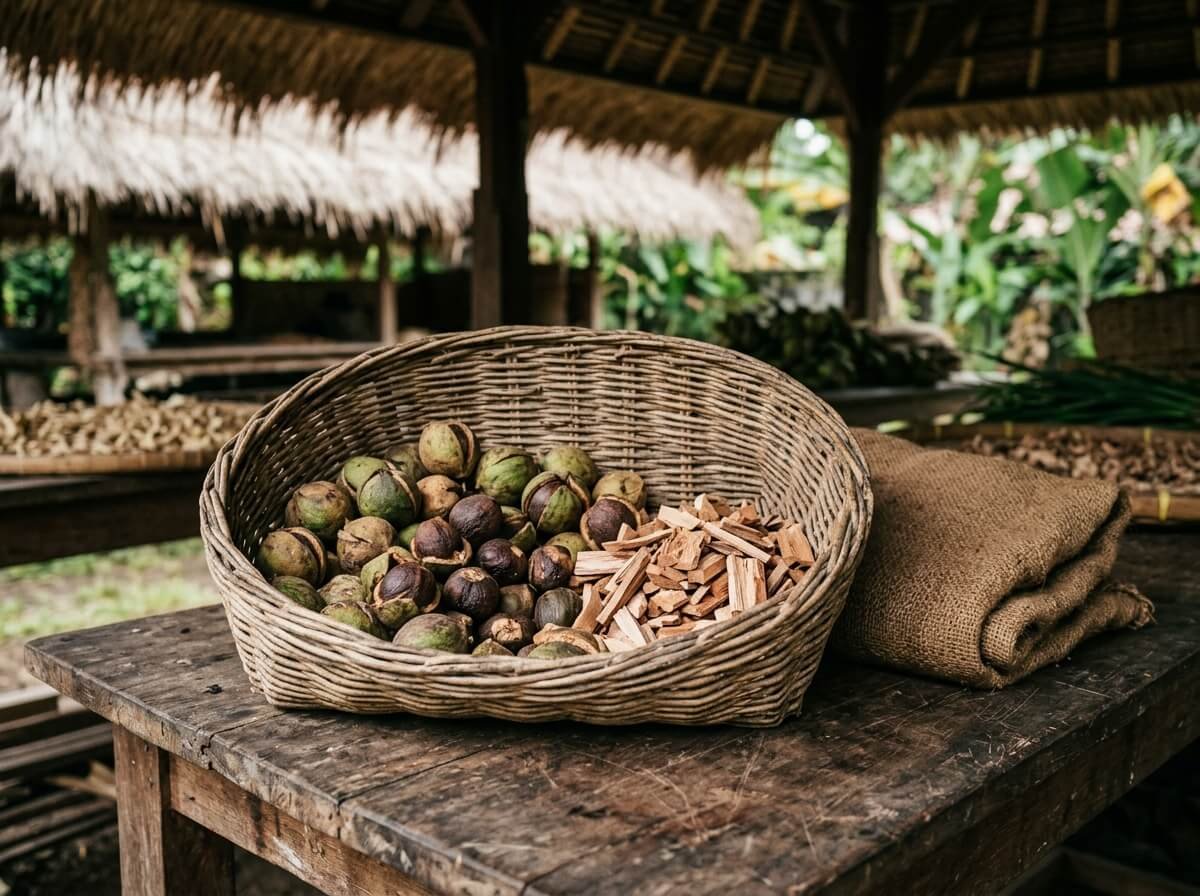
This is the section we promised would be honest. The phrase “Balinese skincare” appears on bottles made in California, Sydney, Berlin, and Seoul. Sometimes the ingredients inside have a clear lineage back to the island or the archipelago. Often they do not. Six questions cut through the marketing.
- Where is the formulation made? A brand using “Bali” as an aesthetic but blending and bottling on another continent is doing a respectful borrowing at best. Both are real, but they are not the same thing as a brand making the product on the island.
- Who is sourcing the ingredients? Look for named growers, named villages, named programs. “Wild-harvested in Indonesia” without specifics tells you nothing. “Illipe from a community cooperative in Central Kalimantan” tells you a lot.
- Is the brand returning value to source communities? Fair pricing is the start. Long-term offtake contracts, training, equipment, and women-led programs are the substance.
- Are the Balinese terms accurate? “Boreh,” “Usada,” “balian,” “canang,” “kamboja” are not interchangeable buzzwords. A brand using them correctly is signalling that they have spent time with the tradition.
- Does the ingredient deck make sense? Coconut, illipe, kukui, cendana, turmeric, frangipani, ylang, tamanu, and rice powder are the heritage stack. A “Balinese” formula whose first five ingredients are synthetic emulsifiers and a fragrance code is wearing the language without the substance. Our clean beauty guide goes deeper on label literacy.
- Does the brand benefit Balinese livelihoods? If the answer is “no Balinese person is touched by this transaction at any point,” the word “Balinese” is a costume.
None of this is about gatekeeping. Care travels. A reader in Toronto applying coconut oil at night with intention is closer to the spirit of Balinese skincare than a glossy bottle that borrows the aesthetic without the substance. But the language deserves accuracy, and the people who carry the tradition deserve the credit and the income.
For the curious, several Indonesian botanical oils we did not feature heavily in this guide, like tamanu and argan, also belong in a serious archipelagic skincare conversation. The tradition is bigger than any single guide.
A few common questions
Is Balinese skincare safe for sensitive skin?
For most people, yes. Coconut and kukui are well tolerated. Turmeric, ginger, and sandalwood can sting if applied to broken skin or used at high concentration on very reactive faces. Patch test boreh on the inner forearm before a full body application, and start with carrier oils alone if your skin is in a sensitised phase.
Will turmeric stain my skin permanently?
No. The yellow tint is temporary and fades within a day. If you want to speed it up, oat-flour and yoghurt washes lift it without scrubbing. The staining of fabrics, however, is permanent, so wear something you do not mind marking.
Can I practice Balinese skincare while pregnant?
Many elements yes, some require care. Coconut oil massage is gentle and traditional. Cooling boreh is more appropriate than warming boreh during pregnancy. Essential oils, including cendana and kenanga, should be used at low concentrations and only after consulting your carer. The Balinese tradition itself prescribes specific preparations for each stage of pregnancy and postpartum; if you can access a trained balian, that guidance will be more precise than any blog.
How is Balinese skincare different from Ayurveda or Korean skincare?
The three traditions overlap and diverge. Ayurveda, from India, shares the use of turmeric, sesame, and ritual bathing, but works within a different diagnostic framework of doshas. Korean skincare emphasises layered cleansing, hydration, and progressive formulation science. Balinese skincare sits closer to Ayurveda philosophically, but its plant palette is archipelagic, its ritual calendar is Hindu-Balinese, and its texture is generally heavier (oils, butters, ground spices) than the lightweight layered logic of Korean care. None is better. They answer different questions about what skin care is for.
Closing thoughts
Balinese skincare, at its honest centre, is not about looking like a holiday. It is about practising care that is rooted somewhere, that respects the plants and people who carry the tradition, and that brings the body back into balance with the day. The five ingredients matter. The rituals matter. The naming matters. And the marketing, frankly, matters less than any of these.
If this is the first time you have read a real account of the tradition, welcome. If you have known it for years and simply wanted to read a version that named things correctly, thank you for reading. The work for all of us is the same: keep the heritage intact, keep the sourcing honest, and let the skin be cared for the way it was always meant to be.