Coconut body oil: how to choose, apply, and layer for deep hydration
Coconut body oil is the most quietly powerful product in Balinese skin care, and also the most misunderstood. The label looks simple. The reality, from coconut grove to skin barrier, is anything but. This guide walks through what coconut body oil actually is, how it should be sourced and chosen, how to apply it without slipping on your bathroom floor, and how to layer it with the rest of your ritual. Everything here is written from twenty plus years of formulating with virgin coconut oil in Ubud, and from the small inconvenient truths most product listings leave out.
By the end you will know the difference between a coconut body oil worth buying and one that is mostly mineral oil with a coconut whisper, why “fractionated” matters more than “virgin” for some skin types, and exactly how to slot a coconut body oil into the rest of your natural skincare routine without overloading your skin.
What coconut body oil actually is, and why the fine print matters
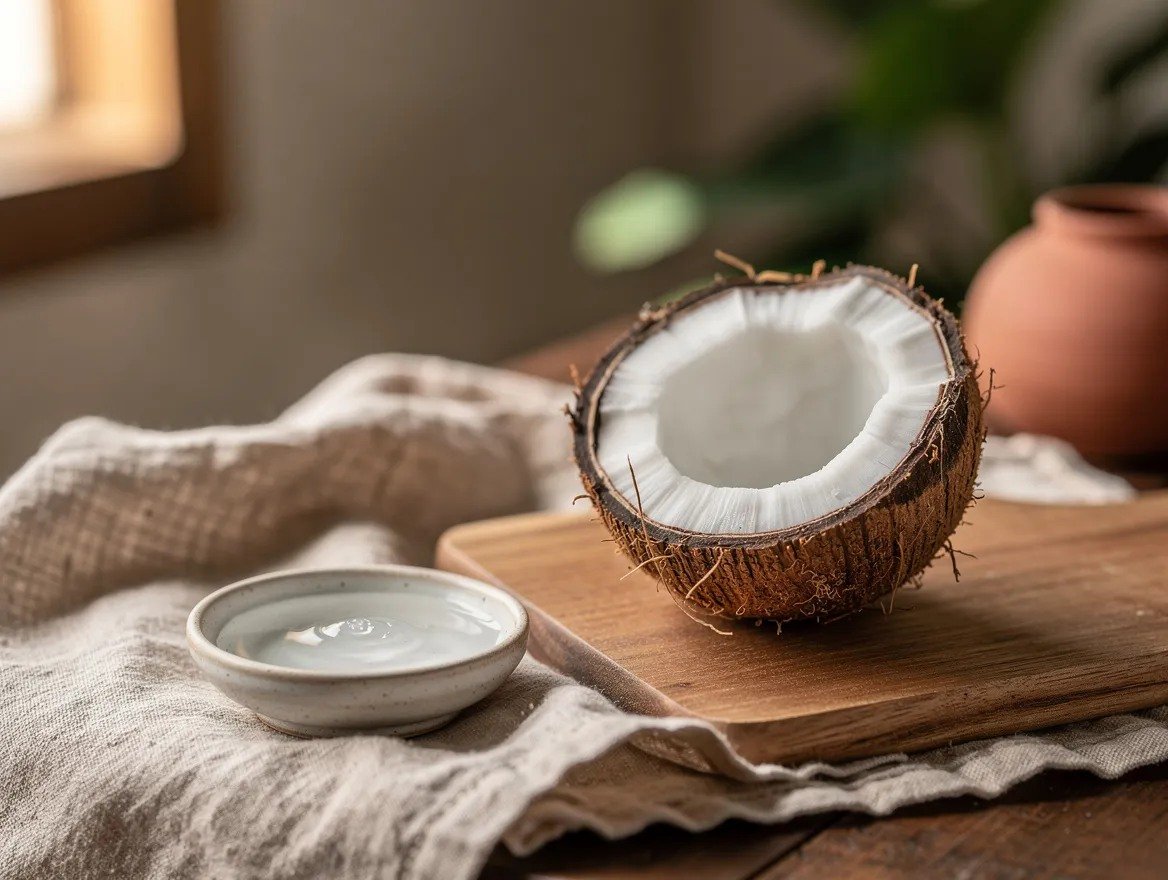
Coconut body oil is, in its honest form, the cold-pressed oil of fresh coconut flesh, intended to be used on the body rather than the face. That is the short version. The long version is more useful because the words on the front of the bottle do a lot of work that the words on the back walk back.
The fats in coconut oil are mostly medium-chain triglycerides. Lauric, caprylic, and capric acids dominate the profile, and they behave on skin differently than the long-chain fatty acids in olive or avocado oil. Medium chains penetrate the upper layers of the stratum corneum more readily, which is the reason coconut body oil feels light at the moment of application and then sinks rather than sits. Lauric acid in particular has a gently antimicrobial profile, which is part of the reason coconut has been used in tropical climates for skin care long before that profile had a name.
The label words to read carefully are these. Virgin means the oil was pressed from fresh coconut meat without solvents or high heat, and it keeps the most of its aromatic compounds and antioxidants. Refined coconut oil is deodorized and bleached, and the result is more neutral, more shelf-stable, and stripped of the soft sweet scent that signals a living oil. Fractionated coconut oil is a different product entirely. The long-chain fats are removed, leaving only the medium chains, which stay liquid even at cool temperatures and feel closer to a carrier oil. Fractionated coconut body oil is a sensible choice for massage and for layering with essential oils. Virgin coconut body oil is the one to choose when you want the full sensory presence of the coconut itself.
Two things are worth saying out loud. Coconut oil is comedogenic on most facial skin, which means it can clog pores. For the body it is generally well tolerated, but if you are acne-prone on your back, shoulders, or chest, do a patch test. And if a “coconut body oil” lists a string of synthetic ester fragrances and mineral oil before the coconut, it is functionally a fragranced occlusive with a coconut accent. That can be fine. It is not what we are talking about here.
The Balinese coconut story, and what sourcing looks like when it is real

Indonesia produces more coconuts than almost anywhere on earth, and Bali sits inside that map. A coconut harvested in the morning can be split, pressed, and bottled by the same evening when the supply chain is short. When it is long, the same coconut can travel for weeks before it sees a press, and what arrives at the press is older, partly oxidized, and chemically further from the fruit. The number on a packing date label is one of the quiet markers of sourcing quality. The other quiet marker is the smell. A fresh, recently pressed coconut body oil smells of coconut. An older or industrially refined one often smells of almost nothing.
The brand we work inside, Utama Spice, has pressed coconut oil in Bali since 1989. The reason that matters is not history for its own sake. It is the relationships. Long-standing relationships with single villages mean we can ask for fresh coconuts pressed within a day, and that requesting it is normal rather than special. The same logic shows up in our kukui oil sourcing and our coconut oil for skin approach. None of this is romantic. It is logistical and slow, and it is the reason a Balinese-pressed coconut body oil can smell of the coconut itself rather than of nothing at all.
Two more sourcing notes worth carrying with you. First, look for cold-pressed rather than expeller-pressed when you can. Cold pressing keeps temperature below the threshold at which the more delicate antioxidants begin to degrade, and it preserves the lauric acid profile. Second, look for unfiltered or lightly filtered virgin coconut body oil if you want the most of the natural plant compounds, and choose filtered or refined coconut body oil if you want a more neutral scent for massage and blending. Neither is better in absolute terms. They are different tools.
How to choose a coconut body oil worth your shelf space
Reading a coconut body oil label well takes about thirty seconds and saves the next year of your shelf from passengers. Six things to check, in order.
- First ingredient. Cocos nucifera oil should be the first ingredient. If anything else leads, the bottle is doing other work and only finishing with coconut.
- Virgin, refined, or fractionated. Virgin for sensory richness, refined for neutrality, fractionated for slip and lightness. Pick by use, not by marketing word.
- Extraction. Cold-pressed is the gold standard. Expeller-pressed is acceptable. Solvent-extracted is a hard pass for any oil you want to put on your body.
- Botanical add-ins. A short list of cold-pressed botanical oils (jojoba, almond, sesame, kukui) and a few essential oils is a green flag. A long list of synthetic fragrance components is a yellow flag for sensitive skin.
- Packaging. Glass beats plastic for oil. Amber glass beats clear glass because it protects against light degradation, which is the slow killer of plant oils. A glass refill option is the strongest signal that the brand is not optimizing for landfill volume.
- Date. Coconut body oil has a usable life of about eighteen to twenty-four months unrefined and longer when refined. A packing date or batch code on the bottle is the difference between sourcing transparency and a guess.
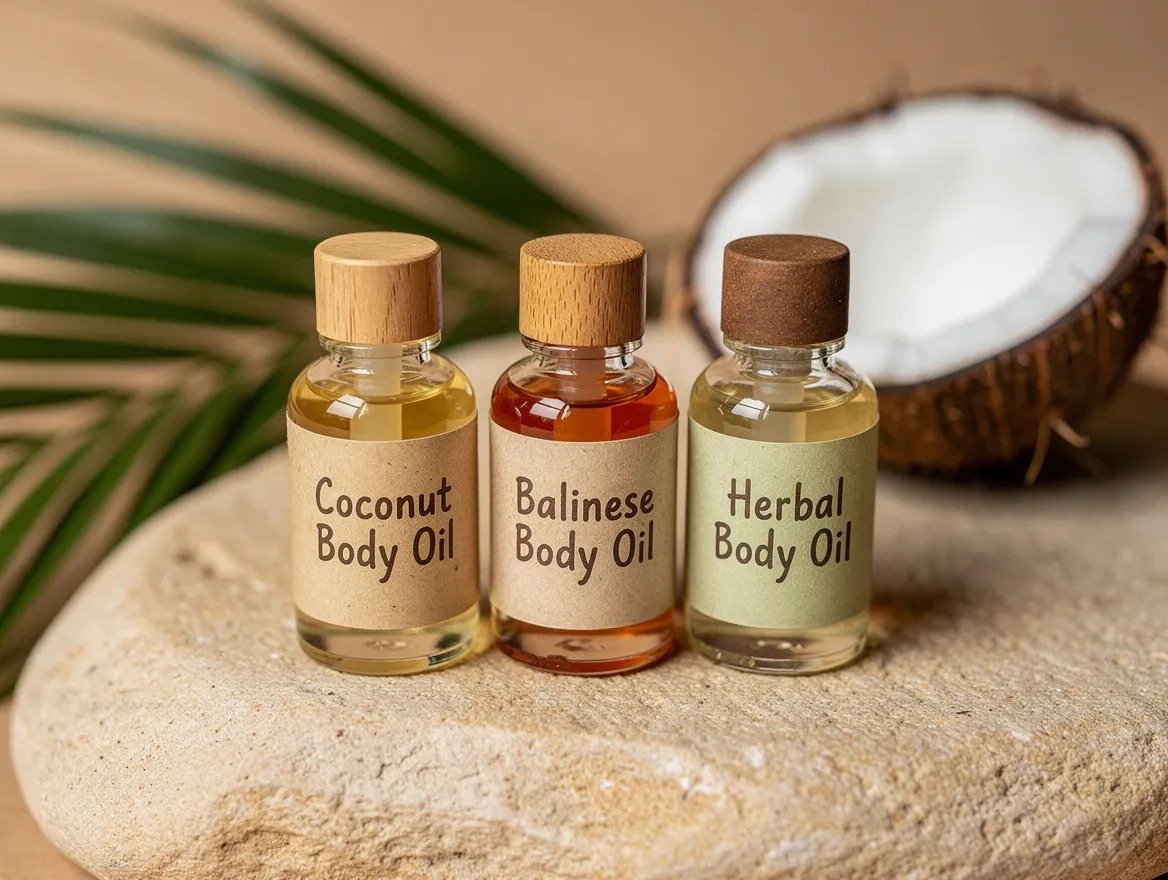
For sensory richness in a daily-use oil at a fair price, our Virgin Coconut Oil 100ml is the simplest expression of all of this. Cold pressed, single ingredient, glass bottle, and pressed in Bali from coconuts harvested within a few days of bottling. For a scented body oil that uses fractionated coconut as the carrier and adds a light Balinese aromatic, our Lemongrass Ginger Body Oil and Lavender Body Oil are the working alternatives. Different tools, same standard for what should be inside.
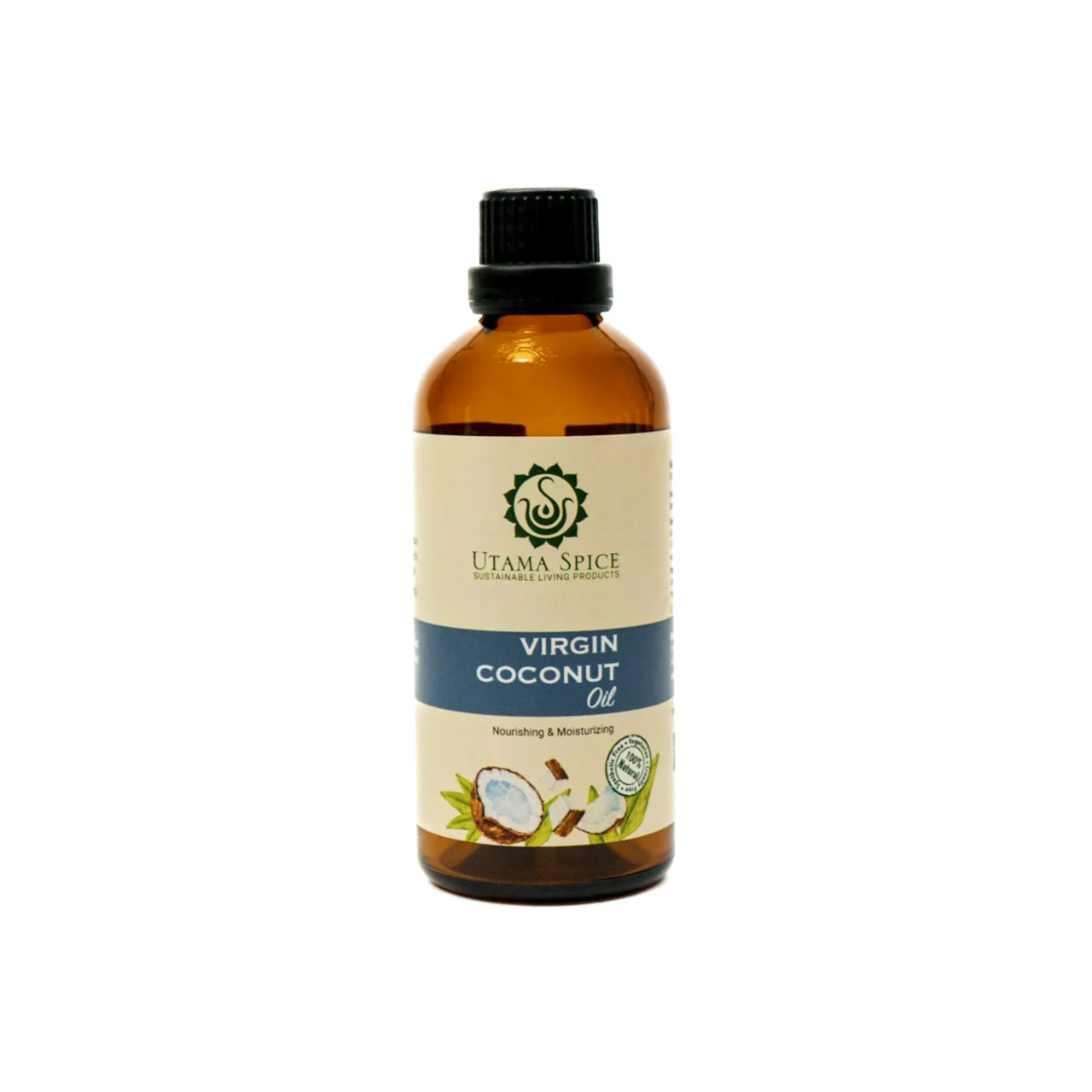
Virgin Coconut Oil 100ml, pressed in Bali
One ingredient. Cold-pressed within days of harvest. Glass bottle that refills at our Ubud apothecary or with our refill partners. The simplest, most useful coconut body oil on our shelf.
How to use coconut body oil: a daily ritual that takes two minutes

The biggest mistake we see is using coconut body oil on bone-dry skin, then wondering why it sits on the surface and refuses to absorb. Oils do not hydrate. Oils seal. The ritual is short and the order matters.
- Towel-dry, do not bone-dry. Step out of the shower and pat dry, but leave the skin damp to the touch. The film of water on the skin gives the oil something to seal in.
- Warm in the hands. Pour a teaspoon or so into your palms and rub them together. Coconut oil is solid below about seventy-six degrees Fahrenheit (twenty-four Celsius), and warming it in the hands turns it from semi-solid back to liquid in three seconds.
- Press, do not rub. Apply with broad, slow pressing strokes from feet upward. Move toward the heart on legs and arms. This is gentle lymphatic priming and not just a poetry line.
- Wait sixty seconds, then dress. A fresh application of coconut body oil feels glossy for about a minute. If you wait, the surface absorbs and you can dress without staining linen.
- Once or twice a day. Most skin asks for once. Hot showers, hard water, and dry winter air are reasons to do it twice.
One small bit of trivia that will save your bathroom floor. Coconut oil makes tile surfaces slippery. Apply on a bath mat or on a towel, not on the wet floor where the oil drips travel.
If you want a deeper read on why a sealing step matters at all, we wrote a short companion piece on hydration versus moisture that explains the order in two paragraphs. The short version is that water hydrates, oil seals, and you need both.

Layering coconut body oil with other botanical oils and butters
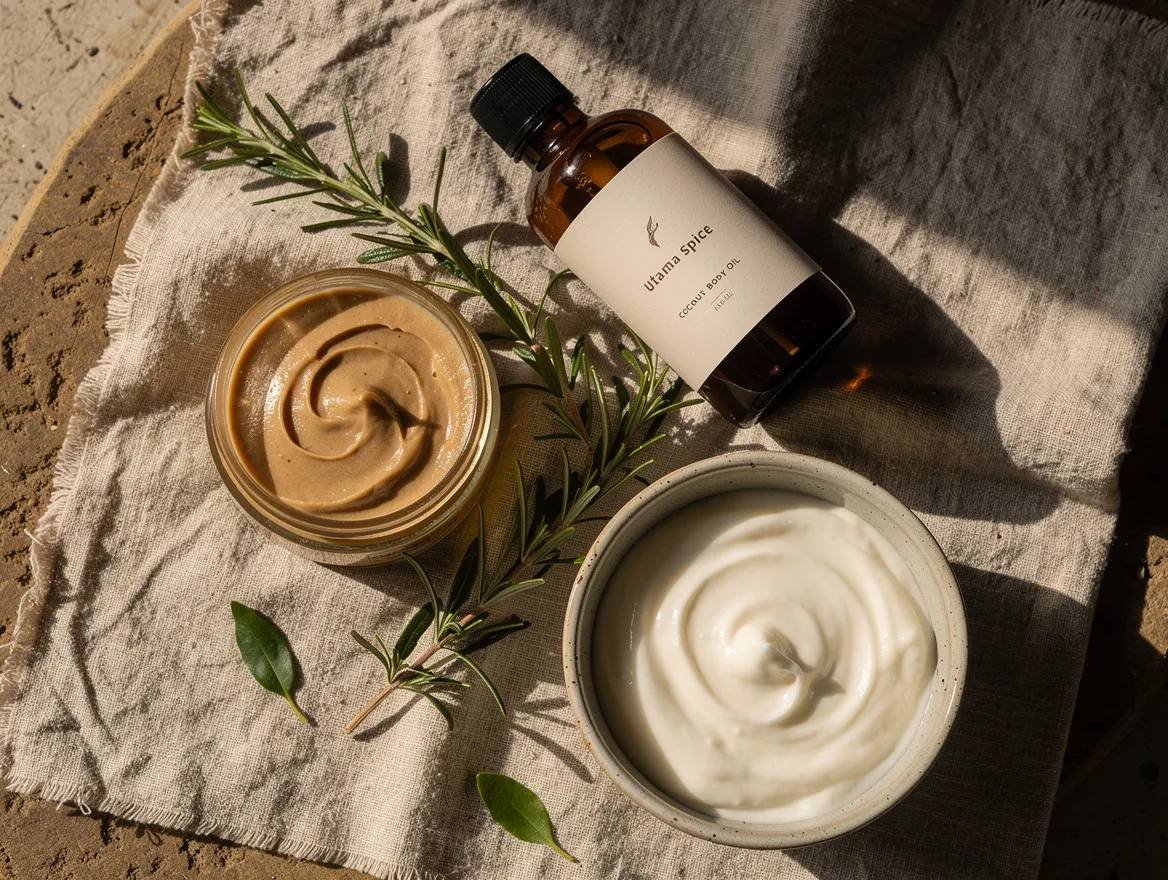
Coconut body oil is rarely the whole answer. Layering with one or two other ingredients is where a daily ritual turns into something that actually rebuilds a tired skin barrier.
Coconut oil and a water-based lotion. If you find virgin coconut oil too heavy in summer, try a thin lotion under and a few drops of fractionated coconut over. The lotion delivers water and humectants, the oil seals. Our Coconut Lotion Lavender is built on this logic, with coconut milk water phase and coconut oil emollient phase in the same bottle.
Coconut oil and body butter. Body butter is mostly butters (shea, cocoa, illipe) with a smaller portion of oil. Use coconut body oil on damp skin first, then a fingertip of body butter on the driest patches (elbows, knees, heels). Our Bliss Body Butter works well for this on humid Bali nights, and Pure Energy Body Butter is the option for colder mornings.
Coconut oil and other carrier oils. Mix coconut body oil one-to-one with jojoba for a lighter feel, with sweet almond for a slightly heavier protective layer, or with kukui oil for a fast-absorbing finish that does not stay glossy. Our carrier oil guide walks through which oils suit which skin type if you want a deeper read on this.
Coconut oil and essential oils. Coconut oil is a competent carrier for diluting essential oils for topical use. The ratio is two to three drops of essential oil per teaspoon of carrier for body application. Never apply essential oils neat, even the gentle ones, and patch test before any new combination.
The reason layering matters is simple. A single oil is doing one thing. A short combination of one humectant lotion, one carrier oil, and one or two butters is doing what a single product cannot, which is to mimic the layered structure of your own skin lipid barrier.
Coconut body oil questions, answered honestly
Is coconut body oil good for very dry skin?
Yes, with one condition. Apply on damp skin so the oil has water to seal in. Coconut oil is an excellent occlusive but a poor humectant. If your skin is very dry and the air is dry, layer a water-based lotion underneath the coconut body oil.
Will coconut body oil clog my pores?
On the body, generally no. Coconut oil is rated four out of five on the comedogenic scale, which is a face concern more than a body concern. If you are acne-prone on the chest, back, or shoulders, do a patch test for a week before committing to daily use. If breakouts appear, switch to a non-comedogenic carrier like jojoba or grapeseed.
Can I use the same coconut oil on my hair, face, and body?
Yes for hair and body. Cautiously for face. Virgin coconut oil is gentle on hair shafts as a pre-wash treatment and as a light finishing oil for ends. On the face it suits some skin and triggers congestion on others, so a patch test is wise before adding it to a facial routine. For a hair-specific blend we make Wellkiss Hair Oil with coconut as the base carrier.
Is coconut body oil safe in pregnancy?
Plain virgin coconut oil is generally well tolerated in pregnancy and is often used by midwives in Bali to soften the belly through the second and third trimester. If the body oil contains essential oils, check the specific blend with your midwife or doctor. A few common essential oils (rosemary, clary sage, sage at concentration) are not recommended in early pregnancy. If in doubt, single-ingredient virgin coconut body oil is the safe choice.
Coconut body oil versus coconut body lotion, which should I choose?
Oil is pure lipid. Lotion is water, lipid, and a small amount of emulsifier. Oil gives a stronger sealing layer and more sensory presence. Lotion gives water and a lighter finish. For most people both belong on the shelf, used at different moments. Our coconut body lotion guide walks through when each one fits best.
Why does my coconut body oil go solid?
Because it is virgin coconut oil and your room is cool. Coconut oil is solid below about twenty-four degrees Celsius and liquid above. There is nothing wrong with the bottle. Warm it in the hands or set the closed bottle in a bowl of warm water for a minute. Fractionated coconut body oil stays liquid at any temperature, which is why it is the carrier of choice for cooler climates and travel.
Can I refill the bottle?
Yes, and this is one of the most useful habits to build. Bringing your own glass bottle to a refill station keeps another piece of plastic out of the system. We run refill stations in Ubud and Sanur, and several of our retail partners do the same. If you are not near a refill point, the next best option is to choose a glass-bottled coconut body oil and reuse the bottle for storage when it is empty.
A small note on what we are choosing when we choose coconut
A coconut body oil is a small daily object, and it is also a small daily decision about where your money goes. Cold-pressed virgin coconut body oil pressed in Bali by a small operation is one set of hands and one set of villages. Refined coconut body oil shipped from a large industrial press through three intermediaries is another. Neither is wrong as an absolute. The decision is yours to make consciously. We hope this guide has made the decision a little easier.
If you want a single quiet choice to make next, start by trying a small glass bottle of single-ingredient virgin coconut body oil with a clear sourcing story. Apply it on damp skin for two weeks. Notice what changes. Then build the rest of the ritual around that one anchor. Care is rarely a stack of products. Most often it is one good ingredient, applied with attention, every day.
One last thought. Coconut body oil sits at the intersection of three quietly important things, which are skin care, climate, and the people who do the actual pressing. The price difference between a fast, refined, plastic-bottled coconut body oil and a slow, virgin, glass-bottled one is rarely large in absolute terms. It is the difference between paying ten dollars for a product and paying twelve. The villages, the soil, the press, and the bottle that ends up in your bathroom are the people who feel that two-dollar difference. We say this not to moralize but because most readers we meet did not know there was a difference in the first place. Now you do.