Wellness Wednesday: why humidity changes how a natural oil behaves on your skin
A face oil that feels perfect in a dry season can suddenly feel heavy, slow to sink in, or strangely greasy once the air turns humid. Nothing has gone wrong with the oil. The air around it has simply changed, and oil behaves differently depending on how much moisture is already in the atmosphere.
Humidity changes what your skin needs to borrow
Natural face and body oils work by slowing the rate at which water leaves the skin. In dry air, skin loses moisture quickly, so an oil’s barrier effect feels immediately useful: it holds in what little moisture is there. In humid air, like Bali’s for most of the year, the skin is already surrounded by water vapor and loses moisture far more slowly on its own. The oil is still doing its job, but the job itself is smaller, so the same amount can feel like more than skin is asking for.
Why oil can feel like it is “sitting” in the tropics
Sebum production also rises with heat and humidity, so skin is often producing its own oil at the same time a routine adds more. Combine that with higher ambient moisture, and a formula applied at a dry-season amount can sit on the surface rather than settling in. This is not the oil failing to absorb. It is two sources of richness meeting at once, with nowhere left for either to go.
What this means in practice
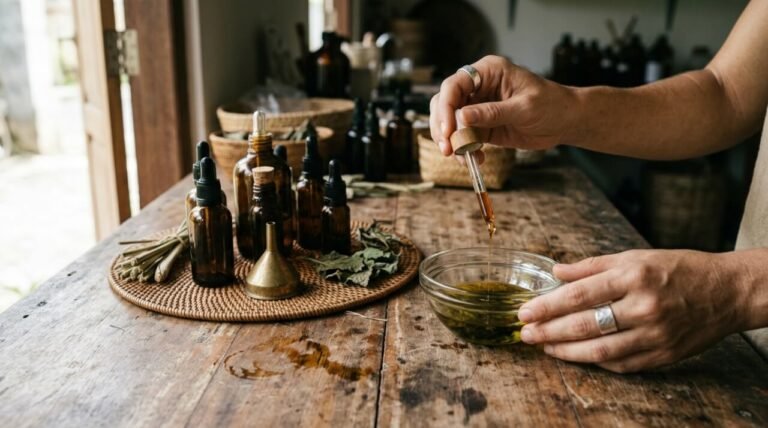
The fix is rarely a different product. It is a smaller amount, applied to slightly damp skin rather than fully dry skin, where it can blend into existing moisture instead of competing with it. On humid days, a few drops go further than a full pump. On drier or air-conditioned days, the same oil can be layered more generously. The product stays constant. What changes is how much the air is already doing on your behalf.
Progress over perfection means reading the climate as closely as the label.