Indonesian wellness at home: five daily rituals from 2,000 years of practice
Search for Indonesian wellness and the internet sends you to the airport. Book a retreat, fly to Bali, drink a glass of jamu by an infinity pool, and come home restored. It is a beautiful picture, and it misses almost everything that matters. Indonesian wellness was never a holiday. It is a daily practice, rooted in more than 2,000 years of archipelagic ritual, and most of it happens in an ordinary bathroom, an ordinary kitchen, at ordinary hours of an ordinary day.
We have made personal care in Bali since 1989, hand-blending small batches from wild-harvested botanicals. From that vantage point, the gap between how the world talks about Indonesian wellness and how it is actually lived feels wide. So this is a different kind of guide. Not where to travel, but how to bring the underlying practice home: five living traditions, each with its own botanical logic, its own place in the day, and its own quiet philosophy of balance. Name each one, understand it, and you can practise Indonesian wellness tomorrow morning without leaving the house.
What Indonesian wellness actually means
Before the practices, the philosophy, because the practices only make sense inside it. Indonesian wellness rests on an idea the Balinese call tri hita karana, the three sources of wellbeing: harmony with the divine, harmony with other people, and harmony with nature. Health, in this frame, is not the absence of illness. It is balance, sehat sejahtera, a state where body, community, and environment are in right relationship with one another.
This matters because it reorders what wellness is for. In much of the Western wellness market, self-care points inward: you optimise yourself, for yourself. The Indonesian frame points outward at the same time. Caring for your skin with a wild-harvested botanical is also caring for the forest that grew it and the family that harvested it. The logic is circular, not extractive, and it is the same logic that runs through everything we make. What you give, you get back.
That is why the practices below are humble on purpose. They are not grand gestures. They are small, repeatable acts, a bath taken with attention, a tonic brewed from kitchen roots, a few minutes of self-massage, a stick of incense lit at dusk. Tradition here is not nostalgia. It is a working blueprint for modern wellbeing, and it asks very little of you beyond showing up. If you want the fuller story of how these ideas shape a daily routine, our guide to Balinese skincare traces the same thread through the products themselves.
It also matters who has carried this knowledge. Indonesian wellness is, overwhelmingly, a women-led tradition. The healers who blended the pastes, the mothers who taught the baths, and the mbok jamu who still walk their routes at dawn with a basket of tonics are the ones who kept these practices alive across generations, often without ever writing them down. When we talk about heritage here, we are naming real people and an unbroken line of care, not a marketing story. Respecting the tradition means keeping that lineage visible every time we borrow from it, and never flattening a living practice into an exotic ornament.
Why every top search result misses the point
Type the phrase into a search engine and the first page is almost entirely retreats, resorts, and destination rankings. Wellness as a place you go. There is nothing wrong with a good retreat, but as an answer to what Indonesian wellness is, it fails in one important way: it makes the practice sound like something you cannot do at home, something reserved for a week off and a plane ticket.
The academic sources swing the other way. Jamu is recognised as intangible cultural heritage, herbal knowledge is catalogued in careful detail, and both are valuable. But a catalogue is not an instruction. It tells you a tradition exists without telling you how to live it on a Tuesday. Between the resort brochure and the research paper, the practical middle is empty, and that middle is exactly where daily wellness lives.
The tradition itself was never destination-bound. Jamu sellers, the mbok jamu, still walk Javanese neighbourhoods each morning with bottles balanced in a basket, bringing the apothecary to the doorstep. The mandi happens twice a day in millions of homes. None of it requires a booking. Read across the Indonesian traditional herbal knowledge that underpins these customs and one thing becomes clear: this is home practice first, and always has been. The goal of this guide is to give that home practice back its instructions.
Mandi: the daily bath as morning anchor
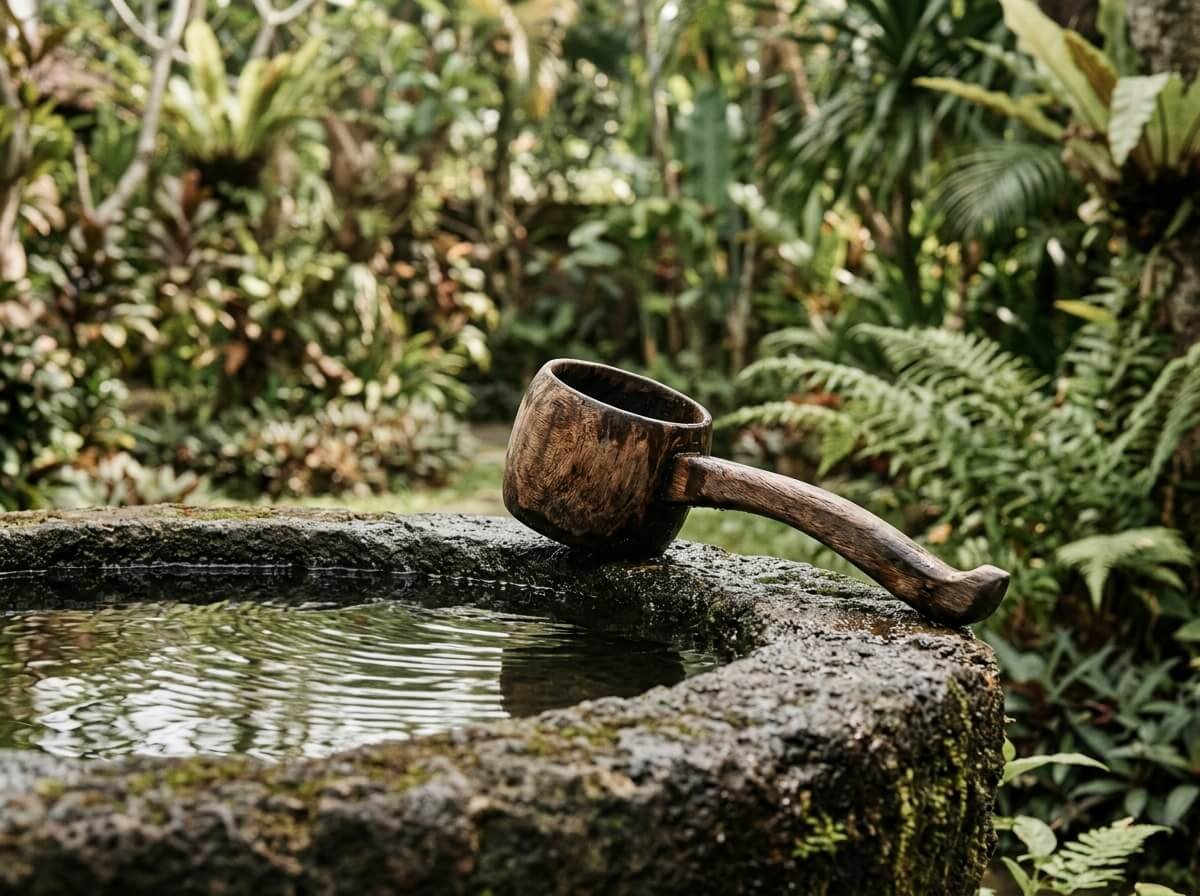
Start where the day starts. Mandi is the Indonesian bath, and in most homes it is taken with a gayung, a dipper, scooping water from a basin and pouring it over the body. It happens at least twice a day, morning and evening, and it is less about getting clean than about marking a threshold. The morning mandi wakes the body and sets the tone. The evening mandi closes the day and releases it.
What the ritual teaches is that cleansing can be care rather than transaction. Water poured slowly, breath following the pour, attention on the sensation instead of the phone: this is the whole technique. You do not need a dipper and a stone basin to borrow it. In a Western shower, the practice translates cleanly.
Bringing mandi into a modern shower
- Begin with three slow breaths before the water touches you, one threshold gesture to separate the bath from everything before it.
- Keep the water warm rather than hot. Hot water strips the skin barrier and rushes the ritual; warm water invites you to slow down.
- Pour or rinse from the shoulders down, unhurried, and let attention rest on the temperature and the sound rather than the task list.
- Cleanse gently, with a mild botanical wash rather than a stripping detergent, so the skin is cared for and not scoured.
- Finish by sealing in water while the skin is still damp, the step that turns a bath into a barrier-friendly ritual.
That last step is where care compounds. On skin still damp from the mandi, a plant oil or a rich botanical cream locks in moisture instead of letting it evaporate. Coconut oil has done this work in Indonesian homes for generations, and there is real science behind the habit, which we cover in our piece on coconut oil for skin. For a softer, whipped finish, a botanical balm like our Pure Energy Body Butter seals the same way while the scent carries the ritual into the rest of the morning.
The evening mandi deserves its own attention, because it does different work. Where the morning bath wakes and readies, the evening one is about release, washing off the day so the body can register that work is over and rest can begin. Kept warm and slow, it becomes a reliable cue for the nervous system, the physical signal that the day has a boundary. In a culture without an off switch, that boundary is quietly radical. It is also free, requires no equipment, and is available every single night.
Jamu: the kitchen apothecary
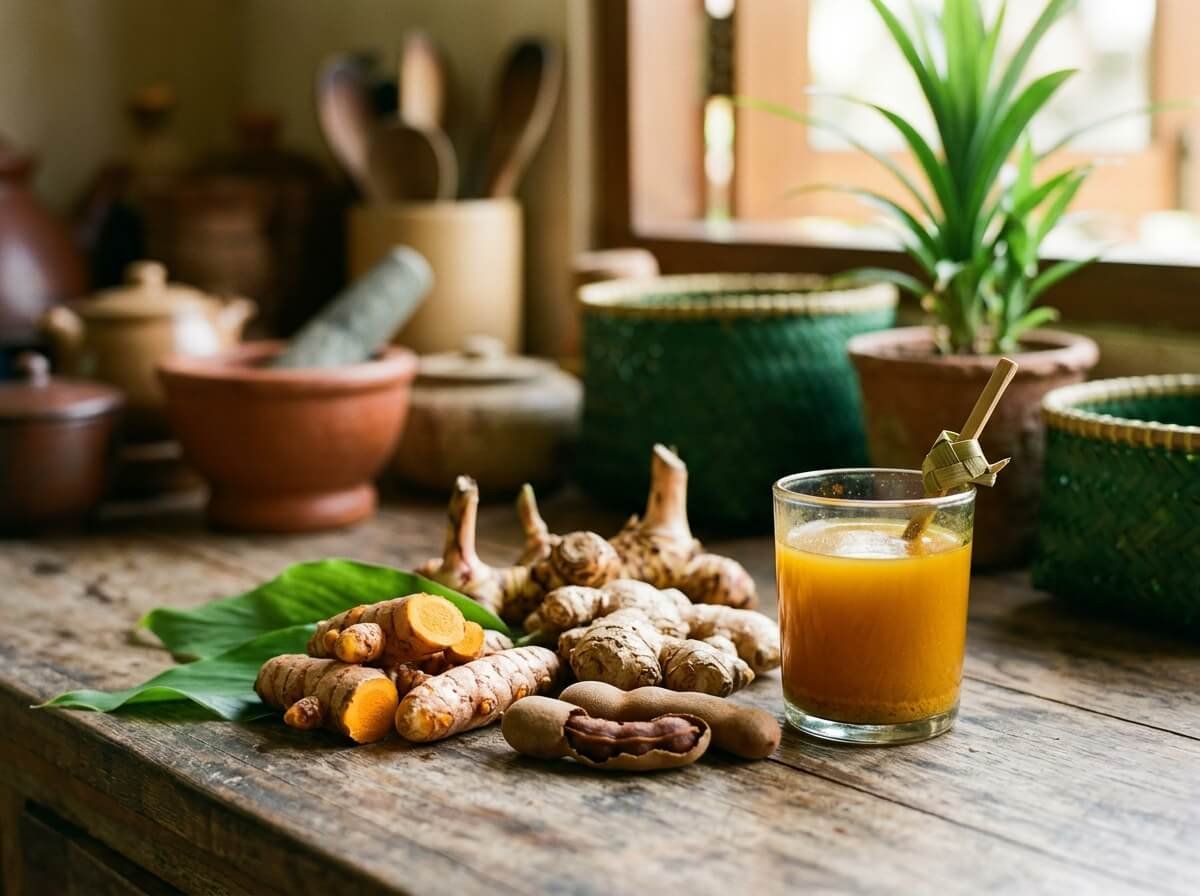
If mandi is the body ritual, jamu is the kitchen one. Jamu is Indonesia’s traditional herbal tonic system, a living apothecary built from roots, barks, and spices most of us already keep on a shelf: turmeric, ginger, galangal, tamarind, lime. It is brewed fresh, drunk daily, and recognised by UNESCO as part of Indonesia’s cultural heritage, though its real home is the ordinary kitchen, not the museum case.
The most common everyday brew is jamu kunyit asam, turmeric and tamarind. Turmeric carries curcumin, long valued for its calming effect on inflammation; tamarind brings brightness and vitamin C; a little palm sugar rounds it out. The point is not one heroic ingredient but the daily rhythm, a small warm cup that becomes a fixed marker in the morning. We tell the longer story of this tradition, and how its aromatic roots cross into scent and ritual, in our feature on jamu and Indonesian aromatherapy.
A simple jamu kunyit asam to make at home
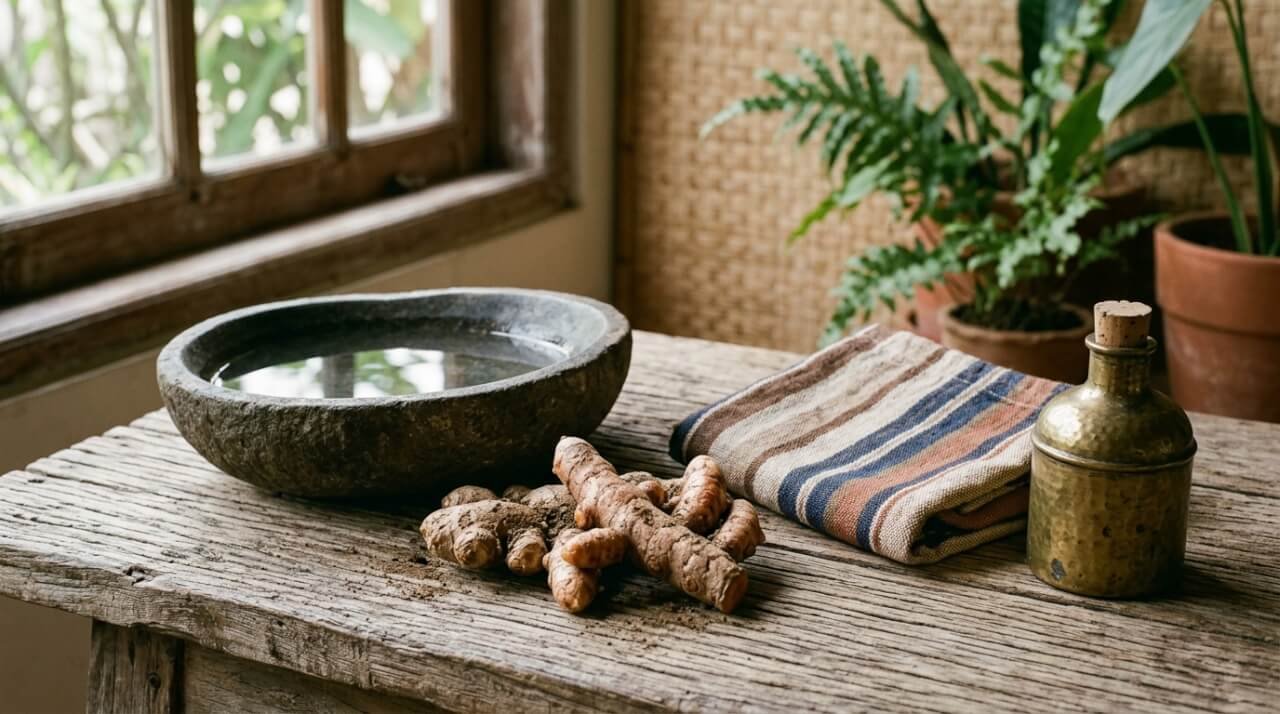
- Grate a thumb of fresh turmeric and a smaller thumb of ginger. Handle turmeric with care; it stains beautifully and permanently.
- Simmer both in about two cups of water for 10 minutes, keeping the heat gentle so the aromatics stay bright.
- Add a tablespoon of tamarind pulp and a little palm sugar or honey to taste, then simmer two minutes more.
- Strain, cool slightly, and drink warm. A squeeze of lime lifts the whole cup.
Kunyit asam is only the doorway. There is beras kencur, a warming blend of toasted rice and aromatic ginger, often taken for energy and appetite. There is bitter jamu pahitan for digestion, and countless regional variations passed from mother to daughter, each household holding its own recipe. The variety is the point: jamu is not a fixed formula but a flexible practice, a way of reaching for the kitchen shelf whenever the body needs steadying. Its aromatic roots also carry over into scent, which is where jamu and Indonesian aromatherapy quietly meet.
Made this way, jamu is not a wellness purchase but a wellness practice, the same roots your grandmother might have used, brewed by your own hands. It is the clearest example of the Indonesian idea that tradition and daily life are the same thing, and that the apothecary was always meant to live in the kitchen. Start with one cup, a few mornings a week, and let it become a fixture rather than a project.
Boreh and urut: the touch traditions
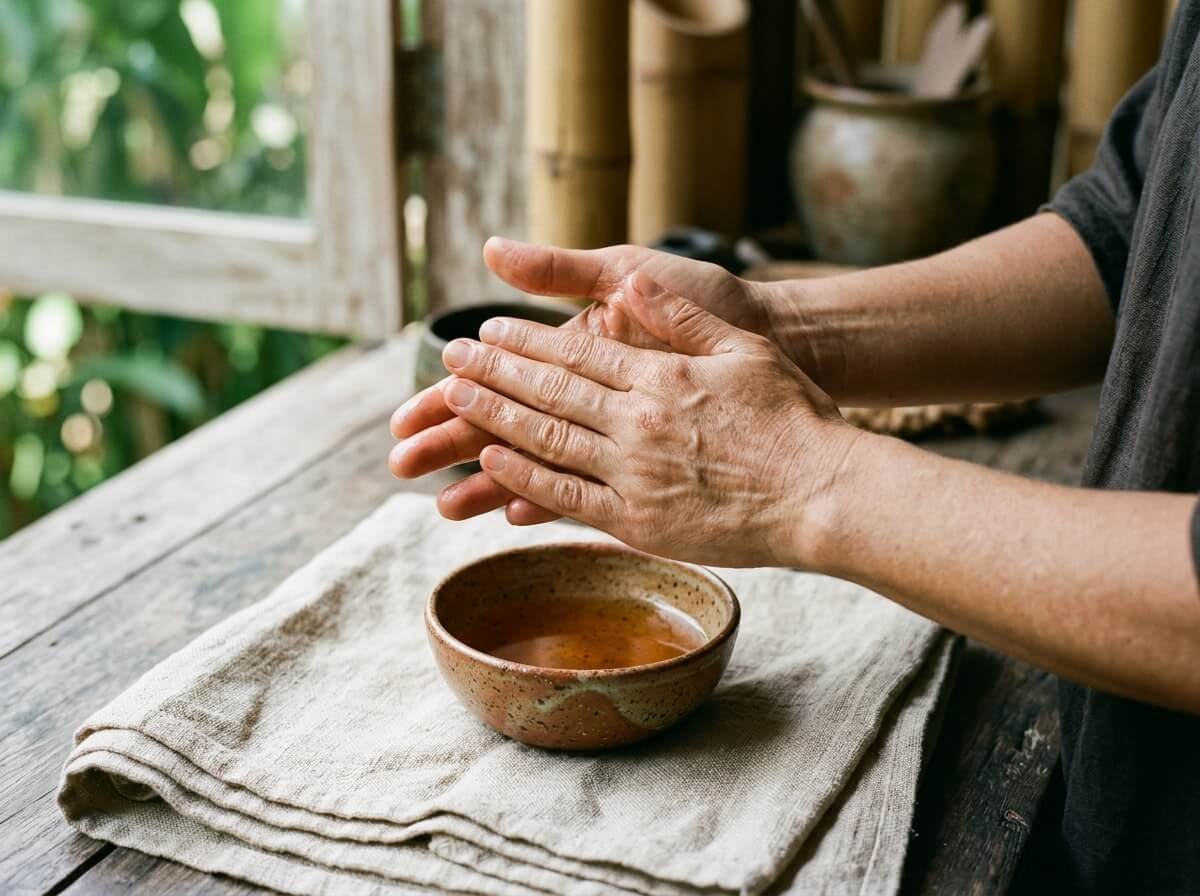
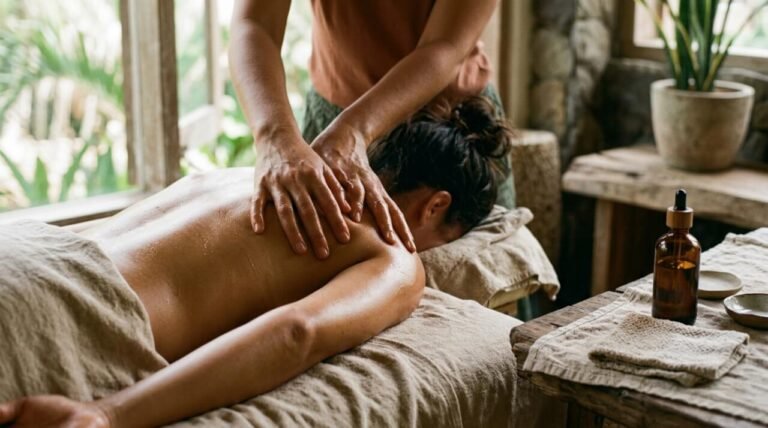
Indonesian wellness takes touch seriously. Two traditions carry it. Boreh is a warming body paste, blended from spices like ginger, clove, and sandalwood, traditionally applied in Bali to ease tired muscles and warm the body through cool or unsettled seasons. Urut is Indonesian massage, a firm, connective-tissue practice passed down through families and village healers, as much a form of care between people as a treatment.
You do not need a practitioner to borrow their logic. Scaled down, both become a 10-minute act of self-care that closes the gap between skincare and bodywork. The medium is a good botanical oil, warmed between the palms, worked into the skin with slow pressure. This is self-massage in an Indonesian key, and it is one of the most grounding practices in this whole guide, precisely because it asks you to slow down and pay attention to the body with your hands.
Boreh, in its full traditional form, is a warming paste rather than an oil, and it is worth understanding even if you start with the simpler oil massage. In Balinese homes it is applied to warm tired or aching muscles, often through cooler or unsettled seasons, and it is a communal act as much as a personal one, applied by another pair of hands. A gentle note of care: warming spices can be strong on sensitive skin, so a small patch test is wise before any spiced blend, and a plain botanical oil is the kinder place to begin. The tradition is generous enough to meet you at whatever level you are ready for.
For this we reach for a coconut-based body oil, the traditional carrier across the archipelago. Our Rose Allure Body Oil blends cold-pressed coconut oil with rose geranium, so it warms easily, absorbs without heaviness, and carries a calm scent that suits an evening practice. If you want to understand the massage tradition in more depth, our guide to Balinese massage oil covers how these blends are chosen and used.
A 10-minute at-home urut sequence
- Warm a tablespoon of body oil between your palms until it is body temperature, never hot.
- Begin at the feet and work upward with long, firm strokes toward the heart, following the direction of circulation.
- Spend extra time on the calves, shoulders, and the base of the neck, where tension gathers.
- Finish at the temples and scalp with slow circles, then rest for a minute before you dress or bathe.

Bring the touch tradition home
Rose Allure Body Oil pairs cold-pressed Balinese coconut oil with rose geranium, crafted for slow evening self-massage. Warmed between the palms, it absorbs cleanly and seals the skin without heaviness.
Dupa and aromatherapy: scent as time-keeper
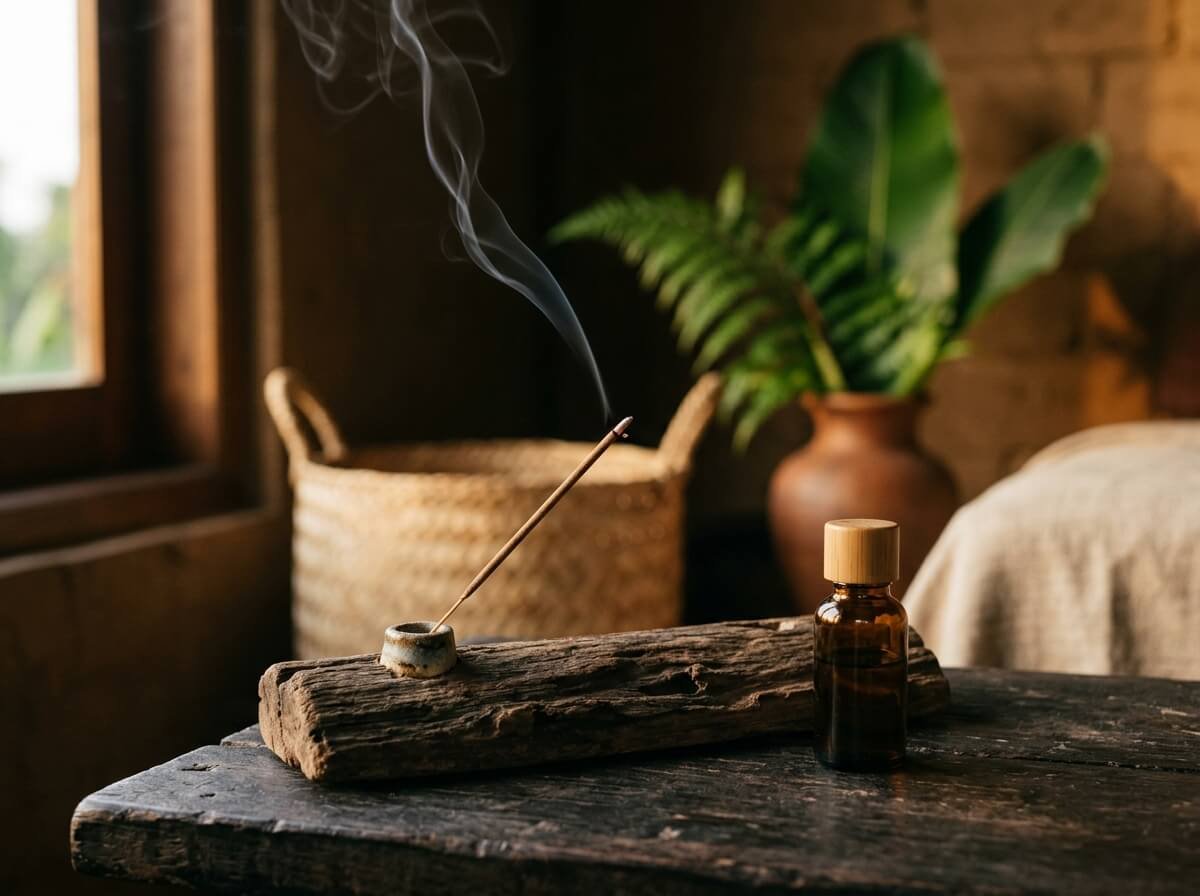
The last of the five practices is the most atmospheric. Dupa is incense, and in Balinese daily life scent is a way of marking time. A particular aroma greets the morning, another accompanies work, another settles the evening, another prepares for sleep. Scent becomes a circadian signal, a cue the body learns to read, and over days it starts to move you gently through the hours without a clock.
This is aromatherapy in its oldest, most practical form, less about a diffuser trend and more about rhythm. You can build a simple four-scent day. Something bright and green for the morning, something clarifying for focused work, something warm for the evening wind-down, and something soft and grounding for sleep. Our aromatherapy diffuser blend recipes give ready-made combinations for each of these moments if you would rather start from a recipe.
The tools are simple. A stick of incense in a holder like our Bali reclaimed wood incense holder for the traditional dupa cue, and if you prefer an open flame-free option, a reed diffuser such as our Nayla Apothecary Reed Diffuser holds a scent through a room all day. For the sleep signal, we reach for our Bali Night essential oil blend, a few drops before bed to close the four-scent day. If you are new to incense as a practice, our guide to natural incense sticks explains how to choose and burn them well.
Building the four-scent day is easier than it sounds. Reach for something citrus or herbaceous at dawn, when you want to feel awake and clear. Move to something clean and focusing through the working hours, a note that keeps the mind steady without lulling it. As the light softens, shift to something warm and rounded, sandalwood, clove, or a spiced blend, to signal the transition out of work. Then, close with something quiet and grounding at night. Over a week the sequence stops being a checklist and becomes a felt sense of where you are in the day, the body reading time through the nose.
Scent is the quietest kind of timekeeping. The body learns it faster than the mind, and it asks nothing of you but to notice.
A 30-day Indonesian wellness practice
Five practices at once is a lot. The Indonesian way would never ask that of you. Change starts small, and the point is not to perform wellness but to let it settle in until it stops feeling like effort. So here is a low-pressure way to build the whole thing over a month, one practice per week, layering rather than replacing.
- Week one, mandi. Add the three breaths and the warm, unhurried rinse to one bath a day. Nothing else changes yet.
- Week two, jamu. Brew one cup of turmeric-tamarind jamu on three mornings this week. Keep the mandi going.
- Week three, urut. Add a 10-minute self-massage with body oil twice this week, ideally before the evening mandi.
- Week four, dupa. Introduce two scent cues, one for morning and one for sleep, and let them anchor the ends of your day.
By the end of the month you are not following a routine so much as living inside a rhythm. Some days you will do all four; many days you will do one, and that is the practice working as intended. Indonesian wellness has never demanded perfection. It asks for presence, repeated gently, in the place you already live.
Common questions about Indonesian wellness at home
Do I need special equipment to start? No. The whole point is that these practices were built for ordinary homes. A warm shower, a few kitchen roots, a tablespoon of body oil, and a single scent cue are enough to begin. The tools can come later, if at all.
Is it respectful to practise Indonesian wellness if I am not Indonesian? Yes, when it is done with attribution and care. The line to avoid is treating a living tradition as an aesthetic to strip for parts. Name where each practice comes from, understand the philosophy of balance behind it, and support the communities and sources that keep it alive. Practised that way, it is honouring, not appropriating.
How is this different from a spa day? A spa day is an event you buy. Indonesian wellness is a rhythm you keep. The value is not in intensity but in repetition, small acts of care returning day after day until they become the texture of ordinary life.
Which practice should I start with? Mandi, almost always. You already bathe, so you are not adding a task, only adding attention. Once the morning and evening baths feel like anchors, the others layer on naturally.
This is also where the philosophy comes full circle. Each of these practices leans on a botanical, and each botanical carries a lineage: coconut from Balinese groves, spices from the archipelago, wild-harvested ingredients like illipe butter and buah merah oil that support the forests and communities they come from. Care for yourself this way and the care travels outward, to the land and the people who keep these traditions alive. That is the whole idea, and it is the reason we have kept making things by hand in Bali for more than 35 years. What you give, you get back.