Wellness Wednesday: why we stop smelling our own scent
We roll on a little scent in the morning. By mid-morning it seems to have vanished, so we roll on a little more. By lunch, everyone who steps into the lift with us can smell it clearly. Everyone except us. This is not a weak oil or a short-lived blend. It is our own nose doing exactly what it was built to do.
Why our own scent disappears
Scientists call it olfactory adaptation, and most of us know it as going nose-blind. When a smell stays steady around us, the receptors in the nose respond less and less, and the brain starts to treat that smell as background. Within minutes, a scent we chose with care drops out of our awareness.
There is wisdom in this. A nose that filters out what is constant stays alert to what is new: smoke, spoiled food, rain on the way. Our noses are tuned for change, not for constant reporting. That is also why a familiar scent can come back to us when we step outside and walk back in. We noted this briefly in our open-the-window ritual. Today it is worth looking at what it does to the way we apply scent.
The scent is still there
The important point is this: when we stop noticing a scent, it has not left our skin. The aromatic molecules are still lifting off, slowly, for hours. So when we reapply because we “can’t smell it anymore,” we are adding a second layer to a first layer that is still working.

That matters for two reasons. The first is the people around us, who smell the full stack. The second is our skin. Essential oils are concentrated plant compounds, and the more often we put them on the same patch of skin, the higher the chance of irritation or sensitisation over time. A blend that suits us well at one light application a day can start to sting at five.
What about the coffee beans?
Fragrance counters often offer a jar of coffee beans to “reset” the nose. It is a lovely ritual, but the evidence behind it is thin. In a 2011 study in Perceptual and Motor Skills, Grosofsky, Haupert, and Versteeg had people sniff coffee beans, lemon slices, or plain air between fragrances. Coffee did no better than air. The simplest reset is the oldest one: fresh air and a little time.
A gentler way to wear scent
- Decide the amount before you start. One short line behind each ear, or one on each covered wrist. Then put the cap back on.
- Trust the clock, not the nose. If the scent fades from your awareness in 20 minutes, that is adaptation. Wait at least four hours before you consider more.
- Check from the outside. Step outdoors for a few minutes, then smell the inside of your wrist. Or ask someone close to you. They will tell you the truth.
- Rest the spot. Move between pulse points on different days, so no single patch of skin carries every application.
- Stop if skin reacts. Redness, itch, or a warm sting means a pause, not a stronger blend.
One honest note on the sun: many citrus blends, ours included, contain whole bergamot peel oil, which can make skin react to direct sunlight. Choose spots that stay covered or out of the sun for 12 hours. Our bergamot guide explains why.
Less, and more noticed
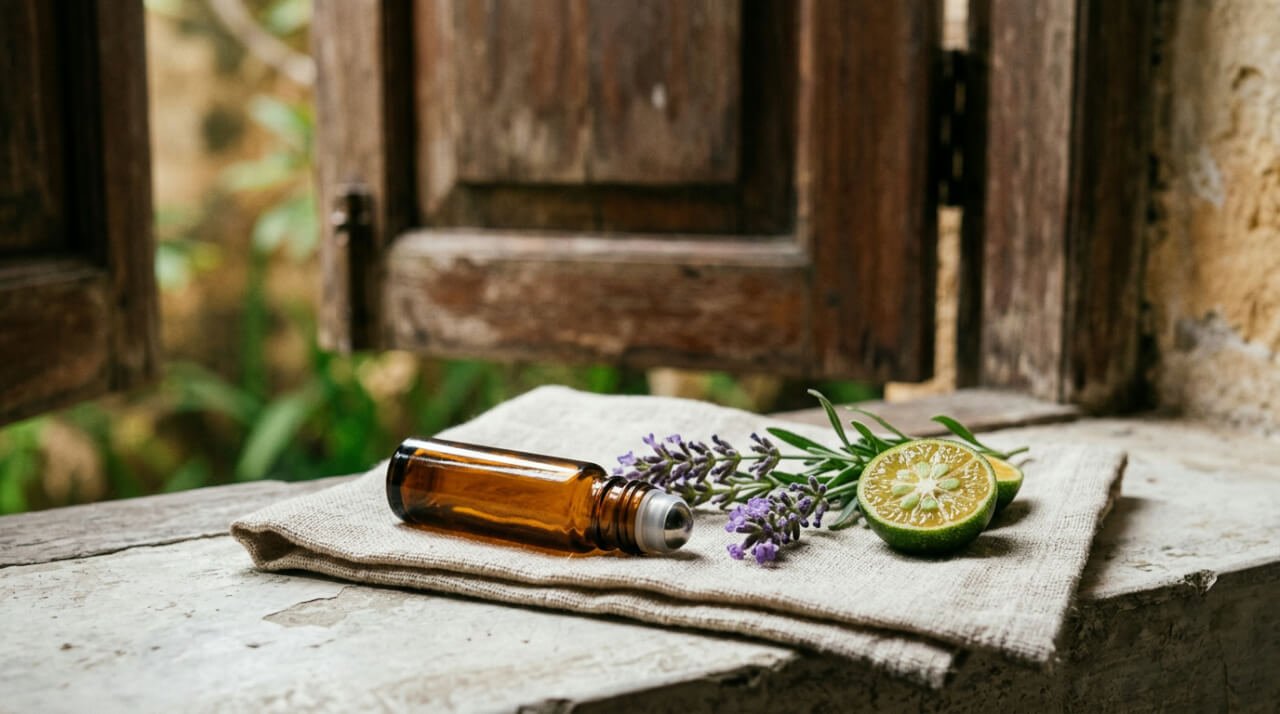
A roller is made for this kind of measured care. Our Bliss Essential Oil Roller blends lavender, bergamot, rose geranium, sweet orange, and patchouli in jojoba oil, already diluted for skin. If you prefer something softer, the Santi Essential Oil Roller carries lavender, rose geranium, cananga, bergamot, and sweet orange. Our essential oil roller guide covers how to read the label, and our 60-second pulse-point ritual gives the morning a shape.
The takeaway is simple. When we can no longer smell our scent, it is usually still there, and our nose is just resting. Apply once, with intention, and let the scent do its quiet work.