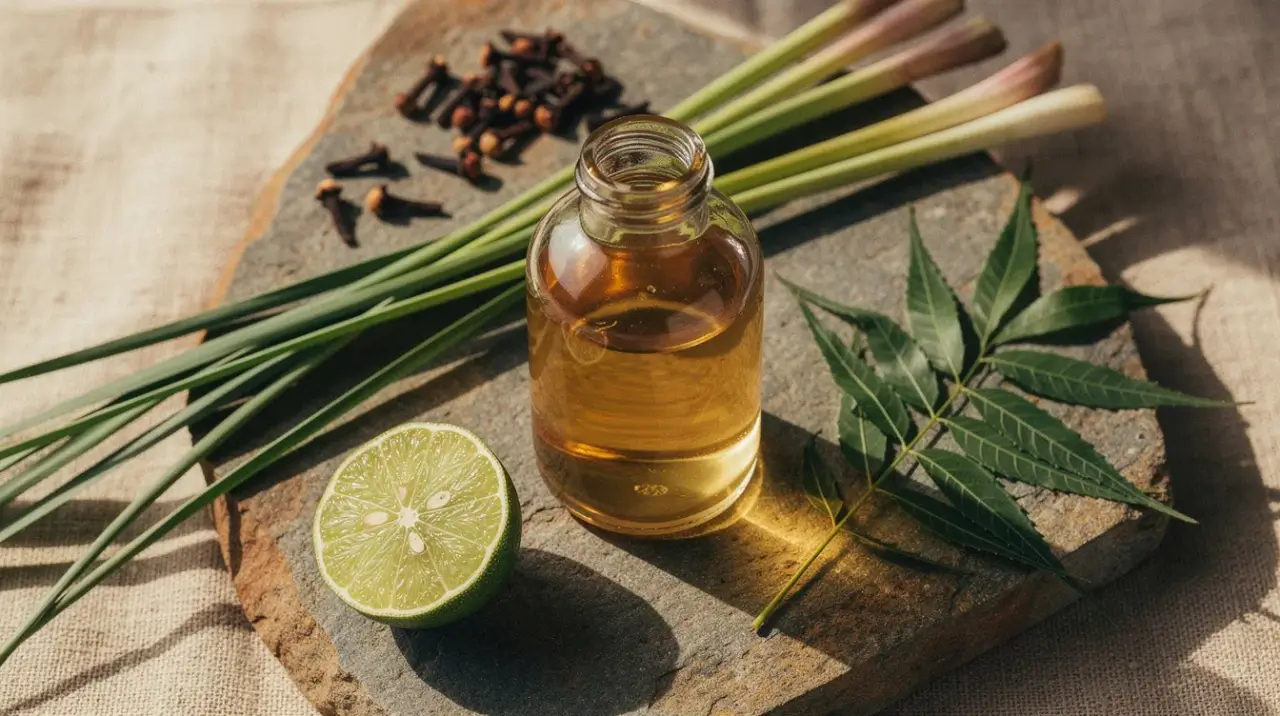
Best natural bug repellent: a guide to plant-based protection that actually works
The search for the best natural bug repellent usually starts the same way: a botanical-sounding label, a few familiar oils, and a quiet hope that something gentle will work as hard as the chemical sprays we grew up with. Sometimes it does. Sometimes it doesn’t. The difference comes down to which active ingredients are actually inside the bottle, at what concentration, and against which insects.
We’ve been blending botanical care in Bali since 1989, and in a tropical climate, the question of what truly protects skin from biting insects is not philosophical. It is daily. This is the guide we wish more brands wrote: clear about what plant-based actives can do, honest about where they fall short, and grounded in the Balinese herbal tradition that has guided our formulations for over 35 years. Whether you are reaching for a spray, a candle, a room repellent, or a lotion, the goal is the same: real protection, made from ingredients you can name.
What “natural” actually means on a bug repellent label
The word “natural” is unregulated in personal care, which is why it shows up on everything from cold-pressed botanical oils to synthetic fragrances. On a bug repellent specifically, “natural” usually means one of three things, and they are not all created equal. The first is a plant-based active ingredient registered with the EPA, such as oil of lemon eucalyptus (OLE) or its refined form, PMD. The second is a traditional essential oil used historically for its insect-repelling properties: citronella, lemongrass, geraniol, neem, clove, catnip. The third, less defensible, is a label that simply leans on the word “natural” without naming a single active ingredient that has been studied.
A truly natural bug repellent will tell you exactly what is in it and at what percentage. If the active ingredient is not on the front of the bottle, the formulation is probably leaning on hope. Look for transparent ingredient lists, named botanical oils with their Latin binomials, and a clear sense of which insects the product is intended for. Mosquito repellents are not always tick repellents. Tick repellents are not always effective against biting flies. Greenwashing thrives where specificity goes missing, and a bug spray that promises to repel “all insects” without naming any of them is a bug spray that has not been tested against any of them.
The most useful framing is this: a good natural repellent is one whose actives are botanical, whose claims are specific, and whose duration of protection is stated honestly. Two hours is a real number. “Long-lasting” is not. We dig deeper into what to look for in our companion guide on natural bug repellent for skin, which covers application logic in more detail.
The plant-based actives that actually repel insects

A handful of botanical ingredients have repeated, peer-reviewed evidence behind them. Knowing the names is the difference between buying a candle that works and buying a candle that smells lovely while the mosquitoes ignore it.
- Oil of lemon eucalyptus (OLE) and PMD. Derived from the leaves of Corymbia citriodora, this is the only plant-based active currently recommended by the CDC alongside DEET and picaridin. PMD, its refined component, provides several hours of mosquito protection at concentrations of around 20% to 30%. Not recommended for children under three.
- Citronella oil. Distilled from species of Cymbopogon, the same genus as lemongrass. Effective but short-lived, typically 30 to 60 minutes before reapplication. Pairs well with other oils in a blend.
- Lemongrass oil. A cousin to citronella, with overlapping aldehyde chemistry. Widely used across Southeast Asia, including in our own kitchens in Bali, where bundles of fresh sereh are kept by the door for the same purpose.
- Geraniol. A naturally occurring alcohol found in geranium, citronella, and rose oils. Studied as a mosquito and tick deterrent, and gentler on the skin than many synthetic options.
- Neem oil. Pressed from the seeds of Azadirachta indica. In Indonesian and South Asian tradition, neem (we call it mimba) is used both topically and around the home. Modern research supports its role as a repellent and antifeedant for several insect species.
- Soybean oil. Not an obvious entry, but Bite Blocker and similar formulations using 2% soybean oil have shown protection times comparable to low-concentration DEET in independent studies.
- Catnip oil (nepetalactone). Surprisingly effective in lab trials against mosquitoes, sometimes more so than DEET on a per-molecule basis, though field formulations are still maturing.
- Clove and cinnamon oils. Powerful in short bursts, often used in ambient repellents rather than skin formulations because of their tendency to irritate at high concentrations.
A blend often outperforms a single oil. Mosquitoes locate hosts through multiple cues at once: carbon dioxide, body heat, lactic acid in sweat, skin volatiles. A repellent that addresses several of these pathways at once tends to hold longer in the field. This is part of why thoughtful blends, rather than single-note formulations, sit at the heart of most credible botanical repellents. If you are curious about how plant oils combine to do more than one thing, our piece on essential oil blends walks through the same logic from an aromatherapy angle.
The Balinese way: protecting against insects in a tropical climate

The tropics teach a different relationship with insects than the temperate world. You do not get to opt out of mosquitoes; you negotiate with them. In Bali, that negotiation has been refined across generations. Bundles of fresh lemongrass (sereh) are placed near doorways. Mosquito coils made from local botanicals smoulder slowly on verandas at dusk. Clove buds are burned in small braziers during ceremonies. Cassia and neem leaves are tucked into wardrobes. The point is not to wage a chemical war on insects; it is to make spaces, and bodies, less attractive to them.
This long horizon of practice is what shapes how we approach repellent formulation. Our spray is built around lemongrass, citronella, clove, and other oils that Balinese healers have used long before there was a label to put them on. We hand-blend small batches in Ubud, the same village where Melanie Templer started Utama Spice from her kitchen in 1989. The lineage matters because formulation is not just chemistry. It is also pattern: which oils sit well together in skin, which proportions hold in heat, how a blend smells after eight hours in tropical humidity, when an essential oil tips from “fresh” to “harsh.” A formulator who has lived through 30 monsoon seasons knows things that a lab in a temperate country cannot replicate.
The Indonesian tradition of jamu, the herbal medicine system woven into daily life across the archipelago, encodes much of this knowledge. We wrote about its philosophy in our piece on jamu and Indonesian aromatherapy, and the same principle applies to bug repellents: the goal is balance, not domination. A good repellent supports the body in being less inviting, rather than coating it in a chemical shield. That is a quieter ambition than the one most bug spray ads make, and a more sustainable one.
Choosing the right format for your environment
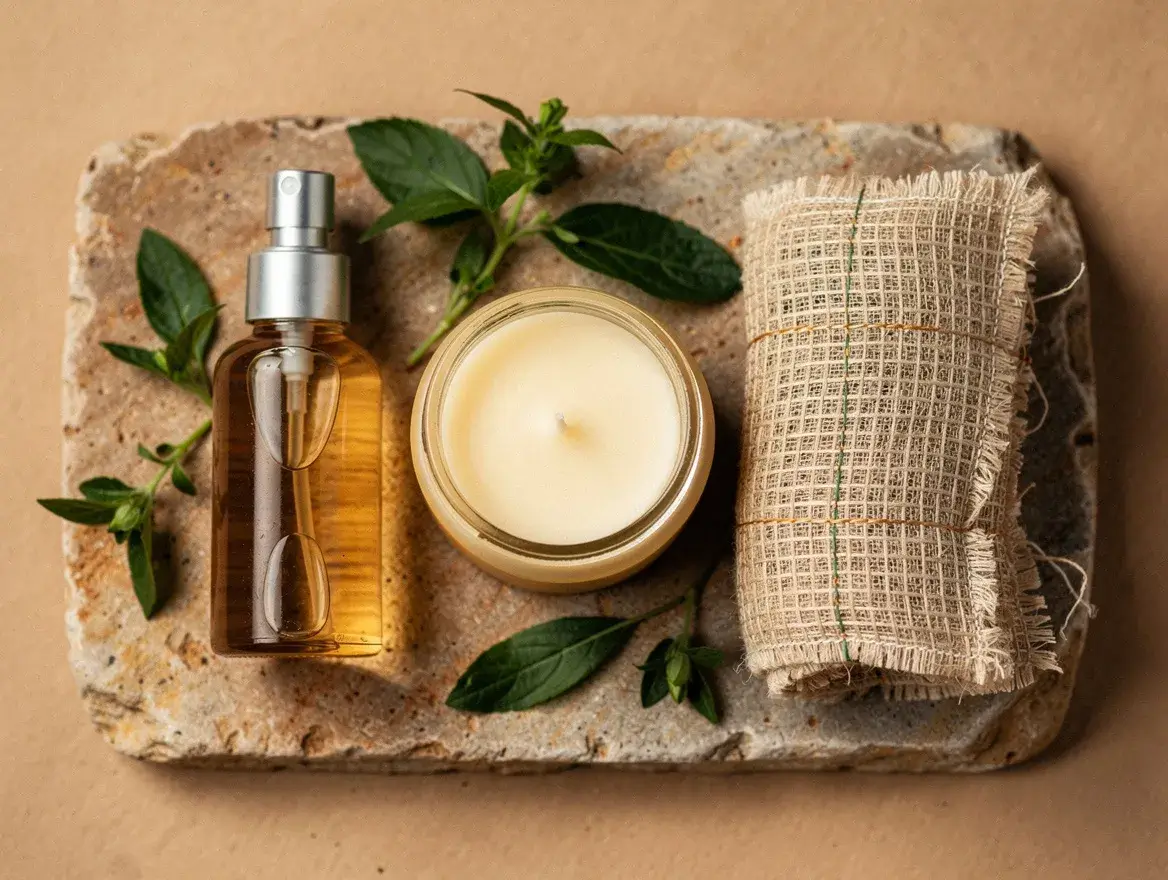
The best natural bug repellent for you depends less on the ingredient list than on the situation you are in. Format matters as much as formula. A spray that suits a beach evening is not the same product as a candle that fills a garden, and a lotion designed for sensitive skin is built differently again.
- Skin sprays. The most flexible format. Easy to reapply, easy to share, easy to carry. Our own Begone Bug Spray is built for this kind of all-day, low-irritation use, with a blend that has been refined across many seasons of Balinese field testing.
- Lotions and balms. Slower to apply, but longer-lasting and ideal for sensitive skin or for children who fight a spray bottle. The fat in a balm slows the evaporation of the essential oils, which is why a good lotion often holds protection a little longer than a spray of the same active percentage.
- Candles and coils. Area protection rather than skin protection. Useful on a porch, around a table, in a circle of chairs. The radius of effect is modest, often three to four metres in still air, and largely zero in a strong breeze. We make a small Begone Bug Candle for exactly this kind of evening use, blended with the same botanicals as our spray so the home scent stays coherent.
- Diffusers and room sprays. Best thought of as ambience plus mild deterrent. Less effective against active biters than a candle or coil, but pleasant for indoor evenings when windows are open. Pair with a screened door if mosquitoes are persistent.
- Yard treatments and mosquito netting. The most overlooked piece of the puzzle. No skin repellent matches a properly hung mosquito net for night-time protection, and standing water in a yard will defeat any repellent you spray on yourself. The most effective natural-living strategy combines a personal repellent with attention to the environment.
Different environments shift the calculus. A humid evening with little wind and lots of standing water demands a higher-percentage active and shorter reapplication intervals. A dry afternoon with a breeze can be handled with a lighter blend. Children, sensitive skin, and pregnancy each shift it further, which we address in the FAQs below.
Best natural bug repellents by format: a buyer’s guide
Here is the format-by-format guide we would give a friend asking the question. We have kept the picks short, because choosing well is more useful than choosing many.
Best plant-based skin spray
A botanical spray earns its place when the blend is robust enough to hold for a few hours and the carrier is gentle enough for daily reapplication. Look for citronella plus lemongrass plus a third anchoring oil (clove, geraniol, or eucalyptus), in a water-and-alcohol or aloe carrier. Avoid sprays with synthetic fragrance, which masks the active scent and often signals corner-cutting elsewhere. Our Begone Bug Spray refill can is built around this kind of multi-active blend, and the refill format keeps glass and plastic out of the bin between uses.
Best botanical candle for outdoor evenings
An area-effect candle should pair a clean wax base (soy, coconut, beeswax) with a meaningful essential oil load. A candle that smells lightly perfumed but only releases trace amounts of citronella will not do much against a determined mosquito. Look for clearly stated oil percentages and a burn time matched to the way you actually use it. Our Begone Bug Candle uses the same botanical blend as the spray, scaled for slow ambient release.

Best refillable option for households
If you reach for bug spray often, a refillable system is the most honest sustainability choice on this list. One bottle, many fills, fewer trips through the recycling stream. The math gets compelling fast: a year of weekly use can mean a dozen single-use bottles avoided. Our 1L refill is what most of our regulars order, decanted into their own spray bottles at home.
Best blend for sensitive skin
Sensitive skin tolerates blends better than single high-percentage oils. Look for low-concentration citronella or lemongrass paired with soothing carriers (aloe vera, coconut oil, jojoba), and avoid clove, cinnamon, and undiluted eucalyptus at the top of the ingredient list. Patch test on the inner forearm 24 hours before broader use.
Best DIY base if you want to mix your own
Start with a base of witch hazel or distilled water plus a small fraction of carrier oil, then add 15 to 25 drops of essential oil per ounce of base. A starter blend: 10 drops citronella, 8 drops lemongrass, 5 drops geraniol, 2 drops clove, per ounce. Shake before each use, store in dark glass, and refresh weekly. For more on building your own blends, our piece on making your own natural bug spray walks through the ratios in more detail.
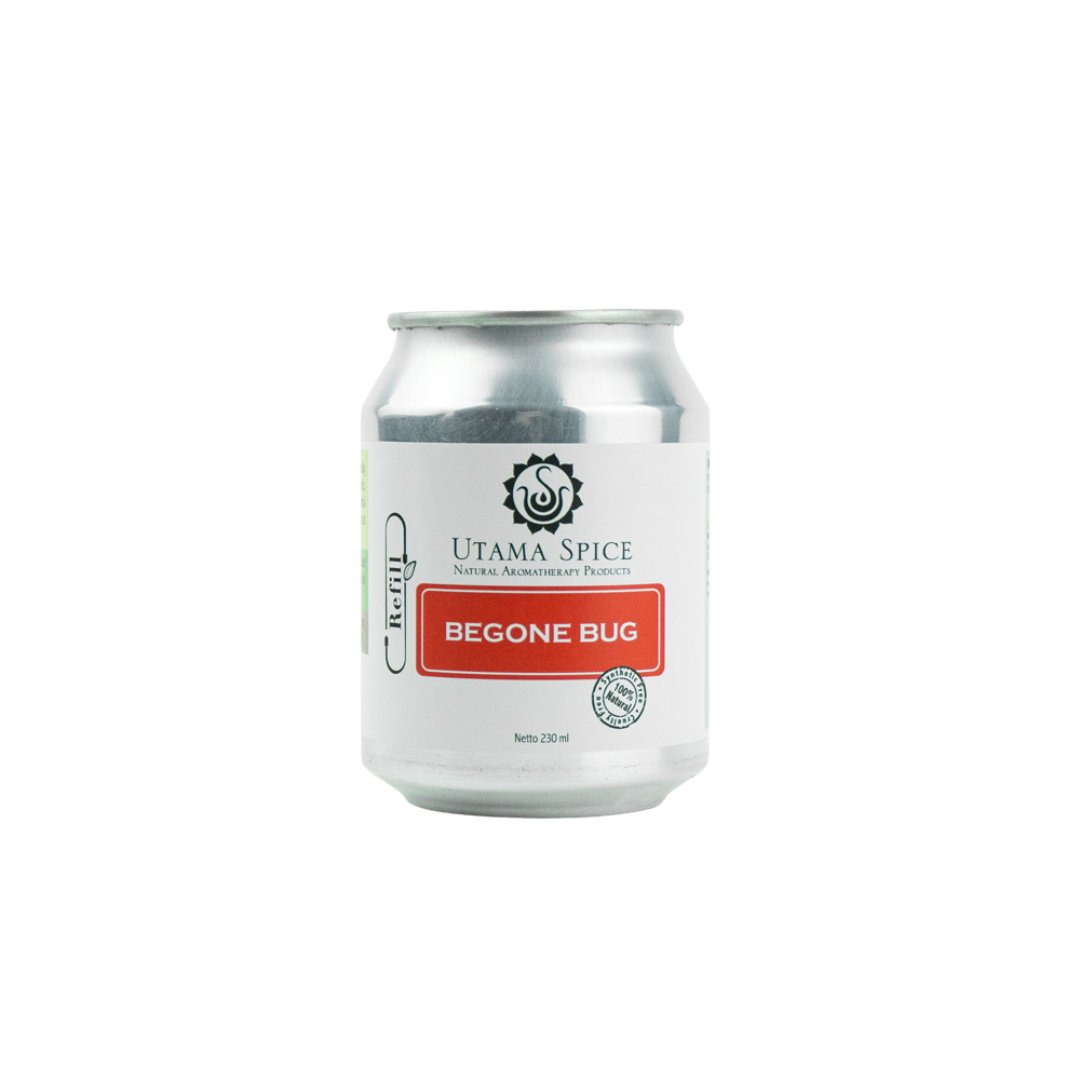
Begone Bug Spray, refilled in Bali
Hand-blended in Ubud with lemongrass, citronella, clove, and the same botanicals Balinese households have used for generations. Designed as a refill can so one spray bottle keeps going, season after season.
When natural is enough, and when it isn’t

This is the part most botanical brands skip, and it is the part that matters most. A natural repellent will handle a porch dinner, a forest walk, a hike in temperate woods, a beach evening, a long flight of paddy-edge meditation. It will not always be the right tool for a high-risk vector zone. We owe it to readers to say so plainly.
In areas with active malaria, dengue, Zika, yellow fever, or known tick-borne disease, the CDC and most public-health bodies recommend higher-percentage DEET, picaridin, or PMD-based repellents over standard essential oil blends. The reason is duration, not philosophy: vector-borne disease prevention requires consistent multi-hour coverage, and most plant oils evaporate too quickly to deliver that without near-constant reapplication. If you are travelling into a malaria zone, a botanical blend is a supplement, not a substitute, to the protection your travel clinic recommends.
For everyday tropical and temperate use, plant-based repellents do the job well, especially when paired with environment management: empty standing water, screen the windows, hang a net over the bed, light a candle on the porch, wear long sleeves at dusk. Pesticide overuse harms beneficial insects and pollinators; we do not need a chemical solution for a problem that environmental design can soften. A natural bug repellent is rarely just one product. It is a layered habit: spray on the skin, candle on the table, net over the bed, lemongrass by the door. Care, in other words, is rarely a single bottle.
For more on how the plants themselves shape this conversation, including the species you can grow on a balcony or in a garden, see our piece on natural bug repellent plants.
Frequently asked questions about natural bug repellents
Is natural bug repellent safe for babies and toddlers?
For infants under two months, the safest approach is physical protection: long sleeves, mosquito netting over the stroller or cot, and limiting outdoor time at dawn and dusk. For children between two months and three years, low-concentration plant-based blends (avoiding oil of lemon eucalyptus, which is not recommended for under-threes) can be used in moderation. Apply to clothing rather than skin where possible, and always patch test first.
Can I use natural bug repellent during pregnancy?
Most plant-based bug repellents are considered safe during pregnancy at standard concentrations, but a few essential oils, including high-percentage clove, cinnamon, and pennyroyal, are best avoided. Citronella, lemongrass, geraniol, and OLE blends are generally well tolerated. If you are travelling into an active mosquito-borne disease zone while pregnant, speak with your doctor about whether a stronger active is warranted; vector-borne illness carries real risk in pregnancy.
How often do I need to reapply a natural bug spray?
More often than a chemical spray, honestly. Most botanical blends hold for one to two hours. After heavy sweat or swimming, reapply immediately. The simplest rule is: if you can no longer smell the spray clearly on your skin, the active oils have evaporated and the repellent effect is gone.
Can I layer natural bug repellent with sunscreen?
Yes, and the recommended order is sunscreen first, allowed to absorb for a few minutes, then bug repellent over the top. Bug spray applied first will dilute and disturb the sunscreen film. Reapply sunscreen on its own schedule, then top up bug repellent more frequently as needed.
How should I store a botanical bug repellent?
Essential oils degrade in heat and light. Store the bottle in a cool, dark cupboard between uses, and avoid leaving it in a hot car or on a sunny windowsill. Most well-formulated blends last 12 to 18 months from the date of opening. Refill bottles last longer if kept sealed.
Will a natural repellent work against ticks?
Some plant-based actives, particularly OLE, geraniol, and 2-undecanone, have shown anti-tick activity in laboratory and limited field studies. In high-density tick areas, especially regions with known Lyme disease, permethrin-treated clothing combined with a higher-percentage repellent on exposed skin remains the most thoroughly studied approach. A natural blend is a sensible supplement to environmental measures rather than a stand-alone solution.
Final thoughts on choosing a natural bug repellent that actually works
A natural bug repellent worth keeping in the bag is the one that is named honestly, formulated thoughtfully, and matched to the environment you are walking into. Read the ingredient list. Look for stated percentages. Ask how long the protection holds. Choose a format that fits your life, whether that is a refillable spray for the school run, a candle for the garden table, or a balm for a child’s small arms. Then accept the trade-offs that come with plant-based protection: shorter wear times, more frequent reapplication, gentler scent, and a much lighter footprint on your body and the world around it.
Care has always been an act of attention. A bottle of botanical bug spray is one small piece of the same practice: choosing what touches your skin with the same care you choose what you eat. That is the work we have been doing in Bali for more than three decades, and it is the work that goes into every refill that leaves our small workshop in Ubud.