Connection Thursday: the Papuan growers behind buah merah, and why we source it the slow way
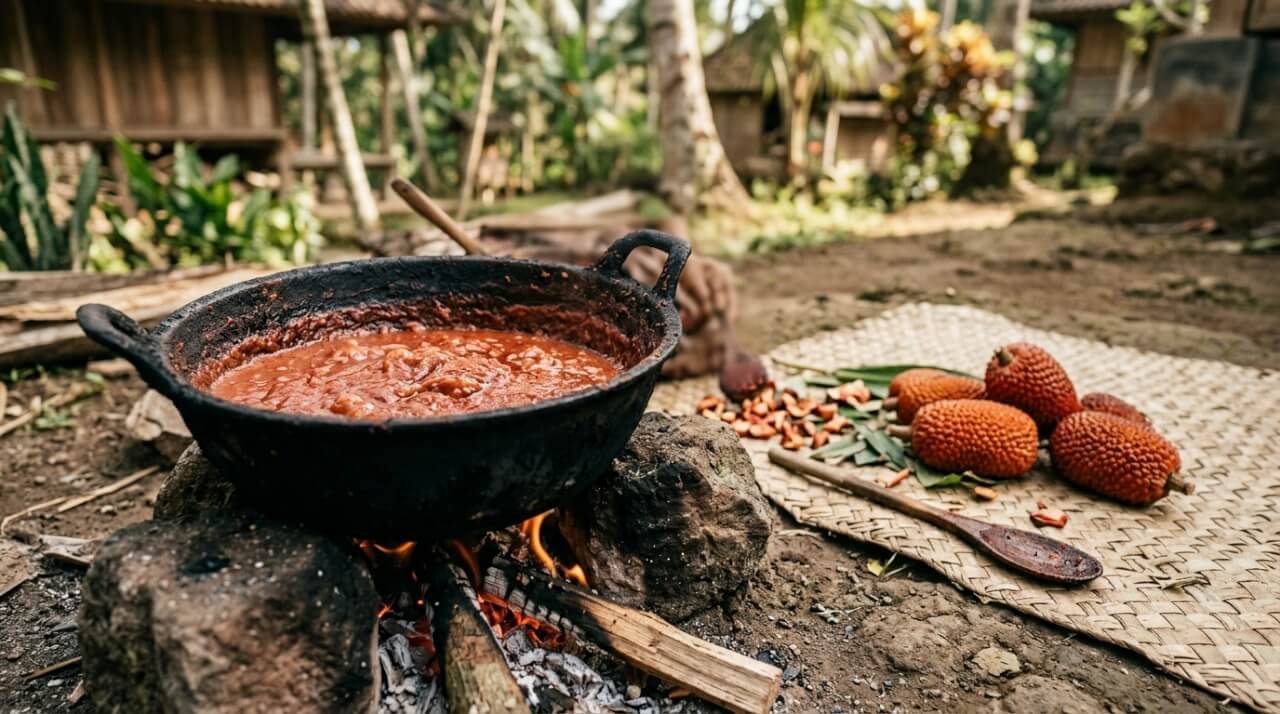
Buah merah, the deep red fruit of the Pandanus conoideus tree, grows almost nowhere outside the highlands of Papua, at the far eastern edge of Indonesia. For generations, Papuan families have harvested it by hand: climbing to reach the heavy, oblong fruit, then slow-cooking the pulp for hours over open fires until it renders into a thick, crimson oil. It is a process passed down rather than written down, kept inside communities long before anyone outside Papua had heard the name.
Long before it appeared in any skincare formula, buah merah held a place in Papuan traditional practice, used topically for skin care and valued as a general tonic. That history matters to us. When an ingredient’s popularity rises overseas, it is easy for the fuller origin story to get flattened into a single word on a label. We would rather tell it properly.
Why the slow way still matters
Buah merah is now prized in skincare for its density of carotenoids and tocopherols, the compounds behind its colour and much of its benefit to skin. It would be easy to industrialise the process: extract faster, cook hotter, buy in bulk from wherever is cheapest. We choose not to, because doing so would sever the oil from the people whose knowledge made it useful in the first place. Sourcing buah merah properly means paying growers a fair price for slow, skilled work, and it means the story on our label matches the story in the village where the fruit was picked.
This is the same principle behind our partnerships closer to home in Bali, from the women’s groups we work with in Munti Gunung to the reforestation partners who help keep illipe forests standing in Kalimantan. Connection, to us, means the supply chain has a face at every step, not just a source.
The takeaway: the next time you see “buah merah” on an ingredient list anywhere, know that a fair price and a slow fire were probably part of the story. You can read more about the oil itself, and what it does for skin, in our earlier piece on buah merah oil.