Travel skincare routine: the honest edit from cabin dry to Bali humid
A travel skincare routine usually gets built backward. Most guides start from the packing list: what to buy in travel size, what to squeeze into a clear quart bag, what fits under the hundred milliliter line. Almost none start from what actually happens to skin between departure and arrival, especially when the destination is somewhere like Bali, where the air outside the airport is nothing like the air inside the cabin.
That gap matters more than most packing lists admit. The real shift is not one climate change but two: first the dry, pressurized cabin air that pulls moisture out of skin for hours, then the humid tropical air on the other end that calls for something lighter, not heavier. A travel skincare routine built for only the first half leaves skin overcorrected for the second. This guide covers both halves honestly: what changes in the air, what actually earns a place in a small bag, how to solve the liquid-limit problem without a fleet of minis, and what a genuine multi-tasking product can and cannot do.
Why cabin air is not the only problem: the second skin shift nobody preps for
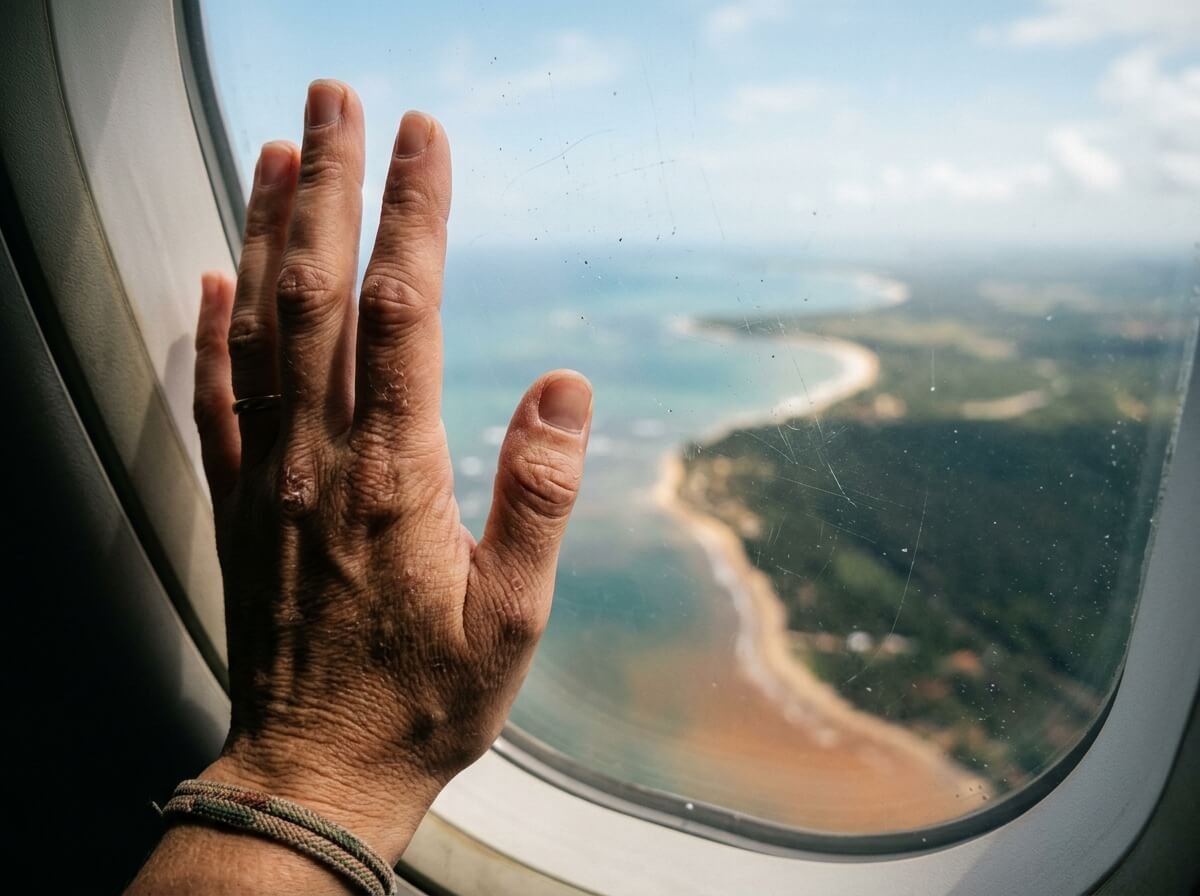
An airplane cabin sits at roughly ten to twenty percent relative humidity, drier than most deserts. Regular indoor air runs closer to thirty to fifty percent, so a five or six hour flight puts skin under desert-level dryness for longer than most people spend outdoors in an entire week. Water moves out through the skin faster than it can be replaced, the outer barrier of lipids and proteins that normally holds moisture in starts to lose its grip, and by the time the seatbelt sign goes off for landing, skin is genuinely parched, not just tight from recycled cabin air.
Most travel skincare advice stops there: drink water, use a hydrating mist, apply a heavier moisturizer before landing. All of that is sound, as far as it goes. The problem is what happens next. Step off the plane into Bali, or Bangkok, or Miami in August, and relative humidity can climb to seventy or eighty percent within the hour. Skin that spent six hours losing water now sits under warm, saturated air, and a moisturizer chosen for cabin dryness, often thick and oil-forward, meant to seal in what little moisture is left, suddenly reads as heavy rather than protective. Pores that felt fine at altitude start to feel congested at sea level in the tropics. It is one of the more common, least discussed causes of a breakout in the first two days of a trip, and it has nothing to do with new food or new water. It is simply the wrong texture for the new air.
The honest fix is not one skincare kit. It is two mindsets carried in one small bag: rehydrate and protect for the flight, then lighten and let skin breathe for the destination. We cover the general version of this principle, choosing texture and order rather than piling on more product, in our guide to how to layer natural skincare. On a trip, that principle carries more weight than usual, because a suitcase does not have the luxury of a full shelf of options to adjust with. Whatever goes in the bag has to do the right job in two different climates, sometimes on the same day.
This is also why a travel skincare routine deserves to be planned before the trip rather than assembled at the airport pharmacy. A rushed, unfamiliar product bought at a kiosk is a poor substitute for something already tested on your own skin, and it is one more reason the honest version of packing light starts at home, not in the departure lounge.
The first twenty-four hours after landing are the ones that matter most. Skin, like the rest of the body, needs a little time to adjust to a new climate, and water taken internally helps as much as anything applied on top. Drink more than feels necessary on the flight itself, keep the moisturizer light for that first day even if the plan is to switch to something richer later in the trip, and resist the instinct to over-correct with a heavier product just because the skin still feels dry from the flight. It usually is not dry anymore. It just has not caught up yet.
Building a travel skincare routine: four things, not ten
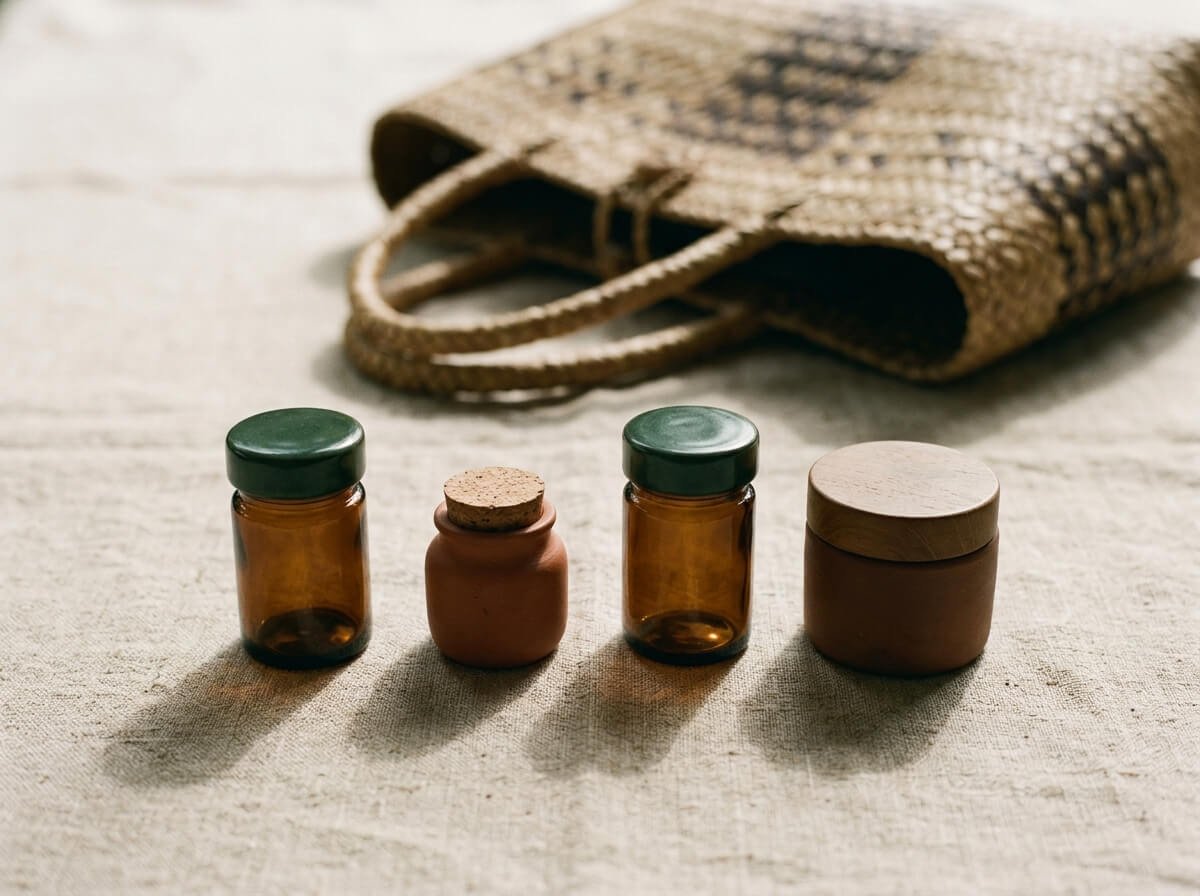
Scroll through most travel skincare roundups and the list runs to ten or twelve items: cleanser, toner, serum, eye cream, day moisturizer, night cream, exfoliant, mask, spot treatment, lip balm, hand cream, and a sunscreen. Almost none of it earns its place in a bag with a hard liquid limit and a shared bathroom counter for two weeks.
A travel skincare routine that respects both the carry-on line and simple restraint runs to four things: a gentle cleanser, a lightweight moisturizer that can flex between dry cabin air and humid arrival, a sun protection product, and one targeted extra, chosen for the specific climate or occasion of that trip, an after-sun oil for a beach week, a calming roller for a stressful work trip. Everything else is a nice-to-have at home and a wasted ounce on the road.
The moisturizer is where most travel bags quietly go wrong. A rich body butter or a heavy night cream, entirely reasonable choices at home in a dry season, becomes the wrong texture the moment humidity climbs. A lighter, non-comedogenic oil or a gel-based cream that absorbs quickly gives skin what it needs without sitting on top of it in tropical air, and it is worth choosing before the trip rather than discovering the mismatch on day two.
This is not a purity test. It is packing math. Every product is weight, a slot in a bag that legally caps liquids at around one hundred milliliters, a little under three and a half ounces, per container, and one more decision to make at six in the morning before a flight. Four honest products, chosen for texture and versatility rather than habit, do more for skin on the road than ten products chosen out of routine. The same restraint that builds a lower-waste routine at home turns out to be exactly what a good travel bag needs too: fewer products, each one doing real work, none of them there out of habit.
Think of it the way a capsule wardrobe works for clothes: fewer pieces, chosen because they work together and suit the actual trip, rather than a suitcase of options for a version of the week that will not happen. A travel skincare routine built the same way is not a compromise. For most people, four thoughtfully chosen products cover a trip better than the ten they would default to at home, because travel strips out the guesswork of a full bathroom shelf and forces an honest answer to a simple question: what does skin actually need for this specific week, in this specific climate.
The TSA problem nobody actually solves: why a pre-diluted roller is already travel-legal
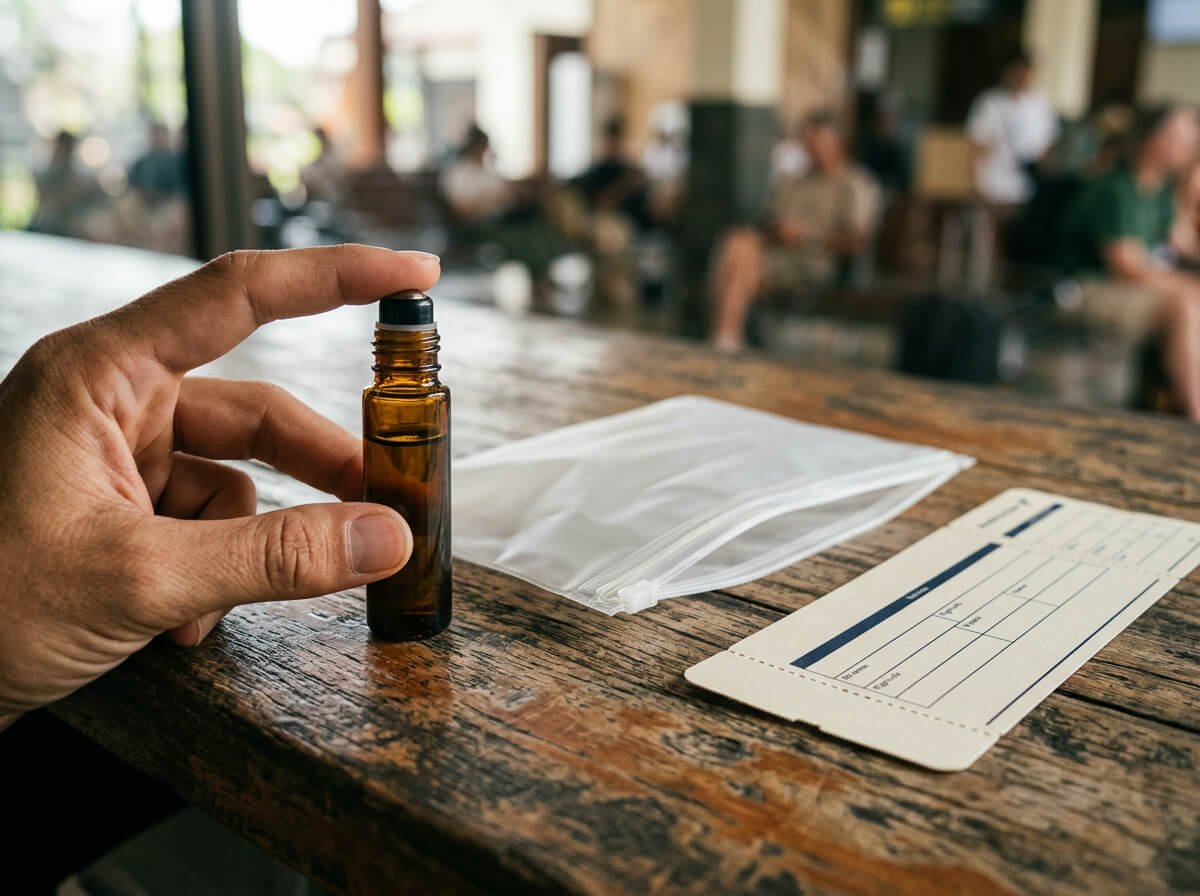
Ask any travel skincare article how to handle the liquid limit and the answer is almost always the same: buy travel-size bottles, or decant your own products into small containers. Both solve the volume problem and create a new one. Travel-size bottles are single-use plastic, bought specifically to be thrown away at the end of a trip, working directly against a refill habit. Decanting means unscrewing a lid over a sink, pouring liquid into a smaller bottle by eye, and hoping it does not spill in a bag at thirty thousand feet, or separate under pressure changes in the cargo hold.
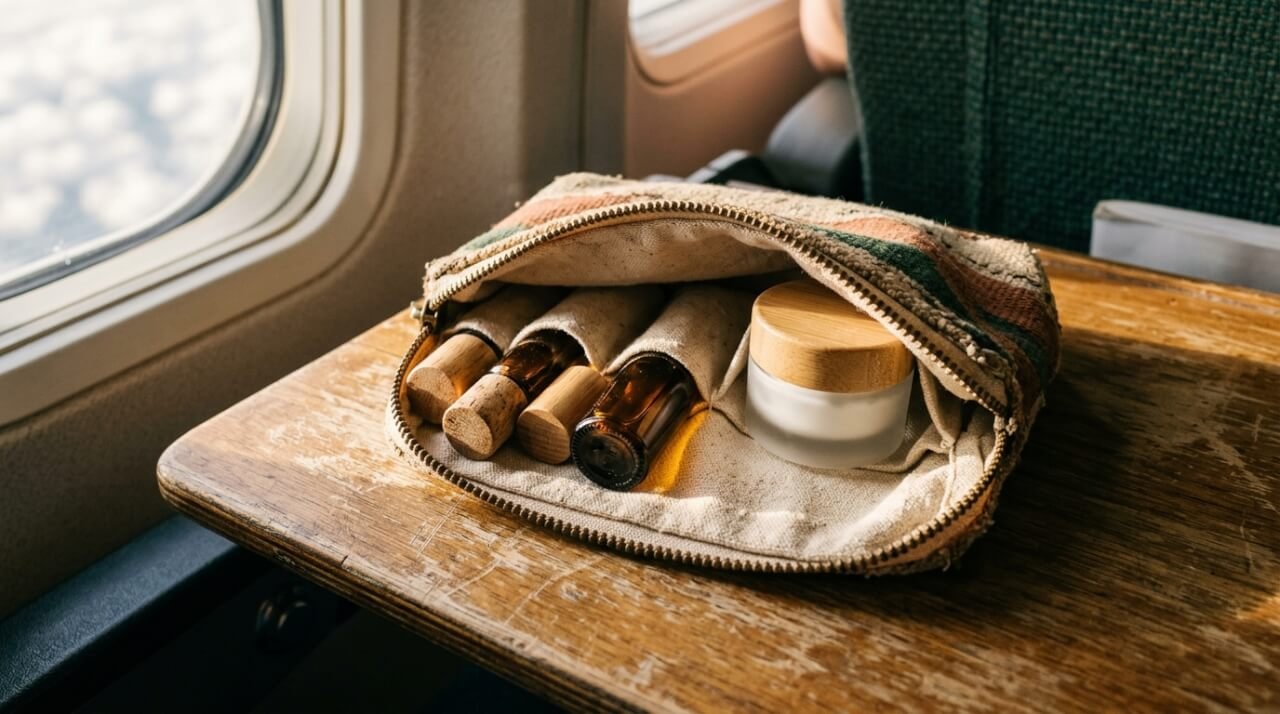
There is a simpler answer that already exists in the aromatherapy line, rather than something to assemble the night before a flight: a pre-diluted essential oil roller. A ten milliliter roller bottle is already a fraction of the hundred milliliter carry-on limit, arrives sealed and correctly diluted from the source, and needs no decanting, no funnel, and no guessing. We go into the mechanics of why a pre-diluted roller is the safer format generally, not just for travel, in our guide to the essential oil roller.
On the road, that same format solves a second problem for free. A roller applies directly to a wrist or a temple with no extra bottle, no cotton pad, and no spill risk in a shared bag, and the rollerball itself controls the amount released, so there is no risk of over-applying neat oil to skin that a bottle and dropper would otherwise allow. The Santi roller, blended for calm, earns a permanent spot in a carry-on for exactly this reason. It was not repackaged as a travel hack. It was already built for this, in the same small-batch tradition Balinese households have long used for portable botanical remedies carried between home and market.
It also removes a genuinely stressful moment at a security checkpoint. A ten milliliter roller reads clearly as a small, sealed item on an x-ray belt, with no loose lid to explain and no risk of a confiscated bottle at the last gate. For a nervous flyer, or anyone traveling with young children and little patience for extra questions at the scanner, that small certainty is its own kind of calm before the roller ever touches skin.

Multi-tasking without the marketing: what a real three-in-one cream simplifies, honestly
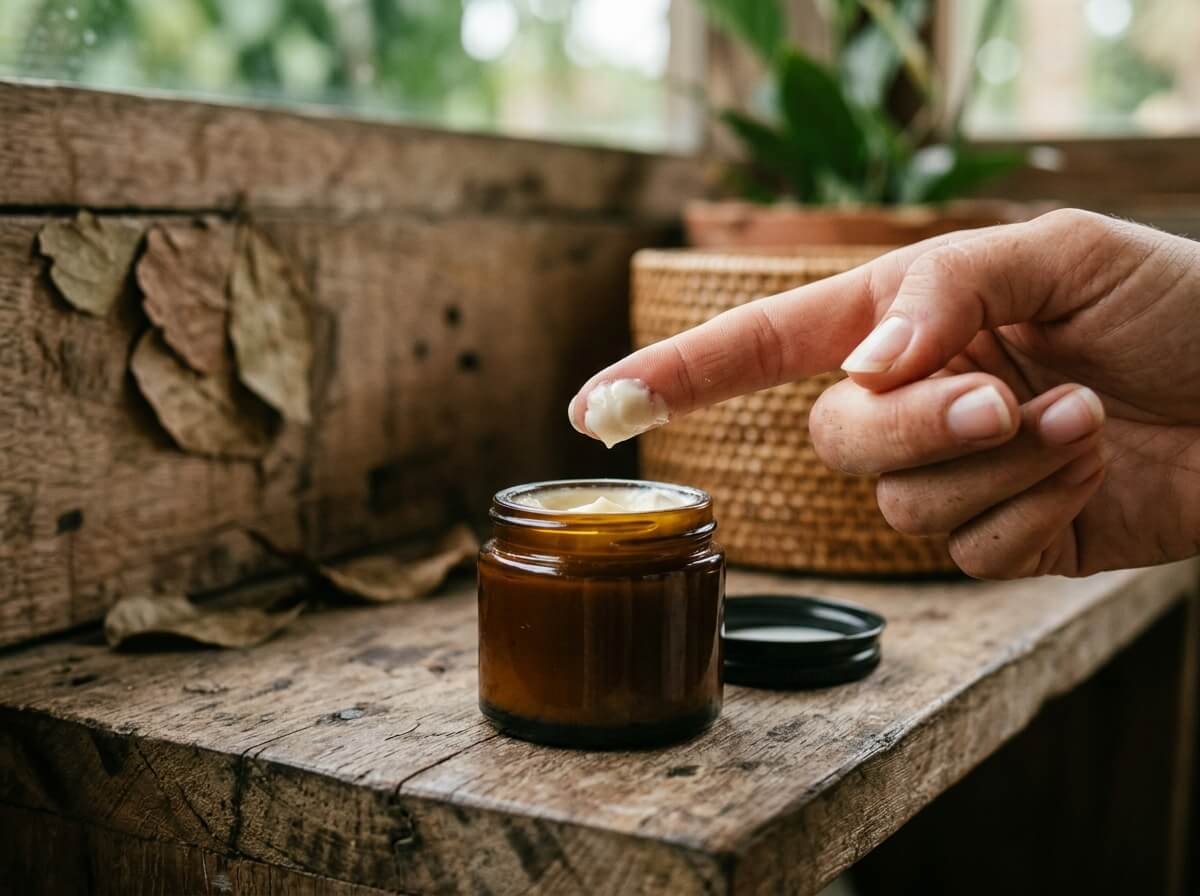
Multi-tasking skincare gets marketed as though one product can replace five, and that claim rarely survives contact with real skin. What a genuine multi-tasking cream can do, honestly, is combine three compatible jobs, hydration, light barrier support, and a finishing texture, into one step. What it cannot do is eliminate the need for cleansing, sun protection, or a treatment aimed at a specific concern.
Our HydroBotanic three-in-one hydrating face cream is built around that honest version of multi-tasking. It carries a humectant to draw in moisture, a light plant oil to support the skin barrier, and a texture designed to sit comfortably under makeup or alone, which is the real definition of three jobs in one jar rather than a marketing label stretched over a single moisturizer. What it does not do, and what no single cream should claim to do, is replace sun protection or a cleanser. Read a label promising a cream that cleanses, treats, protects, and moisturizes all at once, and that is the marketing version worth reading twice.
For a trip, the distinction matters because bag space is genuinely limited. One thirty milliliter jar that reliably does three real jobs is worth its slot for a week or two away. One jar promising ten is worth a second look before it goes in the bag, and worth an honest question at the counter: which three jobs, specifically, and what is left out.
It is also worth testing any new multi-tasking product at home before it becomes the only moisturizer in the bag. A patch test a few days before departure, on the inside of a wrist or behind an ear, costs almost nothing and avoids discovering a sensitivity on the first morning of a trip, when there is rarely a familiar backup close at hand.
Sun protection is the one step you cannot skip, on the plane or the beach
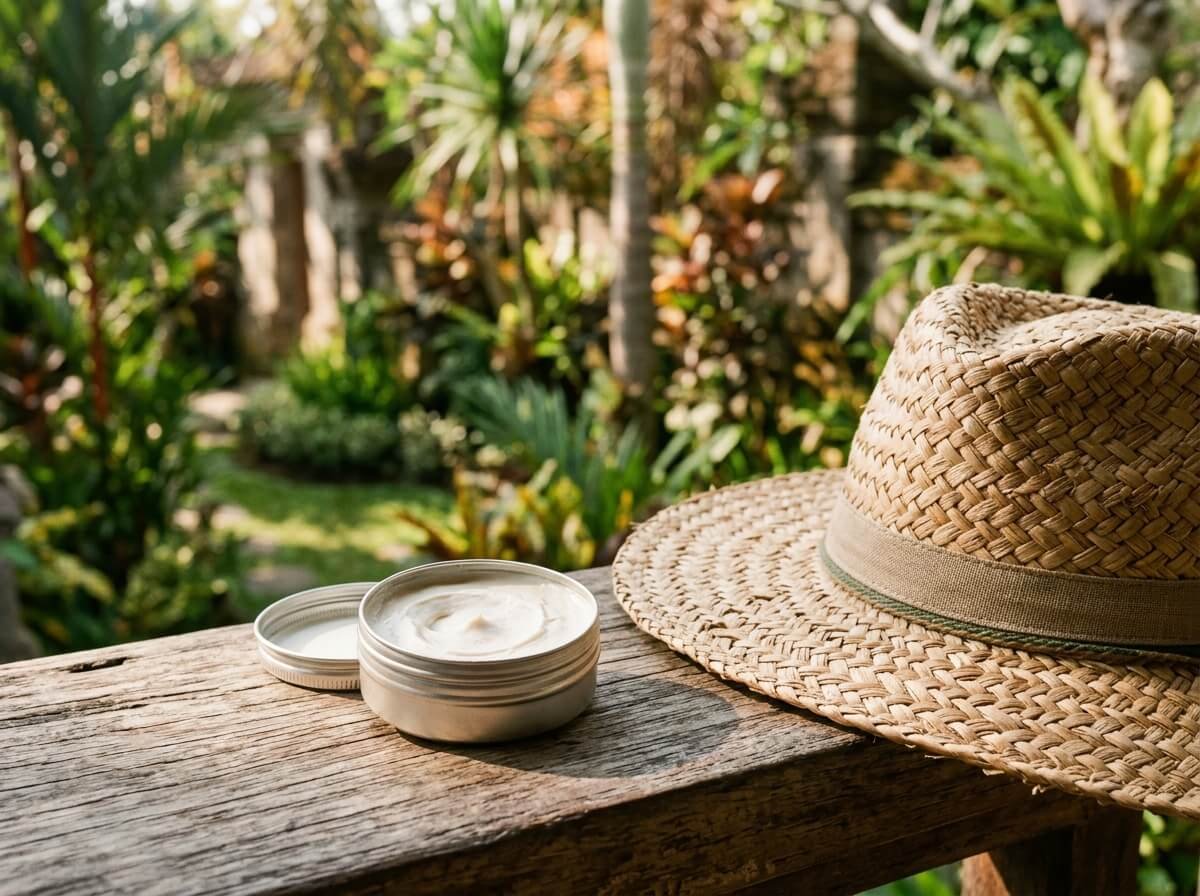
Of the four items in an honest travel skincare routine, sun protection is the one with no acceptable substitute. UV exposure is not limited to the beach. Window seats at altitude receive measurable UVA exposure, glass does not block it the way most people assume, and a morning walk through Ubud’s rice terraces delivers more direct sun in an hour than most people get in a week at home.
A mineral formula, built on zinc oxide rather than a chemical filter, is the more straightforward travel choice for two reasons. It works on contact rather than needing twenty minutes to activate, useful when a taxi to the airport leaves little time to plan ahead, and it holds up better under humidity and sweat without breaking down the way some chemical filters can. It is also the gentler choice for the reef and river systems a beach trip usually swims in, which matters in a region where tourism and marine health are closely tied together. Our zinc natural sunscreen SPF fifty is formulated for exactly that kind of day, one where you might move from an air-conditioned lobby into direct equatorial sun within the hour.
Sun protection does not end when the sun goes down. What happens to skin after a day of real sun exposure, especially in a climate this different from home, is its own small ritual, one we walk through in full in our guide to natural after-sun care. Pack the sunscreen and the after-sun step as a pair, not as two separate decisions made at different points in the trip.
Reapplication matters more on a travel day than a home day, and it is the step most people skip once the initial application feels like enough. A swim, a long walk in humidity, or simple sweat all shorten how long a single application actually lasts, closer to every two hours in direct tropical sun than the half-day some labels imply. A mineral formula is also the gentler starting point for children traveling along, since zinc oxide sits on the skin’s surface rather than being absorbed into it.

Pack calm in a bottle that was already travel-legal
The Santi Essential Oil Roller arrives pre-diluted and sealed at ten milliliters, well under the carry-on liquid limit, with nothing to decant and nothing to spill. Roll it onto a wrist or a temple whenever a flight, a queue, or a new city calls for a moment of calm.
Refill, don’t decant: packing less plastic without a haul of minis
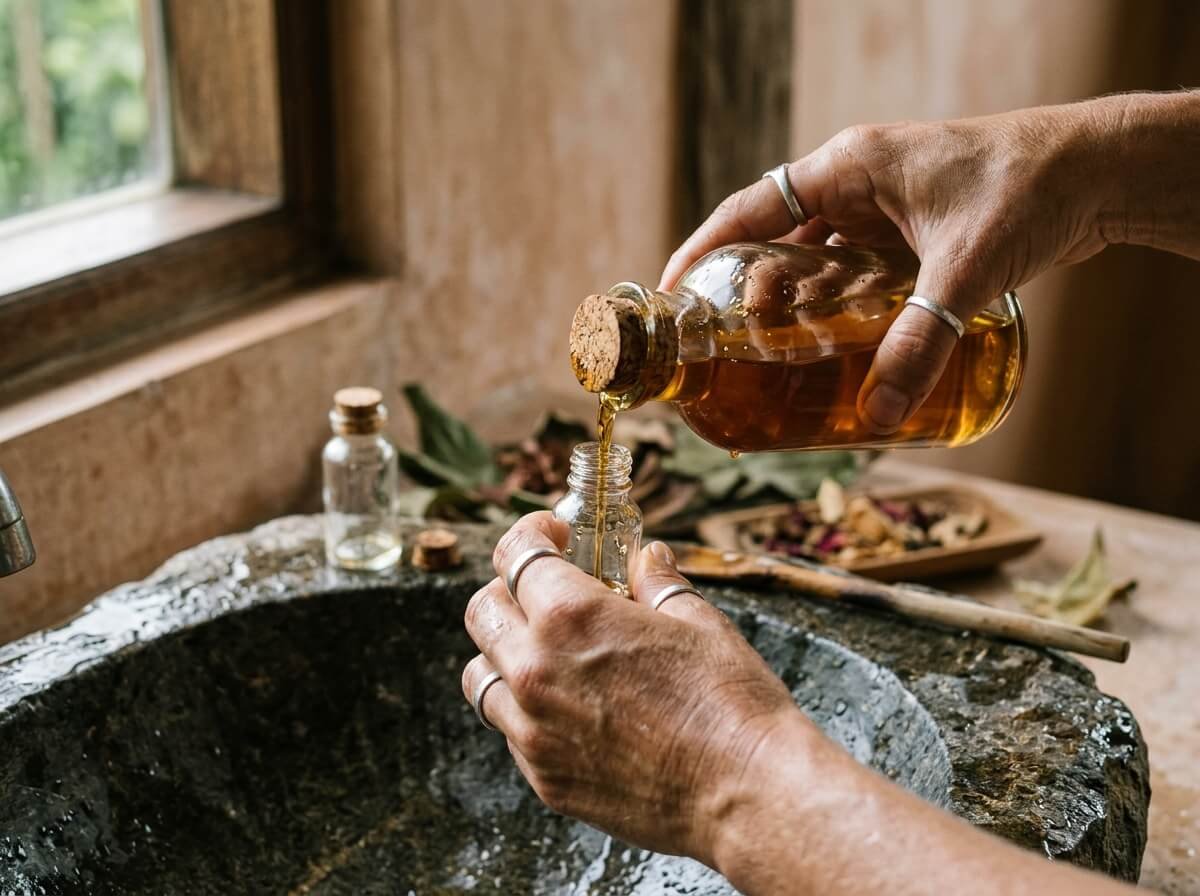
The travel-size aisle solves a real problem, volume limits, by creating a bigger one: a drawer of half-used plastic minis that get thrown away or abandoned in a hotel bathroom at the end of a trip. Multiply that by every trip taken in a year, and the waste adds up faster than most people notice, precisely because each bottle feels small enough to be harmless.
The better habit is the one already built into a refill-first routine at home: pour a small amount of a full-size product already owned into a reusable travel bottle, rather than buying a new plastic mini for a single trip. It takes thirty seconds longer than grabbing a mini off a shelf, and it means the only bottle that leaves the house on a trip is one that comes back and gets refilled again for the next one. This is the same thinking behind our in-store refill program, which kept over two thousand bottles out of landfill in 2025 alone. A travel routine built on refill, rather than rebuy, is a small extension of a habit already worth having at home.
We cover the fuller version of this shift, and why shipping water in plastic is most of what a travel-size product actually is, in our guide to a plastic-free bathroom. The same logic that keeps a bathroom counter lower waste at home works just as well folded into a carry-on.
The same applies to hotel amenity minis. It is tempting to use whatever is left on the bathroom counter rather than unpack a travel bottle, but those small bottles are usually thrown out after a single guest regardless of how much is left, whether used or not. Bringing a small refilled bottle of a product already trusted at home, rather than reaching for the amenity mini, is a small choice that adds up the same way choosing to refill at home does. Real care, at this scale, is mostly a matter of habit rather than sacrifice.
A five-minute packing list for your travel skincare routine

A travel skincare routine does not need a spreadsheet. It needs five minutes and four honest categories, chosen for the actual climate of the trip rather than out of habit. The list looks slightly different for a two-day city trip than it does for two weeks somewhere humid, but the categories themselves stay the same. What changes is which single extra earns the fourth slot.
- One gentle cleanser, in a refilled travel bottle rather than a single-use mini
- One lightweight, non-greasy moisturizer built to flex between dry cabin air and humid arrival, or a genuine multi-tasking cream if it is doing real double duty
- One mineral sunscreen, packed where it will actually get used, in a coat pocket or daypack rather than the bottom of a suitcase
- One targeted extra for the specific trip: a calming roller for a stressful work trip, an after-sun oil for a beach week, whatever the destination actually calls for
That is the whole list. Everything else, the second serum, the extra mask, the backup exfoliant, can stay on the bathroom shelf at home and be waiting when the trip is over. Pack the night before, not the morning of, and lay each item out rather than stacking a bag blind. Five minutes of honest editing does more for a trip than an extra hour of research the week before.
A travel skincare routine built this way earns its space in a carry-on for the entire trip, and quietly does more for skin than a fuller bag ever did. What you carry lightly, you tend to actually use. What you overpack, more often than not, comes home untouched.