Skin microbiome: why fewer ingredients protect it better than another serum
Your skin is not a blank surface waiting to be cleaned. It is a living landscape, home to a vast and mostly invisible community of bacteria, fungi, and other microbes that scientists call the skin microbiome. That community helps hold your barrier together, keeps unwelcome microbes in check, and quietly trains your immune system. And here is the strange part: much of modern skincare treats it as either a problem to scrub away or a reason to buy one more bottle.
This guide takes a calmer view. We will look at what the skin microbiome actually is, why diversity matters more than sterility, what disrupts it day to day, and why the honest answer for most people is not another serum. It is fewer, gentler formulas used with a little more patience. We will also be clear about the limits of what anyone, including us, can claim.
What the skin microbiome actually is
The skin microbiome is the full community of microorganisms that live on and in the outer layers of your skin, along with their genes and the substances they produce. Bacteria get most of the attention, but the community also includes fungi (especially a yeast called Malassezia), viruses, and tiny mites. Most of these residents are not passengers or invaders. They are long-term tenants that have evolved alongside human skin.
A few names come up again and again in the research. Staphylococcus epidermidis is one of the most common bacteria on healthy skin. Cutibacterium acnes (once called Propionibacterium acnes) thrives in oily, follicle-rich areas. Corynebacterium species favour warm, moist places. None of them is simply “good” or “bad”. Their effect depends on balance, location, and the strain involved.
Your skin is not one habitat, it is many
Skin varies enormously across the body, and so does the life on it. Researchers usually group skin into three broad habitats:
- Oily areas, such as the face, chest, and upper back, where sebaceous glands are dense. Lipid-loving Cutibacterium dominates here.
- Moist areas, such as the armpits, the inner elbow, and the creases behind the knees. Staphylococcus and Corynebacterium do well in the warmth and humidity.
- Dry areas, such as the forearms and lower legs. Surprisingly, these tend to host the most diverse mix of bacteria of all.
This matters for daily care. A cleanser that suits your armpits may be far too much for your face. A heavy balm that is welcome on dry shins may feel suffocating on an oily forehead. Treating your whole body with one harsh product ignores the fact that you are caring for several different ecosystems at once.
It lives with your acid mantle, not separately from it
The skin’s surface is naturally slightly acidic, usually a little below pH 5. This thin, acidic film, often called the acid mantle, is one of the conditions many resident microbes are adapted to. When the surface becomes more alkaline, for example after repeated washing with high-pH soaps, the balance can shift toward microbes that prefer those conditions. We explored this link in our short piece on why skin pH matters. The microbiome and the acid mantle are two parts of the same system. When one is steady, the other tends to follow.
Why diversity, not sterility, is the real goal

For most of the last century, the hygiene message was simple: microbes are dirt, and clean means as few of them as possible. The science of the skin microbiome has turned that idea on its head. A healthy forest is not one with no living things in it. It is one with many species keeping each other in balance. Skin works in a similar way.
How resident microbes protect you
Resident microbes defend their territory. Some strains of Staphylococcus epidermidis produce antimicrobial compounds that inhibit Staphylococcus aureus, a common troublemaker linked to infections and eczema flares. Researchers have even found that people with atopic dermatitis often carry fewer of these protective strains. Resident microbes also take up space and nutrients, which leaves less room for opportunists to settle in.
The relationship goes deeper than competition. Skin microbes help break down lipids on the surface into fatty acids that support the acid mantle. They also seem to help “tune” the immune system, teaching it which microbes to tolerate and which to respond to. A diverse, stable community is one of the quiet reasons calm skin stays calm.
What an imbalance can look like
When the community loses diversity, or one species grows out of proportion, scientists call it dysbiosis. Dysbiosis has been associated with several common skin conditions. During eczema flares, for instance, S. aureus often becomes far more dominant. Acne seems to involve particular strains of C. acnes and inflammation around the follicle, rather than the mere presence of the bacterium. Rosacea and dandruff have their own microbial threads in the research too.
An honest note: association is not the same as cause. In many cases it is still unclear whether the microbial shift drives the condition or follows it. What the research does support is a principle: skin tends to do better when we stop waging war on it. If your skin is persistently inflamed, reactive, or broken, a dermatologist is the right first step, not a new product.
What disrupts the skin microbiome day to day
The good news is that the adult skin microbiome is fairly resilient. Studies that followed the same people over months and years found their communities stayed broadly stable. The less good news is that ordinary habits can push it off balance again and again. These are the most common pressures, roughly in order of how often we see them.
Over-cleansing and hot water
Washing is necessary, but more is not better. Frequent washing with high-foam, high-pH cleansers strips the lipids that both your barrier and your microbes depend on. Long, hot showers add to the effect. Skin that feels squeaky and tight after washing is telling you something. We looked at this in our piece on hot water and the skin barrier, and the practical answer is simple: lukewarm water, shorter washes, and a gentle cleanser.
The same logic applies to cleansing routines that use two or three products every night. If you wear heavy sunscreen or makeup, a second cleanse can help. If you do not, it may simply remove more than it needs to. Our guide to double cleansing in a natural routine walks through when it earns its place.
Antibacterial agents used without a reason
Antibacterial soaps sound protective. For everyday skin, they rarely are. In 2016, the US Food and Drug Administration ruled that triclosan, triclocarban, and 17 other antibacterial ingredients could no longer be sold in consumer antiseptic washes, partly because manufacturers had not shown they worked better than plain soap and water. Broad antimicrobial agents do not distinguish between the microbes you want to keep and the ones you do not. We wrote more about this distinction in our guide to natural antibacterial soap.
Over-exfoliation and stacked actives
Acids, retinoids, scrubs, and peels can all have a place. Stacked together, used daily, and layered on already irritated skin, they can thin the outer barrier and change the surface conditions your microbes rely on. The result is often the familiar loop: redness, tightness, breakouts, and then another product to fix the damage from the last one.
Ingredient load, fragrance, and preservatives
Every formula that sits on your skin for hours is part of the environment your microbes live in. Preservatives are essential in any water-based product (they keep mould and harmful bacteria out of the bottle), but they are designed to stop microbial growth. Fragrance blends, synthetic or natural, can sensitise some people. The research on how individual cosmetic ingredients affect the skin microbiome is still young. But a reasonable principle follows from what we do know: the more separate products and ingredients you layer each day, the more variables you add to a delicate system.
The industry’s contradiction: selling balance by adding more
Here is where we want to be direct. “Microbiome-friendly” has become one of the busiest phrases in beauty marketing. Walk through any skincare aisle or scroll any feed and you will see prebiotic serums, probiotic mists, postbiotic essences, and microbiome-balancing boosters. Many of them are sold as additions to an existing routine of five, six, or seven steps.
That is the contradiction. The science of the skin microbiome mostly tells us that skin does better with less disturbance. The industry answer is often one more product. A routine that strips with one bottle and then tries to “rebalance” with three more is not care. It is theatre.
What the labels usually mean
It helps to know the vocabulary. Prebiotics are ingredients, often sugars such as inulin, meant to feed beneficial microbes. Probiotics are live microorganisms. Postbiotics are the substances that microbes produce or leave behind, such as ferment filtrates or lysates (broken-down bacterial cells). In topical skincare, most products labelled “probiotic” actually contain lysates or ferments rather than living bacteria. That is because preservatives, which every water-based product needs, are designed to stop microbes from growing.
Some of these ingredients show promising early results in small studies. We covered the evidence, and its limits, in our guide to fermented skincare. What the research does not yet show is that adding a microbiome-themed serum on top of a harsh routine undoes the harm of the harsh routine.
The questions worth asking
If a product promises to support your skin microbiome, three questions cut through most of the noise:

- What does it replace? If the answer is “nothing, it is an extra step”, be sceptical.
- Does the brand name the strain, the ingredient, and the evidence? Vague words like “balancing” and “biome-boosting” are not evidence.
- What else is in the bottle? A microbiome claim on a formula with a long list of fragrance compounds and actives deserves a second look.
None of this is a reason to feel guilty about what is already on your shelf. It is a reason to choose more slowly next time.
Why fewer, gentler formulas protect the skin microbiome better
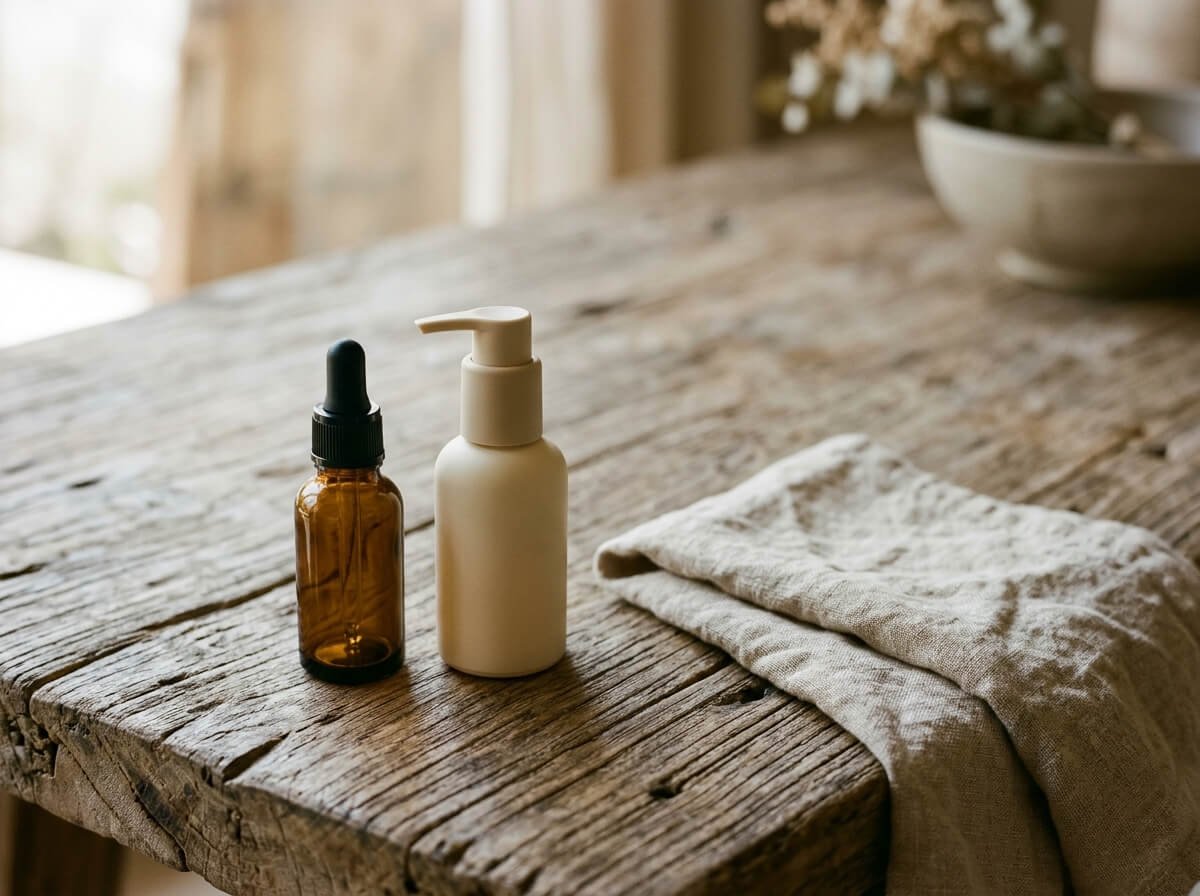
The case for a shorter routine is not about aesthetics or minimalism for its own sake. It is about reducing the number of times each day you change the environment your microbes live in. Every wash, every acid, and every new formula is a small disturbance. A healthy community can absorb some disturbance. It recovers best when it is given time between them.
Fewer disturbances, steadier skin
Think of it the way a gardener thinks about soil. You can keep turning, spraying, and feeding a bed every day, or you can protect it, water it, and let the living system do much of the work. Skin is similar. A gentle cleanse, a simple moisturising step, and daily sun protection cover most of what healthy skin needs. Everything beyond that should earn its place for a specific reason.
This is the thinking behind our longer guide to skinimalism and real multi-tasking skincare. A routine with three thoughtful steps tends to be kinder to the skin microbiome than a routine of eight, even if each of those eight products is well made.
Shorter ingredient lists you can actually read
A short ingredient list is not automatically better, but it is easier to understand, and easier to troubleshoot when something goes wrong. A single-ingredient oil, for example, gives you one variable instead of 30. If your skin reacts, you know why. If it settles, you know that too.
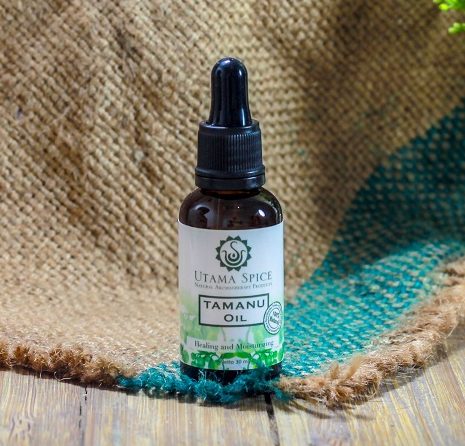
Plant oils and butters also offer something the skin already recognises: lipids. Your barrier is built from fats, and many plant oils supply fatty acids that support it without stripping or flooding the surface. Our Tamanu Oil is a good example. Its label lists one ingredient: cold-pressed Calophyllum inophyllum seed oil, the same tree that grows along the coasts of Bali and across the tropics. For those who prefer a lighter feel, Argan Oil plays a similar role on the face. On the body, a few drops of Virgin Coconut Oil pressed into damp skin after a lukewarm shower is about as simple as care gets.
If you want to look more closely at the ingredients that tend to cause trouble, our guide to skincare ingredients to avoid is a useful companion to this one.
A note from the tropics
In Bali’s warm, humid climate, skin sweats more, and many people feel the urge to wash more often. This is exactly where gentleness matters most. Our makers in Ubud have worked with this climate since 1989, and the rituals that last here are rarely the complicated ones. A rinse with cool water, a little oil, and patience have carried generations of Balinese families through heat and humidity. Tradition is not a substitute for science, but sometimes the two arrive at the same quiet answer.
One ingredient, one variable
Our Tamanu Oil lists a single ingredient: cold-pressed tamanu seed oil, with no added fragrance. Two or three drops pressed into damp skin seal in moisture without adding another layer of unknowns to your routine.
What “natural” does not mean for the skin microbiome

It would be easy to end the story there: natural is gentle, synthetic is harsh, done. That would be greenwashing, and we will not do it. Here is what the honest picture looks like.
Natural is not automatically microbiome-friendly
Plants make some of the strongest antimicrobial compounds on earth. Tea tree, clove, oregano, and cinnamon oils are prized precisely because they can kill microbes. Used neat or in high concentrations, they are not gentle, and they do not spare the residents you want to keep. Even mild botanical cleansers can contain several essential oils. Our own Serenity Face Wash and Bliss Botanical Face Wash are both scented with essential oils, which many people love and some reactive skin types prefer to avoid. Natural is a starting point for a good formula, not a guarantee.
You cannot test your skin microbiome at home
There is no reliable way to see or measure your own skin microbiome at home. Research uses genetic sequencing in a lab, and even then, what counts as “healthy” varies from person to person and from one part of the body to another. Any product that claims to have “rebalanced your microbiome” in a week is making a claim it cannot show you.
Be careful with DIY probiotics
The internet is full of recipes for yogurt masks, homemade ferments, and opened probiotic capsules mixed into creams. Some are harmless. Others introduce microbes that do not belong on skin, or create a warm, wet mix that grows the wrong things. Live cultures meant for the gut are not designed for broken or inflamed skin. If you want to try a microbial ingredient, choose a properly preserved product with a named ingredient and some evidence behind it.
Where we stand
We make botanical products, so we have an interest here, and you should know that. Our position is not that our products feed or fix your microbiome. It is narrower and, we think, more honest: a short routine built from simple, readable formulas disturbs your skin less, and that gives your own living system room to do its work.
A simple routine to protect your skin microbiome

This is not a prescription. It is a starting framework for healthy adult skin. If you have a diagnosed skin condition, check any change with your dermatologist first.
Morning
- Rinse with lukewarm water. If your skin is not oily, you may not need a cleanser in the morning at all.
- Apply a light moisturising step. For many people, two or three drops of a simple face oil pressed into slightly damp skin is enough.
- Finish with sunscreen. Sun damage weakens the barrier over time, and a mineral formula is a calm choice for reactive skin.
Evening
- Cleanse once with a gentle, low-foam cleanser. Use your hands, not a brush, and keep it under a minute.
- Pat dry with a clean, soft towel. Do not rub.
- Seal with a moisturiser or oil while skin is still slightly damp.
Weekly and body care
- Exfoliate no more than once or twice a week, and less if your skin is sensitive.
- Keep showers short and warm rather than hot, and moisturise your body straight afterwards.
- Use soap where it is needed (hands, underarms, feet, and groin) rather than lathering every inch of skin every day.
- Under the arms, choose a deodorant that does not depend on harsh antibacterials. Our guide to probiotic deodorant explains how formulas like Probiotic Deodorant Nayla take a gentler approach to odour.
Give it time
When you simplify, give your skin about four to six weeks before you judge the result. Skin cells turn over on roughly a monthly cycle, and the community living on them needs time to settle. Change one thing at a time. If your skin is recovering from over-exfoliation or a damaged barrier, our guide on how to repair your skin barrier has a step-by-step plan.
Skin microbiome: frequently asked questions

What is the skin microbiome in simple terms?
It is the community of bacteria, fungi, and other microbes that live on your skin. Most are harmless or helpful. They help protect your barrier, compete with harmful microbes, and support a calm immune response.
How do I know if my skin microbiome is out of balance?
You cannot test it at home. Signs that your skin is under stress (persistent tightness, stinging, new sensitivity, or breakouts after adding products) suggest your routine may be too harsh. Those signs point to the barrier and the routine, not a specific microbial diagnosis. A dermatologist can assess ongoing problems.
Do probiotic skincare products contain live bacteria?
Usually not. Most products labelled “probiotic” contain bacterial lysates or ferment filtrates. Live bacteria are hard to keep alive in a preserved formula, and preservatives are needed to keep products safe.
Does washing with soap destroy the skin microbiome?
No. Normal washing temporarily reduces microbes on the surface, and the community recovers. Problems tend to come from washing too often, with water that is too hot, or with harsh, high-pH, or antibacterial cleansers.
Is natural skincare better for the skin microbiome?
Not automatically. Some botanicals are strongly antimicrobial. What helps most is a short routine of gentle, readable formulas used with restraint. Ingredient origin matters less than the overall load and how often you disturb your skin.
Can diet affect my skin microbiome?
Research on the gut-skin connection is active and interesting, but still early. A varied, fibre-rich diet supports gut health, and there are signs this may influence skin. It is not yet possible to say which foods change the skin microbiome directly.
How long does it take for the skin microbiome to recover?
After a short disruption, such as a single harsh wash, surface communities rebound within days. After weeks of over-exfoliation or barrier damage, give it at least four to six weeks of gentle care. Our short Wellness Wednesday note on skin as a living ecosystem is a good reminder to keep nearby during that reset.
Caring for the skin microbiome is less about adding and more about allowing. Fewer products, gentler water, and a little patience give a living system the room it needs. What you give, you get back.