Natural shampoo for hair loss: how botanical surfactants and tropical ingredients support thinning hair
Watching more hair than usual collect in the shower drain, the brush, or the pillowcase is unsettling. It is also, for many people, an invitation to look more closely at the products they have been using every day. If you are considering a natural shampoo for hair loss, you are asking exactly the right question, because the cleanser you choose touches the scalp more often than almost anything else in your routine, and the wrong formula can quietly work against the goal of keeping the hair you have.
The story most marketing tells is incomplete. A truly hair-loss-friendly shampoo is not just a label that says “natural,” and it is not a single hero ingredient. It is a thoughtful combination of gentle plant-based surfactants, scalp-supportive botanicals, and a pH that respects the skin. In Bali, generations of herbalists have been making versions of this for centuries, working with coconut, candlenut, hibiscus, and rosemary long before any of these words appeared on a bottle in a Western pharmacy. This guide brings the science and the tradition together, so you can read any natural shampoo label with confidence and build a wash routine that actually supports thinning hair.
Why hair thins: the scalp connection most guides skip
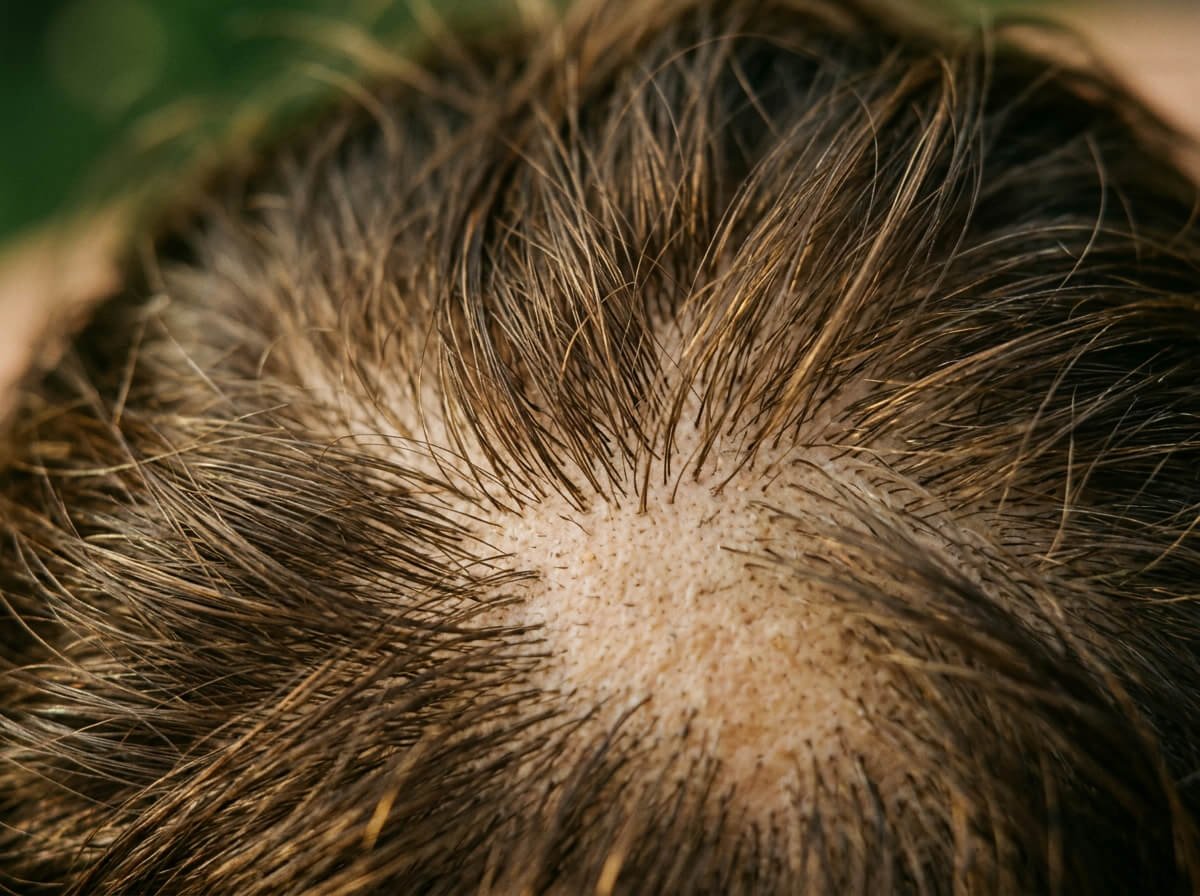
Hair loss has many causes, and most fall into one of three broad groups: hormonal shifts (androgenetic patterning, postpartum changes, thyroid issues, menopause), nutritional or metabolic stress (iron deficiency, low ferritin, crash dieting, high cortisol), and scalp-level disturbance (irritation, inflammation, fungal imbalance, follicle-clogging buildup). The first two are clinical territory and deserve a conversation with a dermatologist or doctor.
The third is where the choice of shampoo actually moves the needle. The scalp is skin, with a barrier, an oil profile, and a community of microorganisms that, when balanced, keep the follicle environment calm. When the scalp barrier is stripped repeatedly, or when the pH is pushed too far above the native 4.5 to 5.5 range, that environment shifts. Sebum production becomes erratic, the stratum corneum loses water, and inflammation can creep in around the follicle. Inflamed follicles do not produce strong hair.
This is why a hair-loss conversation that starts with “what shampoo are you using” is not a marketing gimmick. The shampoo is one of the few products that touches the scalp daily or every other day, and that frequency means small irritants compound. The right wash supports the barrier, respects the microbiome, and leaves the scalp calm enough for the follicle to do its work. Anything that does the opposite is, at best, a missed opportunity. At worst, it is a contributor.
How conventional shampoo ingredients can worsen thinning
Walk down a drugstore aisle and almost every clear bottle on the shelf shares a similar architecture. Strong synthetic surfactants do the cleansing, silicones add the shine, fragrance compounds give the smell, and a few preservatives hold it all together. Each of these can be reasonable on its own. The problem for thinning hair is the cumulative effect of using them daily on an already sensitised scalp.
Harsh sulfates
Sodium lauryl sulfate (SLS) and sodium laureth sulfate (SLES) are the most common heavy-duty cleansing agents. They lather generously and remove oil aggressively, which is useful for cleaning car engines and unhelpful for protecting a delicate scalp barrier. Repeated SLS exposure has been shown in dermatology research to disrupt the stratum corneum, increase transepidermal water loss, and trigger contact irritation in sensitive users. None of that helps a follicle that is already struggling.
Silicones and heavy film-formers
Dimethicone and similar silicones coat the hair shaft to create instant slip and shine. They can be wonderful for damaged ends and rough for the scalp, because they build up over time and trap debris around the follicle opening. For someone with thinning hair, that clogged opening can mean weaker emerging strands. The shine is real, but the long game is not on your side.
Synthetic fragrance and pH disruption
“Fragrance” or “parfum” on an ingredient list is a black box of dozens of unlisted aroma molecules, some of which are known sensitisers. A scalp that flares with redness or itch after every wash is a scalp that is fighting inflammation instead of growing hair. Combine this with a pH that drifts above 6 (which happens in many alkaline-leaning formulas) and you have a daily disturbance to the acid mantle that protects the skin from microbial overgrowth.
The remedy is not to demonise conventional shampoo. It is to recognise that thinning hair has different needs from a teenager’s oily roots, and to swap the heavy-duty formula for something gentler. Our deeper look at how to choose a gentle, botanical natural shampoo walks through what to keep and what to skip in more detail.
Natural surfactant science: how coconut-derived cleansers protect hair differently
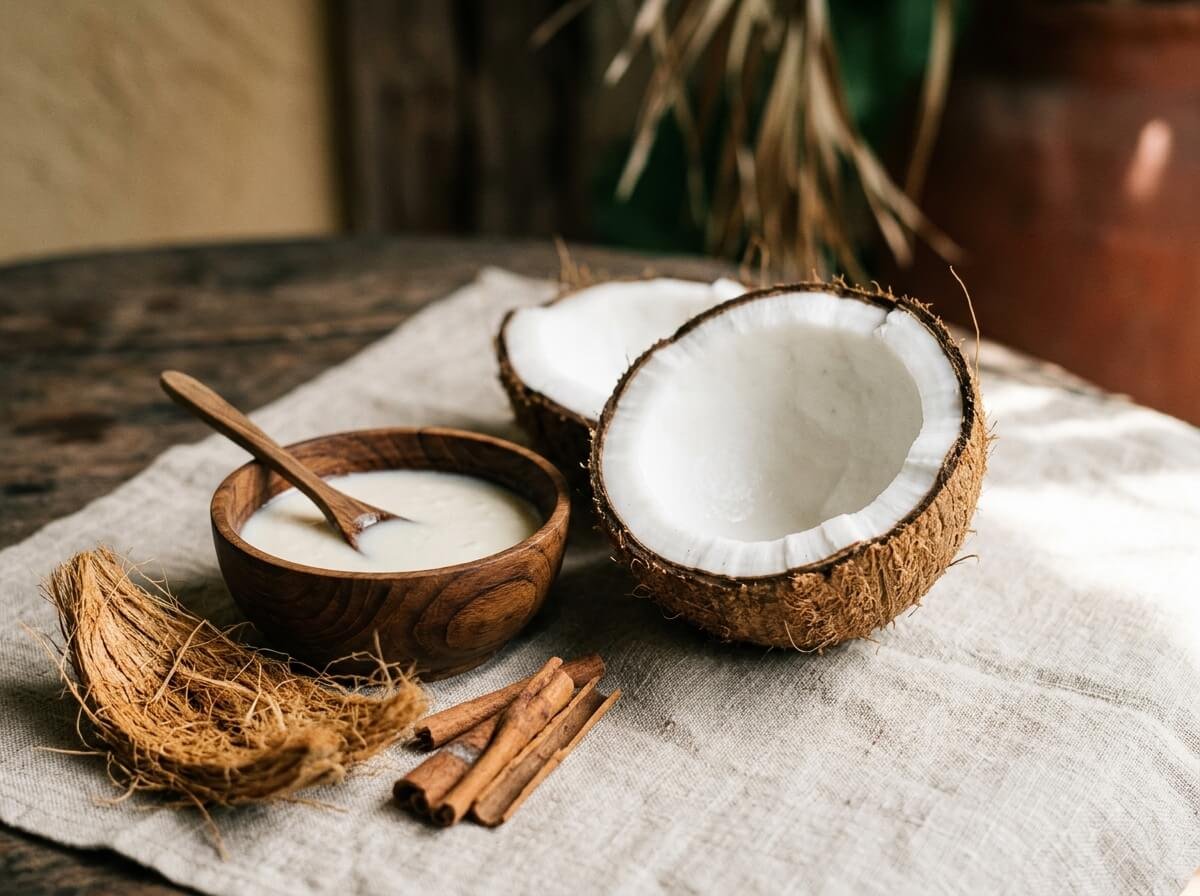
Surfactants are the molecules that lift oil and dirt off skin and hair so water can rinse them away. Every shampoo needs them. The question is which ones, and how aggressively they work. The natural shampoos that earn their place on the shelf for thinning hair tend to lean on a particular family of cleansers derived from coconut, with names that look long on a label but are actually closer to food chemistry than to petrochemistry.
- Cocamidopropyl betaine, made from coconut fatty acids, is an amphoteric surfactant that lathers well and stays mild even on sensitive skin. It is the cleanser many salon-grade shampoos use to soften an otherwise harsh blend.
- Sodium cocoyl isethionate and sodium lauroyl sarcosinate are gentle anionic cleansers, also coconut-derived, that produce a creamy lather without stripping. They are the workhorses of well-formulated baby shampoos and scalp-friendly natural lines.
- Decyl glucoside and coco glucoside are sugar-based surfactants built from coconut alcohols and corn glucose. They are mild, biodegradable, and at home in formulas designed for irritated scalps and curly textures.
What these share is a gentler interaction with the scalp barrier. They clean by surrounding oil and lifting it, rather than by breaking down the lipid layer that keeps the skin calm. Several are slightly acidic when formulated, which means the finished shampoo can sit in that 4.5 to 5.5 pH zone the scalp prefers, instead of pushing it alkaline.
For hair that is thinning, this matters in two ways at once. The strand itself stays smoother because the cuticle is not roughed up at every wash, and the follicle environment stays calmer because the scalp barrier is not being chipped away. Pair the right surfactant base with the right botanical actives, like the ones used in our Tea Tree Shampoo or our All Natural Shampoo #6, and the wash itself becomes part of the recovery, not a setback.
Five botanical ingredients that support hair density
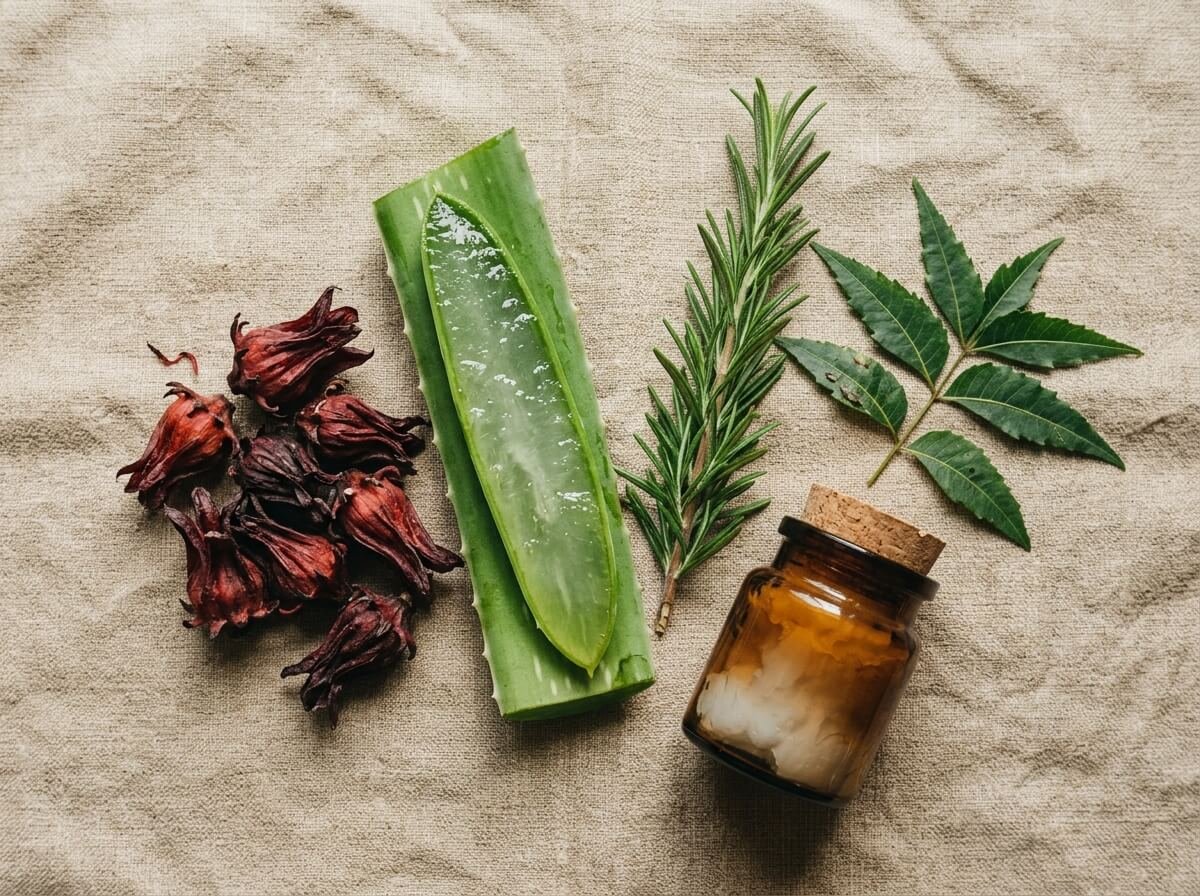
A gentle surfactant base is the foundation. The botanicals are what turn a baseline cleanser into a natural shampoo for hair loss that earns its name. Five plants have a particularly long track record, in both modern research and traditional practice, for supporting the scalp environment that dense hair needs.
1. Tea tree (Melaleuca alternifolia)
Tea tree is the antimicrobial workhorse of the natural haircare world. Small clinical studies have shown that shampoos formulated with around five percent tea tree essential oil reduce dandruff severity and itching, both of which are markers of scalp inflammation. Less inflammation around the follicle means a calmer environment for emerging hair. Tea tree also has a faint, clean aromatic note that many people find satisfying, without the artificial sharpness of synthetic fragrance.
2. Rosemary (Rosmarinus officinalis)
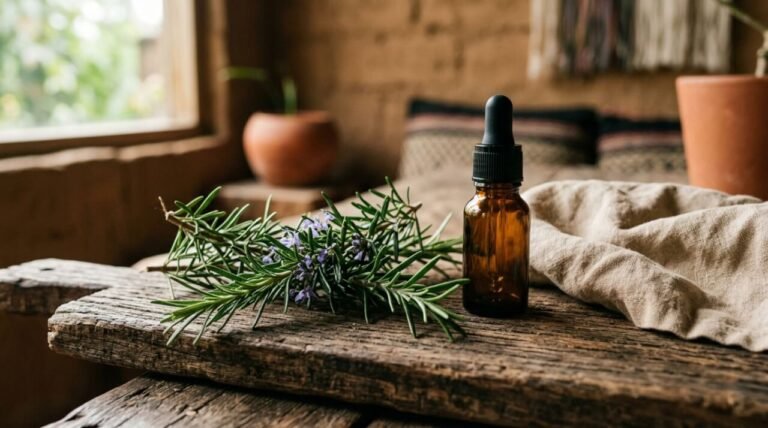
Rosemary has been a haircare favourite in Mediterranean and Indonesian traditions for centuries, and the modern interest is now catching up. A 2015 study compared rosemary oil to minoxidil 2 percent over six months in patients with androgenetic alopecia and found comparable hair count results, with less scalp itching in the rosemary group. The likely mechanism is improved local microcirculation around the follicle, plus a calming effect on inflammation. As an aqueous extract or a properly diluted essential oil, rosemary belongs in any shampoo designed for thinning hair.
3. Coconut oil and coconut milk
Coconut shows up twice, because it does two different jobs. Inside the formula, coconut-derived surfactants do the cleansing. Inside the strand, a small amount of unsaponified coconut oil can penetrate the cortex thanks to its low molecular weight and straight-chain fatty acid structure, which has been documented in studies on hair protein retention. The result is hair that loses less protein at each wash, which matters disproportionately for thinning strands that cannot afford to be brittle. If you want to go deeper on the cosmetic chemistry of coconut, our piece on why coconut oil is good for your skin and hair covers it in detail.
4. Aloe vera
Aloe is a humectant, a scalp soother, and a gentle clarifier in one. Its polysaccharides hold water against the scalp without weight, and its enzymes help loosen flaky buildup around the follicle opening. People with sensitive, itchy, or product-clogged scalps often see the fastest visible calming from formulas that lean on aloe. We go into the topical detail of aloe in our aloe vera gel for skin guide, and the same principles apply on the scalp.
5. Candlenut (kemiri) and Balinese plant oils
Candlenut, known locally as kemiri, has been used as a hair restorative across the Indonesian archipelago for as long as anyone can remember. Its oil is rich in linoleic and alpha-linolenic acids, which support the lipid component of the scalp barrier, and traditional preparations include slow-roasted kemiri pressed into a thick black oil that elders still apply to the scalp before washing. Read more on this and other tropical oils in our kukui oil guide, which sits in the same Balinese hair-care family.

A shampoo built for sensitive scalps and thinning hair
Our Tea Tree Shampoo blends a coconut-derived surfactant base with five percent tea tree essential oil, castor oil, and rosemary infusion. Sulfate free, silicone free, and balanced to scalp pH. Made in small batches in Bali.
Balinese hair-washing rituals: what generations of herbal practice teach
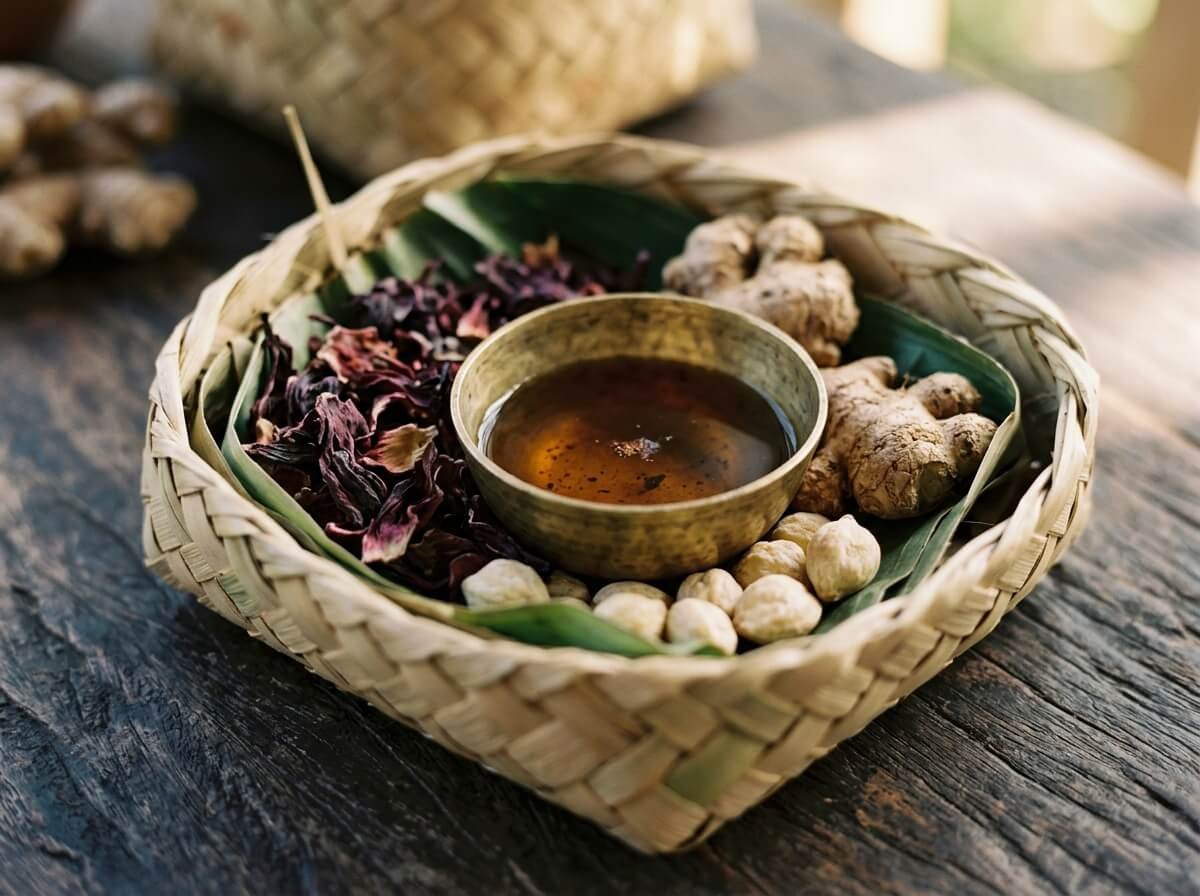
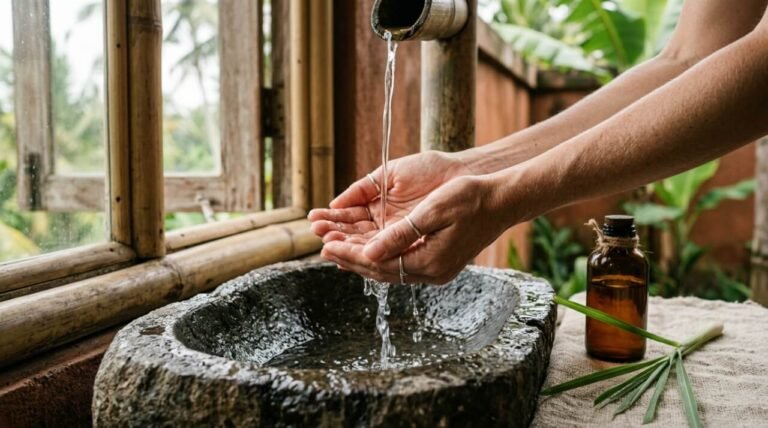
Long before commercial shampoo arrived in Bali, a typical hair wash involved a hot water infusion of hibiscus leaves, a paste of ground kemiri (candlenut), and a finishing rinse with rice water or fermented coconut water. The grandmothers who still do this insist that the order matters: oil first to feed the scalp, lather second to clean the strand, rinse last to seal the cuticle. It sounds elaborate, and in practice it is a fifteen-minute ritual most women learned by watching, not by reading.
The science behind it lines up with what modern trichology recommends for thinning hair. The pre-wash oil reduces hygral fatigue (the swelling and contracting that weakens the hair shaft over many wash cycles), the gentle plant-based lather cleans without stripping, and the slightly acidic rinse leaves the cuticle smooth so each strand reflects light and looks denser than it is. Even on a busy Bali morning, this sequence still appears in family compounds, and it has held up across centuries because it works.
The lesson for a modern routine is not that we all need to make candlenut paste from scratch. It is that the order of operations matters, that pre-wash oils are not a complication but a protection, and that finishing rinses are not optional. We unpack this in our natural shampoo and conditioner guide and in the companion piece on choosing the best natural hair oil for daily and pre-wash use.
Reading a natural shampoo label: what to look for, what to skip
The cosmetic ingredient list is one of the most undervalued tools in haircare. Once you know what to look for, you can stand in any aisle, anywhere in the world, and read a bottle in under a minute. Three quick gates apply to anyone shopping for a natural shampoo for hair loss.
Gate one: the surfactant base
The first three or four ingredients after water are the cleansing system. Look for coco glucoside, decyl glucoside, sodium cocoyl isethionate, sodium lauroyl sarcosinate, or cocamidopropyl betaine, in any combination. Skip if the first surfactant is sodium lauryl sulfate, sodium laureth sulfate, ammonium lauryl sulfate, or any olefin sulfonate as the lone cleanser.
Gate two: the active botanicals
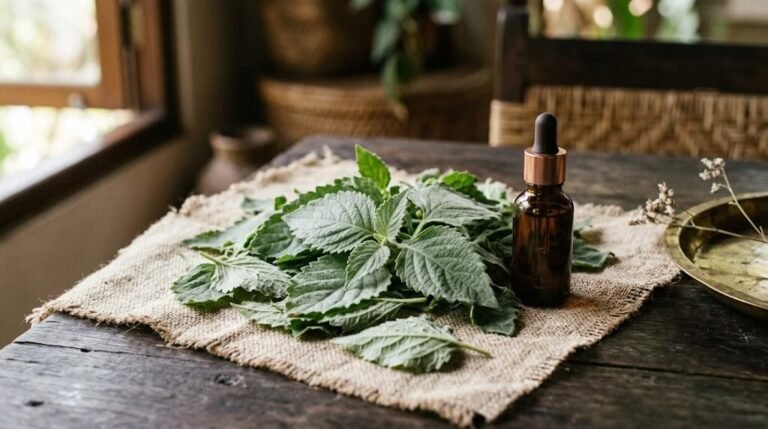
Look for a real concentration of plant actives somewhere in the upper third of the list. Tea tree (Melaleuca alternifolia leaf oil), rosemary (Rosmarinus officinalis leaf extract), aloe vera (Aloe barbadensis), and nettle (Urtica dioica) are reliable choices for thinning hair. Skip if the only botanicals appear at the bottom of the list after fragrance and preservatives, which usually means they are present in cosmetic trace amounts.
Gate three: the things that should not be there
Skip dimethicone, cyclopentasiloxane, and other silicones unless you have a specific reason. Skip synthetic fragrance or “parfum” if your scalp is sensitive. Skip formaldehyde-releasing preservatives such as DMDM hydantoin and quaternium-15. None of these single ingredients is a poison, but for a scalp you are trying to keep calm, the cleaner the formula the better.
This three-gate method is the same one we use when we build any product in the Utama Spice hair line, including the Hydrating Conditioner that pairs with our shampoos and the pre-wash Herbal Silk Hair Oil that follows the Balinese order of operations.
Building a hair-loss-friendly wash routine with natural shampoo
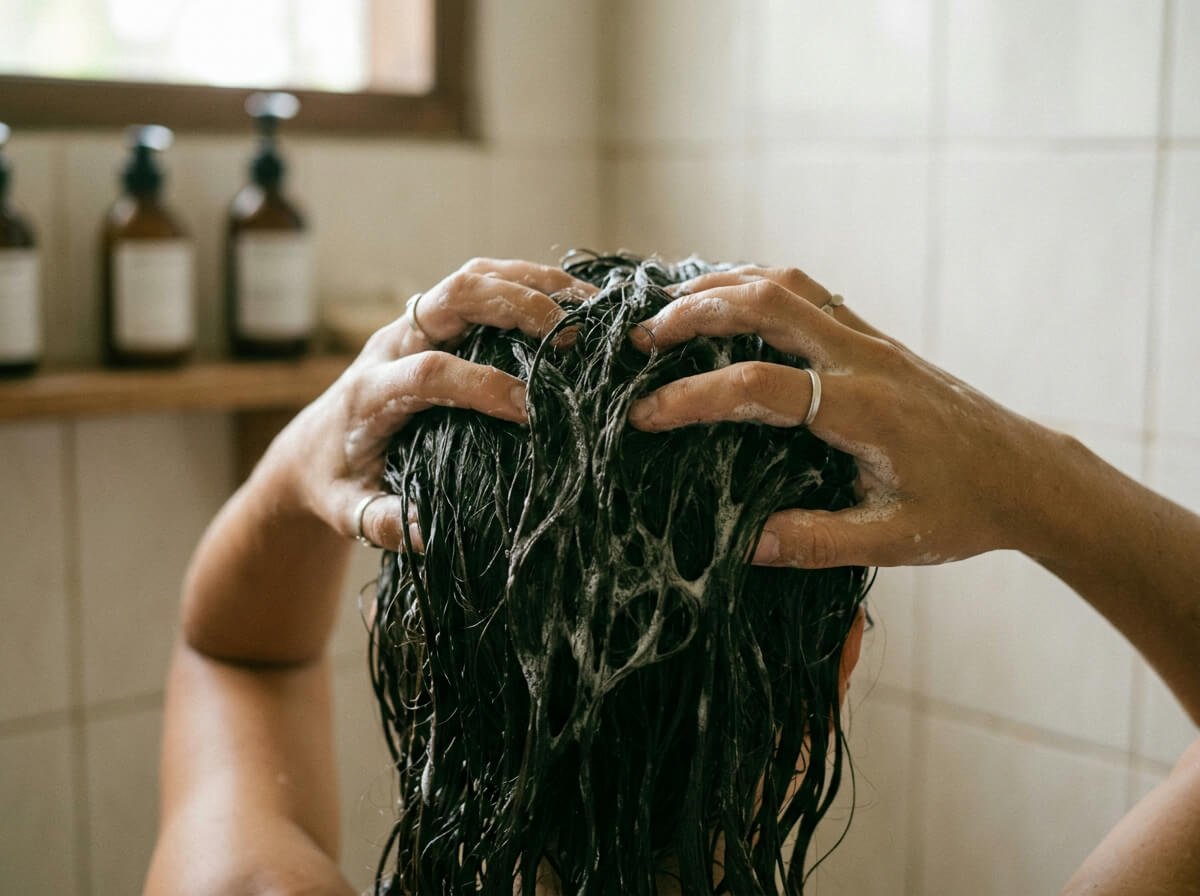
A natural shampoo is the centre of the routine, not the whole routine. The Balinese order of operations and the modern trichology of thinning hair agree on a handful of small habits that, together, support density over months and years.
- Begin with a pre-wash oil on the scalp and lengths, twenty to forty minutes before showering. A few drops of a botanical oil such as our Wellkiss Hair Oil or any coconut-and-rosemary infusion will reduce hygral fatigue and feed the scalp barrier.
- Wet the hair thoroughly before applying shampoo. Pre-saturated hair takes a much smaller dose of cleanser to lather well, which means less surfactant exposure for the scalp.
- Massage at the scalp, not the lengths. The shampoo is for the skin. The suds that rinse down the strands will do all the cleaning the lengths need. Use the pads of your fingers, never your nails, in slow circular motions for at least sixty seconds.
- Rinse longer than feels necessary. Residual surfactant is one of the most common causes of an itchy scalp. Add fifteen seconds to whatever feels enough.
- Follow with a light conditioner from the mid-lengths down. Avoid the scalp itself with the conditioner. We explain why in our natural conditioner for hair guide.
- Finish with a cool rinse if you can stand it, for thirty seconds. It tightens the cuticle and adds a noticeable shine, which makes thinning hair look denser without adding any product weight.
- Towel dry gently. Press the hair between the folds of a soft towel rather than rubbing. Wet hair is fragile, and thinning hair is more fragile still.
How often you wash is personal. Once every two or three days is a common landing place for thinning hair, because daily washing exposes the scalp to more surfactant cycles than most barriers tolerate well, and washing less often than that can let sebum and product accumulate. If your scalp feels itchy or your roots look heavy before the next wash, your timing is off. Adjust by half a day at a time.
The whole wash routine sits inside a larger picture. Sleep, diet, stress, hormonal balance, iron levels, and how you handle your hair the rest of the time all contribute. We touch on the wider self-care frame in our natural skincare routine guide, and the same patience and steadiness apply to hair. A natural shampoo for hair loss is not a miracle product, and it should not need to be. It is one piece of a calm, daily practice that gives the scalp the conditions to keep the hair you have, and to welcome the new growth that follows.
Final thoughts
Choosing a natural shampoo for hair loss is less about chasing a single hero ingredient and more about respecting the scalp as the skin it actually is. A gentle coconut-derived surfactant base, a real concentration of tea tree, rosemary, aloe, and Balinese tropical botanicals, a pH that sits in the scalp’s preferred range, and a small ritual of pre-wash oil and patient massage will do more for thinning hair than almost anything bought in a hurry. The tradition behind these formulas is older than the marketing language used to sell them, and that is part of why they hold up. Choose well, wash with care, and trust the steadiness of small choices made daily. Hair responds to that, more than it responds to anything else.