Refillable body care: how to choose a real refill program (and spot the greenwashing)
Refillable body care is one of the few words in sustainability that is doing real work, and one of the few that is being used as a marketing ornament. The difference matters. A real refill program saves bottles, reduces shipping weight, builds a direct relationship between maker and customer, and changes what a brand can keep getting away with. A performative one sells the same single-use packaging in a slightly nicer shape and calls it a movement. This guide is for anyone who wants to tell the two apart.
We have run a refill station at our shop in Ubud since the 1990s, so this is a piece written from the counter, not from the marketing deck. We will walk through the four refill formats in use today, the lifecycle math behind whether a refill actually saves plastic, the six questions worth asking any brand that uses the word, the categories of body care that refill well and the ones that still struggle, and finally what a refill counter looks like when it is kept honestly. By the end, you should be able to evaluate any refillable body care claim on its actual merits, not its packaging.
Refill is not a trend, it is the historical default

For most of human history, soap, oil, balm, and cleaning supplies arrived in a vessel you brought back. The grocer scooped, the apothecary poured, the village mill weighed. Glass, ceramic, brass, and tin held what we used; we washed them and returned. Disposable packaging as a default is roughly 100 years old, which is a sliver of the timeline of personal care. Refill is not a futuristic fix. It is what we did for thousands of years, briefly forgot, and are now relearning, often with better materials than the originals.
Naming this matters because the word “refillable” has been culturally framed as new, eco-luxury, and a little inconvenient. None of that is accurate. It is older than the shelf in your bathroom. The inconvenience belongs to disposable packaging, which delegates the cost (the bottle, the cap, the shipping fuel, the recycling that mostly does not happen) to the planet and to municipal waste systems, then sells itself as effortless. Refill returns the cost to the place where it can be seen and counted. A useful starting point is our short note on the quiet rebellion of bringing your own bottle, which gives the historical frame in one Friday read.
This is also a values frame, not only a logistical one. Refilling treats packaging as infrastructure, not as identity. It moves the conversation from how the product looks on the shelf to what it leaves behind when the bottle is empty. Brands that take refill seriously tend to take other things seriously too: where ingredients come from, who picks them, what a fair price for that work looks like, and what happens to a bottle after the last pump. Refillable body care, done with intent, is a discipline that reorganizes the whole supply chain backward from the empty bottle.
The four refillable body care formats, and what each one really gives back

Most refillable body care today fits one of four formats. Each has its own logic, its own logistics, and its own honest trade-offs. Knowing which format you are looking at clarifies what the brand is asking of you and what they are actually saving.
1. In-store refill stations
You bring an empty container, you fill it from a large dispenser, you pay by weight or volume. This is the format with the strongest math behind it. There is no secondary packaging, no shipping for the refill itself, no recycling step. The trade-off is access: you have to be near a station. In Bali, our shop and a handful of partner stores carry the line; in other geographies, refill stations cluster in larger cities or specialty stores. If you live near one, this is the most plastic-saving option available, by a wide margin. Our piece on ten years of refills, and the math nobody puts on a label walks through how the numbers add up over a decade of routine refilling.
2. Send-back refills
You buy a fresh product, you return the empty for reuse via a prepaid mailer or in-store drop-off. The brand cleans, refills, and resells the original container. The math here is real but conditional. Shipping the empty back has a carbon cost; the program only nets a saving when bottles cycle several times. Look for published return rates: the strongest send-back programs report what percentage of empties actually come home (rarely above 30 to 40% on the best programs). Below 20%, the program is mostly marketing.
3. Sachet or pouch refills
You buy a “starter” bottle once and then buy a thin pouch or sachet to refill it. The pouch uses roughly 70 to 85% less plastic by weight than the original bottle, which is real. The catch is that multi-layer pouches and sachets are usually not recyclable through curbside streams because they are laminate plastics. So the format saves resin upfront and creates a different, more stubborn waste downstream. Sachets work best for short shelf-life products and travel kits; pouches work best for the home-bottle workflow.
4. Concentrate-plus-water
You buy a small concentrate (a tablet, a thick paste, or a tiny bottle) and reconstitute it at home with tap water. Cleaning products do this well; body care does this awkwardly. Most water-based body products need precise emulsion chemistry that does not survive being mixed in your bathroom sink. Where concentrates work for body care, it is usually for low-water formulas like cleansing oils or anhydrous balms that do not need water at all. When you see “concentrate” on a body care label, read carefully: a true anhydrous concentrate saves a great deal of weight and shipping; a watered-down “concentrate” that demands you add a fixed volume from your tap is essentially a packaging trick.
The lifecycle math: when refillable body care actually saves plastic

Refill saves plastic when three conditions are met: the refilled container is used many times, the refill itself carries less material than a fresh bottle would, and the system does not add a heavier shipping or energy burden than the saving justifies. When any of those three fail, the math tips back toward single-use. This is the part the marketing rarely discusses, and it is the part worth holding the line on.
A simple, defensible rule: a refillable body care product should be measurably lighter or smaller than a comparable single-use bottle of the same volume, the refill cycle should not require new packaging every time (a fresh bottle for every refill defeats the purpose), and the system should reach a break-even point within the first or second cycle, not the fifth or sixth. If a send-back program needs five round-trips per bottle to break even, and the average customer only sends one bottle back, the program is rounding to zero. Our note on where your recycled bottle actually ends up covers the disposal end of this, which is where most lifecycle assumptions quietly fall apart.
The honest way to think about it: refillable body care is not a one-time act of virtue, it is a small, regular practice that compounds. One refill is a rounding error. Ten refills, in the same bottle, over two years, is real packaging saved, real shipping weight avoided, and a real signal to the brand that this matters. Counters and ledgers exist for this reason: they translate small, regular practices into something a brand can be measured against. Skipping the counter is one of the easier ways to spot a program that does not want to be measured.

Six questions to ask before believing a refillable body care claim

Use these six questions as a checklist the next time a brand uses the word “refillable” in its marketing. A strong program answers all six clearly, with numbers. A weak one deflects, sells, or quietly pivots to talk about the rest of its sustainability story instead.
- Which of the four refill formats is this, exactly? If the brand cannot name it cleanly (in-store, send-back, pouch, or concentrate), they probably do not have a refill program. They have a refillable-looking product.
- How much packaging does the refill itself use, by weight, compared to a fresh bottle? Look for a specific percentage. Vague language (“less plastic”) is not an answer.
- How many cycles does it take to reach lifecycle break-even? If the brand does not know, they have not run the math. If the number is above three cycles, the program is fragile.
- What is the documented return rate or refill rate? For send-back, ask what percentage of empties come home. For in-store, ask how many refills the average bottle has seen. Counters and ledgers are the answer.
- What happens to the refill packaging after use? Sachet pouches in particular often cannot be recycled curbside. A brand that has thought about this will tell you the disposal path, not just the savings.
- Who, internally, owns the refill program? A real refill effort has a person responsible for it (operations, sustainability, customer care). If no one can name them, the program is a slogan.
The asymmetry is worth noticing. Asking these six questions to a brand running a real program is welcome; they have the numbers, and they like being asked. Asking them to a brand that is using “refillable” as decoration produces a noticeably different texture of response: redirection, brand-story-padding, and very few numbers. The texture itself is the answer.
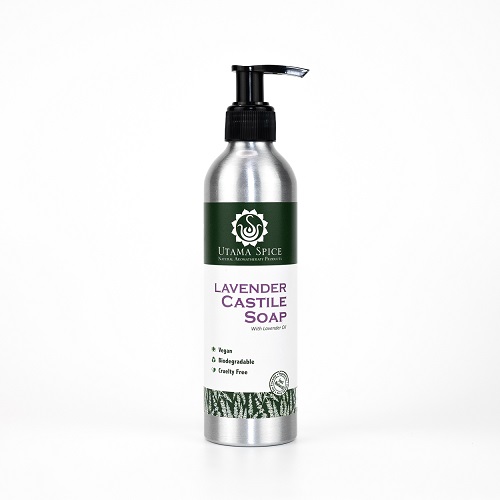
Lavender liquid soap, refilled by the counter since the 1990s
Our Lavender Liquid Soap is the most-refilled product in our Ubud station, a stable castile-style formula in dark glass, designed for the bottle to stay and the soap to keep coming back. Refilled at the counter, shipped where the counter cannot reach, and counted every time.
Refillable body care category by category: what refills well, what still struggles

Not all body care products refill equally well. The format only works when the chemistry, the viscosity, and the shelf life cooperate with the refill cycle. Some categories are nearly purpose-built for it. Others still need solving.
Refills well: liquid soaps and hand washes
Liquid soap is the cleanest fit. Stable formula, forgiving viscosity, long shelf life, easy to pour. Our Lavender Liquid Soap, Lemongrass Liquid Soap, and Tangerine Liquid Soap are all refilled from the same large bulk reservoirs at our refill station. We chose castile-style soap chemistry because it tolerates being decanted and rebottled without losing its lather or its skin feel. For deeper context on what makes a liquid soap worth refilling at all, our guide to natural liquid body soap works through the formulation logic.
Refills well: body oils
Single-phase, anhydrous, low risk of contamination. Body oils are the second-cleanest refill candidate. Dark glass extends shelf life because the oils stay protected from light, and the bottle itself can run for many cycles. Our coverage of natural body oils as a carrier guide and our coconut body oil layering primer both treat oils as a category designed for the refill rhythm, not as a one-off purchase.
Refills decently: body lotions and emulsion creams
Refillable, but with more care. Lotions are oil-in-water emulsions, which means they need preservation, and they are more sensitive to contamination than oils or soaps. The refill works when the bottle is cleaned, dried, and refilled in a controlled environment (a station counter, not an open jug in a stockroom). For the formulation backbone here, see our coconut body lotion guide, which walks through what changes when water enters the formula.
Refills well in the jar format: body butters and balms
Solid butters and balms refill beautifully into reusable tins or jars because there is no water phase to manage. Our Bliss Body Butter uses wild-harvested illipe butter as its structural fat, and the jar happily takes a refill scoop. The broader natural body butter guide covers what to look for in a butter that will survive the refill cycle, and the illipe butter origin story explains why we picked that particular fat as the backbone of the line.
Still struggles: deodorants and SPF
Both categories rely on packaging that does more than hold the product (stick housings, pump valves, airless dispensers), and the packaging itself is the durability problem. Genuine refillable deodorants exist; refillable SPF is rare for shelf-life reasons. When you see either claim, the six questions above are especially worth running.
From Bali: a working refill culture, the counter, and what real accountability looks like

Our refill station in Ubud has been running since the early 1990s. It is a counter with bulk reservoirs, a row of scales, a notebook, and a person who fills, weighs, prices, and writes down the result. Customers bring their own bottles or use one of the glass refill bottles from the shelf behind the counter. The whole exchange takes about three minutes per bottle. Nothing about it is photogenic. It works.
In 2025, this station and our partner programs together kept 2,245 bottles from being made and discarded. That number is small in absolute terms compared with a multinational sustainability press release, and that is the point. The number is real. It is a count of actual bottles that customers brought back, weighed, and refilled. It is published because we keep the ledger. Our piece on the customers who keep coming back to refill covers the texture of this from the counter side: who shows up, what they bring, what the routine looks like over years rather than over a single visit.
A working refill culture has three qualities you can recognize. First, it is repetitive: the same customers come back week after week, year after year, and the rhythm of refilling becomes ordinary rather than special. Second, it is counted: someone writes the number down, and the number is published. Third, it is local: the supply chain shortens, the makers and the refillers and the customers know each other’s names. That third quality is the one most easily lost when refill culture scales, and it is the one that most of the work to keep refill honest centers on.
For a final note on the practice itself, our refill Friday on the pump bottle problem covers a small mechanical truth that affects most refillable body care users sooner or later: the pump is often the part of the bottle that fails first, and a thoughtful refill program plans for it. If a brand sells a “refillable” bottle whose pump cannot be refurbished, replaced, or recycled, the rest of the program is borrowing time from a finite mechanism.
Refillable body care, in the end, is a simple proposition. The bottle stays, the contents come and go, the supply chain shortens, the counter is kept, and a relationship between the brand and the customer is rebuilt on something more honest than a unit purchase. It does not make a single product more virtuous than it was. It makes a hundred small repeated purchases real, traceable, and visibly lighter on the planet. That is what we are after. That is what to look for in any brand that uses the word.