Natural deodorant ingredients to avoid: the greenwashing trap (and what to choose instead)
Most lists of natural deodorant ingredients to avoid stop at aluminum, parabens, and phthalates. That is the easy half of the problem. The harder half is what you find on the shelf next to those, dressed in soft greens and earthy fonts, marketed as clean, plant-based, and skin-loving, that still leaves your underarms red, itchy, or stinging by week two. Greenwashed deodorant is not always dangerous. It is often just badly formulated. This guide takes you through both layers, starting with how underarm skin actually works and ending with a label-reading method you can use in any shop, anywhere. The aim is calm clarity, not fear.
Why ingredient lists matter for underarms

Underarm skin is thinner than the skin on your forearm, folded, warm, and almost always slightly damp. That combination matters because it changes how ingredients behave once they meet you. A formula that sits politely on the back of a hand can soften, swell, and migrate under an armpit, where heat and friction help it dissolve into the upper layers of the skin barrier. This is not panic territory. The body handles small quantities of most things well. It is, however, the reason underarms are the loudest reporters when a formula is wrong for you. Rashes, stinging, darkening, and itch show up here before they show up almost anywhere else.
The barrier itself is a quiet structure of lipids and corneocytes held together at a slightly acidic pH, somewhere between 4.5 and 5.5. When that pH tips up toward neutral or alkaline, the barrier starts to leak: water out, irritants in. The microbes that live on your skin, the ones that turn neutral sweat into the molecules we call body odor, also depend on that acidic range to stay balanced. Most well-meant deodorant problems begin here, with a formula that pushes the pH the wrong way or strips the lipids that hold everything together. Once you understand this, the rest of the ingredient story falls into place. You are not looking for the cleanest sticker. You are looking for a formula that respects the skin it sits on.
It also helps to understand what underarms are doing. Sweat itself is almost odorless. There are two kinds of sweat glands here, eccrine and apocrine, and the apocrine ones (the ones that wake up at puberty) produce a thicker secretion containing lipids and proteins. That secretion is the buffet. Local bacteria break it down into the volatile molecules our noses register as body odor. A deodorant has two honest jobs: slow that breakdown a little, and absorb or mask the molecules that do form. An antiperspirant has a third job, which is to physically block the duct. Skipping antiperspirants is a barrier-respecting choice. Picking a deodorant that does the first two jobs without picking a fight with your microbiome is the next choice.
For a broader view of how the brand thinks about ingredient honesty in personal care, our guide to clean beauty covers the same logic across face, body, and hair. The same calm scepticism applies to the underarm.
The conventional scary list, briefly
If you have already switched away from conventional antiperspirant, you know this list. It is worth a brief, honest pass, then we move to the harder part.
- Aluminum salts (aluminum chlorohydrate, aluminum zirconium). These plug the sweat duct, which is why they suppress wetness so well. The research on aluminum and disease is contested, but the case for skipping it on principle is simple: it is the opposite of what skin would do on its own. Our guide to the best aluminum-free deodorant walks through the alternatives in detail.
- Parabens (methyl-, propyl-, butyl-). Preservatives flagged for endocrine activity in early studies. Many natural brands have moved on. There is no real reason to use them.
- Triclosan. A broad antibacterial. Effective, but disruptive to the wider skin and gut microbiome, and now restricted in many jurisdictions.
- Phthalates. Found hiding inside the catch-all word “fragrance” on older labels. Linked to endocrine concerns. The European Union has tightened rules; many other markets have not.
- Propylene glycol. A penetration enhancer and humectant. Not dangerous in small doses, but an irritant for sensitive underarms, and a clue that the formula is trying to drive other ingredients into the skin.
- Synthetic fragrance (parfum, parfum mix). The least transparent line on most labels. A single word can stand for dozens of compounds. Allergens are common, and the underarm is one of the worst places to wear them.
- Talc. Functional and inert when pure, but with a long history of cross-contamination concerns. Many brands have switched to alternatives.
If you have already left these behind, well done. The interesting question is what shows up in their place. Some of it is genuinely better. Some of it is the same problem in a softer typeface.
The natural-label trap: when clean still irritates

Here is the pattern we see again and again. Someone reads about aluminum, switches to a natural deodorant, and feels good for a week. Then the rash starts. Or the dark patches. Or the strange, slightly burning sensitivity after a shower. Most of the time, the bottle in their hand is not toxic. It is just incompatible with how their underarm wants to work. Three ingredient families do most of this damage.
- High-pH actives. Baking soda is the headline example, covered in detail in the next section. There are others: certain mineral salts, certain bases used to stabilise stick formulas. They neutralise odor by killing the bacteria that produce it. They also push the skin pH out of its happy range.
- Essential oils used as bactericides, not perfumers. Tea tree, oregano, eucalyptus, clove. Beautiful botanicals at low concentrations. At the higher concentrations a deodorant needs to actually work on smell, they become real irritants on thin underarm skin.
- Naturally derived but still synthetic. Propanediol from corn sugar instead of petroleum, behenyl alcohol, polyglyceryl esters. Some of these are genuinely lovely materials. Others are simply old chemistry with a new feedstock. Natural origin does not automatically mean kind to your barrier.
None of this is a reason to give up on natural deodorant. It is a reason to read the label one level deeper than the front of the package, and to be ready to switch formulas if your underarms tell you something is off. Our writers on aluminum-free deodorant for women and aluminum-free deodorant for men work through this same trial-and-error logic with care.
The baking soda problem
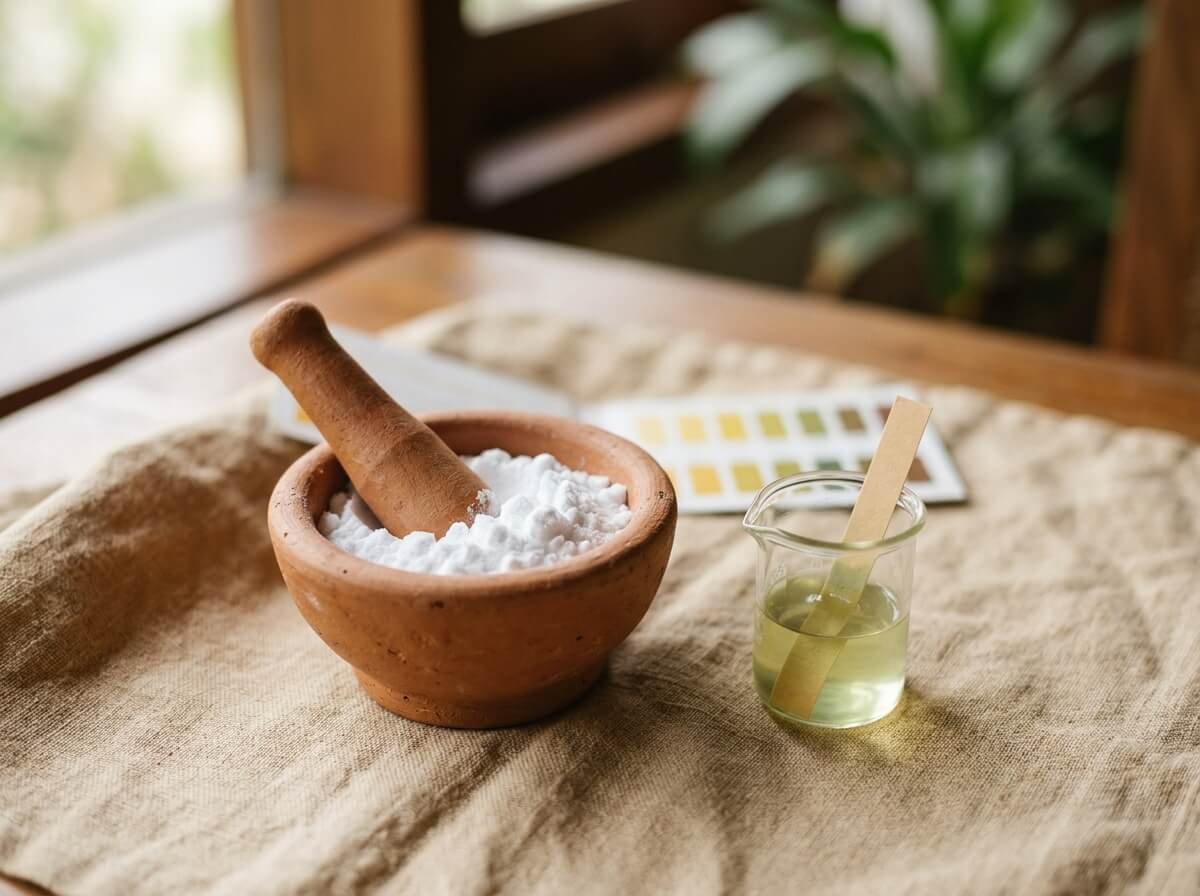
Baking soda, sodium bicarbonate on the label, is the single most common reason a well-intentioned natural deodorant gives someone a rash. The chemistry is simple. Baking soda has a pH around 9, well above the 4.5 to 5.5 range your skin prefers. Apply it morning and night, day after day, and you are slowly tipping the surface of your underarm into mildly alkaline territory. The barrier responds the way it always does to alkaline insult: lipid loss, dryness, micro-cracks, and an increase in transepidermal water loss. In simple terms, the skin gets drier and more reactive.
The reason baking soda is so popular is that it works. Odor-producing bacteria struggle in an alkaline environment, so the deodorant effect is real, often dramatic. For some people, especially those with thicker or oilier underarm skin, it can run for years with no obvious problem. For others, sometimes after months of happy use, the wall comes down. The classic sequence is a sudden red itchy patch on one side, then both, then a rash that does not respond to switching back to the same brand because the barrier is now compromised and almost any deodorant stings. Switching away from baking soda usually solves it. So does a few days of fragrance-free balm, or a soothing aloe-rich product like our Aloe Vera Gel, while the skin re-anchors its pH.
If a label lists sodium bicarbonate in the top half of its ingredients, treat that as a flag, especially if you are new to natural deodorant or have sensitive skin. Lower in the list (after the carriers, after the butters, after the clays) it is often fine, especially when buffered with something acidic. Position on the ingredient list is information. Use it.

There is a quiet adjacent problem worth naming: shaving. Many people apply deodorant straight after a wet shave, when the barrier is at its most vulnerable. Add an alkaline active to that moment and the math is unkind. If you shave, give the underarm five minutes to dry and re-anchor before any product. A simple change. Less rash.
Essential oils, fragrance allergens, and naturally derived greenwashing
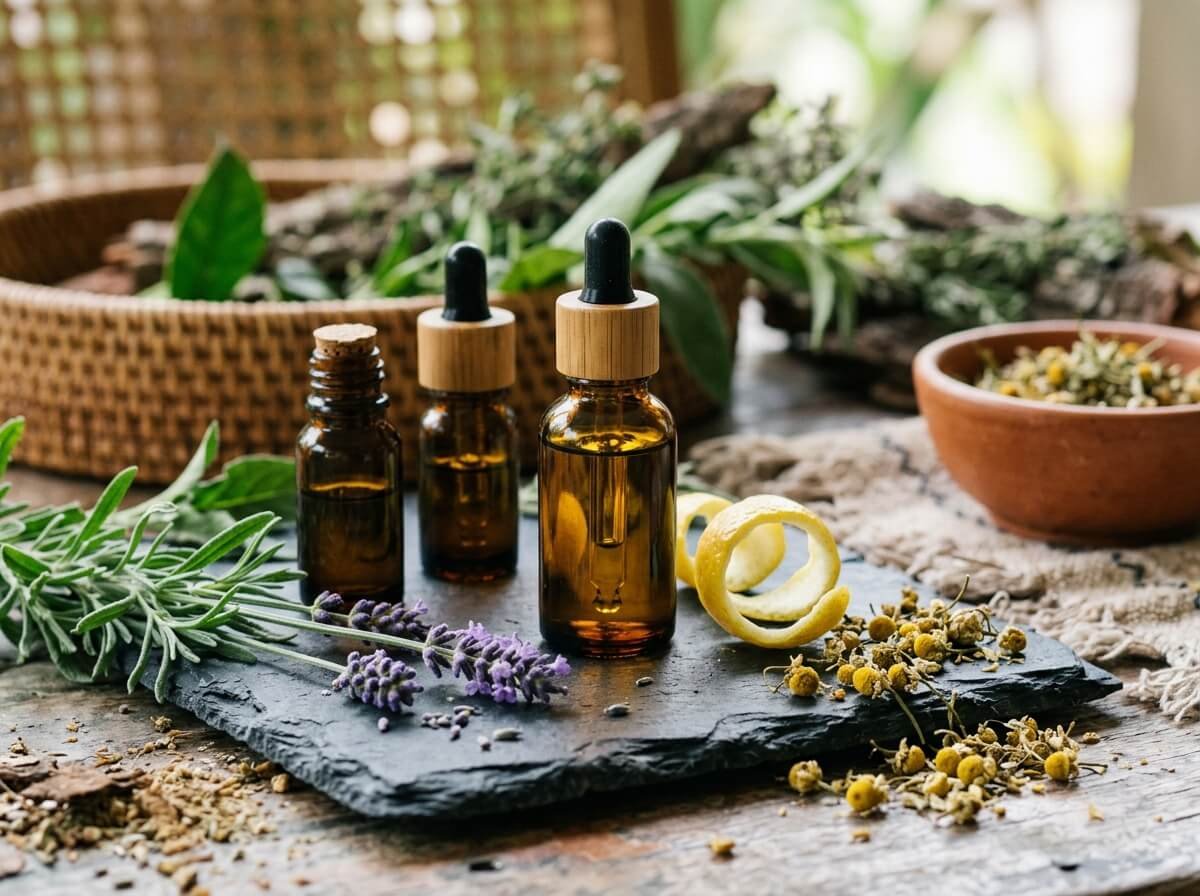
Essential oils are some of the most useful botanicals in personal care. They are also some of the most common irritants on thin underarm skin. The same molecules that give an oil its character, linalool in lavender, limonene in citrus, citral in lemongrass, geraniol in rose, eugenol in clove, are listed on European labels as the 26 fragrance allergens for good reason. They are skin sensitisers. Most people are fine with low doses on the body. A daily application under the arm at the doses some natural deodorants need to actually mask odor is a different ask of the skin.
This does not mean essential oils belong nowhere near a deodorant. It means a few sensible rules. Total essential oil content under one to two percent of the formula. Strong sensitisers (cinnamon, clove, oregano) used very sparingly or not at all. The blend balanced with calming carriers such as fractionated coconut, jojoba, or sweet almond. And, for sensitive skin, the option of a fragrance-light or unscented version next to the scented one. A brand that offers both, and tells you the rough percentage of essential oil in each, is being honest with you.
The other quiet trap is the “naturally derived” phrase. It is true and meaningless at the same time. Coconut sugar is naturally derived. So is propanediol fermented from corn. So is, technically, almost any modern preservative system that starts with a plant. Some of these ingredients are genuinely gentler than their petroleum-source counterparts. Others are identical molecules with a softer marketing story. The honest brands explain which is which on their site. The dishonest ones use the phrase as a halo. Refillable body care is one place where this distinction matters: a refill program is only worth subscribing to if the formula inside the bottle deserves it.
One more sleight of hand worth knowing: undisclosed scent groups. A label that reads “natural fragrance” or “parfum (essential oils)” without listing the oils by name is doing the same thing that synthetic-fragrance brands do. The word natural in front of an opaque blend does not buy you any more transparency. Ask the brand. Better ones publish a full breakdown on their site. If they cannot, take that as a soft no.
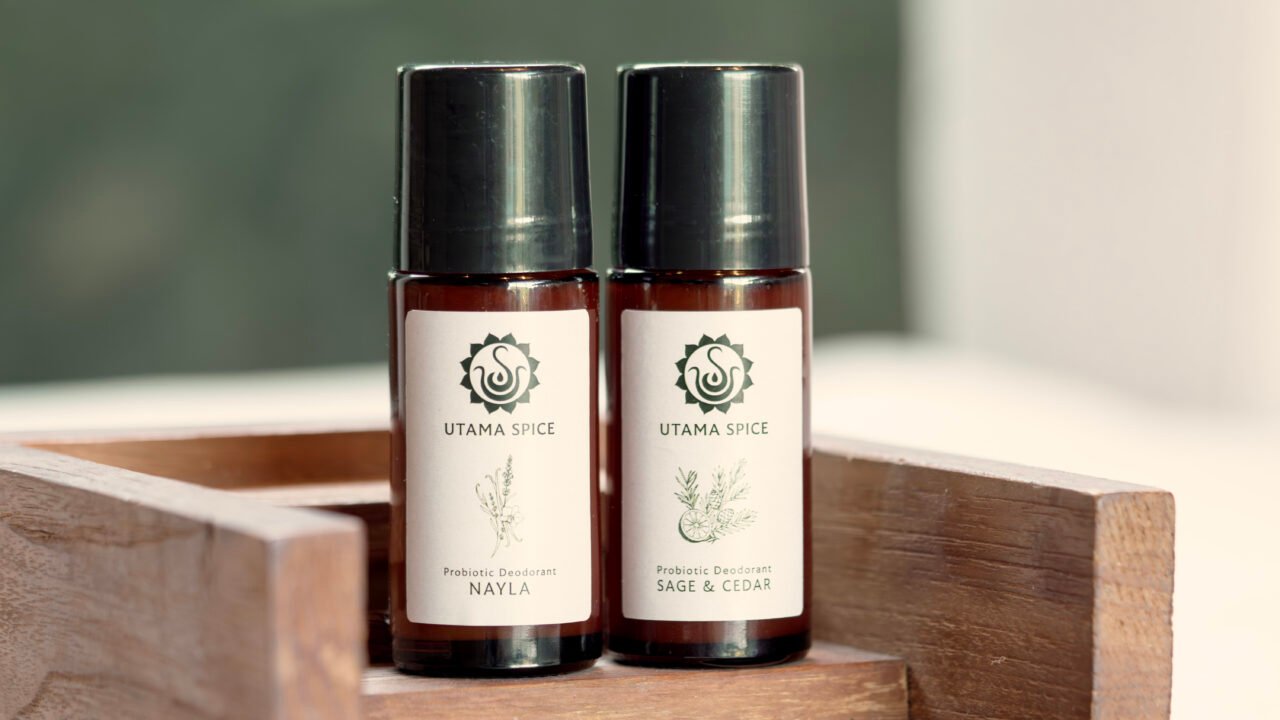
A probiotic-based deodorant, made in Bali
Our Probiotic Deodorant in Sage and Cedar works with your skin microbiome instead of stripping it. Magnesium-buffered, baking-soda free, aluminum-free, in a refillable glass roll-on. Crafted at our workshop in Bali.
What to look for instead
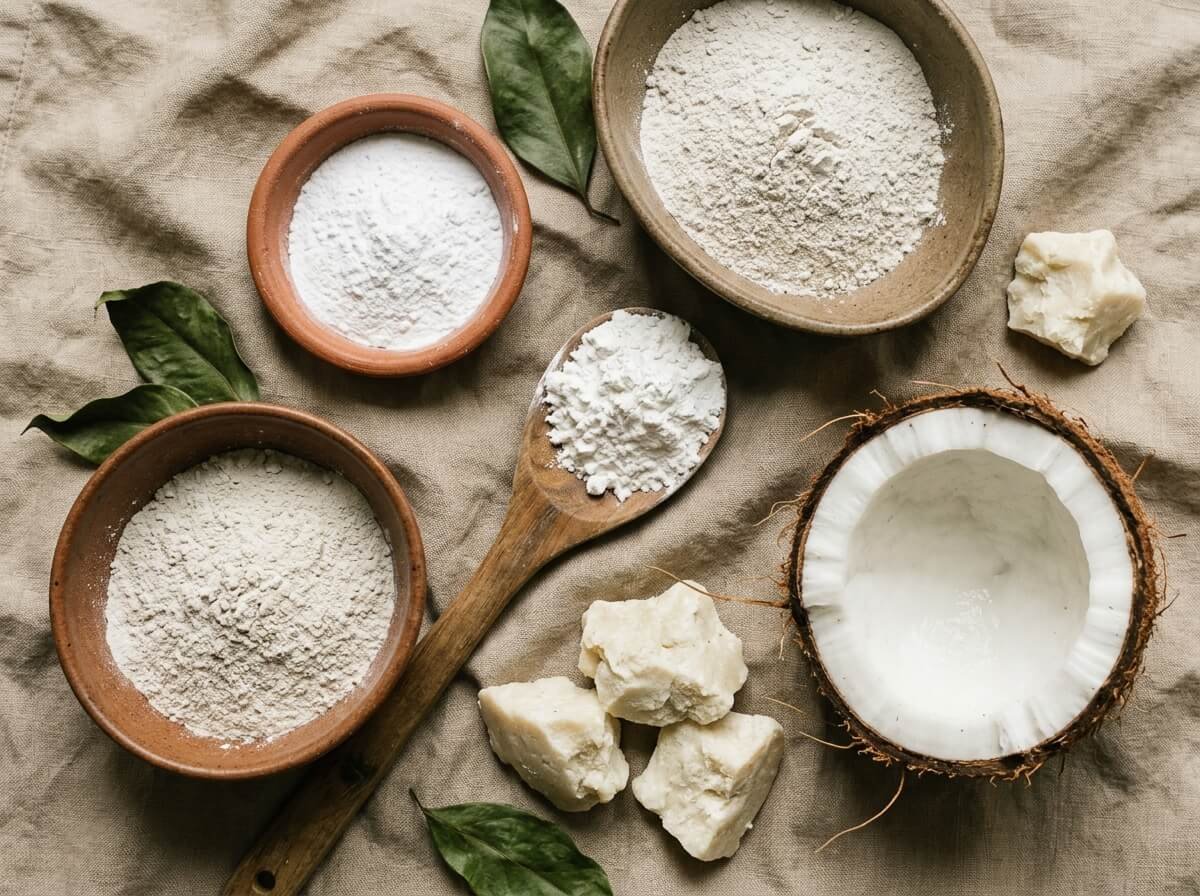
The positive list is shorter than the avoid list. That is normal. A well-built natural deodorant does not need many active ingredients. It needs the right ones, in the right order, in a base that respects skin pH and lipid balance. These are the materials a formulator who cares about your underarm tends to reach for.
- Magnesium hydroxide. The kind alternative to baking soda. Still mildly alkaline, but much closer to skin pH and far less likely to cause the classic rash. A reliable odor neutraliser when buffered correctly.
- Zinc ricinoleate. A salt of castor-oil fatty acid that traps the volatile molecules our bacteria produce. It does not kill the microbes, it deactivates the smell. Friendly to the microbiome.
- Kaolin and bentonite clays. Gentle absorbents that pick up moisture without stripping the barrier the way talc-style powders sometimes can. Soothing in their own right.
- Arrowroot powder. A starch absorbent traditionally used in body powders. Light, dry, and well tolerated by most people. Pairs naturally with a butter base.
- Coconut oil and shea butter. Bali-grown coconut oil and ethically sourced shea sit at the heart of many of our body formulas. They build a barrier-respecting base, glide on at body temperature, and carry mild antibacterial activity without the sting of strong essential oils. Read more in our guide to aluminum-free deodorant spray, which uses the same logic in a different format.
- Pre- and probiotics, fermentates, and microbiome-friendly actives. The newest category and the most interesting. Instead of killing odor bacteria, these formulas feed the species that produce less smell. Our Probiotic Deodorant in Sage and Cedar, and its sister Probiotic Deodorant in Nayla, sit in this category.
- Light, well-chosen essential oils at low total percentage. Lavender, geranium, sandalwood, cedar, sage, vetiver. Used sparingly, they smell honest and rarely irritate. Used to do the work of an antibacterial, they sting.
None of these are silver bullets. What they share is a respect for the underarm as a working ecosystem, not a problem to be solved with chemistry.
A short note on transition. If you are moving from antiperspirant to any of the formats above, expect a week or two of louder sweat and louder smell. The ducts have to open again. The microbiome has to rebalance. This phase passes. It is not a sign the new deodorant is broken. Wash with a mild cleanser, let the underarm breathe through the day, and resist the urge to apply more product than the bottle suggests. More baking soda, more essential oil, more anything in the alkaline column makes the transition harder, not easier. Patience here is part of the formulation.
How to read a natural deodorant label like a formulator

This is the practical part. The next time you pick up a bottle that claims to be clean, plant-based, or natural, run it through these six checks. Two minutes in the shop saves a month of underarm trouble at home.
Before the list, one calibration. Ingredient lists, by law in most countries, run in descending order of concentration down to one percent. After that, the order can be a brand decision. So the top of the list tells you what is mostly in the bottle. The bottom is a more honest test of the brand’s character. Both ends are useful. Skim the middle.
- Read the bottom of the ingredients list first. Anything alarming in the last third (heavy preservatives, undisclosed fragrance, propylene glycol) tells you more about the brand than the first three lines do.
- Find the baking soda position. If sodium bicarbonate appears in the top three ingredients, treat it as a high-risk formula for sensitive skin. Lower in the list, it is usually fine.
- Count the essential oils. Five or more in the ingredient list, especially the strong ones (tea tree, oregano, clove, cinnamon), means a high total essential oil load. Beautiful for a candle. A risk under your arm.
- Look for the buffer. If the formula uses an alkaline active, a good brand will balance it with something acidic (a fruit acid, a citrate, a fermented base) and mention this on the site or label.
- Check the carrier base. A barrier-respecting formula leans on coconut oil, shea butter, jojoba, or a clay-and-starch base, not propylene glycol or behenyl alcohol stabilisers.
- Read the brand site, not the brand front. If the company can explain why each material is in the formula, in plain language, and where it comes from, that is a green flag. If the answers are decorative, slow down.
A short version of all of this, for when you do not have time for the long one. Avoid sodium bicarbonate in the top three ingredients, undisclosed fragrance, propylene glycol, and any product that lists more than four or five essential oils in total. Look for magnesium hydroxide or zinc ricinoleate as the active, kaolin or arrowroot as the absorbent, coconut oil or shea butter as the base, and a brand that publishes its full ingredient list and sourcing on the site. That is most of the story. The rest is your own skin telling you what it likes.
Natural deodorant is, in the end, a small daily relationship between your skin and a short list of materials. The list is what matters. Read it slowly. Trust your underarms when they report. Switch when something is wrong without guilt. The goal is not the cleanest bottle on the shelf. It is the calmest skin under your arm, the kindest formula for it, and the quiet confidence that what you are putting on you, every morning, is doing real work and no quiet harm. That is what natural is meant to mean.