Wellness Wednesday: some citrus oils react with sunlight, so timing is the fix
Citrus oils smell like sunshine, so it feels natural to wear them on a bright morning. But a few of them react with sunlight on the skin, and the result is not a tan. It is a burn or a patch of dark pigment that can stay for months. The fix is not to avoid citrus. It is simply to know which oils do this and to time them well.
What happens on the skin
The peels of some citrus fruits contain compounds called furocoumarins. On their own, they are harmless. When skin that carries them meets ultraviolet light, they absorb that energy and pass it into the skin cells around them. The reaction is called phytophotodermatitis. It can show up a day or two later as redness, sometimes blisters, and often a brown mark in the shape of wherever the oil (or juice) landed.
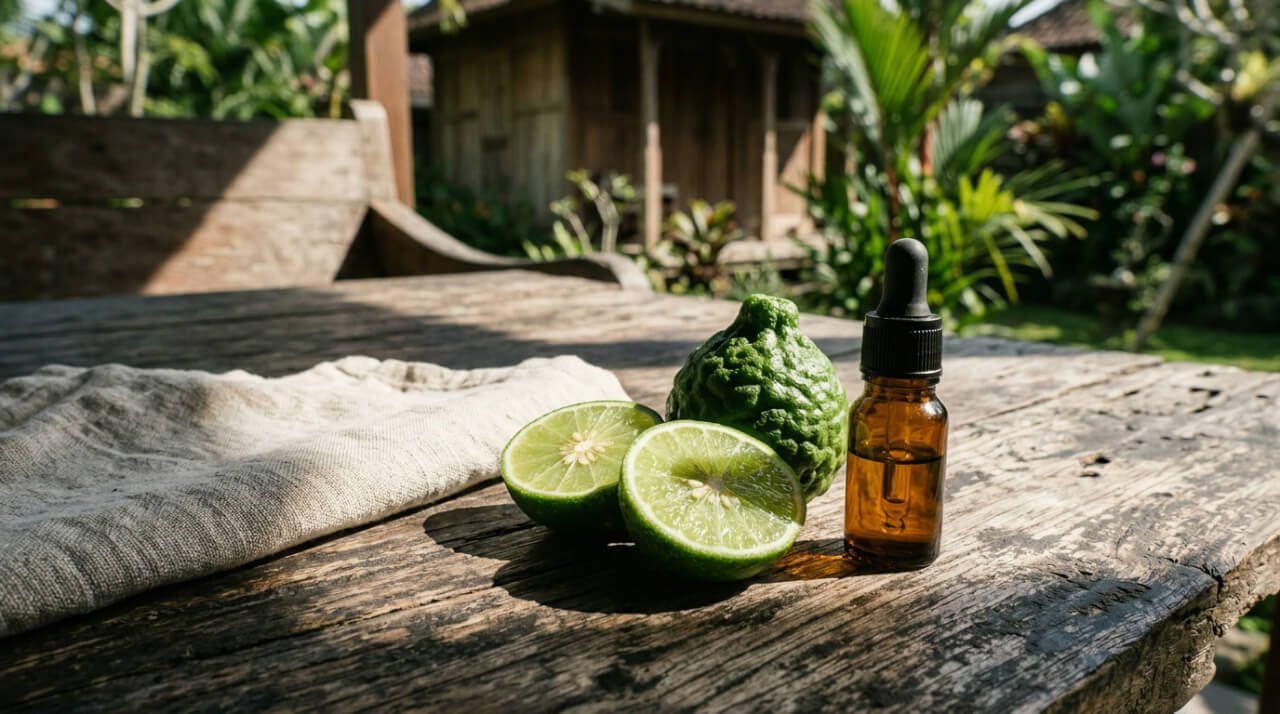
It does not take an essential oil to cause it. Squeezing fresh lime over a meal in the sun and wiping your fingers on your wrist is enough. In Bali, where jeruk nipis is squeezed over almost everything and the sun is strong year-round, it is a quiet, common lesson.

Which oils carry the risk
The method of extraction matters as much as the fruit. Most citrus oils are cold-pressed from the peel, which keeps the furocoumarins in. Steam distillation leaves them behind.
- Take care with: cold-pressed bergamot (the strongest), cold-pressed lime, bitter orange, lemon, and, to a lesser degree, grapefruit.
- Lower concern: sweet orange, mandarin, and tangerine, which are not considered phototoxic at normal skin dilutions.
- No concern: steam-distilled lime, and bergamot labeled “bergapten-free” or “FCF,” which has the reactive compounds removed.
How to time it well
- Allow 12 hours. After applying a phototoxic oil to exposed skin, keep that skin out of direct sun and tanning beds for 12 hours. Evening is the easy answer.
- Or keep it covered. Skin under clothing is protected. A roller on the inner wrist under a sleeve is different from one on a bare shoulder at the beach.
- Diffuse instead. Scent in the air carries no phototoxic risk, so morning citrus belongs in the diffuser.
- Rinse-off is gentler. In soaps, shampoos, and dish soap, the oil washes away before the sun can reach it.
Dilution still matters too. Our guide on how to dilute essential oils explains why, and the bergamot and grapefruit guides go deeper into each oil.
To be transparent about our own shelf: our Bergamot Essential Oil and our essential oil rollers contain whole bergamot, so we treat them as evening or covered-skin oils. For a bright daytime citrus, our Orange Essential Oil is sweet orange, the gentle one. A few drops in the diffuser while the coffee brews is enough.
Nature rarely gives us an ingredient without conditions. Respecting them is what lets us keep enjoying the citrus, sun and all.