Wellness Wednesday: a patch test needs two days, because allergies answer slowly
Most of us test a new serum the same way: a dab on the wrist, a glance an hour later, and then straight onto the face. It feels careful. But the reaction most worth catching is the one that arrives slowly. Your skin can take two days, sometimes longer, to tell you it disagrees with something.
Two kinds of reaction, two speeds
Skin can react to a product in two quite different ways. Irritation is the fast one. It is direct contact damage, and it shows up within minutes or hours as stinging, heat, or redness exactly where the product sat. The quick wrist check catches this.
Allergy is the slow one. Allergic contact dermatitis is a delayed immune response. Immune cells in the skin have to recognize an ingredient, signal for help, and gather before anything becomes visible. That usually takes 24 to 72 hours. It is why dermatologists read their patch tests at around 48 hours and then again a day or two later, because some reactions only appear on the second reading.
“Natural” does not skip this step. Many of the fragrance compounds the EU now requires brands to name on labels, more than 80 of them, come from plants: linalool in lavender, limonene in citrus peel, geraniol in rose. Most people use them happily for life. A few do not, and a patch test is how you find out which group you are in.

A patch test that respects the timing
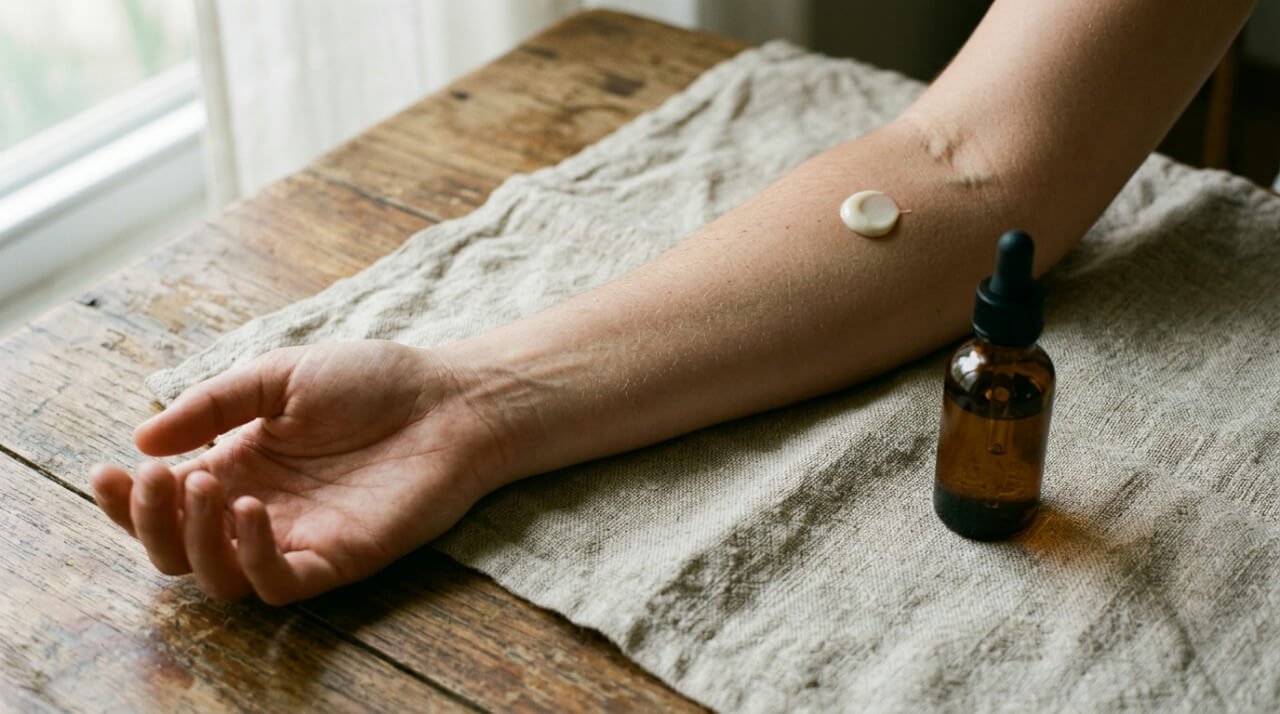
- Choose quiet skin. The inner forearm near the elbow crease is thin, rarely rubbed, and easy to watch.
- Use a coin-sized amount. Apply it the way you plan to use the product, and leave it on.
- Repeat morning and evening for three to five days. A leave-on product meets your skin again and again, so the test should too.
- Look, do not just feel. Check for redness, small bumps, itch, or dry patches, including ones that appear after you stop.
- Then the face, gently. Facial skin is thinner, so try a small area along the jawline for two more days before the full routine.
If anything appears, wash the area with plain water and stop using the product. Introduce one new product at a time, too. If two arrive together, you cannot tell which one your skin is answering. For essential oils, dilute before any skin contact; our guide on how to dilute essential oils covers safe ratios.
A pass is not forever
Sensitivity can develop over years of repeated contact, and some plant compounds become more reactive as they oxidize with age and air. That is one reason how you store essential oils matters. If a long-loved product suddenly stings, believe your skin and pause. Reactive or flushing skin has its own needs, which our guides to repairing the skin barrier and natural skincare for rosacea explore.
We apply the same patience to our own shelf. Our Sensitive Face Serum is a light blend of jojoba, evening primrose, and grape seed oils with a small amount of lavender and blue chamomile. It is made with reactive skin in mind, and it still deserves a few quiet days on your forearm first. No formula suits every skin, and the honest way to know is to ask yours.
Two days feels slow when a new bottle is waiting. It is a small price for a routine your skin has actually agreed to.