Natural face oil: a complete guide to botanical oils for radiant skin
Your skin already knows how to care for itself. It produces sebum, regulates moisture, and repairs damage around the clock. A good natural face oil works with that intelligence, not against it. By delivering plant-derived fatty acids, antioxidants, and vitamins in a form your skin recognises, botanical face oils strengthen the barrier your body has already built. This is not a trend. Healers in Bali, the Pacific Islands, and West Africa have trusted plant oils for generations, long before the beauty industry caught on.
In this guide, we walk through how natural face oils actually work, which botanical oils suit each skin type, and how to incorporate them into a routine that feels like a daily ritual of reconnection. Whether you are new to face oils or refining what you already know, the goal is the same: clarity, not complexity.
What makes a natural face oil different
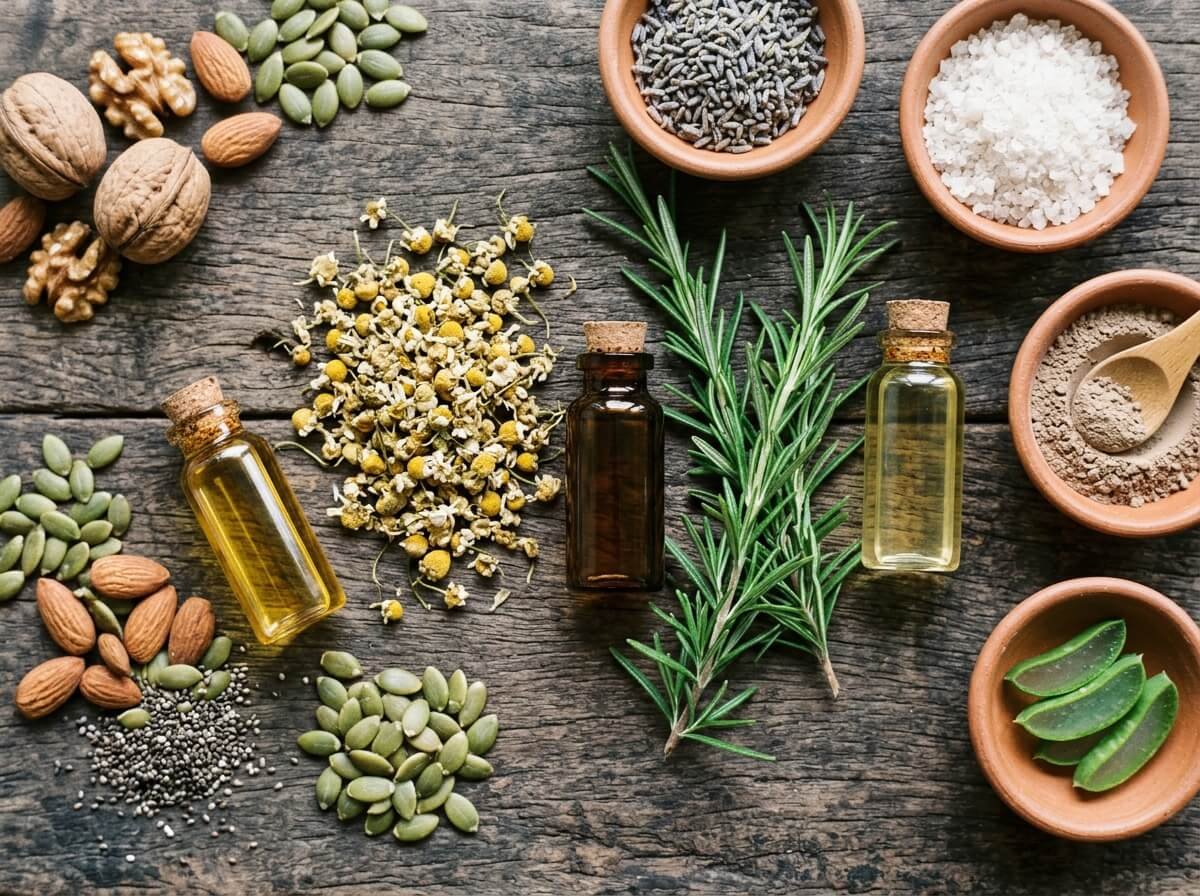
Not all face oils are created equal. A natural face oil is cold-pressed or expeller-pressed from plant seeds, nuts, or fruit, retaining the full spectrum of fatty acids, vitamins, and polyphenols that the plant evolved to protect itself. Synthetic oils and mineral oils, by contrast, sit on the surface of the skin. They form a barrier that can trap debris and interfere with your skin’s own regulatory cycle.
The distinction matters most at the molecular level. Plant-derived oils like tamanu, argan, and jojoba share a lipid structure remarkably similar to human sebum. This bio-compatibility means they absorb efficiently, delivering nutrients where they are needed without clogging pores. Cold pressing preserves heat-sensitive compounds, including vitamin E, carotenoids, and essential fatty acids, that would break down under industrial refining.
Sourcing is the other half of the equation. A tamanu oil wild-harvested in the Pacific and cold-pressed within days of collection carries a different nutrient profile than one that has been sitting in a warehouse for months, refined, and deodorised. At Utama Spice, we work directly with small-batch harvesters and community cooperatives because proximity to the source means fresher, more potent oils. Indonesian traditional herbal knowledge has always understood this: the care you give the ingredient determines the care it gives back.
How natural face oils nourish your skin
Your skin’s outermost layer, the stratum corneum, is essentially a wall of dead skin cells held together by a lipid matrix. Think of it as bricks and mortar: the cells are bricks, the lipids are mortar. When that mortar breaks down from sun exposure, harsh cleansers, or dry air, moisture escapes and irritants get in. This is what dermatologists call a compromised skin barrier.
Natural face oils replenish the mortar. Oleic acid (omega-9), found abundantly in argan and tamanu, penetrates the outer layer to soften and condition. Linoleic acid (omega-6), dominant in rosehip and grapeseed, strengthens the barrier without adding weight. The ratio between these two fatty acids determines how an oil behaves on your skin, which is why choosing the right oil for your skin type matters so much.
Beyond the barrier, many botanical oils carry active compounds that go further. Tamanu oil contains calophyllolide, a compound studied for its ability to support skin repair. Helichrysum, the key ingredient in our Immortelle Helichrysum Face Serum, is rich in arzanol, which research associates with calming inflammation. These are not marketing claims: they are the plant’s own defence chemistry, repurposed for your skin.
If you are already following a natural skincare routine, a face oil slots in as the final sealing step, locking in the water-based hydration from serums and toners beneath it.
The best natural face oils for every skin type
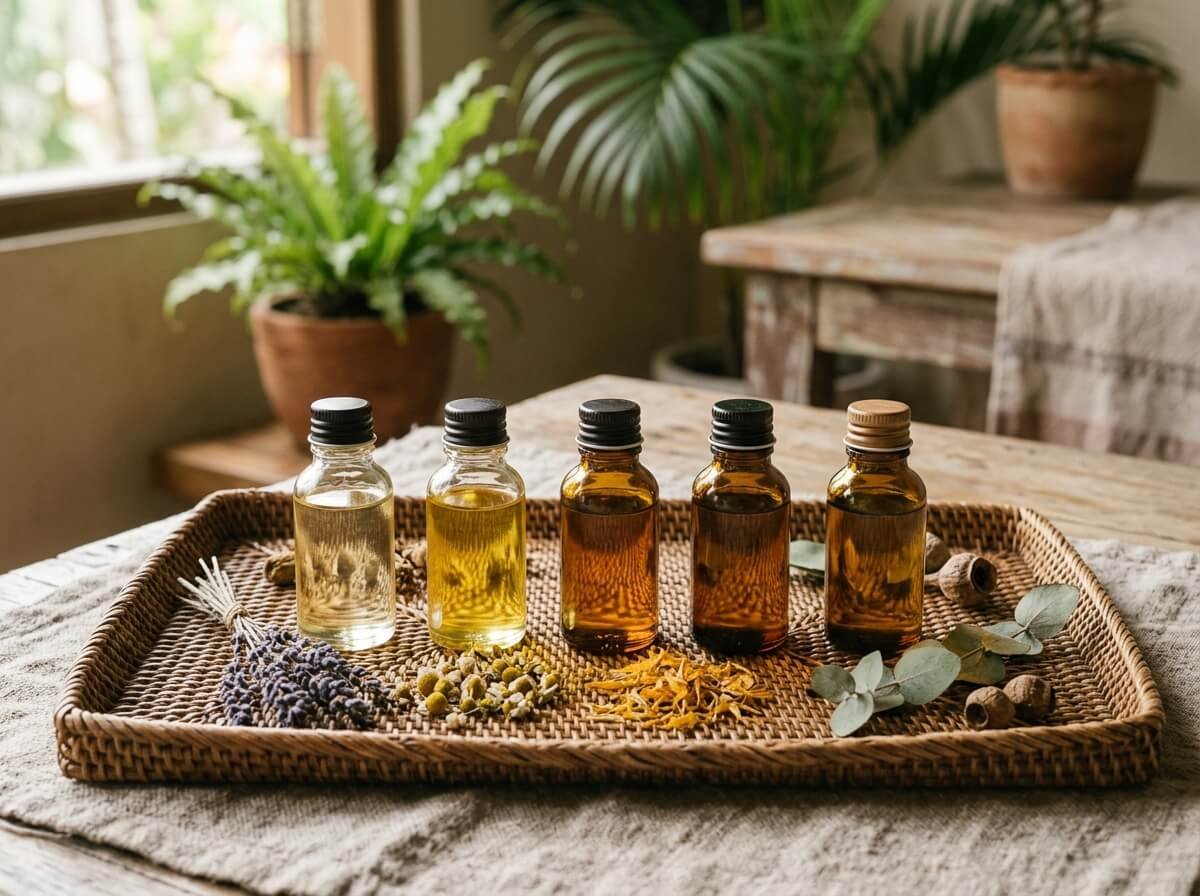
Choosing a natural face oil starts with understanding your skin’s current needs. Skin type is not fixed: it shifts with the seasons, your environment, and your routine. The key is matching the oil’s fatty acid profile to what your skin is asking for right now.
Dry skin
Dry skin craves oleic acid. Look for oils high in omega-9: argan (43% oleic), tamanu (34% oleic), and avocado (up to 70% oleic). These heavier oils penetrate deeply and hold moisture in the skin for hours. Argan oil is a reliable starting point, rich in vitamin E and ferulic acid, both potent antioxidants that protect against environmental stress.
Oily and acne-prone skin
It sounds counterintuitive, but oily skin often benefits from face oils. The key is linoleic acid. Research published in the Journal of Clinical and Aesthetic Dermatology found that acne-prone skin tends to have lower levels of linoleic acid in its sebum, making that sebum thicker and more likely to clog pores. Applying a linoleic-rich oil, such as rosehip (54% linoleic) or grapeseed (70% linoleic), can help rebalance sebum composition. Jojoba oil is another excellent option because its structure mimics sebum so closely that it signals your skin to produce less. Our Oily Face Serum is formulated with this principle in mind.
Sensitive skin
Sensitive skin needs oils with a strong calming profile and minimal potential for irritation. Helichrysum (immortelle) oil, chamomile-infused carrier oils, and calendula oil are traditional choices. Tamanu oil is worth considering too: its calophyllolide content supports the skin’s natural repair process, which is exactly what reactive skin needs. For a gentle, pre-formulated option, the Sensitive Face Serum blends calming botanicals in a lightweight base designed for skin that reacts easily.
Combination skin
Combination skin responds well to balanced oils that are neither too heavy nor too light. Rosehip oil is a reliable choice here: its blend of linoleic and alpha-linolenic acids works across both oily and dry zones. Squalane (derived from olives) is another option, ultra-lightweight and non-comedogenic, though it lacks the vitamin richness of cold-pressed seed oils.
Botanical oils we trust and how we source them
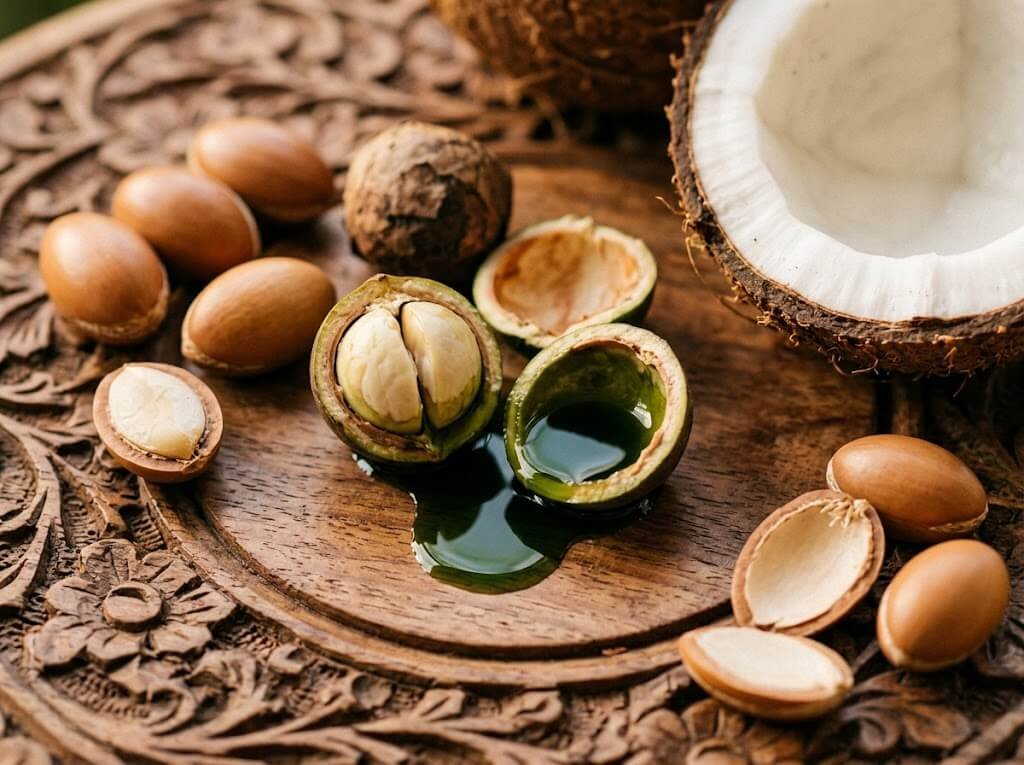
Ingredient stories matter. Where an oil comes from, who harvested it, and how it was processed determine its quality more than any lab certificate. Here are the botanical oils at the heart of the Utama Spice face care line, and the sourcing relationships behind them.
Tamanu oil
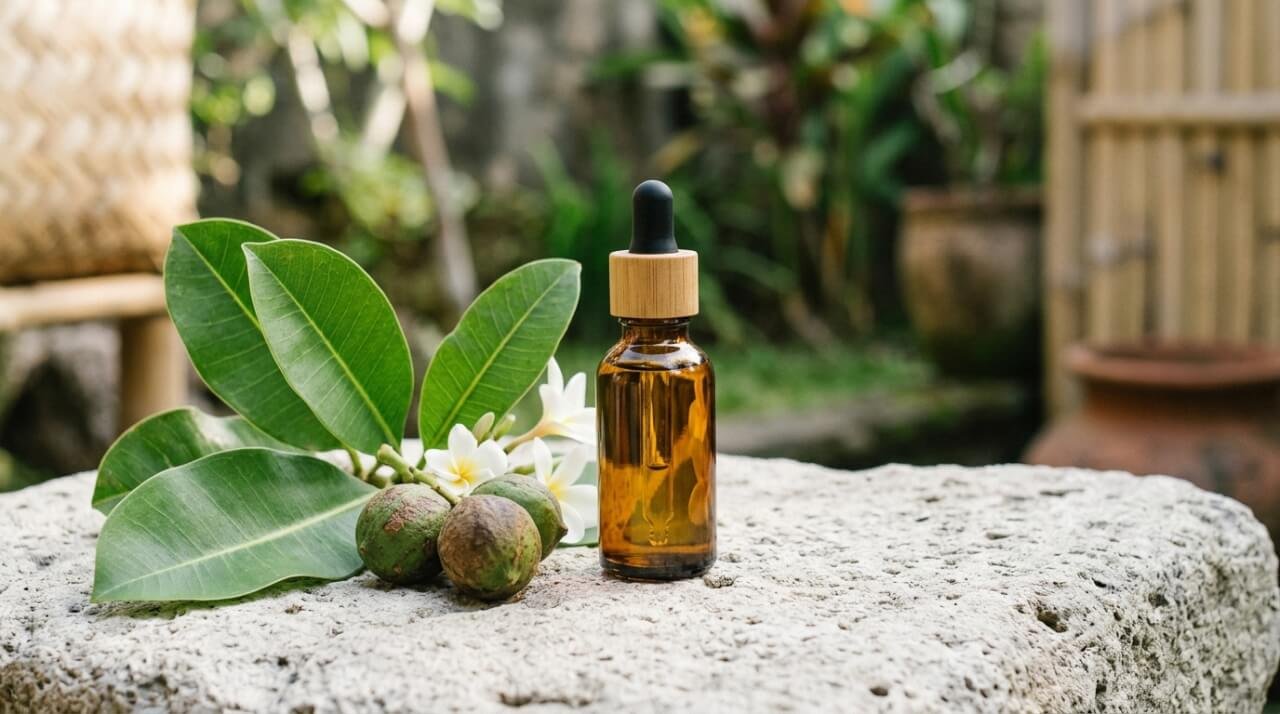
Tamanu oil comes from the nut of the Calophyllum inophyllum tree, native to the Pacific and Southeast Asian coastline. The nuts are sun-dried for weeks until the oil darkens to a deep emerald green. This slow curing is essential: it concentrates the calophyllolide and xanthones that give tamanu its remarkable skin-supporting properties. We source ours through community harvesters who have worked with these trees for generations. If you want to experience this ingredient as a standalone treatment, our cold-pressed Tamanu Oil is a good place to start.

Argan oil
Argan kernels are hand-cracked and cold-pressed, primarily by women’s cooperatives in Morocco. Rich in oleic acid, vitamin E (tocopherols), and squalene, argan is one of the most versatile face oils available. It absorbs cleanly, leaves no greasy residue, and pairs well with heavier oils when your skin needs both deep nourishment and surface protection. We feature argan as a key ingredient across several formulations for its balance of lightness and nutrient density.
Virgin coconut oil
Bali coconut is the backbone of our formulations. Sourced through the Aluan Partnership from sustainable coconut plantations, our virgin coconut oil is cold-pressed and unrefined. Its lauric acid content gives it natural antimicrobial properties. While pure coconut oil on its own can be comedogenic for some skin types, it works beautifully in blended formulations where its antimicrobial and conditioning properties complement lighter carrier oils.
Helichrysum (immortelle)
Helichrysum italicum, sometimes called immortelle or everlasting flower, produces an essential oil prized for its calming and restorative properties. The arzanol it contains has been studied for its ability to modulate inflammatory pathways in the skin. We use it as the hero active in our Immortelle Helichrysum Face Serum, paired with a base of nourishing carrier oils that deliver it deep into the skin.
How to use natural face oil in your daily routine
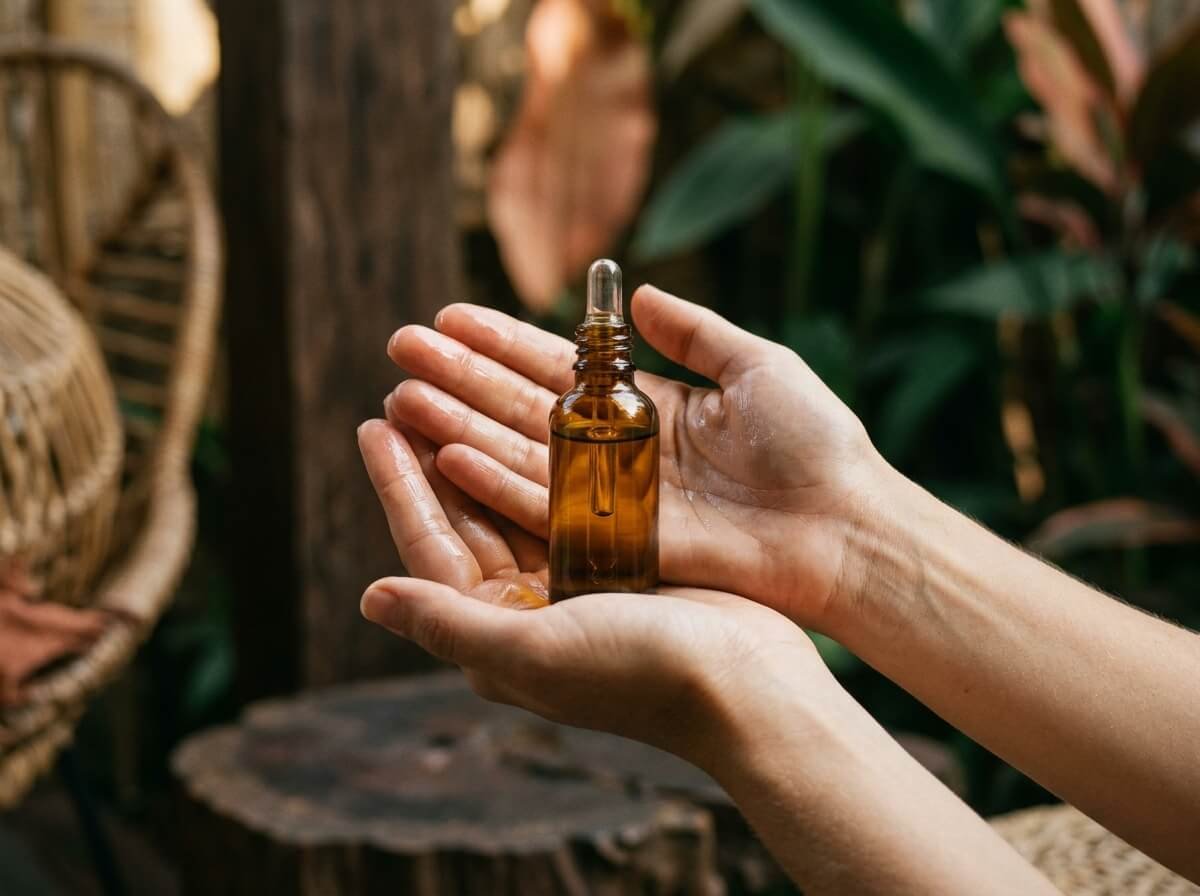
Using a natural face oil is simple, but timing and technique make a difference. Here is a straightforward approach that works for most skin types.
When to apply
Face oil goes on as the last step of your skincare routine, after cleansing, toning, and any water-based serums. Oil molecules are larger than water molecules, so applying oil first creates a barrier that prevents water-based products from absorbing. If you use a moisturiser, apply the face oil either before (to boost absorption into the moisturiser layer) or after (to seal everything in). Both approaches work; the right one depends on your skin and how it feels.
How much to use
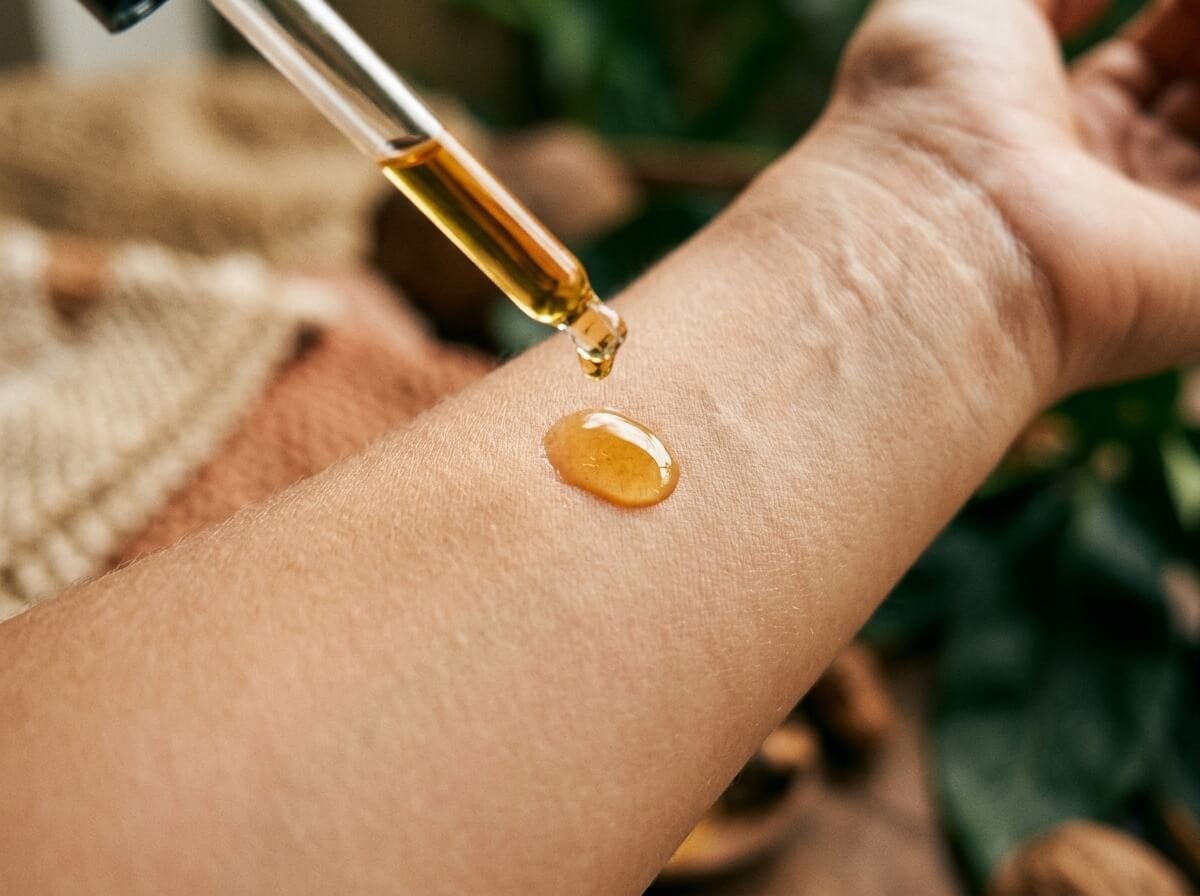
Less is more. Two to four drops are enough for your entire face. Warm the oil between your palms for a few seconds, then press gently into your skin using upward motions. Do not drag or pull. This pressing technique, sometimes called press-and-release, helps the oil absorb evenly without disrupting the skin’s surface.
Morning versus evening
For morning application, choose a lightweight oil (rosehip, jojoba, or a formulated blend like our face serums) that absorbs quickly and layers well under natural sunscreen. For evening, you can use a richer oil (tamanu, argan) that has all night to work. Many people find that alternating between a light morning oil and a nourishing evening oil gives their skin the best of both worlds.
Layering with other products
The basic layering order is: cleanser, toner, water-based serum, face oil, moisturiser (optional), sunscreen (morning). If you use our HydroBotanic Face Cream, you can apply your face oil right before it. The cream’s water-based formula and the oil work together to create a balanced hydration-and-seal effect. Read our complete natural skincare routine guide for a deeper walkthrough of product layering.
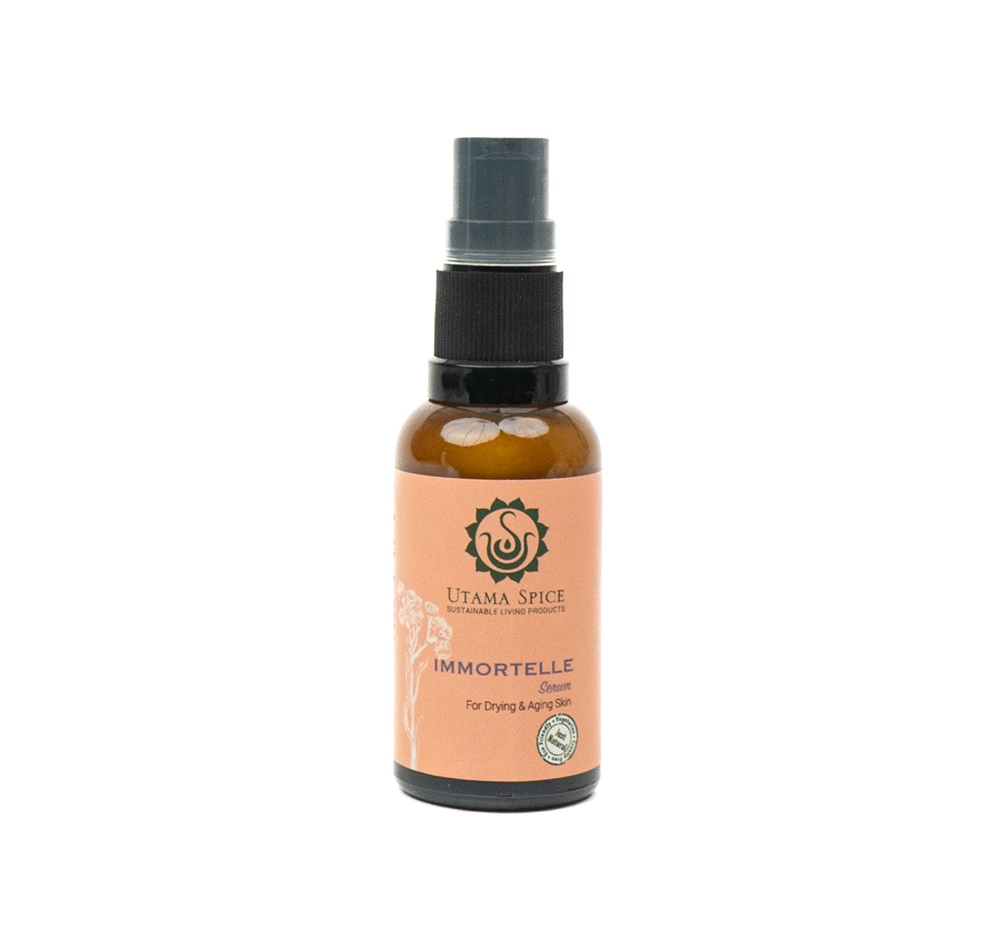
Experience helichrysum in your daily ritual
Our Immortelle Helichrysum Face Serum pairs calming helichrysum essential oil with a nourishing base of cold-pressed carrier oils. Lightweight, fast-absorbing, and formulated for all skin types.
Common natural face oil myths and what the science says
Myth: face oil causes breakouts
This is the most persistent misconception. The comedogenicity of an oil depends entirely on its fatty acid composition and how it is processed. Mineral oil and some heavy plant oils (like unrefined coconut when used pure) can clog pores. But linoleic-rich oils like rosehip, grapeseed, and jojoba actually help regulate sebum and reduce breakout frequency. The key is choosing the right oil for your skin, not avoiding oils altogether.
Myth: oily skin does not need face oil
As we discussed in the skin-type section, oily skin often produces excess sebum because it is dehydrated at the barrier level. Stripping oils away with harsh cleansers triggers the skin to compensate by producing even more sebum. Applying a lightweight, linoleic-rich face oil can signal your skin to ease off its own oil production. The best face serum for oily skin uses this balancing principle.
Myth: face oil replaces moisturiser
Oils and moisturisers do different things. Oils are occlusives and emollients: they soften skin and reduce moisture loss. Moisturisers (especially those with humectant ingredients like hyaluronic acid or aloe) attract and bind water. Using both together, humectant first, then oil to seal, gives you the most complete hydration. That said, if your skin is naturally well-hydrated and you prefer a simpler routine, a face oil alone can be enough, especially in humid climates like Bali where ambient moisture does half the work.
Myth: all natural oils are the same
Processing method, storage conditions, and sourcing origin create enormous differences between the same type of oil. A cold-pressed, single-origin argan oil retains far more active compounds than a refined, blended version. Look for oils that state their extraction method (cold-pressed or expeller-pressed), origin, and whether they are unrefined. Transparency in sourcing is a reliable signal of quality. As we have explored in our guide to essential oils benefits, the way a plant is harvested and processed determines the potency of what reaches your skin.
Choosing the right natural face oil for you
The best natural face oil is the one that matches your skin’s current needs and comes from a source you trust. Start by identifying your primary skin concern: dryness, excess oil, sensitivity, or general maintenance. Then choose an oil whose fatty acid profile addresses that concern. If you are unsure, a formulated face serum (which blends multiple carrier oils and active botanicals in tested ratios) is a safer starting point than a single-ingredient oil.
Here is a simple framework:
- Dry, dehydrated skin: argan, tamanu, or avocado oil (oleic-dominant).
- Oily, acne-prone skin: rosehip, grapeseed, or jojoba oil (linoleic-dominant).
- Sensitive, reactive skin: helichrysum-infused serum, chamomile, or calendula oil.
- Combination skin: rosehip oil or a blended face serum that balances both profiles.
- Mature skin: tamanu (for repair support) plus argan (for deep nourishment).
Whatever you choose, look for cold-pressed, unrefined oils from brands that disclose their sourcing. Transparency is not a luxury: it is the minimum standard for any product you put on your face. The care you give your skin should trace all the way back to the hands that harvested the ingredient and the soil that grew it. That is what we mean by natural face oil, not just the absence of synthetics, but the presence of intention at every step.
If you want to explore Utama Spice’s face oil collection, start with our Natural Face Serum for an all-rounder, the Immortelle Helichrysum Face Serum for calming care, or the Sensitive Face Serum if your skin tends toward reactivity. Each one is crafted in small batches in Bali, using the same sourcing relationships and cold-pressing methods we have described in this guide.