Essential oils for eczema: what calms the itch, and what makes it worse
If you have searched for essential oils for eczema, you have probably met two kinds of answers. One is a cheerful list of five or eight oils to try. The other is a stern warning to avoid them all. The truth sits somewhere quieter. Eczema is a barrier problem first, and the most useful oil for eczema-prone skin is usually not an essential oil at all. It is a plain, bland carrier oil, sealed onto damp skin, used every day.
This guide is written for the long game. We will look at what eczema actually is, why fragrance (including the most natural fragrance) is one of its common triggers, which carrier oils have real evidence behind them, and where lavender, chamomile, and tea tree fit, if they fit at all. We will close with the red flags that mean a doctor, not a dropper bottle, is the right next step.
A gentle note before we begin: this is education, not medical advice. Eczema can be stubborn and personal. If you are managing it with a dermatologist, keep them in the loop on anything new you put on your skin.
What eczema actually is: a broken barrier, not just dry skin
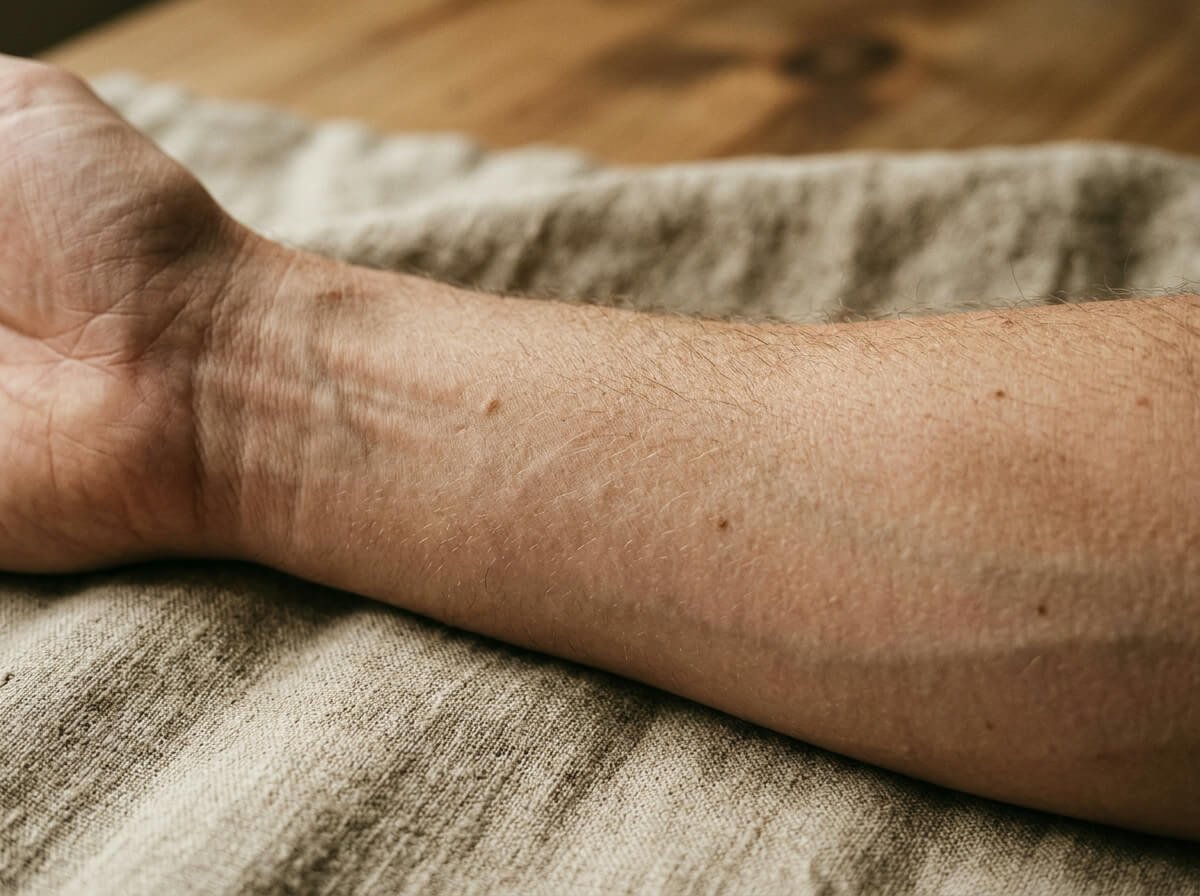
Eczema (most often atopic dermatitis) is not simply dry skin that needs more moisture. It is a skin barrier that leaks. The outer layer of skin, the stratum corneum, works like a brick wall: skin cells are the bricks and a mix of fats (ceramides, cholesterol, and free fatty acids) is the mortar. In eczema-prone skin that mortar is thinner and patchier. Many people carry changes in a protein called filaggrin, which helps hold the wall together and keep it naturally moisturised from within.
A leaky wall lets two things happen at once. Water escapes outward, so the skin dries, tightens, and cracks. Irritants, allergens, and microbes find their way inward, so the immune system reacts with inflammation. That inflammation itches. Scratching breaks the barrier further. Then the cycle repeats, sometimes for years.
This is why the first question with eczema is never “which oil kills the itch?” It is “how do we rebuild the wall?” Everything else (cooling, calming, scent, ritual) comes second.
The itch-scratch cycle
Itch is the symptom most people want gone, and it drives most of the damage. Each scratch strips more of the barrier and invites more inflammation. Breaking the cycle tends to come from steady, boring care: bland moisturisers applied often, short lukewarm baths, soft fabrics, and treating flares early rather than late. None of that photographs well. All of it works better than any single bottle.
Why bacteria matter
Eczema-prone skin is more easily colonised by Staphylococcus aureus, a bacterium that can worsen inflammation and, in some cases, cause infection. This is part of why antimicrobial oils like tea tree get recommended so often. It is also why infected eczema needs proper medical care, which we cover further down.
Why “essential oils for eczema” is a phrase to handle with care
Here is the part most oil lists leave out. Fragrance is one of the most common causes of allergic contact dermatitis, and essential oils are fragrance. Natural origin does not change that. A plant’s scent molecules (linalool in lavender, limonene in citrus, terpinen-4-ol and friends in tea tree) are the same molecules that patch-test clinics see again and again.
There is a second layer. As essential oils age and meet air and light, some of their compounds oxidise. Oxidised linalool and limonene are much stronger sensitisers than the fresh versions. A bottle that sat open on a sunny bathroom shelf for a year is a different substance from the day it was poured. Old tea tree oil in particular becomes more irritating as it oxidises.
Now combine that with eczema. A leaky barrier lets these molecules reach the immune cells underneath far more easily than healthy skin would. So the people most drawn to “natural eczema remedies” are also the people most at risk of becoming sensitised to them. Once you are allergic to a fragrance compound, that allergy usually stays for life.
None of this means essential oils are forbidden. It means they are a careful, optional extra, not the treatment. If an article frames an essential oil as the cure for eczema, it is selling you something. We would rather tell you the truth and keep your trust.
Who should skip essential oils on eczema skin entirely
- Babies and young children, whose skin is thinner and more absorbent.
- Anyone with a known fragrance allergy, or a past reaction to a “natural” product.
- Anyone in an active flare, with skin that is raw, cracked, weeping, or broken.
- Anyone whose eczema is around the eyes, lips, or genitals.
For a broader grounding in safe use, our essential oil safety guide covers storage, shelf life, and sensitive groups in more depth.
Carrier oils do the real work: coconut, tamanu, and sunflower
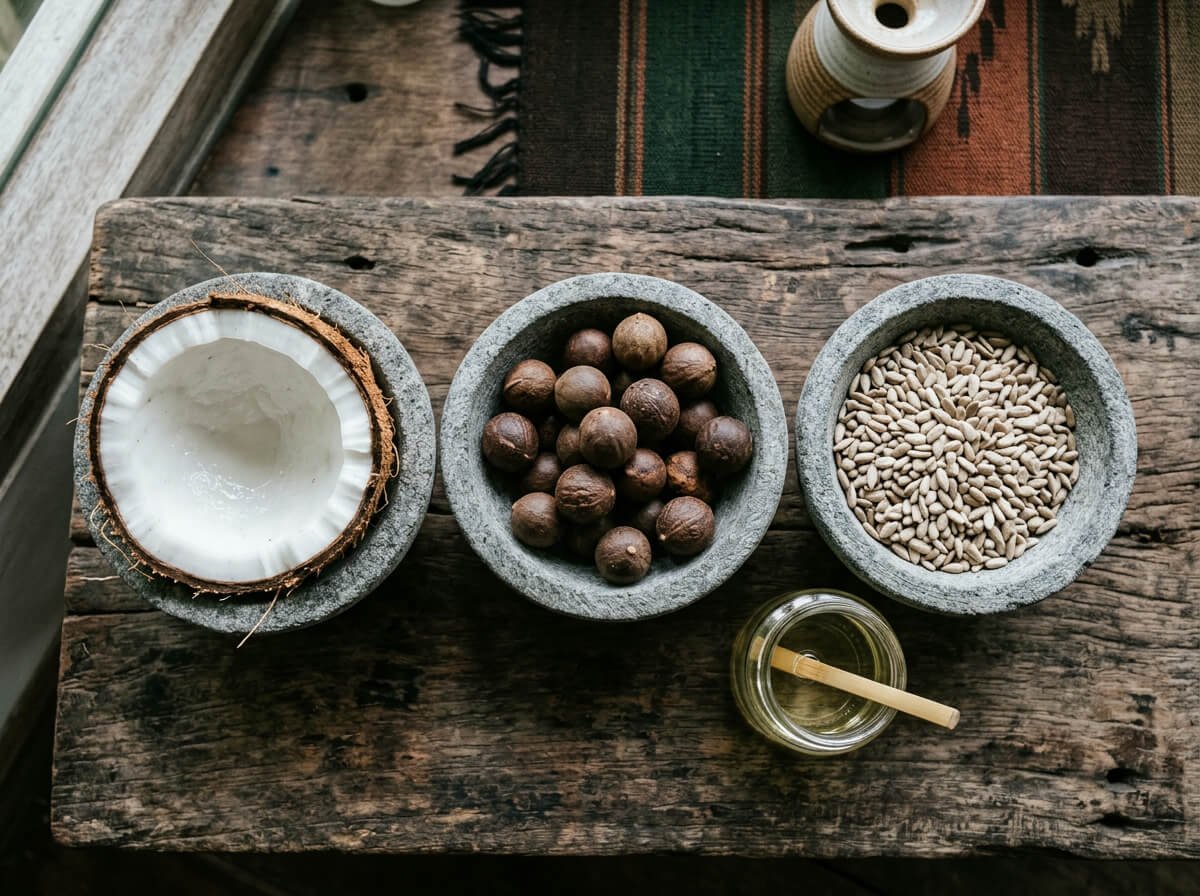
If essential oils are the supporting cast, carrier oils (the plain, pressed plant oils) are the lead. They do two useful jobs for eczema-prone skin. As occlusives, they sit on the surface and slow the water loss. Some also deliver fatty acids that help the barrier’s own repair. Crucially, a good carrier oil carries little or no scent.
Virgin coconut oil
Coconut is the oil with the most encouraging small trials for eczema. In one randomised study of children with mild to moderate atopic dermatitis, virgin coconut oil applied twice daily improved eczema severity scores more than mineral oil over eight weeks. Another small trial found it reduced Staph aureus colonisation on eczema skin. These are modest studies, but they point the same way.
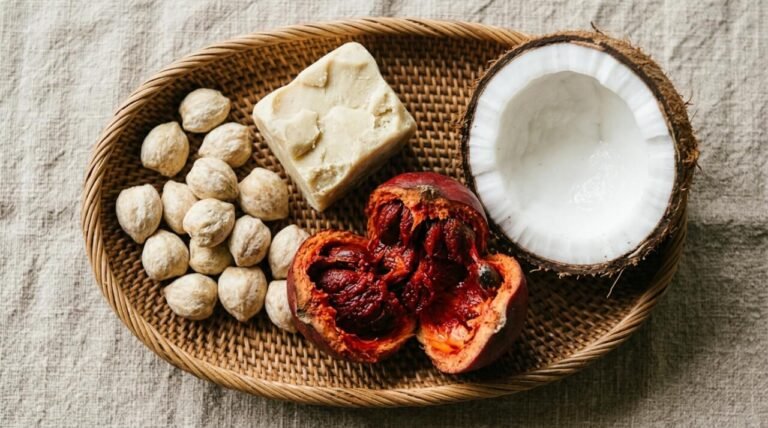
The key word is virgin: cold-pressed, unrefined, nothing added. Our Virgin Coconut Oil is pressed from Balinese coconuts with nothing else in the bottle. One honest caveat: coconut is comedogenic for some faces, so it tends to suit body, hands, and limbs better than acne-prone cheeks. Our guide to how to use coconut oil for skin walks through when it helps and when it does not.
Tamanu oil
Tamanu oil, pressed from the nut of the Calophyllum inophyllum tree, is thick, green-gold, and gently earthy in scent. It contains compounds such as calophyllolide that have shown anti-inflammatory and wound-healing activity in laboratory and animal research. Human evidence specific to eczema is thin, so we will not oversell it. What we can say is that tamanu is a rich, fragrance-free emollient with a long history of use on irritated skin across the Pacific and Southeast Asia.
Because tamanu is a nut oil, anyone with a tree-nut allergy should skip it or speak to their doctor first. For a fuller picture, our tamanu oil benefits guide covers its sourcing and character in detail.
Sunflower seed oil (and why olive oil can backfire)
Sunflower seed oil is rich in linoleic acid, a fatty acid the skin barrier uses directly. In a well-known study comparing the two oils on adult forearms, sunflower oil preserved barrier integrity and improved hydration. Olive oil did the opposite: it weakened the barrier and caused mild redness. Olive oil is high in oleic acid, which can loosen the barrier rather than seal it. It is a useful reminder that “natural” and “kitchen cupboard” do not mean “good for eczema”.
If you want to compare more options side by side, our guide to choosing a carrier oil covers absorption, texture, and shelf life.
Butters for the driest patches
For thick, lichenified patches on elbows, knees, and hands, a plant butter can offer a heavier seal than an oil. Wild-harvested illipe butter from Kalimantan is firm, almost scentless, and rich in stable fats. Our illipe butter benefits guide explains where it comes from and who harvests it.
The essential oils with the best evidence, used the safe way
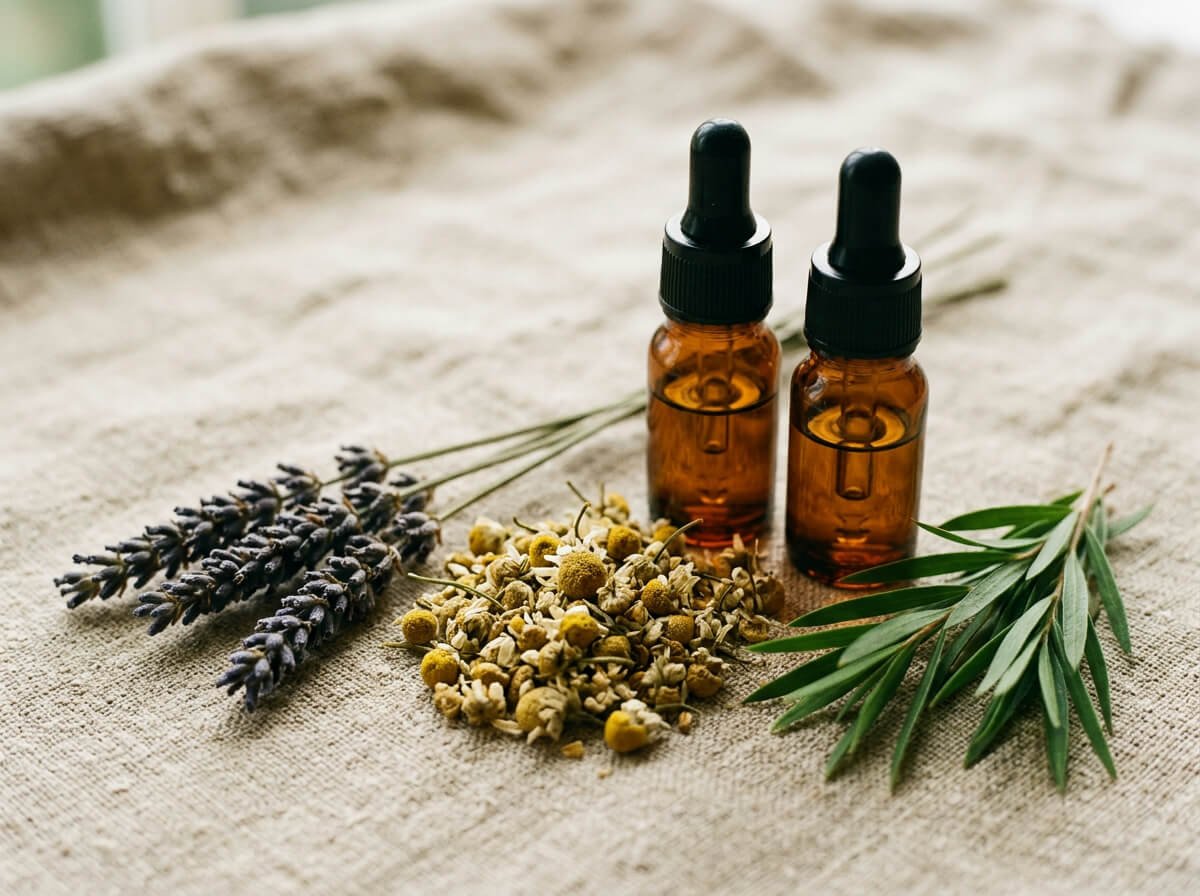
With all of that said, there are a few essential oils that come up again and again in eczema research. The honest summary of a 2024 scientific review is this: most of the evidence is from lab dishes and animals, the handful of human trials are small, and none of it replaces a moisturiser or a doctor’s treatment. Here is how the common three stack up.
Lavender
Lavender (Lavandula angustifolia) shows anti-inflammatory and calming activity in lab studies and has a long reputation for soothing skin. It is also one of the more frequently reported causes of fragrance allergy, largely because of linalool and its oxidation products. If you use it, use it fresh, highly diluted, and only on calm, intact skin. Our Lavender Essential Oil is pure Lavandula angustifolia; treat it as an occasional supporting note in a carrier oil, not a treatment. Our lavender essential oil benefits guide covers its wider uses.
German chamomile
German chamomile (Matricaria chamomilla, sometimes called blue chamomile) contains chamazulene and bisabolol, both studied for their calming effect on inflamed skin. Some older trials of chamomile creams showed modest results for mild eczema. One clear caution: chamomile is in the daisy family, so people allergic to ragweed, daisies, or marigolds may react to it.

Tea tree
Tea tree (Melaleuca alternifolia) is the antimicrobial of the group. It has real activity against Staph aureus in lab studies, which is why it appears on so many eczema lists. It is also one of the most sensitising oils once it oxidises, and it can sting broken skin. For eczema, it belongs, at most, in a very low dilution on intact skin near (not on) a flare. Our Tea Tree Essential Oil is best kept tightly capped, cool, and dark, and replaced within a year. Read our tea tree essential oil benefits guide for the full picture.
The oils to leave out
Some essential oils are poor matches for reactive skin under any circumstances. Cinnamon bark, clove, oregano, and lemongrass are strong irritants. Cold-pressed citrus oils, such as bergamot, lemon, and lime, can cause sun reactions. Peppermint feels cooling but its menthol can sting and sensitise. If your skin is eczema-prone, these are simply not worth the risk.
A note on blends: for calm-phase facial skin that tolerates botanicals, our Sensitive Face Serum pairs jojoba, evening primrose, and grape seed oils with small amounts of lavender and blue chamomile. Because it contains essential oils, patch test it first, and keep it away from active eczema patches.
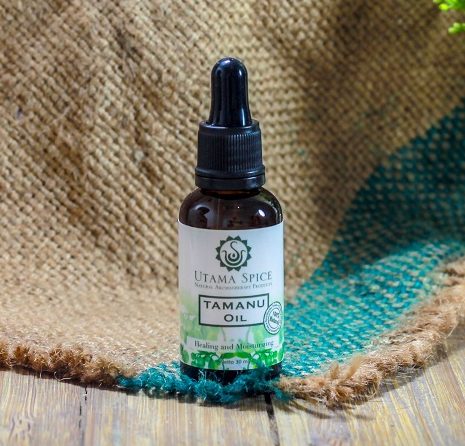
A single-ingredient oil for reactive skin
Our Tamanu Oil is one thing only: cold-pressed Calophyllum inophyllum seed oil, with no added fragrance. Seal a few drops onto damp skin after bathing, or use it as the carrier for a very light blend. Skip it if you have a tree-nut allergy, and patch test first.
How to patch test and build a gentle routine
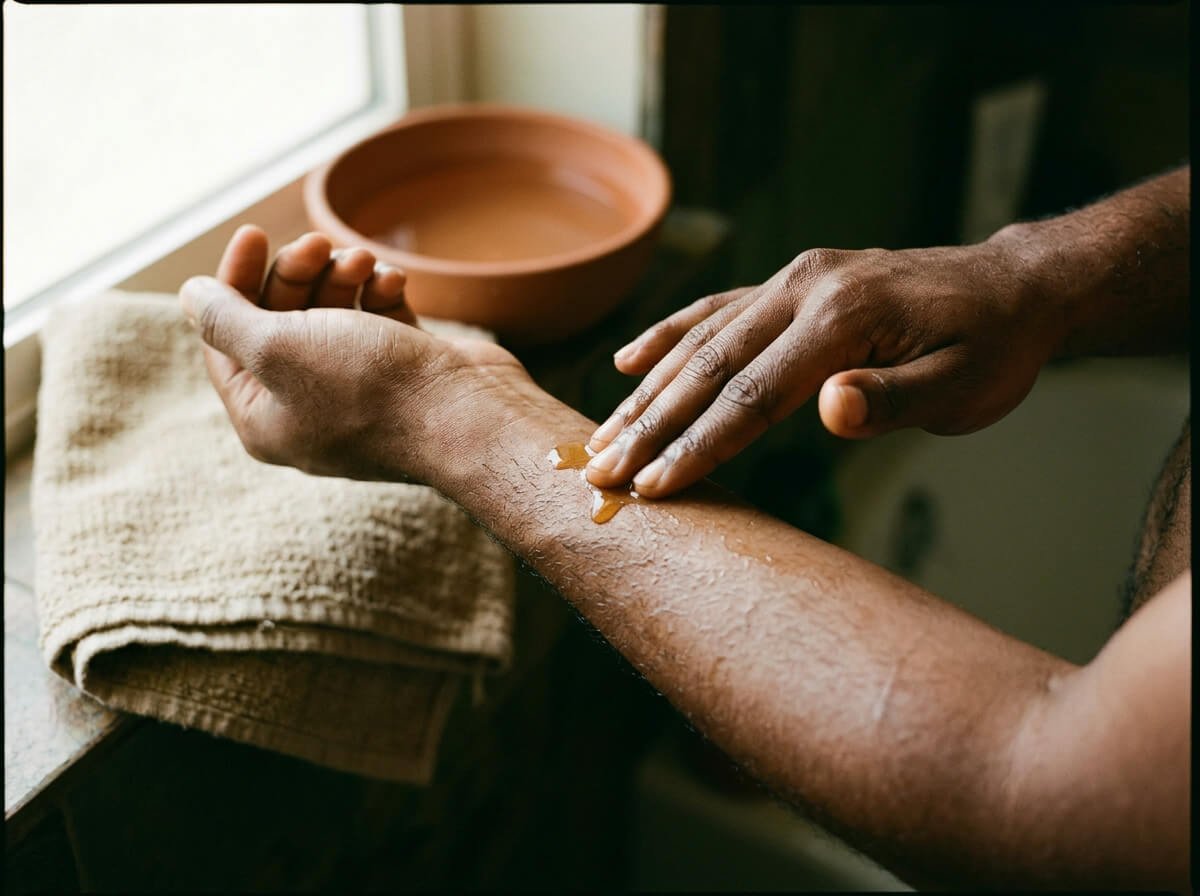
If you decide an essential oil is worth trying, the way you introduce it matters more than which one you choose. Here is the routine we would suggest, step by step.
Step one: patch test properly
- Mix your oil at the dilution you plan to use (see below) in your chosen carrier.
- Apply a coin-sized amount to the inner forearm or behind the ear, on skin that is not currently flaring.
- Leave it, and repeat once or twice a day, for at least 48 hours, ideally up to a week. Allergic reactions can take days to show.
- Any redness, itching, bumps, or burning means stop. Do not try a “stronger” or “purer” version.
Step two: dilute far more than you think
For eczema-prone skin, we suggest no more than 0.5% essential oil, and often less. That is roughly one drop of essential oil in two teaspoons (10ml) of carrier oil. For comparison, many general massage blends sit at 2% to 3%, which is too strong here. Our guide on how to dilute essential oils includes a full dilution chart.
Step three: soak and seal
The most useful habit for eczema skin needs no essential oil at all. Take a short, lukewarm bath or shower (hot water strips the barrier). Pat the skin gently, leaving it slightly damp. Within about three minutes, apply your carrier oil or butter to lock that water in. This is often called “soak and seal”, and it is a dermatologist favourite for good reason.
Step four: keep the rest of the routine quiet
- Choose fragrance-free cleansers and laundry products where you can.
- Wear soft, breathable cotton or linen next to the skin.
- Keep nails short, and pat or press itchy skin instead of scratching.
- Add one new product at a time, two weeks apart, so you can trace any reaction.
Our sensitive skin routine guide goes deeper on building a minimal, low-reactivity regime.
A note on tropical heat and humidity
In Bali, we see a pattern many people in hot climates share. Humidity can ease dryness, but heat and sweat are common eczema triggers. Sweat sitting in skin folds itches and irritates. In warm weather, lighter textures (a few drops of oil rather than a thick butter), a cool rinse after sweating, and loose natural fabrics tend to help. Air conditioning, on the other hand, dries the air, so indoor skin may still need the full soak-and-seal routine.
Red flags: weeping, infection, and when eczema needs a doctor

Natural care has a real place in eczema, but it has limits, and knowing them is part of caring well. Please stop home remedies and see a doctor promptly if you notice any of the following.
- Weeping, oozing, or honey-coloured crusts, which can signal a bacterial infection.
- Clusters of painful, punched-out blisters or sores, especially with fever. This can be eczema herpeticum, a viral infection that needs urgent care.
- Spreading redness, warmth, swelling, or fever.
- Eczema that disturbs sleep, school, or work, or that does not improve after one to two weeks of gentle care.
- Any eczema in a baby, or a sudden severe flare in anyone.
Never apply essential oils to broken, weeping, or infected skin. It can sting badly, slow healing, and raise the risk of sensitisation. Prescription treatments, including topical steroids and non-steroid creams, are not a failure of natural living. Used as directed, they calm inflammation so the barrier can recover, and the gentle carrier-oil routine above works well alongside them.
A simple skin diary helps here. Note new products, foods, weather, stress, and sleep alongside flares. Patterns appear over weeks, and they make any doctor’s visit more useful.
A Balinese view: coconut and tamanu as gentle, traditional emollients

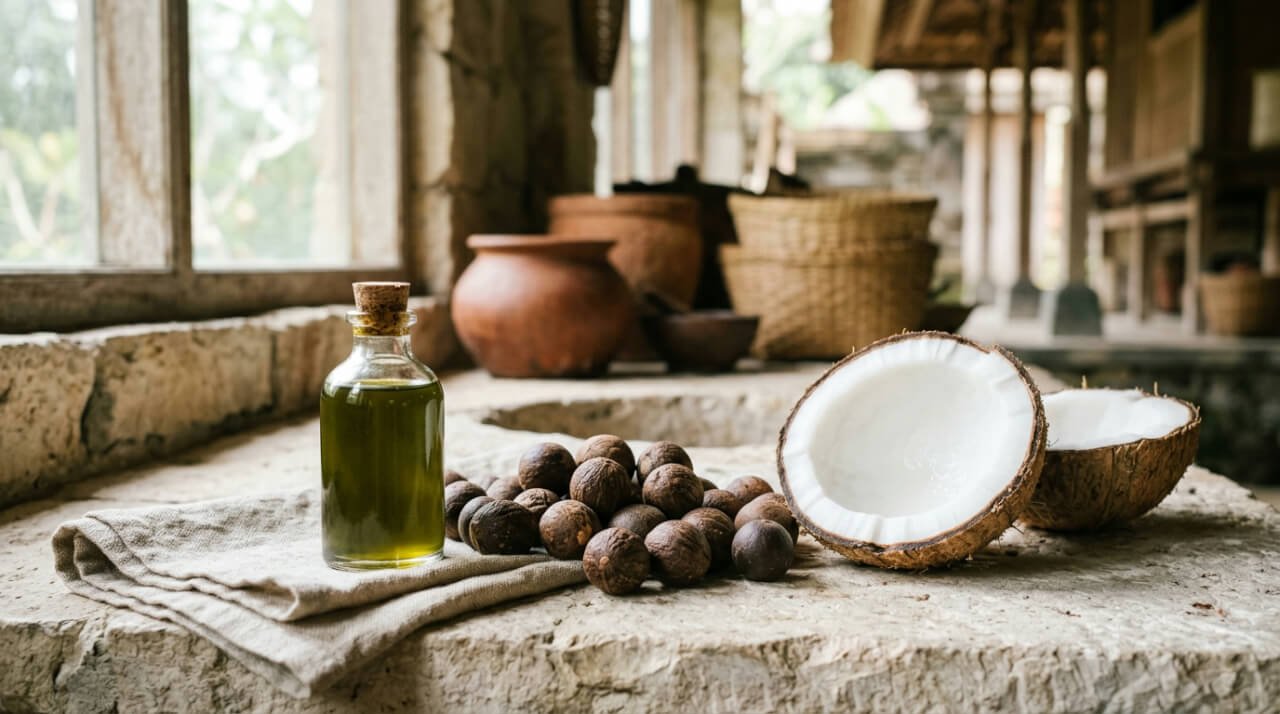
In Bali, oils have always been part of daily care. Coconut (kelapa) is everywhere: in the kitchen, in hair care, and pressed onto skin after bathing. Along the coasts of Indonesia grows the nyamplung tree, the same Calophyllum inophyllum that gives us tamanu oil. Its round fruits fall near the shoreline, and communities across the archipelago have long pressed the seed for lamp oil and for skin.
What strikes us about this tradition is its restraint. These are bland, rich, practical oils, used often and generously, not perfumed potions. That is close to what modern dermatology recommends for eczema: frequent, fragrance-free emollients that help the skin hold its own water. Ancestral habit and current science meet in a simple place.
Melanie Templer started Utama Spice in her Ubud kitchen in 1989 with that same instinct: what goes on the skin should be simple and close to its source. We press and bottle our coconut oil in Bali, sourced through our Aluan partnership, and we keep single-ingredient oils single-ingredient. For eczema-prone skin, that simplicity is the point. If you are curious how a rich butter compares to coconut for very dry skin, our comparison of coconut oil vs illipe butter lays out the differences.
We share this heritage with respect, not as a cure. Balinese tradition did not claim that coconut or nyamplung oil heals eczema, and neither do we. It offers a rhythm: gentle oil, applied with care, every day.
Essential oils for eczema: frequently asked questions
Can essential oils cure eczema?
No. No essential oil cures eczema. At most, a few (lavender, German chamomile, tea tree) may offer mild calming or antimicrobial support when highly diluted on intact skin. The core of eczema care is barrier repair: bland moisturisers or carrier oils, gentle bathing, avoiding triggers, and medical treatment for flares.
Is tea tree oil safe for eczema?
It can be, with care, for some people. Tea tree has antibacterial activity, but it is also a known sensitiser, especially once it oxidises. Use it fresh, at 0.5% or less, never on broken skin, and patch test for several days first. If your eczema is infected, see a doctor rather than relying on tea tree.
Can I use lavender oil neat on eczema?
Please do not. Applying any essential oil undiluted to eczema-prone skin raises the risk of irritation and lifelong fragrance allergy. Always dilute it in a carrier oil, and keep it off active patches.
Does coconut oil help eczema?
Small clinical trials suggest virgin coconut oil can improve mild to moderate eczema in children and reduce Staph aureus on the skin. It works best as a soak-and-seal emollient on the body. It is not a cure, and a few people are sensitive to it, so patch test first.
What is the best essential oil for eczema on babies?
For babies, the safest answer is none. Infant skin is thin and absorbent, and baby eczema should be guided by a doctor or health visitor. A plain, fragrance-free emollient is the usual first step.
Which carrier oil is best for eczema?
Sunflower seed oil and virgin coconut oil have the best small-trial evidence. Tamanu is a rich, fragrance-free option with promising lab data. Avoid olive oil on eczema skin, as it can weaken the barrier.
Can essential oils help with eczema itch at night?
Diffusing a calming oil like lavender in the bedroom (not on the skin) may help some people relax before sleep, which can ease the urge to scratch. Keep the diffuser away from the bed, run it for short periods, and stop if anyone in the room is sensitive. For the itch itself, a cool compress and a fresh layer of carrier oil usually help more. Our guide on essential oils for bug bites covers similar itch-calming principles.
Eczema asks for patience, not perfection. Start with the barrier, keep the fragrance light or absent, and let any essential oil earn its place slowly. Care that is quiet and consistent tends to be the care that lasts.