Sensitive skin routine: sensitive vs sensitized, and why less is the actual fix
A sensitive skin routine usually starts in the wrong place: with a new cleanser, a calming serum, another step added to a shelf that is already crowded. Most of the top advice on sensitive skin follows the same pattern, a longer product ladder, one more specialist item for every symptom. Almost none of it asks the one question that actually matters first: is your skin sensitive, or is it sensitized.
The difference changes everything about what to do next. True sensitive skin is a chronic, often genetic barrier trait you manage for life. Sensitized skin is usually a temporary, self-inflicted state, caused by too many actives, too much exfoliation, or over-cleansing, and it is reversible with a deliberate reset. This guide walks through both, plus the honest truth about natural products and fragrance, a real patch-test protocol, and a calming approach shaped by Bali’s own climate and craft.
This is also, quietly, a stance against a habit the skincare industry rewards: buying a new product every time skin misbehaves. Care in action, for us, means finding the smallest effective step, not the newest one. That belief shapes everything below, from the self-check to the reset itself.
If a cleanser has ever left your face tight and pink, if a new serum has ever triggered a breakout within days, or if a summer of sun and sweat has ever undone a routine that worked fine all winter, this guide is written for that exact moment. The goal is not another product recommendation to try. It is a way of thinking about reactive skin that most of the internet skips past.
Sensitive skin is not one thing: reactive-prone, intolerant, and sensitized
Skincare roundups tend to treat “sensitive skin” as a single category, then hand everyone the same six-step routine. In practice, reactive skin shows up in at least three distinct forms, and telling them apart is the actual diagnostic work most guides skip.
- Reactive-prone skin: a lower threshold for irritation that shows up consistently, often alongside conditions like rosacea or eczema, and tends to run in families.
- Intolerant skin: a barrier that struggles with a specific, identifiable trigger group (certain acids, alcohol-based toners, strong fragrance) but is otherwise calm.
- Sensitized skin: skin that has become reactive recently, through over-exfoliation, stacking too many actives, hot showers, over-cleansing, or seasonal stress, and calms back down once the trigger is removed.
The distinction matters because each type responds to a different fix. Reactive-prone skin needs consistent, gentle management over years. Intolerant skin needs one trigger identified and avoided. Sensitized skin needs a pause, not a new purchase. Treating all three the same way, with an ever-growing product ladder, is exactly why so many people cycle through specialized serums without ever getting calmer skin.
It is worth naming how often the mislabeling happens the other way, too. Skin dismissed as “just sensitive”, a fixed trait to manage forever, is frequently sensitized skin stuck in a loop: a new product is added to calm a reaction, that product itself becomes one more variable the barrier has to process, and the cycle repeats. Recognizing that loop is often the single most useful thing a reactive-skin routine can teach.
Our own general natural skincare routine works well for the first two groups once the trigger is known. Sensitized skin needs something different first: less, not more. That distinction is the spine of this entire routine.
Is your skin sensitive, or is it sensitized? An honest self-check

Before adding a single new product, it is worth spending two minutes on a real self-check. Sensitized skin almost always traces back to a habit, not a diagnosis, and most people can find the culprit once they look for it honestly.
Ask yourself, truthfully:
- Have you added a new active, acid, or retinoid in the last four to six weeks.
- Are you exfoliating (physical or chemical) more than two to three times a week.
- Do you double-cleanse or cleanse more than twice a day.
- Have you layered three or more “active” serums at once, hoping for a faster result.
- Did the reaction start suddenly, after a product change, rather than gradually over years.
A “yes” to two or more of these points toward sensitized, reactive skin that has been over-stimulated, not a permanent condition. The fix is not a specialized new product. It is subtraction, which is exactly what the reset in this guide is built to do. If your skin has reacted this way for years, regardless of routine changes, and often flares with heat, stress, or certain foods, that pattern points toward genuinely reactive-prone skin, and a dermatologist is worth involving alongside anything here.
A simple way to track the pattern: keep a short note on your phone each time skin reacts, noting the date, what changed in the two or three days before, and how the skin looked and felt. Two or three entries are usually enough to reveal a pattern that memory alone tends to miss, especially when the trigger is subtle, like a new laundry detergent or a friend’s borrowed towel.
There is a physiological reason subtraction works so quickly. Every active ingredient, every exfoliation, every extra cleanse asks the skin barrier to do work: shedding cells faster, dissolving surface lipids, adjusting to a new pH. Stack enough of those requests at once and the barrier falls behind, moisture escapes faster than it should, and the nerve endings just beneath the surface become easier to trigger. Removing the requests, rather than adding a product to calm the resulting irritation, lets the barrier catch up on its own.
The natural-brand truth: fragrance and essential oils can trigger reactive skin too
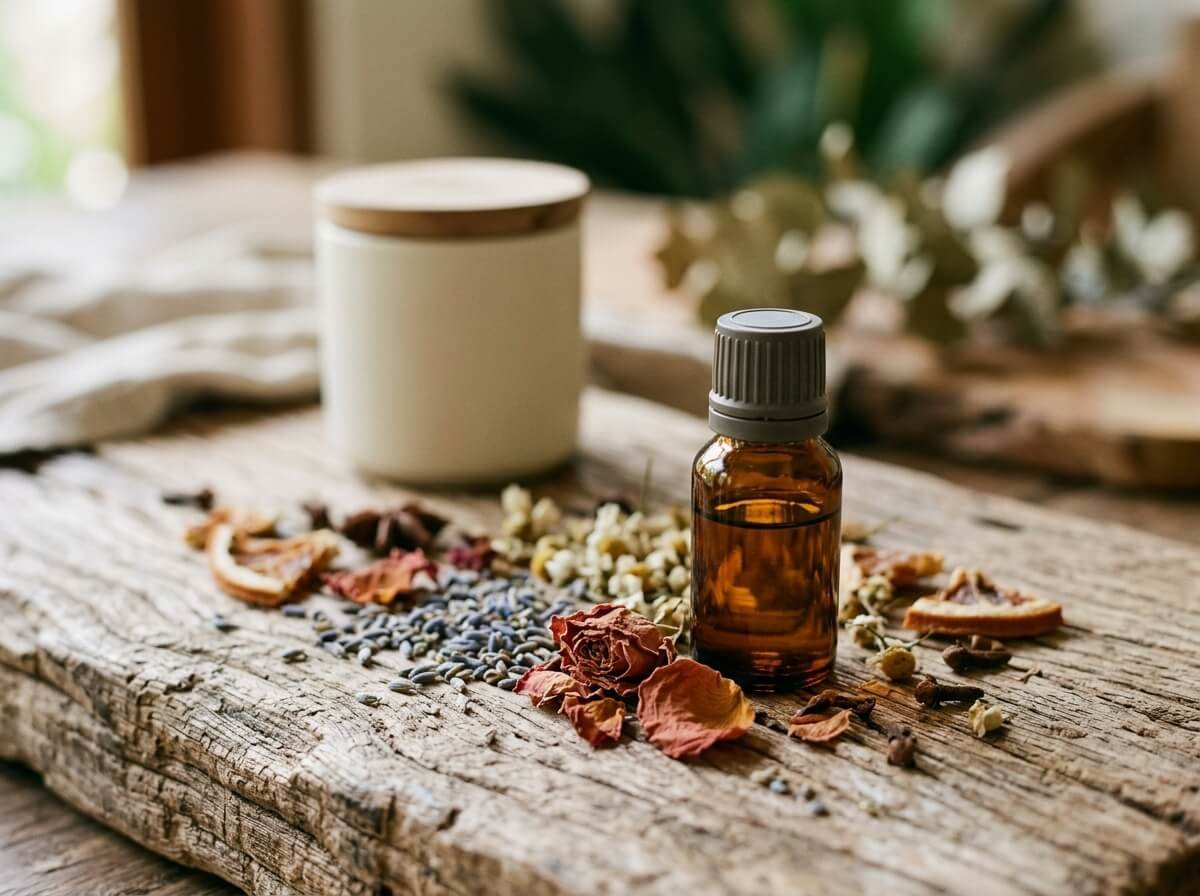
Here is the part most natural and clean brands avoid saying out loud: natural does not automatically mean gentle. Citrus oils, high fragrance loads, and many essential oils are documented irritants for reactive skin, plant-derived or not. A formula can be entirely botanical and still overload a compromised barrier.
We say this plainly because pretending otherwise is exactly the kind of greenwashing we built this brand to stand against. Even a favorite like coconut oil, brilliant for body and hair, can sit too heavy on reactive, blemish-prone facial skin. The honest answer for reactive skin is fragrance-free or minimal-essential-oil first, always, regardless of how “clean” the ingredient list looks on the front of the bottle.
This does not mean abandoning natural formulation. It means reading past the marketing language and checking what is actually in the bottle, which is exactly what the label-literacy section further down walks through. If you already use an oil cleansing method, the same principle applies there too: choose the carrier oil for its gentleness, not its scent.
We say this as a brand that formulates with essential oils across much of our range, because they are woven into Balinese wellness tradition and, used well, genuinely support skin and mood. But tradition also teaches restraint: a healer does not reach for every herb in the garden for a single remedy. The same discipline belongs in a bottle. Fewer active fragrance compounds, chosen deliberately, protects the skin they are meant to nourish.
A handful of specific botanical compounds show up in independent irritation studies more often than others: linalool, limonene, geraniol, and citral, all common in citrus and floral essential oils and all capable of oxidizing on exposure to air into more reactive byproducts over a bottle’s shelf life. None of that makes them dangerous in a well-formulated product used as intended. It does mean a reactive-skin routine is the wrong place to experiment with a new scented formula, however natural its ingredient list looks.
Your sensitive skin routine, simplified: a three-step reset
If the self-check above pointed toward sensitized skin, resist the urge to add anything new for two weeks. The fastest way back to calm skin is almost always dropping down to three steps, not adding a fourth.
Two weeks is not an arbitrary number. Skin cell turnover and barrier lipid repair both operate on roughly that cycle, so it gives the barrier enough time to rebuild before you judge whether the reset has worked. Cutting it short, or reintroducing a product after a few calm days, is the most common reason a reset appears not to work when it simply was not given enough time.
Step one: cleanse, once, gently
Cleanse only once a day, in the evening, with a fragrance-light, low-foaming formula. In the morning, a rinse with cool water is often enough. Skip physical scrubs and acid cleansers entirely during the reset, and use lukewarm water rather than hot, patting skin dry with a soft towel instead of rubbing it.

Step two: treat, with one product only
Choose a single treatment serum built specifically for reactive skin rather than layering three specialized ones. Our Sensitive Face Serum was formulated for exactly this step, a short ingredient list, minimal essential oil, nothing extra to react to. A thin layer of aloe vera gel underneath works well too, for its soothing, humectant properties.
Step three: seal, and stop
Finish with a barrier-supporting moisturizer, then stop. Our HydroBotanic 3-in-1 Hydrating Face Cream pairs ceramides with plant oils for exactly this sealing step. No extra serum, no extra oil, no exfoliant, for two full weeks.
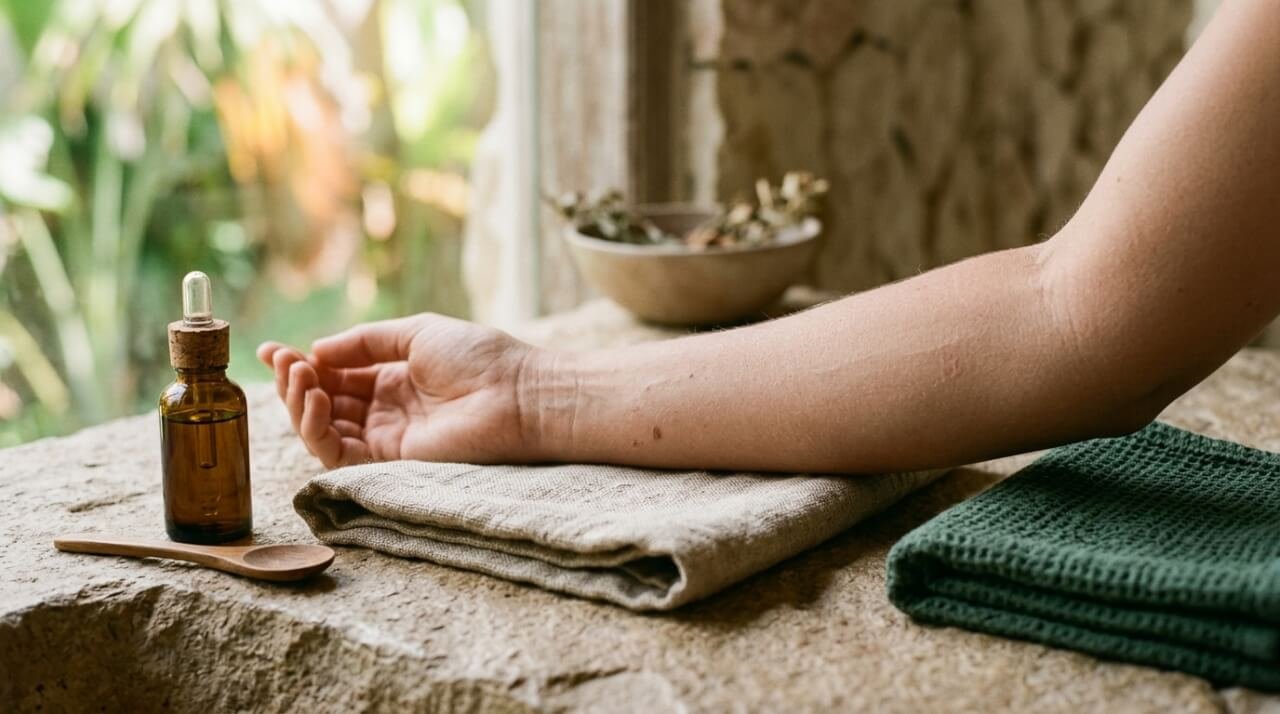
Once skin has calmed, reintroduce anything new one product at a time, patch-tested on the inner forearm for 48 to 72 hours before it goes anywhere near your face. Wait one full week between each new addition. Our guide to how to layer natural skincare covers the order to reintroduce products in once the reset is complete.
Resist the temptation to layer sun protection into this list as a fourth step. It is essential, not optional, but it belongs after the reset’s three steps as a non-negotiable finishing layer rather than part of the count. Choose a mineral formula with a short ingredient list for the same reason as everything else here: fewer compounds for a reactive barrier to process.
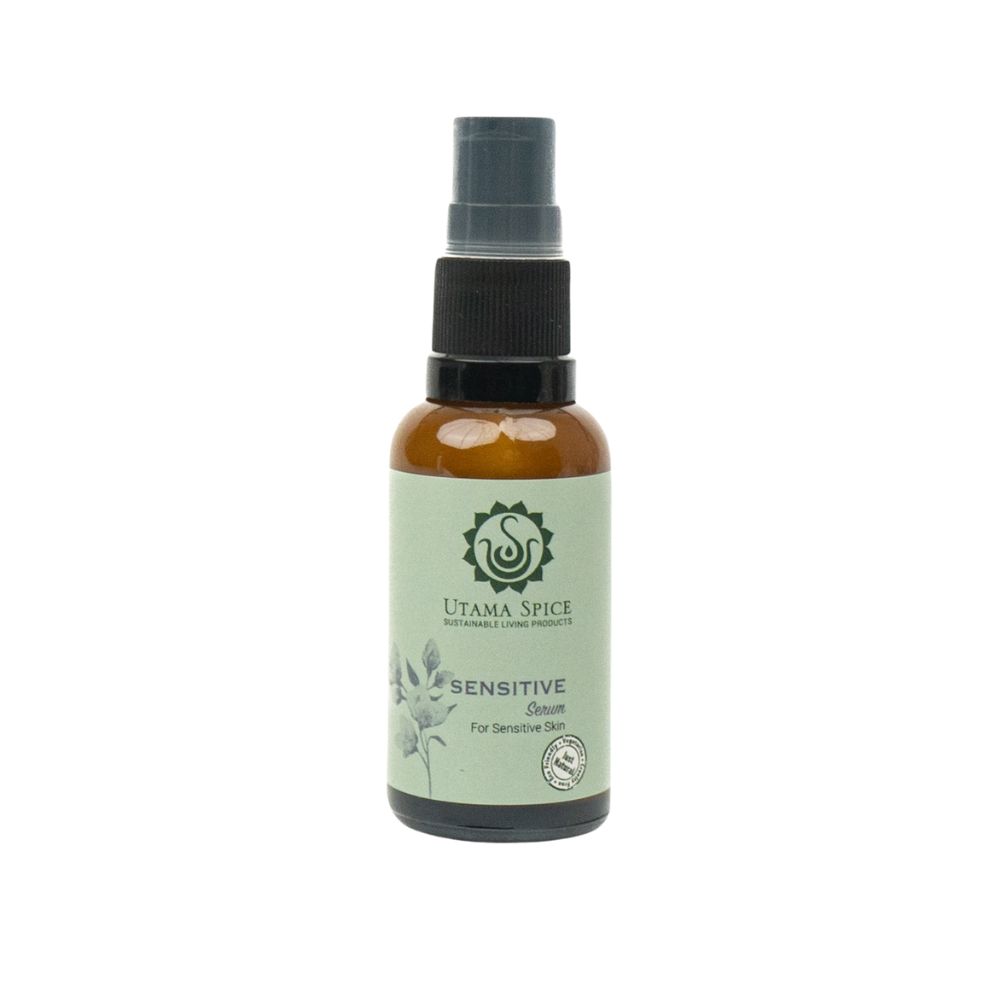
One serum, formulated for reactive skin
Our Sensitive Face Serum was built around the reset described above: a short, fragrance-light formula for skin that reacts easily, not a longer ingredient list to compensate for one that does not work.
What to look for, and avoid, on a natural ingredient label when skin is reactive
Reading a label for reactive skin means looking past the front-of-bottle claims and checking the actual ingredient list, ideally near the top, where concentration tends to be highest.
Watch for these, even in natural formulas
- High concentrations of citrus oils (limonene-heavy), listed early in the ingredient list.
- Denatured alcohol, often used in natural toners for a lightweight feel.
- Strong essential oil blends layered for scent rather than function.
- Multiple acids or exfoliating enzymes stacked in one formula.
- Undiluted vinegar or high-acidity botanical extracts.
Ingredient lists are ordered by concentration, highest first, so an irritant sitting in the first five to seven entries carries far more weight than the same ingredient listed near the bottom. A trace amount of lavender oil at position eighteen behaves very differently on skin than the same oil at position three.
Ingredients that tend to be safer for reactive skin
- Aloe vera, for its soothing, humectant properties.
- Ceramides and ceramide-supporting plant oils, which reinforce rather than strip the barrier.
- Colloidal oat or oat extract, a well-studied calming ingredient.
- Squalane and other lightweight, non-comedogenic emollients.
- Hyaluronic acid, for hydration without added fragrance load.
Our full guide to skincare ingredients to avoid goes deeper on specific INCI names worth knowing. As a general rule, a shorter ingredient list with fewer active fragrance compounds is safer than a longer one, even when every ingredient on it is technically natural. A rich natural face cream can still be reactive-skin friendly, as long as it leans on plant oils and ceramides rather than fragrance for its appeal. The word “fragrance” itself is worth watching too: it is a catch-all term that can legally cover dozens of individual compounds without listing a single one by name, which makes it one of the least transparent words on any label, natural or otherwise.
One more detail worth checking: a product’s pH. Healthy skin sits slightly acidic, around 4.5 to 5.5. Cleansers and toners formulated well outside that range, especially higher, alkaline formulas, can strip the barrier’s protective acid mantle even when every listed ingredient is gentle on its own. It rarely appears on a label, but a brand that publishes it, or answers the question when asked, is usually one worth trusting with reactive skin.
Climate and lifestyle triggers: heat, hot water, and a cooling Balinese approach

Heat, sweat, hot showers, and intense equatorial sun are all well-documented triggers for reactive skin, and they are especially relevant here in Bali, where humidity and sun intensity sit far above what most skincare advice, written for temperate climates, accounts for.
Hot water strips the skin barrier faster than warm or cool water does, so keep showers lukewarm and finish facial cleansing with a cool rinse. Pat skin dry rather than rubbing, and apply moisturizer while skin is still slightly damp to lock in hydration. Keep a chilled bottle of aloe vera gel in the refrigerator during hot months. A thin layer applied after sun exposure or a sweaty day cools skin quickly and reduces the flush that often precedes a reactive episode.
This cooling instinct is not new. Balinese ritual has long paired cleansing with calm rather than intensity, a slower pace, cool water, and simple botanicals rather than a crowded routine. It is worth remembering that wisdom, especially on the days your skin is telling you to do less.
Lifestyle habits outside the bathroom matter too. Tight synthetic fabrics trap sweat against the skin and can worsen reactivity on the jawline and neck, where many people apply skincare last and rinse least thoroughly. Loose, breathable linen or cotton, especially in humid conditions, reduces that friction. Pillowcases carry the same logic: a cotton or linen case washed weekly removes a source of buildup that a reset routine alone cannot fix.
Hydration works from the inside too. Consistent water intake supports barrier function, and in a hot, humid climate, fluid loss through sweat happens faster than most people account for. A simple habit, a glass of water alongside your evening cleanse, is a small, unglamorous part of the same reset.
Frequently asked questions about a sensitive skin routine
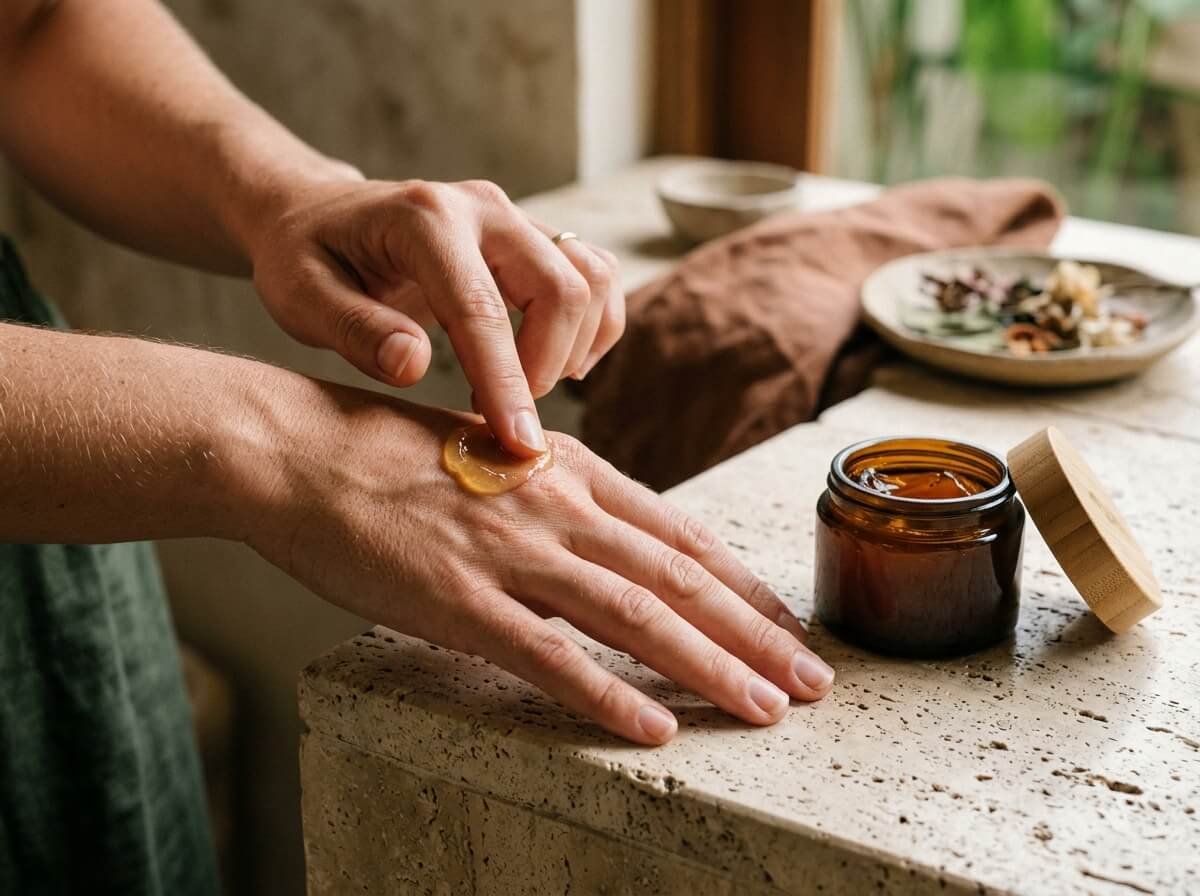
Can sensitive skin use essential oils at all
Sometimes, in very low concentration and well diluted, but during an active reactive period, the safest choice is skipping essential oils entirely. Reintroduce them last, once your barrier has recovered, one at a time.
How long should a patch test run
Apply a small amount to the inner forearm and wait 48 to 72 hours before using a new product on your face. Some reactions take two or three days to appear, so checking after just a few hours is not enough.
Does natural always mean gentler
No. Natural ingredients can still irritate reactive skin, particularly fragrance and citrus oils. Gentleness comes from a short, deliberate formula, not from the word “natural” on the front of the bottle.
When is it time to see a dermatologist
If reactivity persists for more than two to three weeks after a full reset, flares without an obvious trigger, or comes with swelling, blistering, or pain, it is time to bring in a dermatologist. A routine reset like this one is not a substitute for medical care when skin is telling you something more serious is happening.
What if my routine already has too many products to know where to start
Start over rather than trying to audit each item individually. Strip down to the three-step reset above for two weeks, let skin calm fully, then reintroduce your existing products one at a time, patch-testing each before it returns to your face. This tells you exactly which product was the problem, instead of guessing.
Can stress or lack of sleep cause sensitized skin
Yes. Stress hormones and poor sleep both measurably slow barrier repair, which is part of why reactivity often spikes during demanding weeks even without a single new product added. Treat rest as part of the routine, not separate from it.
The actual fix is usually less, not more
A sensitive skin routine does not need to grow every time your skin reacts. Most of the time, it needs to shrink. Tell sensitive from sensitized, strip the routine back to three deliberate steps, read labels for fragrance load rather than marketing language, and let your climate shape the ritual as much as the ingredients do. Care, real care, is often the decision to add less, not more.
What you give, you get back. Give your skin two calm weeks instead of a new product, and it tends to answer honestly, showing you what it actually needed all along.