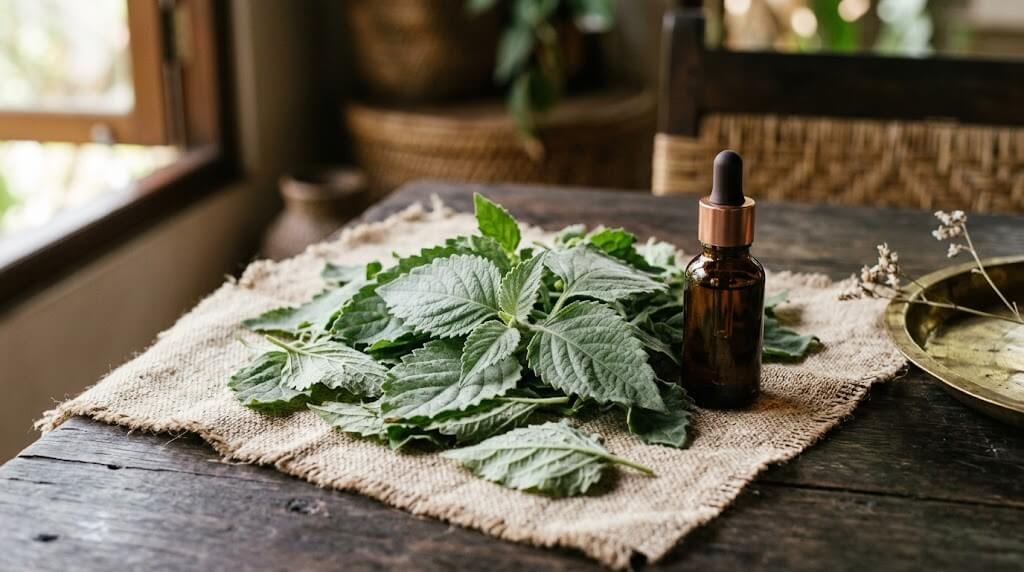
Ingredient Tuesday: nilam (patchouli), Indonesia’s gift to scent and skin
Long before patchouli became shorthand for a 1960s perfume counter, it was a working ingredient on Indonesian farms. The plant is called nilam here, a shrub of the mint family (Pogostemon cablin) that thrives in the warm uplands of Aceh, North Sumatra, and parts of West Java. Indonesia today supplies roughly 90 percent of the world’s patchouli oil, and most of it begins as a pile of sun-cured leaves stacked beside a small village still.
What makes nilam interesting is not the fresh leaf, but what happens after the leaf rests. Farmers harvest the top growth, lay it out to wilt for two or three days, then let it cure under shade for several more. This slow drying breaks down the leaf’s cell walls and develops the heavy, earthy compounds the oil is known for. Steam distillation, often in copper alembics, then yields a thick amber liquid rich in patchoulol, a sesquiterpene alcohol that gives patchouli its deep, woody base note and its long, steady presence on skin.
What the science says
Modern studies are catching up to what traditional Indonesian medicine has worked with for generations. Patchouli oil shows measured antimicrobial activity against common skin organisms, which is one reason it has long appeared in formulas meant for blemish-prone or congested skin. Its sesquiterpene profile also offers natural soothing properties, useful in body care where calm and conditioning matter more than fragrance theatrics.

It is also one of the rare essential oils that genuinely improves with age. Properly stored, patchouli rounds out, darkens, and softens over years rather than fading. Perfumers call this maturation. We call it patience, and it is part of why a small amount goes a long way.
How we use it
In our blends, patchouli is a base, not a headline. It anchors lighter florals and citrus, gives lotions a quiet warmth, and brings a grounded note to ritual scents meant for the end of the day. If you want to understand how oils like this work together, our piece on essential oils, what they do and why sourcing matters walks through the basics. And if you enjoyed last week’s note on kukui oil, nilam belongs in the same conversation: an Indonesian ingredient whose value lies in the slow work it does on skin, not the noise it makes on a label.
One leaf, dried with care, can scent a room for weeks. That is the kind of efficiency we keep returning to.