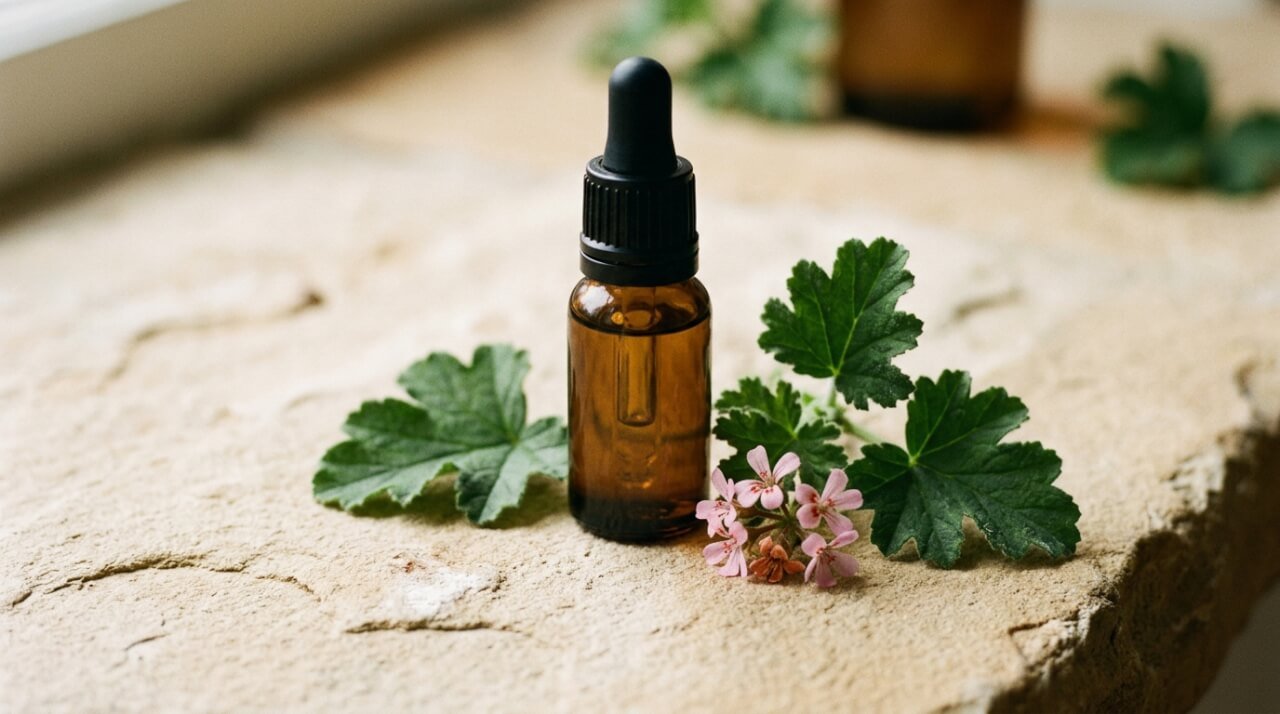
Rose geranium oil benefits: the balancing oil often mistaken for rose
Few oils cause as much gentle confusion as this one. The rose geranium oil benefits people talk about are real, but the oil itself is often misunderstood, sold under a borrowed name, and asked to do the work of a flower it only resembles. It is not rose. It is not quite the geranium on your windowsill either. It is its own quiet, balancing thing, and once you understand what it is, it becomes far easier to use well.
This is an honest guide, written the way we like to write about botanicals: rooted in where the plant comes from, clear about what the science actually supports, and calm about what it does not. We will look at the botany, the aroma chemistry, the benefits for skin and mood, how to use it safely, and how to tell a real bottle from a diluted one. Along the way, we will connect it to the Balinese way of using plant oils as daily ritual rather than quick fixes.
If you take one thing from this guide, let it be this: rose geranium rewards people who understand it. Treat it as a balancing, versatile companion oil rather than a cure for anything, dilute it with respect, and buy it from a source that will tell you the truth about where it came from. Do that, and it becomes one of the most useful bottles on your shelf.
What rose geranium oil actually is (and why it gets mistaken for rose)
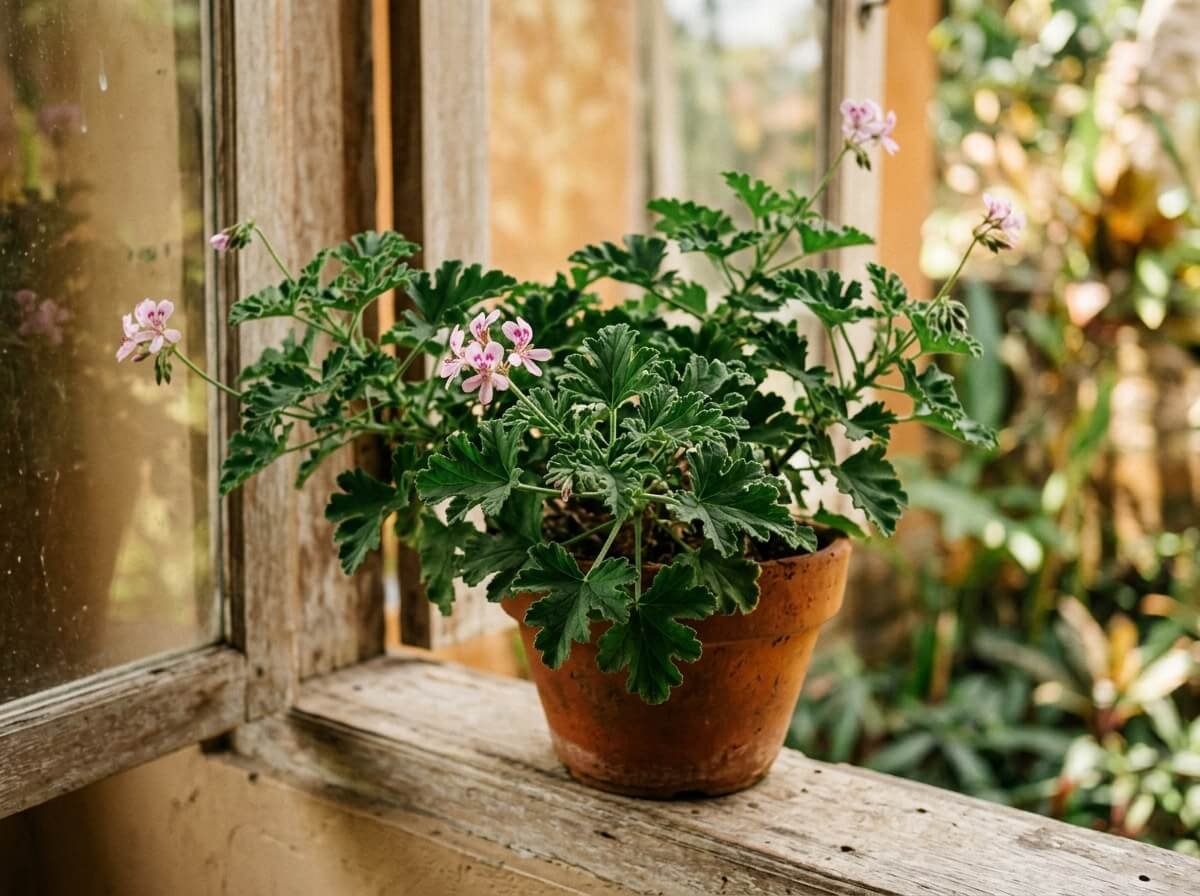
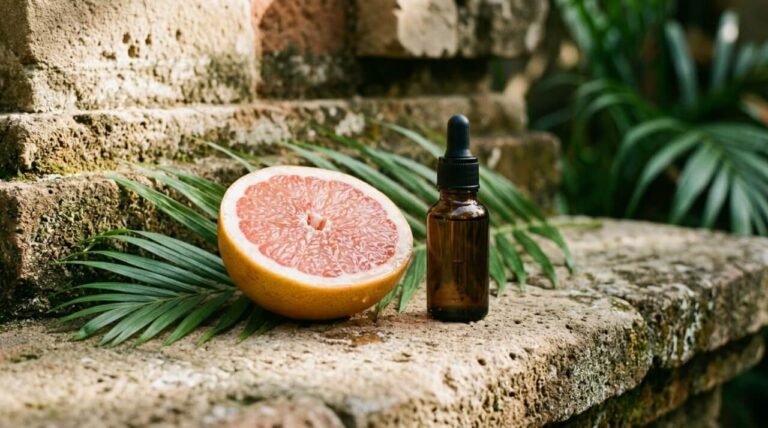
Rose geranium oil is steam-distilled from the leaves and stems of Pelargonium graveolens, and from a closely related plant often labelled Pelargonium roseum. Notice the genus: Pelargonium, not Rosa. This is not a rose. True rose oil comes from the petals of Rosa damascena, and it is one of the most expensive oils in the world. Rose geranium smells rosy because it shares some of the same aroma molecules, not because it shares any botanical family with the rose.
There is a second layer of confusion. The cheerful red flower many people call a geranium is usually a pelargonium too, but the aromatic plant grown for oil is a specific, leafy, strongly scented variety. The oil is pressed from green growth, the leaves and stalks, rather than the flowers. That is why a bottle can smell of roses while the plant it came from looks nothing like one.
Because true rose oil is so costly and rose geranium is far more affordable, rose geranium has long been used as a rose substitute, and sometimes, less honestly, as an adulterant slipped into bottles sold as rose. Knowing this is the first step to buying well. If a rose oil seems suspiciously cheap, rose geranium is often part of the reason. We think that is worth saying plainly, because the essential oil aisle rarely does.
The plant itself has a quietly global story. Native to South Africa, it was carried to Europe and later to the island of Reunion in the Indian Ocean, where the prized Bourbon variety developed its distinctive character. Today the oil is distilled across Egypt, China, and South Africa as well. The distillation is simple in principle: fresh or partly dried leaves and stems are packed into a still, steam is passed through them, and the aromatic oil is carried off with the vapour and separated once it cools. It takes a great deal of green material to fill one small bottle, which is part of why quality and origin matter so much.
The chemistry behind rose geranium oil benefits
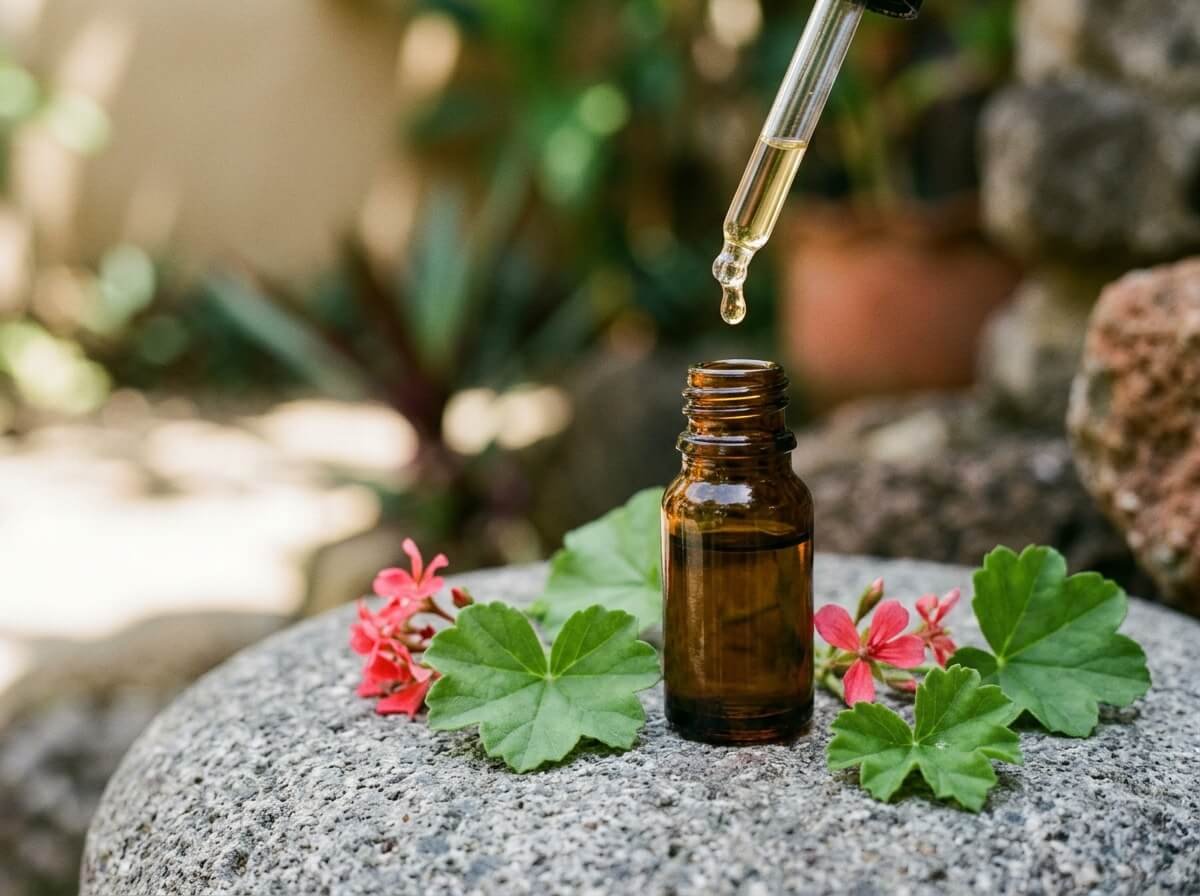
Most of the rose geranium oil benefits you will read about trace back to a handful of aroma molecules, so it helps to know them by name. The oil is rich in geraniol and citronellol, two rose-scented alcohols that also appear in true rose and in citronella. It usually carries linalool, isomenthone, and small amounts of compounds like guaia-6,9-diene. The exact ratio shifts with where the plant grew and how it was distilled, which is why two honest bottles can smell slightly different.
These molecules are the reason rose geranium reads as balancing rather than sweet or heady. Geraniol and citronellol give the soft, rosy top note. The green, minty undertones from isomenthone keep it grounded, so it never tips into the cloying register. In practical terms, that balanced profile is what makes the oil so versatile: it blends easily, it lifts a mood without shouting, and it sits comfortably on skin when properly diluted.
There is a practical footnote worth knowing. Geraniol and citronellol are the same molecules that make citronella a familiar insect deterrent, and rose geranium shares some of that quality. It will not replace a dedicated repellent, but it explains why the oil turns up in natural bug-off blends and why a diffuser of it can gently discourage mosquitoes on a warm evening. The chemistry does more than one job.
It is worth being honest here. Aroma chemistry explains scent and gives us plausible reasons for some skin and mood effects, but a molecule appearing in a lab study is not the same as a proven result on your face. We will hold that distinction throughout, the same way we do when we write about clove essential oil and its eugenol. Real care means naming what we know and what we are still learning.
Rose geranium oil benefits for skin
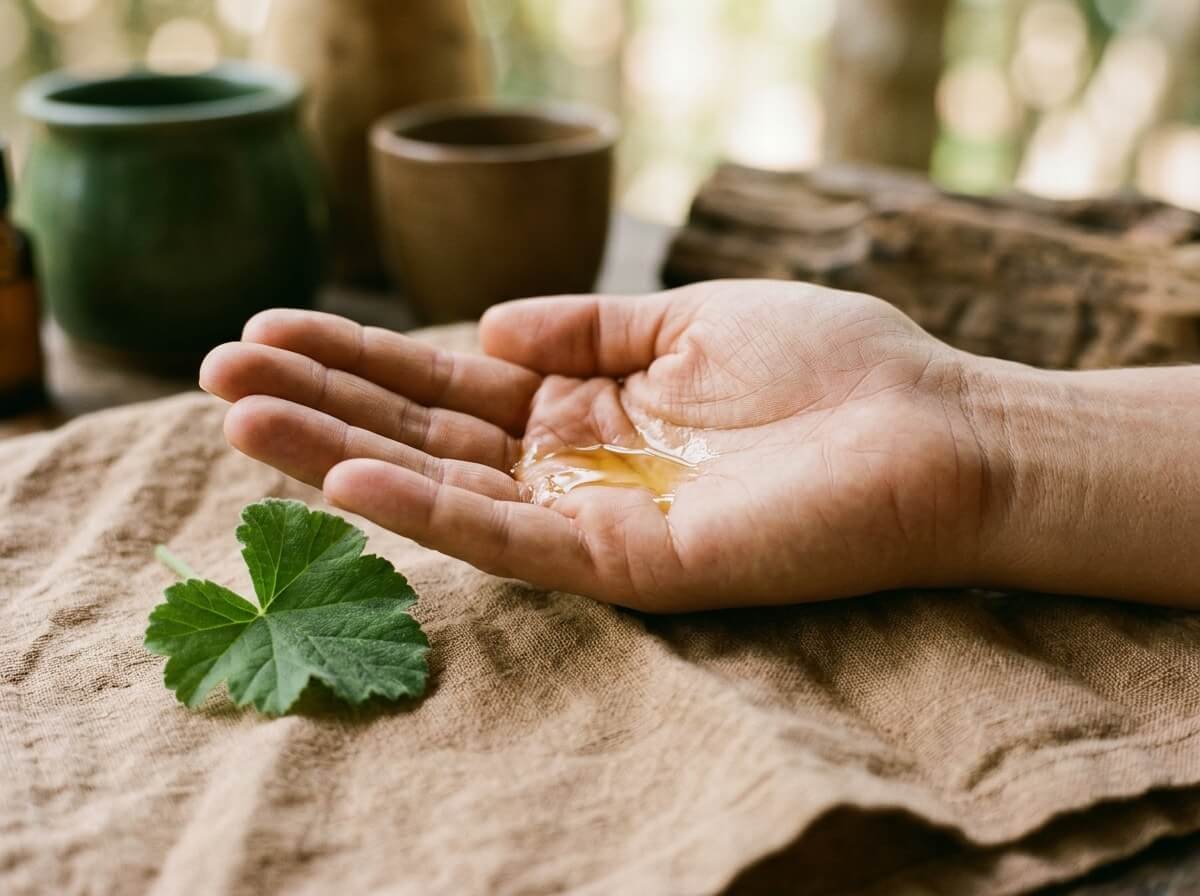
The skin-related rose geranium oil benefits are where tradition and early research overlap most usefully. The oil is mildly astringent, which is why it has a long history as a tonic for skin that feels congested or uneven. Many people find it helps a complexion feel more balanced, less tight in some places and less shiny in others. That balancing reputation is the thread that runs through almost every traditional use.
- Sebum balance: its astringent, toning quality can help skin that swings between oily and dry feel steadier over time.
- Soothing feel: geraniol and citronellol are associated with calming, comforting effects on the look of stressed skin.
- Antimicrobial support: laboratory work suggests the oil can discourage some bacteria and fungi, which is part of why it appears in blends aimed at blemish-prone skin.
- Antioxidant activity: in vitro studies show antioxidant behaviour, though this is a long way from a proven wrinkle treatment.
That last point deserves a plain word. You will see rose geranium sold as a wrinkle cure. The honest position is quieter: there is some antioxidant and soothing evidence, the tradition is genuine, and the results are modest and supportive rather than dramatic. We would rather you trust it for what it reliably does, a balancing, comforting botanical, than feel let down by a promise no plant oil can keep.
It also suits a range of skin types, which is unusual. Because its defining quality is balance rather than a single strong action, it tends to play well whether your skin leans oily, dry, or somewhere in between. Combination skin, the kind that is shiny across the forehead and tight at the cheeks, is where people most often notice the steadying effect. As with any active botanical, the change is gradual. Skin responds to consistency over weeks, not to a single dramatic application.
One rule holds firm: rose geranium is an essential oil, so it is never applied neat. It belongs in a carrier. A cold-pressed carrier such as our Virgin Coconut Oil turns a few potent drops into a spreadable, skin-friendly blend. For skin that reacts easily, a gentle pre-made formula like our Sensitive Face Serum takes the guesswork out of dilution entirely. To build your own facial blend, start with a single drop of rose geranium in a teaspoon of carrier, use it in the evening, and see how your skin feels after a week before adding any more.

Beyond skin: scent, mood, and daily ritual

Rose geranium earns its place in aromatherapy through that same balancing character. In diffusion or on the wrists, its soft, rosy-green scent is widely used to steady the mood, to ease the edge off a tense afternoon, and to bring a sense of settled calm. Traditional aromatherapy has long reached for it during times of hormonal change and premenstrual tension, valued more for how it makes people feel than for any single clinical claim.
In Bali, plant oils have never been quick fixes. They are part of ritual, applied slowly, with attention, often as massage. If you have read our guide to Balinese massage oil, you already know the rhythm: warm oil, unhurried hands, breath. Rose geranium sits beautifully in that practice, and it pairs naturally with other Indonesian botanicals we love, the grounded depth of patchouli, the floral warmth of ylang ylang, and the temple-flower softness of cananga. Together they make a scent that feels rooted in place. Our wider notes on Indonesian wellness at home show how these small daily practices add up.
If you want to experience rose geranium in daily ritual without blending anything yourself, our Rose Allure Body Oil pairs it with cold-pressed coconut oil in a ready-to-use body oil. It is the simplest way to bring this balancing botanical into your routine, smoothed over damp skin after a shower the way we describe in our note on oiling damp skin.

Rose geranium, ready for your ritual
Our Rose Allure Body Oil blends rose geranium with cold-pressed Balinese coconut oil, so you get the balancing botanical already diluted and ready to smooth over damp skin. Crafted in small batches, made to be refilled.
How to use rose geranium oil safely
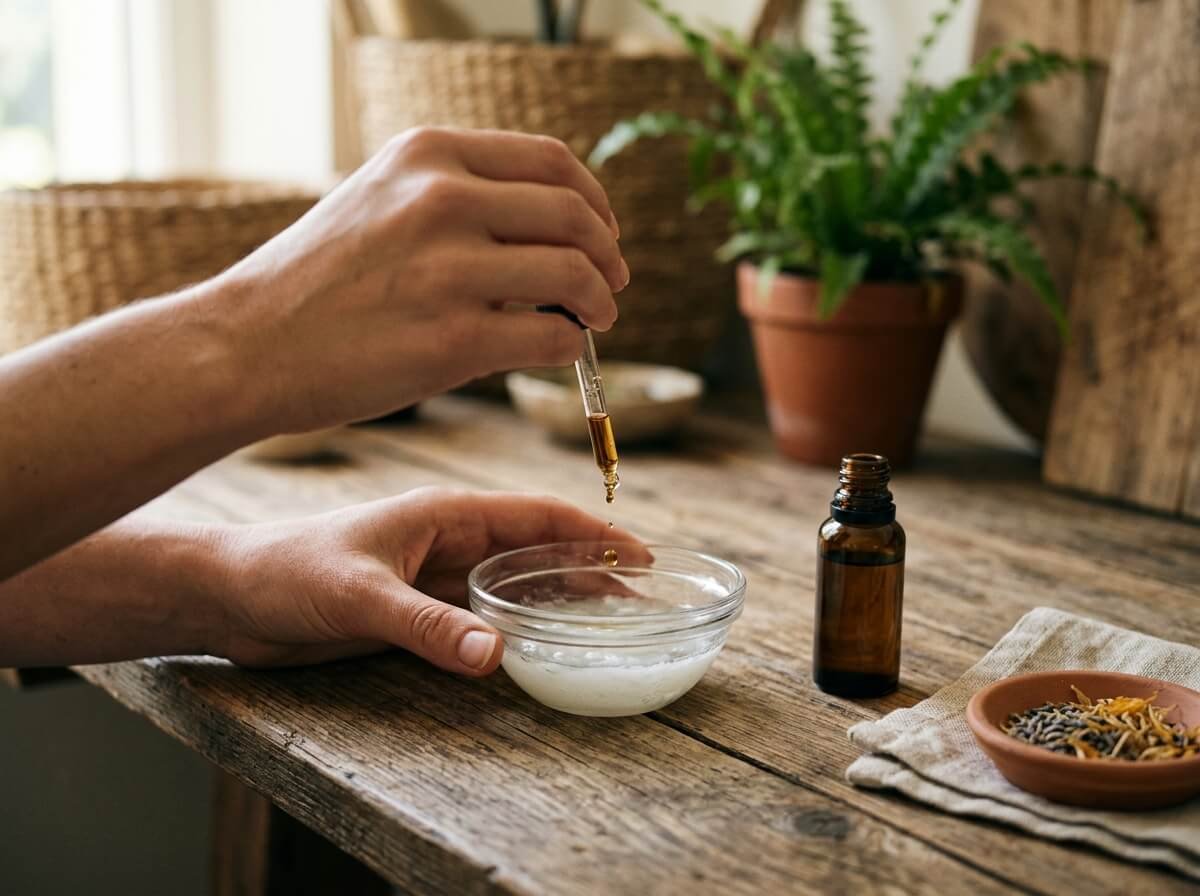
Rose geranium is gentle by essential oil standards, but gentle is not the same as consequence-free. A little care makes all the difference, and none of it is complicated.
- Always dilute. Keep it to roughly 1% to 2% in a carrier oil for skin, which is about six to twelve drops per 30 ml. Never apply it neat.
- Patch test first. Dab a diluted drop on your inner forearm and wait 24 hours. Geraniol and citronellol are recognised skin allergens, which is why the EU lists them on labels, so anyone with sensitive or reactive skin should go slowly.
- Good news on sun exposure. Unlike citrus oils, rose geranium is not considered phototoxic, so it will not react with sunlight the way cold-pressed lemon or bergamot can. That makes it an easy choice for daytime blends.
- Pregnancy and children. If you are pregnant, breastfeeding, or blending for a child, keep dilutions low and check with a qualified practitioner first. Traditional use during hormonal change is common, but caution is the kinder default.
If measuring drops feels fiddly, a pre-blended product removes the risk of over-concentration entirely. This is one reason we blend oils like our Bliss Essential Oil Blend and our finished body oils at safe, tested ratios, so the care is built in before the bottle reaches you.
Storage matters more than people expect. Keep the bottle tightly closed, away from heat and direct light, and it will hold its character for a good two to three years. Essential oils do not spoil the way food does, but they do slowly oxidise, and an oxidised oil is more likely to irritate skin. If your bottle starts to smell sharp or flat rather than soft and rosy, it has had its day, and it is better retired to a room diffuser than put on your face.
Simple ways to bring rose geranium into your week
You do not need a shelf of equipment to enjoy this oil. A few small rituals cover most of what people reach for it to do, and each one keeps the dilution safe by design.
- An evening diffuser blend: three drops of rose geranium with two of a grounding oil like patchouli, to soften the shift from a busy day into a slow evening.
- A balancing body ritual: smooth a ready-blended rose geranium body oil over damp skin straight after a shower, when warm skin drinks it in most easily.
- A calming bath: stir four to six drops into a tablespoon of carrier oil or a handful of bath salts before adding them to the water, so the oil disperses instead of sitting on top.
- A wrist-and-breath pause: keep a pre-diluted roller nearby, roll a little onto your wrists, cup your hands, and take three slow breaths when the afternoon gets loud.
How to buy a real bottle of rose geranium oil
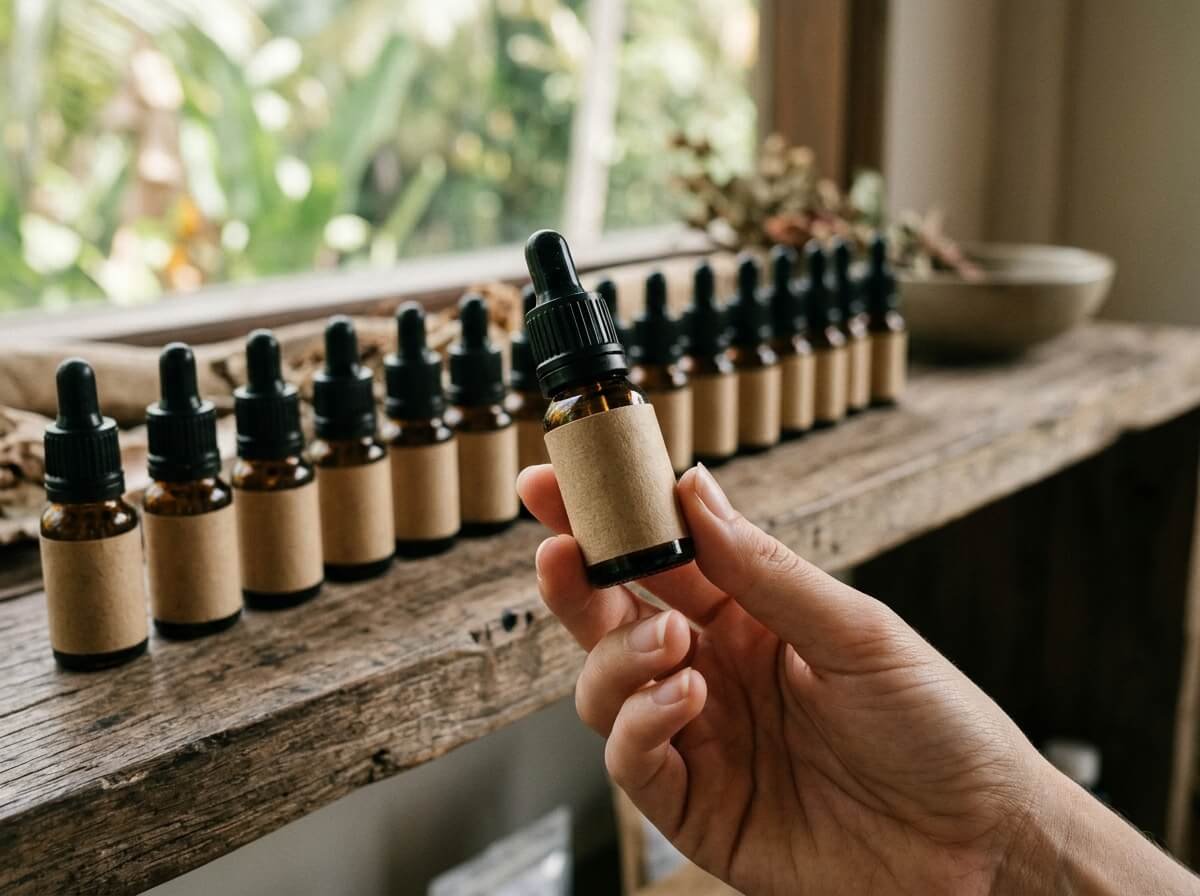
Because rose geranium is so often used to stretch or fake more expensive oils, learning to read a label protects both your skin and your money. Here is what an honest bottle tells you.
- The Latin name. Look for Pelargonium graveolens or Pelargonium roseum printed clearly. A bottle that only says “rose geranium fragrance” is telling you it is a scent, not an oil.
- Country of origin. Quality rose geranium comes from places like Egypt, South Africa, China, and the island of Reunion, whose Bourbon geranium is especially prized. Origin should not be a secret.
- Pure, undiluted, and single-species. The label should confirm it is 100% essential oil with nothing added, and ideally that it has been tested by GC/MS, the gas analysis that reveals what is genuinely inside.
- Amber glass, sensible price. Light degrades essential oils, so real ones live in dark glass. And if the price looks too good next to true rose oil, remember that rose geranium is the affordable cousin, not a bargain rose.
There is a sustainability layer here too. A well-made rose geranium depends on healthy soil, careful harvesting, and growers who are paid fairly for slow, seasonal work. When a bottle is unusually cheap, someone or something upstream is usually absorbing the cost, whether that is the land or the people working it. Buying honestly is not only about protecting your skin. It is part of the same circle of care that runs through everything we make in Bali, where sourcing and craft are inseparable.
This is where our Outlaw streak shows. The natural aisle is full of vague labels and borrowed names, and we think transparency should be the standard, not the exception. Ask where a plant grew, who distilled it, and what is actually in the bottle. A brand that cares will have the answers ready.
Common questions about rose geranium oil
Is rose geranium oil the same as rose oil?
No. Rose oil is distilled from Rosa damascena petals and is one of the most expensive oils there is. Rose geranium is distilled from Pelargonium graveolens leaves and stems. They share some rosy aroma molecules, which is why rose geranium is often used as a more affordable rose-like alternative.
Can I put rose geranium oil directly on my face?
Not undiluted. Blend it into a carrier oil at around 1% to 2%, or reach for a pre-formulated serum or body oil where the dilution is already done for you. Always patch test first, especially if your skin reacts easily.
What does rose geranium oil smell like?
Soft and rosy with a green, faintly minty undertone. It is lighter and more balanced than true rose, which is exactly why it works so well in blends and daily rituals.
Rose geranium is a quiet, dependable botanical: rosy without the rose price, balancing without the drama, and honest once you know how to read it. Used with care and diluted with respect, it earns a lasting place in a grounded, natural routine. That, more than any single claim, is the real benefit worth keeping.