Wellness Wednesday: what aromatherapy actually does to your nervous system
The pathway no other sense has
Smell is the only sense that travels to the brain without stopping at the thalamus first. Every other sense — sound, sight, touch, taste — passes through the thalamus, the brain’s relay station, before reaching the cortex where we process and interpret it. Smell takes a shorter road. Scent molecules bind to receptors in the nose, and signals travel directly to the olfactory bulb, which sits at the edge of the limbic system: the seat of emotion, memory, and the stress response.
This is why a scent can shift your mood before you have time to think about it. It is not placebo. It is anatomy.
What the research shows
The most studied compound in aromatherapy is linalool, a naturally occurring terpene found in lavender (and in lower concentrations in sandalwood, rosewood, and certain citrus blossoms). A 2018 study published in Frontiers in Behavioral Neuroscience found that inhaled linalool reduced anxiety markers in mice without acting on GABA receptors directly in the way that pharmaceutical anxiolytics do — instead, linalool appeared to activate GABA signalling via the olfactory nervous system, without requiring absorption into the bloodstream.
Limonene, the dominant terpene in citrus oils, has been shown in multiple small trials to elevate mood and reduce cortisol levels in hospitalized patients and people with mild depressive symptoms. The mechanism is less clear than for linalool, but the limbic connection is consistent.

Sandalwood and vetiver work differently. Their compounds interact more with the alpha-adrenergic system, which governs alertness and the sensation of being grounded. They are why base notes in a blend feel anchoring rather than uplifting.
Inhalation versus topical application
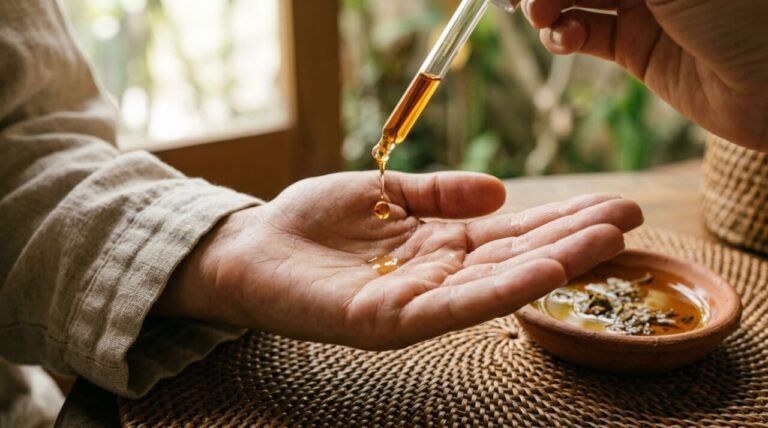
For nervous-system effects, inhalation is the primary route. Diffusing an oil or adding a few drops to a palm inhaler delivers scent molecules to the olfactory epithelium quickly and with minimal dilution. Topical application — as in a body oil, balm, or massage blend — works through two pathways simultaneously: skin absorption of volatile compounds and inhalation of what evaporates off the skin’s surface. The warmth of the body helps volatilise the oil, which is why a chest rub of eucalyptus or cajeput feels so effective. If you want to use essential oils on skin, dilution in a carrier oil slows the evaporation rate and protects the skin — slower release, longer effect.
One honest caveat
Aromatherapy is not a clinical intervention. The studies are mostly small, and few pharmaceutical-grade trials exist. What the research does support is real — measurable physiological responses to specific volatile compounds — but aromatherapy works best as a daily care practice, not a replacement for medical treatment. The value is in the ritual: a quiet morning pause, a grounding inhale before a difficult conversation, a warm bath with a few drops of something you love. These moments are biological as much as they are intentional.
For a practical look at how different oils affect focus and mental clarity, the guide to essential oils for focus covers the compounds behind alertness and concentration specifically.