Turmeric for skin: kunyit, the golden root of Balinese ritual
Turmeric for skin is one of those traditions that arrived long before the research did. In Bali we call it kunyit, the golden root pounded into ritual pastes for generations, carried to weddings, folded into the temple offerings, worn on the skin as much as eaten. Today the same root sits in serums and masks around the world, often oversold and under-explained. This guide is our attempt to give it back its honesty: what turmeric for skin can genuinely do, what the science supports, where the folklore runs ahead of the evidence, and how to use it without turning your bathroom yellow.
We have been hand-blending botanicals in Bali since 1989, and kunyit has been in the kitchen the whole time. So we will speak plainly, the way a maker would, rooted in tradition and grounded in what actually holds up. If you want the short version: turmeric is a calm, brightening, gently clarifying botanical, not a cure. Used with respect, it earns its place. Used as a miracle claim, it disappoints. Let us walk through it properly.
What turmeric for skin actually does
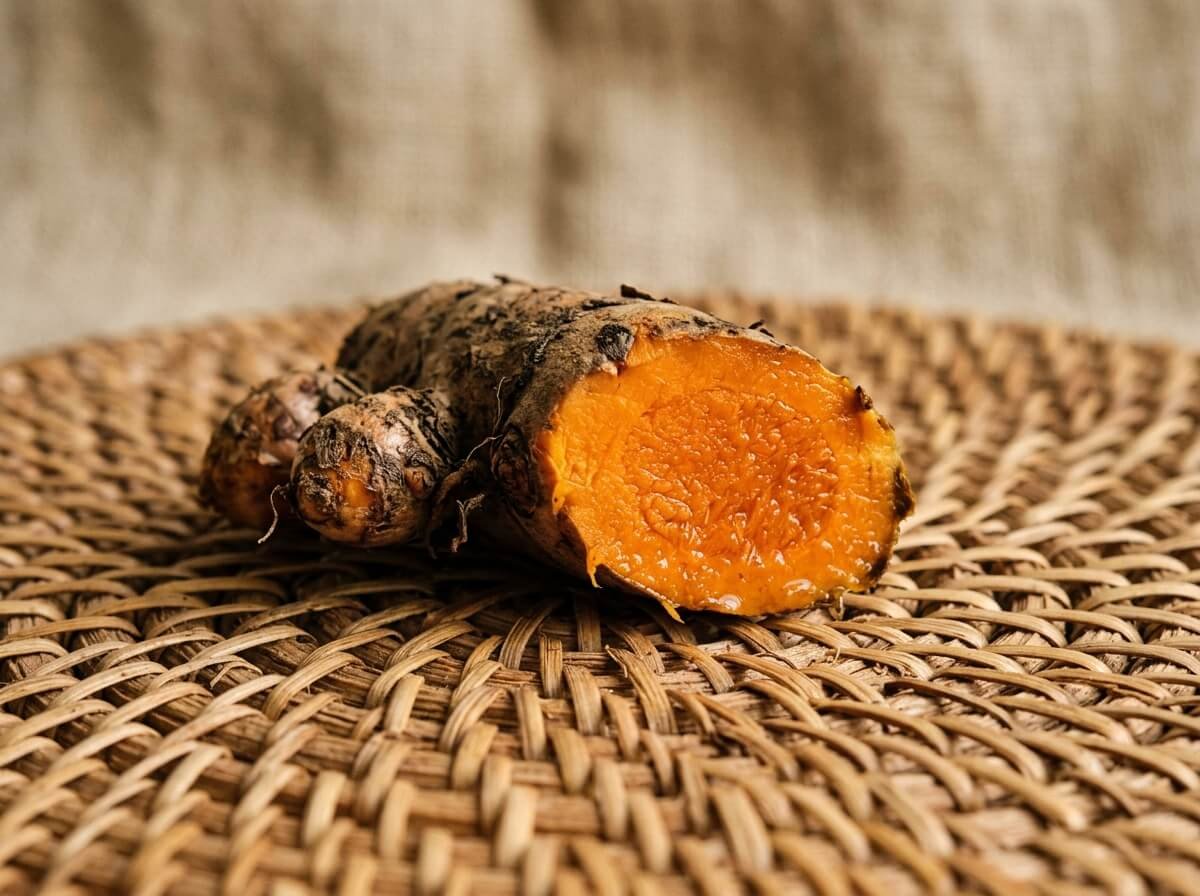
Turmeric is a rhizome, an underground stem in the ginger family, and its active reputation rests mostly on a group of yellow compounds called curcuminoids, curcumin chief among them. On the skin, turmeric earns its keep in three quiet ways rather than one loud one.
First, it calms. Turmeric has a long record of soothing the look of redness and irritation, which is why traditional pastes were laid over tired, sun-worn, or inflamed skin. Second, it brightens. Not by bleaching, but by helping to even the appearance of dull, uneven tone over time, so skin looks clearer and more awake. Third, it clarifies. Turmeric has been used to keep breakout-prone skin in balance, part of why it appears in so many cleansing rituals across South and Southeast Asia.
It also helps to know what turmeric is not. It is not an exfoliating acid, so it will not resurface skin the way a glycolic or lactic acid does. It is not a retinoid, so it does not push cell turnover in the same measured way. What it offers instead is a gentler kind of support, closer to the botanical care our grandmothers practised than to a laboratory active. That difference is a feature, not a shortcoming. For skin that finds strong actives too much, a calming root that works with the skin rather than against it is often exactly what has been missing.
What it does not do is transform your skin overnight, erase years, or replace a considered routine. Turmeric is a supporting player, a botanical that nudges skin toward balance. That framing matters, because most disappointment with turmeric comes from expecting a headline result from a gentle root. Treat it as part of a wider practice, the way it has always been used, and it rarely lets you down. If you are building that wider practice from scratch, our guide to Balinese skincare and its heritage ingredients is a good place to see where a root like this fits.
The science of curcumin, honestly
Here is where we part ways with the hype. Curcumin is genuinely interesting to researchers. It behaves as an antioxidant, meaning it helps neutralise the reactive molecules that age and stress the skin, and it shows anti-inflammatory activity in study after study. Reviews of topical and oral turmeric have reported improvements in skin conditions linked to inflammation, and small trials have looked at its role in tone, wound support, and the visible signs of environmental stress.
The honest caveat is bioavailability. Curcumin is poorly absorbed and unstable on its own, which is precisely why traditional recipes almost never used turmeric alone. Kunyit was blended with oils, with rice, with other botanicals, combinations that, we now understand, help the actives do their work and stay put on the skin. Tradition solved the delivery problem centuries before the word bioavailability existed. That is one of our six beliefs in practice: tradition is innovation, ancestral knowledge as a blueprint for modern wellbeing.
There is one more piece of the science worth naming: protection. Environmental stress, from sun to pollution, drives much of what we think of as premature ageing, and antioxidants are part of how skin defends itself. Turmeric adds to that defensive layer. It is not a sunscreen, and nothing here replaces daily protection, but a botanical that helps skin cope with oxidative stress is a sensible companion to the basics. This is also why turmeric tends to appear in routines aimed at keeping skin resilient rather than in quick-fix regimens.
So when you read that turmeric is scientifically proven to do this or that, hold it lightly. The direction of the evidence is encouraging, especially for calming and brightening the look of skin. The certainty some brands project is not there yet. We would rather tell you that than sell you a promise. Ancient knowledge meets modern research, always transparent, and sometimes transparency means saying the studies are promising but not finished.
Kunyit in Balinese ritual
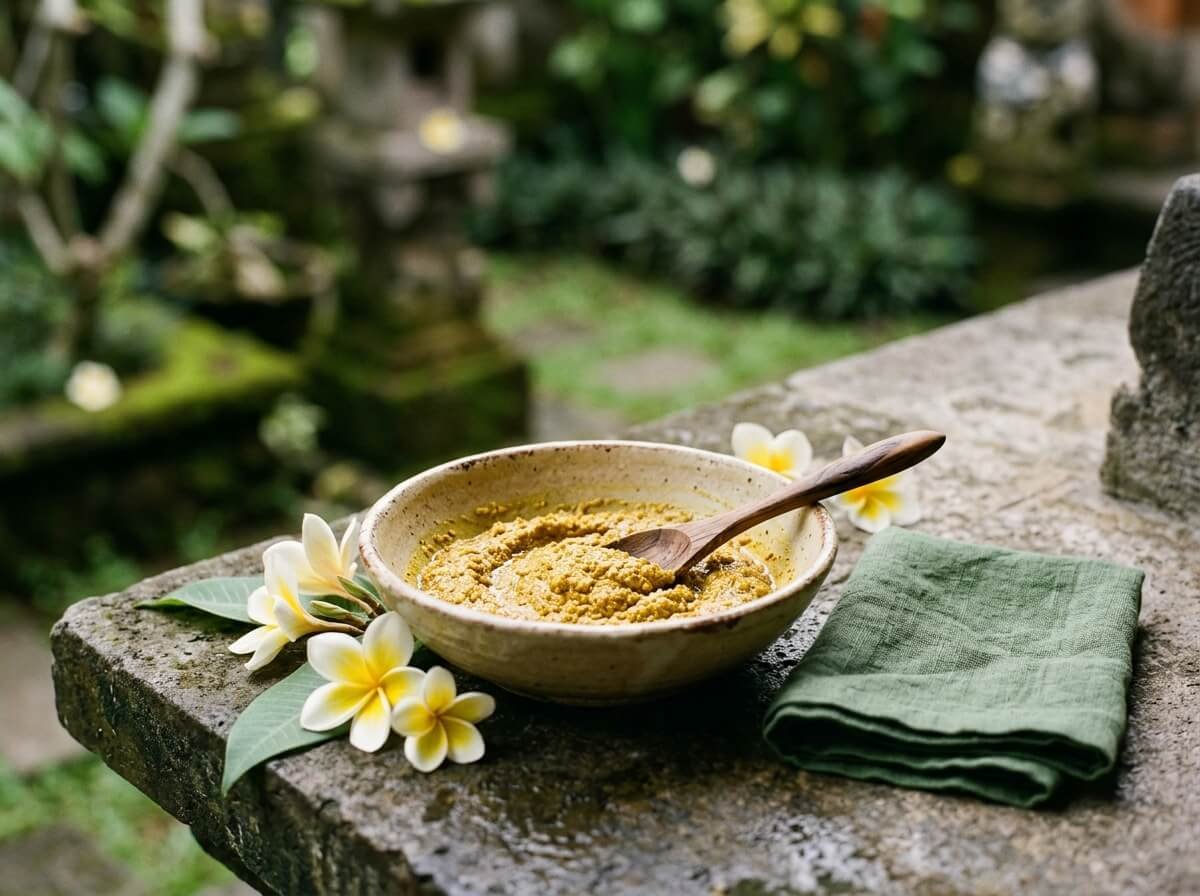
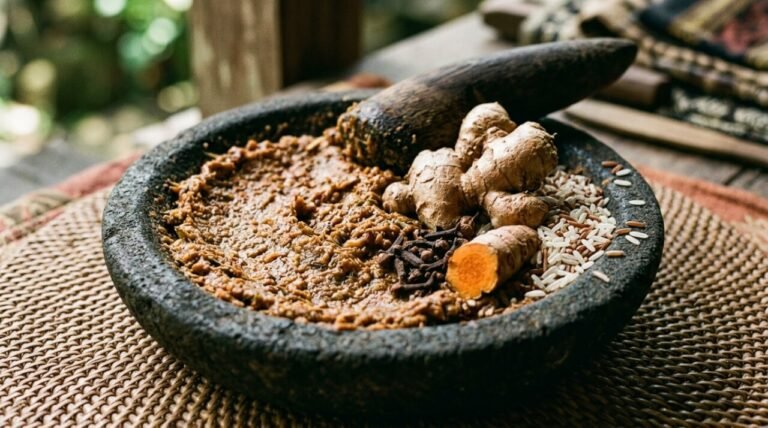
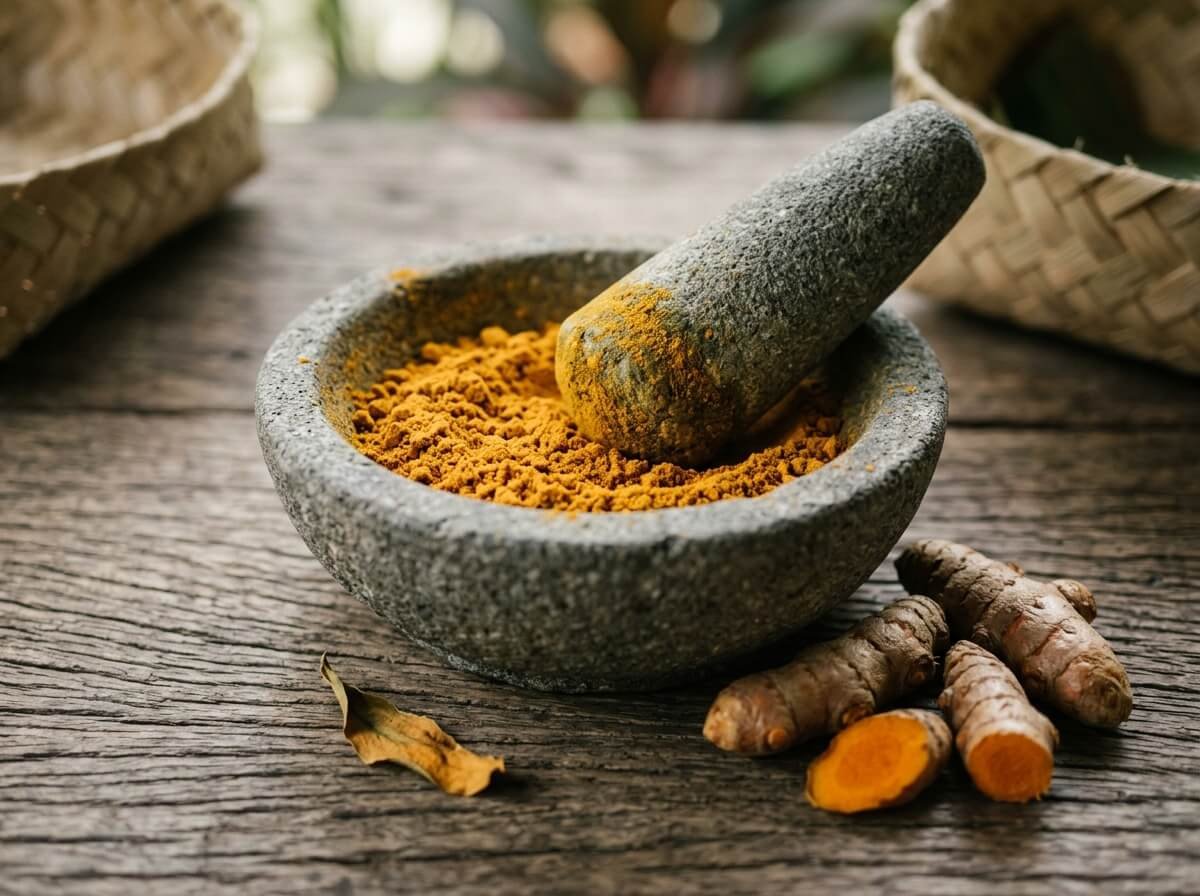
In Bali, turmeric is not a skincare ingredient so much as a thread running through daily and ceremonial life. The most familiar example is lulur, the golden body treatment traditionally given to brides in the days before a wedding. Kunyit is ground with rice flour and other botanicals into a warm paste, massaged over the body, left to dry, then rubbed away to lift dead skin and leave a soft, luminous finish. It was care, celebration, and community in one bowl.
Alongside lulur sits boreh, a warming spiced paste used to ease tired muscles and ward off chill, and countless household remedies passed between generations. What unites them is a relationship with the plant, not a transaction. The root was grown nearby, prepared by hand, and used with intention. This is the part that mass-market skincare tends to strip away when it lifts an ingredient out of its culture and prints its name on a label.
There is a livelihood in that bowl too. The botanicals we blend pass through many hands before they reach a jar, and we work to make sure those hands are treated fairly, through partnerships like the Munti Gunung social enterprise, which supports women and families in East Bali with real work and skill-building. A root grown, harvested, and prepared with care carries that care forward. When we talk about turmeric for skin, we are also talking about the people and the place it comes from, because for us the two were never separable.
We hold this carefully. Turmeric belongs to many traditions across Indonesia, India, and beyond, and it deserves to be represented accurately rather than flattened into a trend. When we work with kunyit, we try to honour where it comes from and the hands that have carried it. If the wider ritual context interests you, the lulur tradition also shapes how we think about exfoliation in our honest guide to natural face scrubs.
Turmeric for different skin concerns
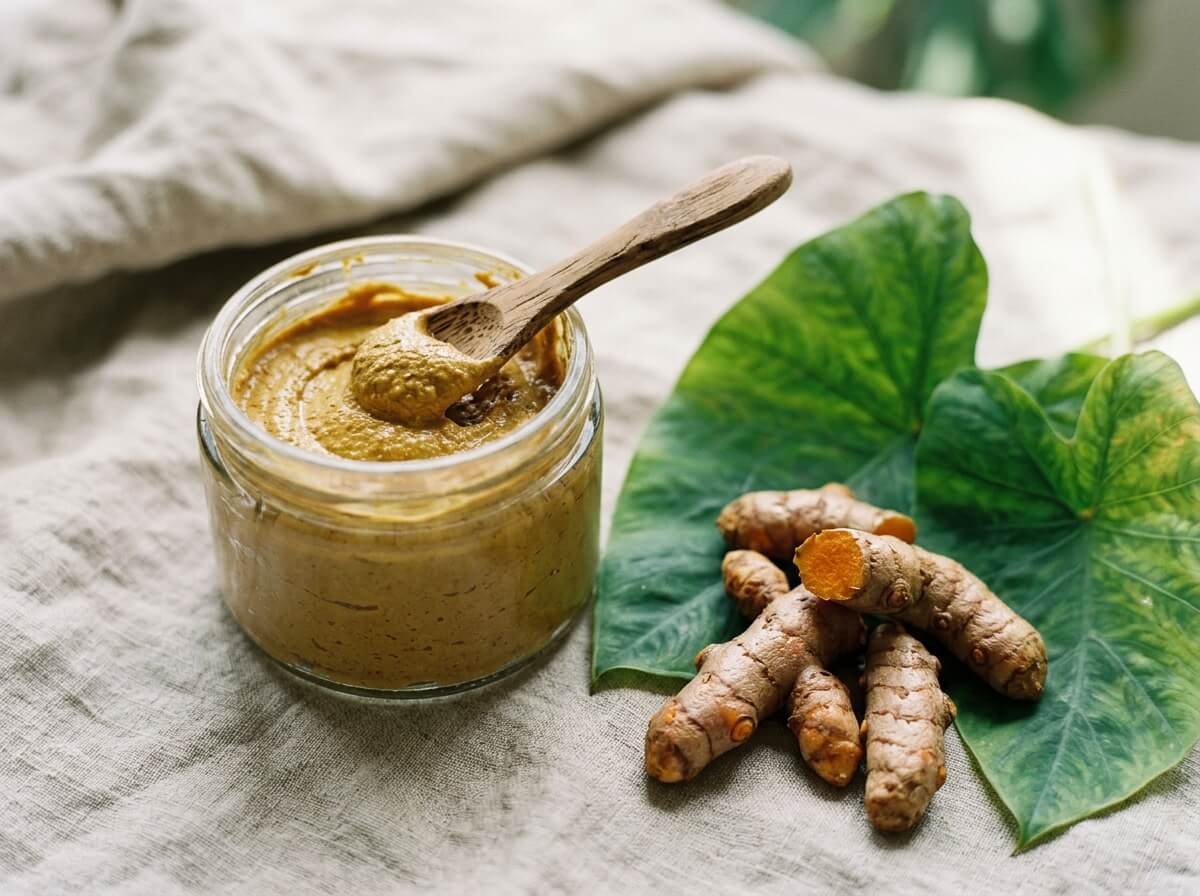
Turmeric is versatile, but versatile does not mean identical for everyone. Here is how we think about it, concern by concern.

- Dullness and uneven tone. This is turmeric at its most reliable. Regular, gentle use can help skin look clearer and more even over weeks, not days. Pair it with rest, water, and sun sense rather than expecting it to work alone.
- Breakout-prone skin. Turmeric’s clarifying and calming reputation makes it a thoughtful ally when skin runs congested. It sits well alongside a simple routine, which we cover in our routine-first guide to natural acne care.
- Sensitive or reactive skin. The soothing side of turmeric can suit sensitivity, but a strong DIY paste can also feel too much. Formulated, buffered products are usually the calmer choice here, and a lightweight option like our Sensitive Face Serum can carry the calm without the mess.
- Tired, stressed skin. As an antioxidant botanical, turmeric fits into the same family of care as our other tropical actives. If you want the wider picture, our overview of plant-based skincare for mature skin puts turmeric in context with oils and butters.
Whatever your concern, turmeric works best inside a routine, not in place of one. Cleanse first so the botanical meets clean skin. Follow a mask or turmeric step with a moisturiser or facial oil to seal in comfort, because clarifying care can leave skin wanting hydration afterwards. And protect in daylight, since brighter, more even-looking tone is easy to undo with unguarded sun. Turmeric is one thoughtful step among a few simple ones, and it shines when the basics around it are steady.
The format you choose matters as much as the concern. A clay-and-turmeric mask draws and clarifies, which suits congested and dull skin, much like the balance we describe in our guide to a clay mask for oily skin. A leave-on serum or oil delivers the calming, brightening side more gently over time. For most people, the easiest and least messy way to bring turmeric for skin into a routine is a well-made mask a couple of times a week. Our Temu-Temu Face Mask is built exactly around this idea, pairing white clay with temulawak, a golden cousin of turmeric grown across the Indonesian archipelago.

Golden clarity, the Balinese way
Our Temu-Temu Face Mask blends white clay with temulawak, turmeric’s golden cousin, to gently draw, clarify, and restore radiance. One small pot, an ancient ritual, hand-blended in Bali.
How to use turmeric for skin without the stain
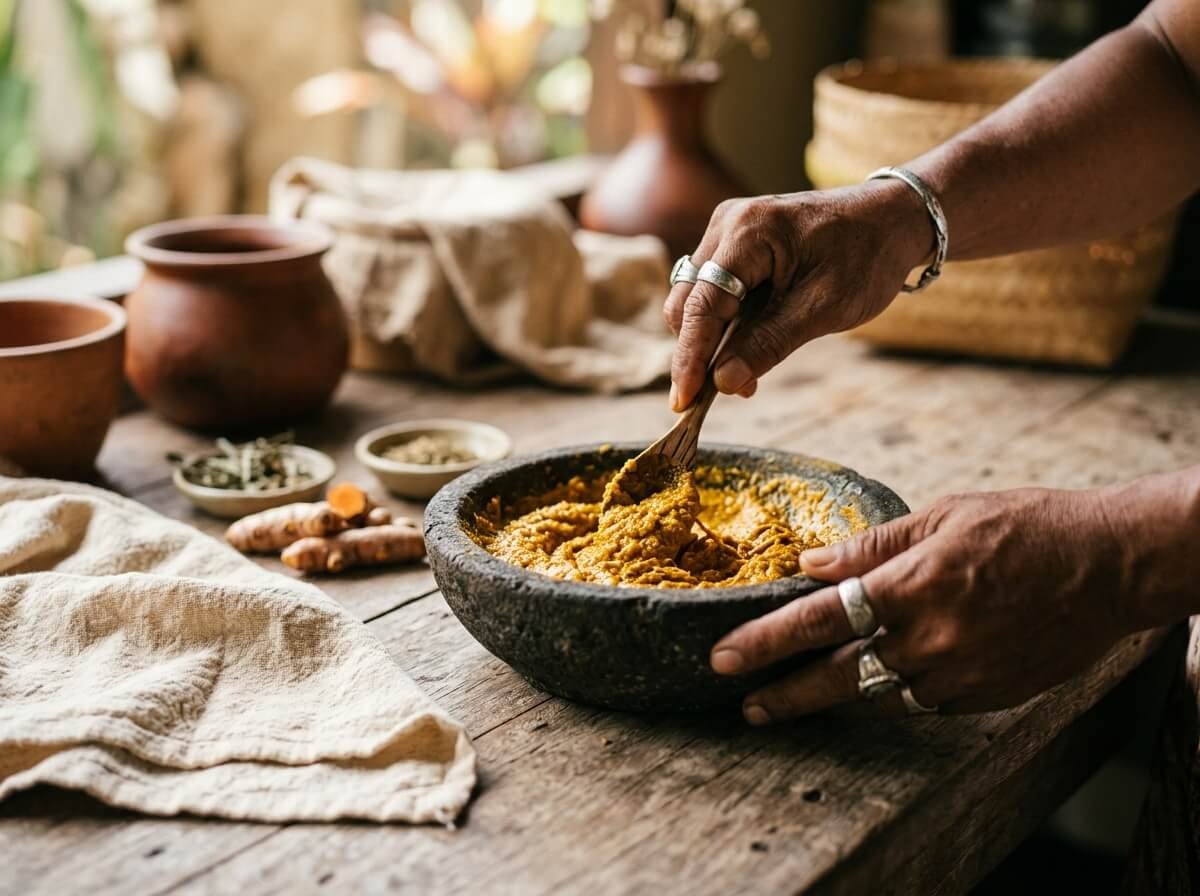
The single biggest worry people have about turmeric for skin is the yellow. It is a real concern, and it is manageable. Turmeric can temporarily tint skin, nails, cloth, and grout, but a few habits keep it in check.
- Choose the right turmeric. Cosmetic and Kasturi-style turmeric varieties are prized precisely because they stain less than the culinary root. Formulated masks are balanced to minimise tint from the start.
- Keep the dose small. A little kunyit goes a long way. In a home paste, a quarter teaspoon in a spoonful of base is plenty. More turmeric does not mean more benefit, it means more mess.
- Buffer it. Blend turmeric with clay, honey, yoghurt, or a carrier oil rather than applying it neat. This is exactly the traditional approach, and it also tempers the colour.
- Mind your timing. Leave a mask on for 10 to 15 minutes, not an hour. Longer does not deepen results, it deepens the stain.
- Rinse smart. Remove with a gentle cleanser and a soft cloth. If a faint warmth of colour lingers, a swipe of oil or a cream cleanser lifts it. A clay-based wash such as our Pore Cleansing Facial Wash with Clay helps clear residue cleanly.
If you do want to make a simple paste at home, keep it humble. Stir a small pinch of cosmetic turmeric into a teaspoon of plain yoghurt or honey, or into a little clay loosened with water, until you have a smooth, spreadable paste. Yoghurt brings a soft lactic gentleness, honey adds calm and slip, and clay draws and clarifies. Apply a thin, even layer, avoid the delicate eye area, and rest while it sets. This is the same logic as the traditional recipes, just scaled to a single face, and it keeps both the mess and the guesswork low.
If you prefer to skip the kitchen chemistry altogether, a ready-made mask removes the guesswork. You get the buffering, the dose, and the staining all handled for you. For fuller exfoliation days, some people alternate a turmeric mask with a gentle scrub like our Green Leaf Face Scrub, or reach for the multi-use Face and Body Clay when they want to treat body and face together in one ritual. Whichever route you take, patch test first on the inner arm, especially if your skin runs sensitive.
Choosing turmeric skincare worth your trust
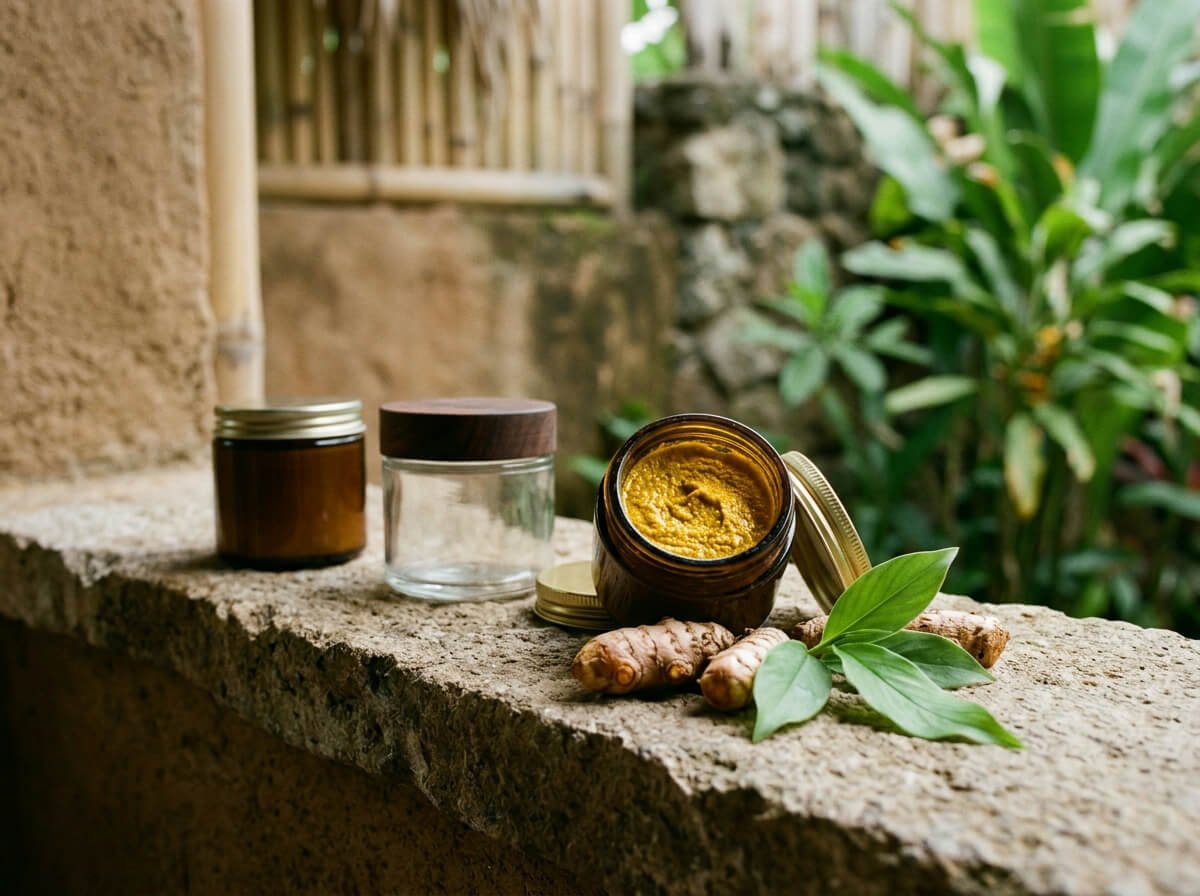
Turmeric is having a moment, which means the shelves are crowded with products that borrow its glow and little else. We do not name competitors, but we will name the patterns worth watching. Here is how to read a turmeric label with clear eyes.
- Find the turmeric in the list. Look for Curcuma longa, Curcuma xanthorrhiza (temulawak), or a named turmeric extract reasonably high in the ingredients, not buried at the bottom as a token. Position on the list roughly tracks quantity.
- Beware the colour trick. A vivid yellow product is not proof of active turmeric. Colour is easy to add. Actives are not. Judge by the ingredient list, not the shade, and if you are weighing base textures, our comparison of mud mask versus clay mask helps you read those too.
- Watch the claims. Words like miracle, flawless, or overnight are a signal to slow down. A honest turmeric product talks about calming, brightening the look of tone, and clarifying, not erasing.
- Look for supporting ingredients. Because curcumin needs help to work and stay stable, the best formulas pair it with clay, oils, or other botanicals. A short, sensible ingredient list beats a long theatrical one.
- Ask where it comes from. Sourcing is where care shows. A brand that can tell you where its botanicals grow and who tends them is a brand thinking beyond the label.
Sustainability belongs on this list too, even if the label rarely mentions it. A turmeric product you will actually finish, in packaging that can be refilled or reused, does more good than a beautiful jar that stalls half-used on a shelf. We built refill into Utama Spice from the beginning because the most sustainable product is the one used fully and replaced simply. When you weigh a turmeric mask or serum, it is fair to weigh the whole life of the thing, not only the moment it touches your skin.
This is the Utama Spice stance in a sentence: no greenwashing, no pretending, just real care that works. Turmeric does not need to be dressed up. It needs to be respected, sourced well, and formulated with intention. When you find a product doing that quietly, you have found one worth keeping.
Turmeric for skin: frequently asked questions
How often should I use turmeric on my skin?
For most people, two to three times a week as a mask is a comfortable rhythm. Turmeric rewards consistency over intensity, so a gentle habit beats an occasional heavy session. If your skin is sensitive, start once a week and build from there.
Will turmeric permanently stain my skin?
No. Any tint is temporary and sits on the surface. Keeping the dose small, buffering with clay or oil, limiting time to 10 to 15 minutes, and rinsing with a gentle cleanser all keep staining minimal. A little oil lifts any lingering warmth of colour.
Can turmeric lighten dark spots or scars?
Turmeric can help the appearance of uneven tone look clearer and more balanced over time, which many people notice on dull skin and post-blemish marks. It is not a bleach and it will not erase a scar. Think of it as gentle, gradual evening, paired with patience and daily sun sense.
Is turmeric safe for sensitive skin?
Often, yes, because turmeric is soothing by nature. That said, a strong homemade paste can overwhelm reactive skin. Formulated, buffered products are the calmer choice, and a patch test on the inner arm is always wise before the first full use.
What is the difference between turmeric and temulawak?
They are close relatives in the same botanical family. Curcuma longa is common turmeric, while Curcuma xanthorrhiza, temulawak, is a larger Indonesian rhizome long used in Javanese and Balinese remedies. Both carry curcuminoids and share the calming, brightening character, which is why temulawak sits at the heart of our Temu-Temu Face Mask.
Can I leave a turmeric mask on overnight?
We would not. Longer contact does not improve results, and it does increase the chance of staining and, occasionally, irritation. Ten to 15 minutes is the sweet spot for a rinse-off mask. Leave-on care is better handled by a formulated serum or oil designed for the purpose.
Turmeric for skin is not a shortcut, and it was never meant to be. It is a root with deep roots, a botanical that Balinese hands have trusted for generations because it quietly does what it says: calms, brightens, clarifies. Used with a little care and a lot of respect, it belongs in a modern routine as naturally as it belonged in a wedding-day lulur. That is the whole philosophy in one small golden root. What you give, you get back.