What is palo santo? The holy wood, its two namesake trees, and how to choose it with respect
What is palo santo? It is a fragrant wood from the dry forests of South America, and its name means “holy wood” in Spanish. Light the tip of a pale stick and a sweet, citrus-bright, faintly minty smoke curls up. That scent has carried palo santo from village healers in Ecuador and Peru to yoga studios and bathroom shelves all over the world. Yet most guides skip the parts that matter most to a conscious buyer: two unrelated trees are sold under the same name, only one of them is threatened, and the way the wood is harvested decides whether a stick is honest or not.
We are a Balinese brand, and we do not sell palo santo. We have, however, been hand-rolling incense from local botanicals in Bali since 1989, so sacred smoke is close to our hearts. This guide is our attempt at the explainer we wished existed. It covers what palo santo actually is, how to tell the two trees apart, what a real sourcing claim looks like, how to burn it calmly and safely, and how to honor the people who have used it for generations. At the end, we share what our own island burns, and why we choose to work with what grows close to home.
What is palo santo? The holy wood in plain language
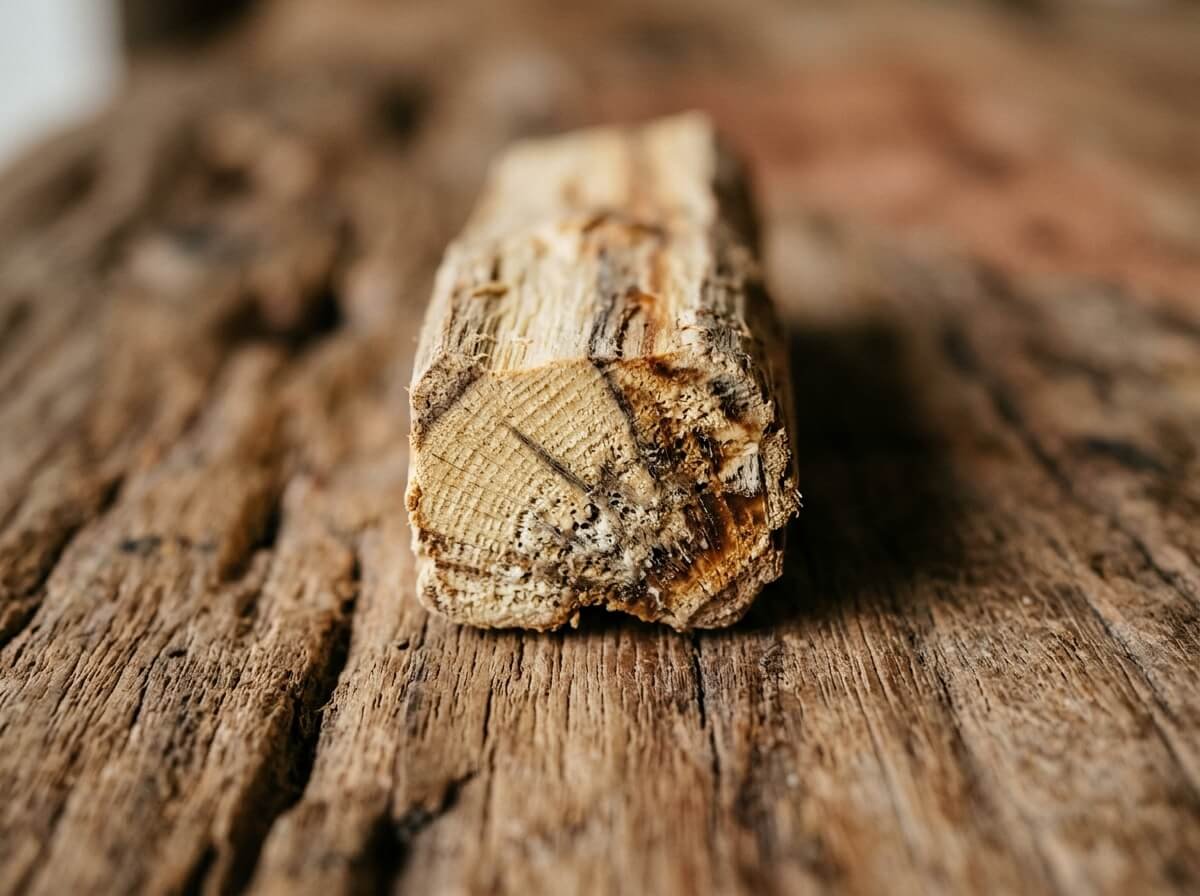
Palo santo, in the sense most people mean today, is the wood of Bursera graveolens. It is a small, pale-barked tree that grows in the dry tropical forests of Latin America, from Mexico south to Peru, including coastal Ecuador and the Galápagos Islands. In the dry season the trees drop their leaves and stand silver-grey against brown hills. In the rains they flush green again.
The Spanish name translates simply as “holy stick” or “holy wood.” It reflects a long history of use in folk healing and household ritual, not a botanical description. People across the region have burned the wood, brewed it, and used its oil for generations.
What it smells like, and why
Unlit, a good stick smells soft and sweet, like lemon peel rubbed between the fingers with a hint of pine. Lit, the scent deepens into something resinous and slightly minty. Chemistry explains much of this. Studies of the essential oil from aged heartwood find it dominated by limonene, the same bright compound found in citrus peel, along with smaller amounts of alpha-terpineol and other terpenes. That is why palo santo reads as both fresh and warm at once.
Here is the detail many sellers leave out: freshly cut palo santo does not smell like much. The aromatic oils concentrate as the wood ages, traditionally for several years after a tree or branch has died and fallen to the forest floor. Time, not the axe, makes the fragrance. We come back to why that matters in the harvesting section below.
A cousin of frankincense and myrrh
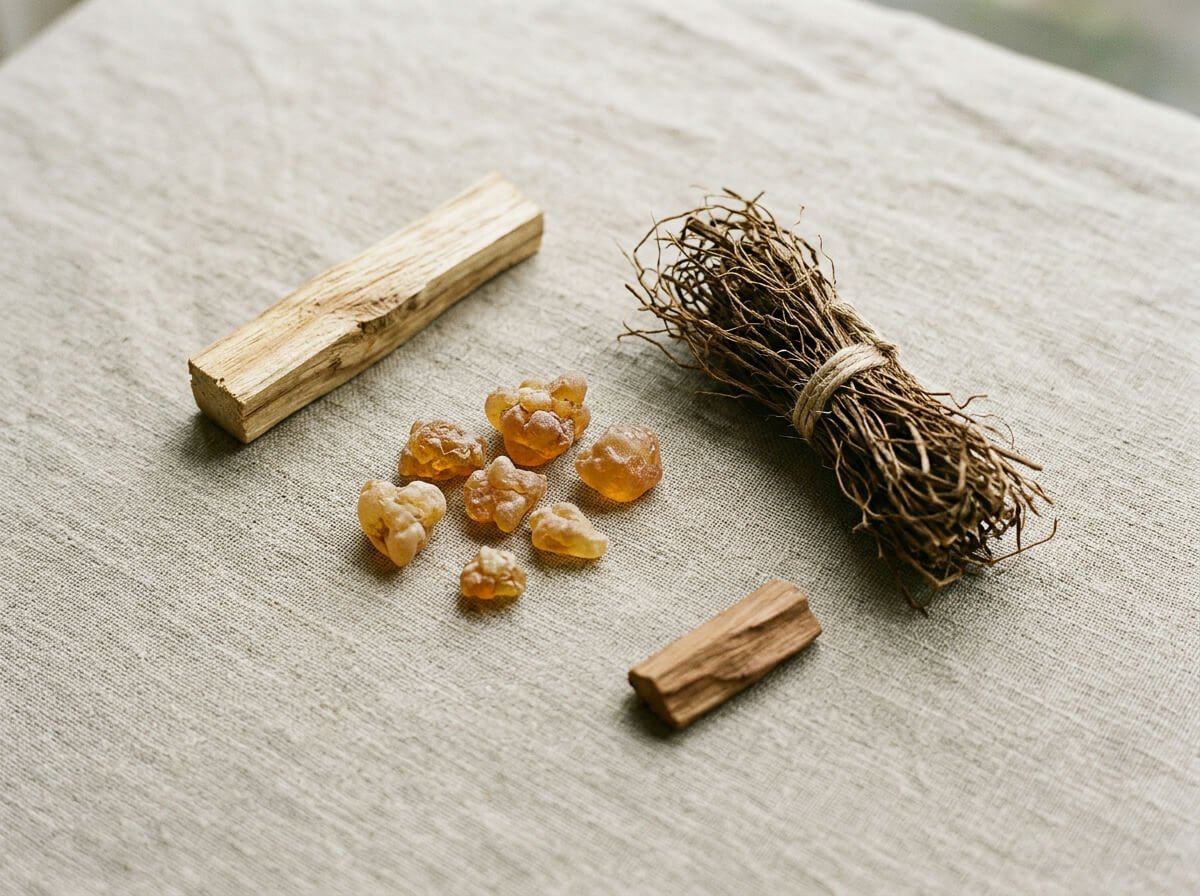
Bursera belongs to the Burseraceae, a plant family often called the torchwood or incense-tree family. Its relatives include Boswellia, the source of frankincense, and Commiphora, the source of myrrh. So when people ask whether palo santo is the same as frankincense, the honest answer is no, but they are family. Both share a resinous, uplifting character, which helps explain why both have been burned in sacred settings for centuries. If you are curious about the older cousin, our guide to frankincense and its long history is a good place to continue.
Two trees, one name: Bursera graveolens vs Bulnesia sarmientoi
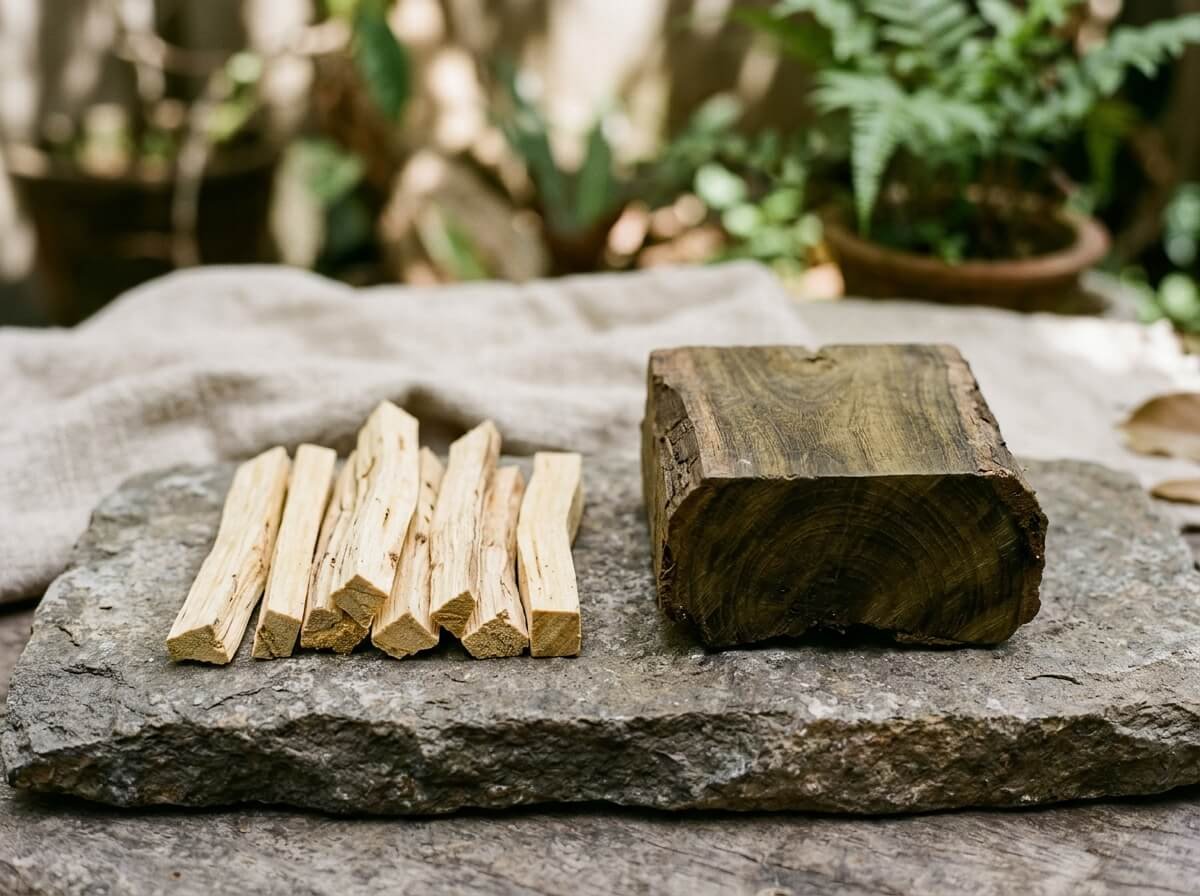
Common names are slippery. “Palo santo” is used for at least two unrelated trees, and the confusion sits at the heart of the question “is palo santo endangered?” Both answers you have heard, yes and no, are partly true, because they describe different plants.
Bursera graveolens: the stick in most shops
This is the pale, light, citrus-scented wood sold as sticks, chips, and essential oil. On the IUCN Red List, the global reference for extinction risk, Bursera graveolens is assessed as Least Concern. Globally, it is not considered threatened.
Global status is not the whole story, though. Local populations can still be under pressure where demand is high and forests are shrinking. Peru, for example, listed the species as critically endangered in 2006 and banned the cutting of live trees, allowing only the collection of naturally fallen or dead wood. The species was later removed from that national protected list in 2014. The pattern is common in conservation: a species can be secure across its whole range while specific forests still need careful stewardship.
Bulnesia sarmientoi: the threatened namesake
The second tree grows in the Gran Chaco, the vast dry forest where Argentina, Bolivia, and Paraguay meet. Bulnesia sarmientoi is a different plant entirely, from a different family, with dense, heavy, olive-brown heartwood. It is also called palo santo locally, and its distilled oil is traded as guaiacwood oil, a common perfumery ingredient with a smoky, rosy, tea-like scent.
This is the palo santo that really is in trouble. The IUCN lists Bulnesia sarmientoi as Endangered, driven by clearing of the Chaco and strong demand for its wood and oil. It has been listed on CITES Appendix II since 2010, which means international trade in its logs, sawn wood, and oil requires export permits and a finding that the trade will not harm the species in the wild.
Why the mix-up matters
When an article says “palo santo is endangered,” it is usually, often unknowingly, describing the Chaco tree. When a seller replies “palo santo is not endangered,” they are describing Bursera. Neither statement helps a buyer unless the species is named. Our gentle rule is this: a trustworthy product names its Latin species on the label. If it says Bursera graveolens, you know which tree you are holding. If it only says “palo santo” or “holy wood,” ask. The same habit serves well across aromatherapy. A clear botanical name is the first sign that a maker knows, and respects, their source. We follow that rule ourselves, as in our guide to cananga, the Balinese temple flower, which untangles a similar name confusion with ylang ylang.
Where palo santo comes from and how it should be harvested
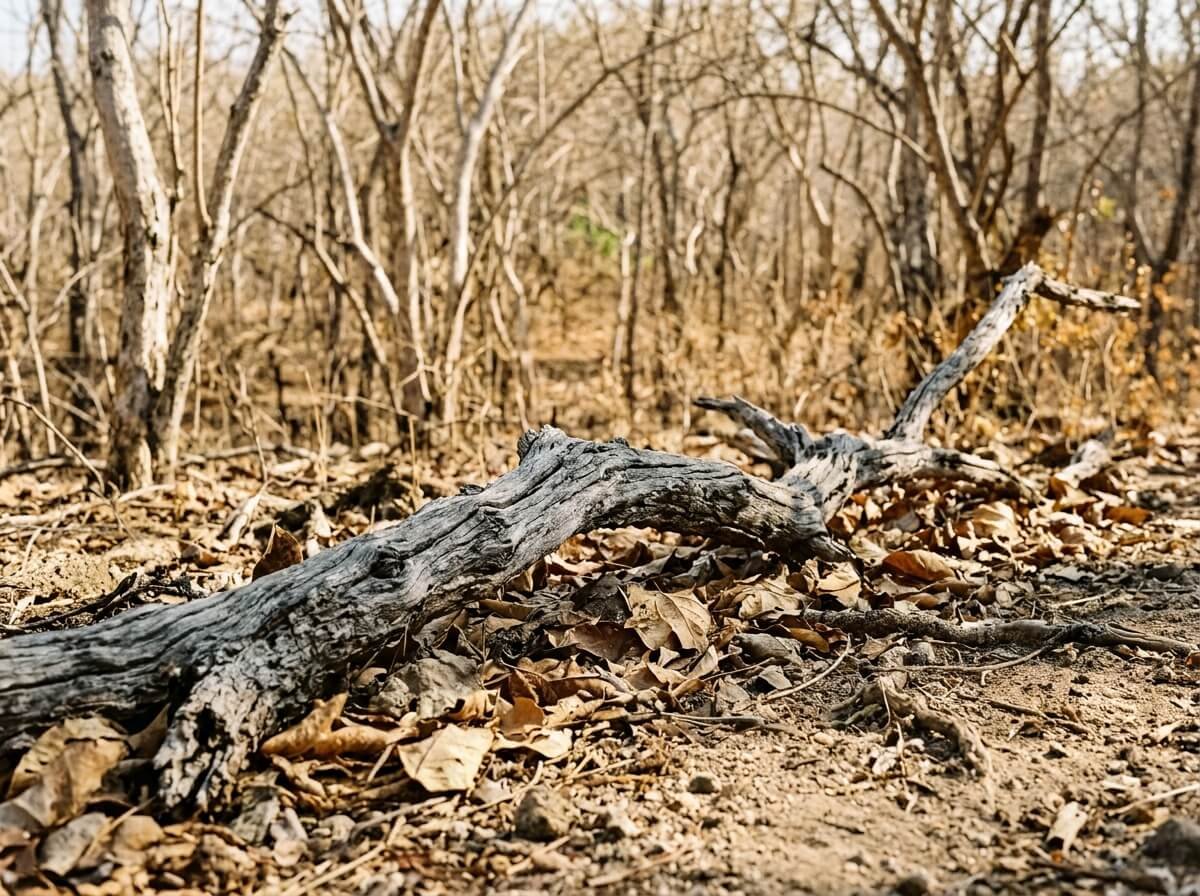
The traditional harvest of palo santo is a lesson in patience. Gatherers collect branches and trunks from trees that have died naturally and lain on the forest floor. Over the years, as the wood weathers, its oils concentrate and its scent matures. Wood cut from a living tree is not only ethically questionable. It is also, by most accounts, less fragrant. In other words, the respectful harvest and the quality harvest point the same way.
In Peru, harvest rules have long reflected this, with collection limited to naturally fallen or dead trees. In Ecuador, a number of producers and community projects run replanting programs alongside their deadwood collection. These are good signs, though they vary a great deal from one supplier to the next.
“Sustainably sourced” is not proof
Here is the plain truth: anyone can print “sustainably sourced” on a box. Those two words cost nothing and verify nothing. As palo santo moved from regional markets into global wellness trends, demand outpaced the supply of naturally aged deadwood, and the temptation to cut corners grew. A label claim is where a conversation starts, not where it ends.
Before you buy, these are the questions we would ask any seller:
- Which species is it? Look for Bursera graveolens by name.
- Which country and region? “South America” is not an answer. A real supply chain can name a province or community.
- Is it fallen or deadwood? Ask how long the wood aged on the forest floor and who collected it.
- Who benefits? Does the harvest support the communities who live with these forests?
- Is there any replanting? Reforestation is a meaningful extra, though it does not replace a deadwood-only harvest.
- Does the price make sense? Very cheap, very uniform sticks in huge volume deserve a second look.
If a seller cannot answer, that tells you something too. You can also smell the difference. Well-aged deadwood is resinous enough that you often catch its scent before you light it. Bland, dry, odorless sticks may be young wood.
We hold our own ingredients to the same standard. It is why our illipe butter comes through our Forestwise partnership in Kalimantan, wild-harvested by families who have tended the same groves for generations. Provenance is not a marketing story. It is the story.
Respecting its roots: palo santo in South American tradition
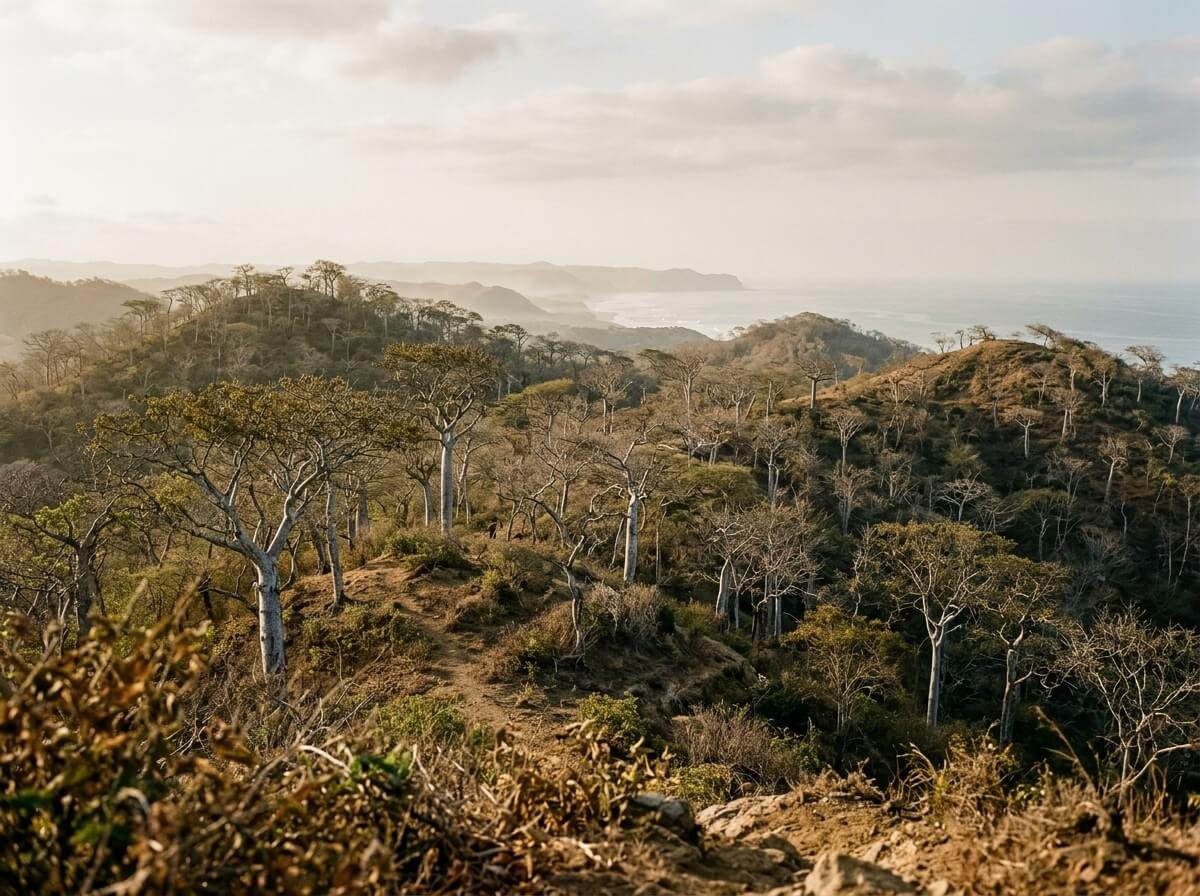
Long before palo santo sat in a gift box beside a crystal, it was part of daily life along the dry coasts and foothills of Ecuador and Peru. Indigenous and mestizo communities have used the wood and its oil in folk healing, in household blessings, and in the work of curanderos, the traditional healers of the region. The smoke has been used to mark a space, to settle a mood, and to keep biting insects at a distance on warm evenings. The oil has been rubbed into aching muscles. The wood has been carved into small, everyday objects.
We share this as context, not as a claim. People hold these practices as living traditions, with meanings that belong to them. We are not the right voice to explain their spiritual significance in depth, and we would gently encourage anyone who feels drawn to palo santo to learn from sources rooted in those communities.
A word on “smudging kits”
Many retailers now bundle palo santo with white sage and sell them as “smudging kits.” It is worth pausing on that. Smudging describes specific ceremonies of particular Indigenous nations in North America, and white sage (Salvia apiana) is a plant held sacred by Indigenous peoples of California, where wild stands have faced their own overharvesting pressures. Palo santo comes from a different continent and a different set of traditions. Packaging them together as a one-size ritual flattens two cultures into one product.
You do not need to stop enjoying palo santo to be respectful. Simply call it what it is: a fragrant wood, burned with intention. Know where it came from. Avoid language that borrows ceremonies you were not taught. That is the same respect we ask for Balinese tradition, and it travels well across every culture.
How to burn palo santo calmly and safely
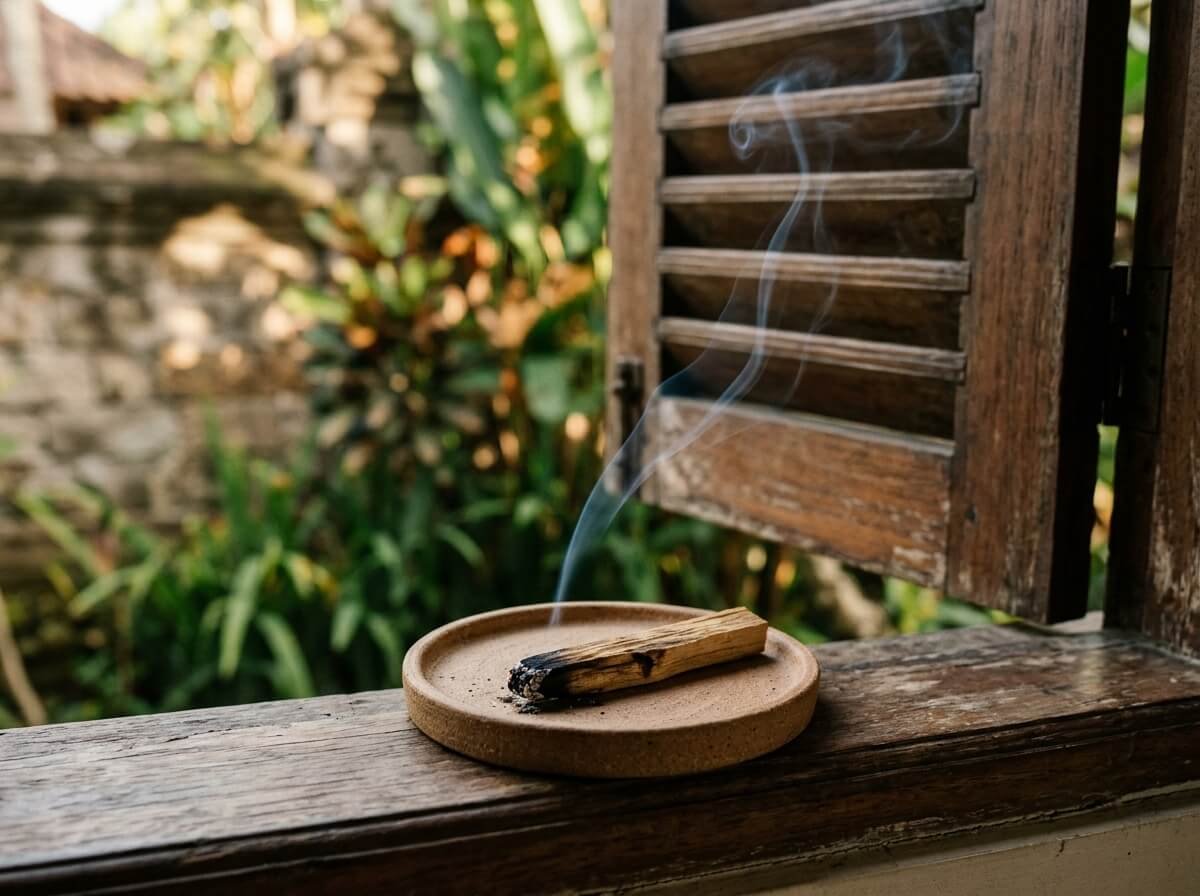
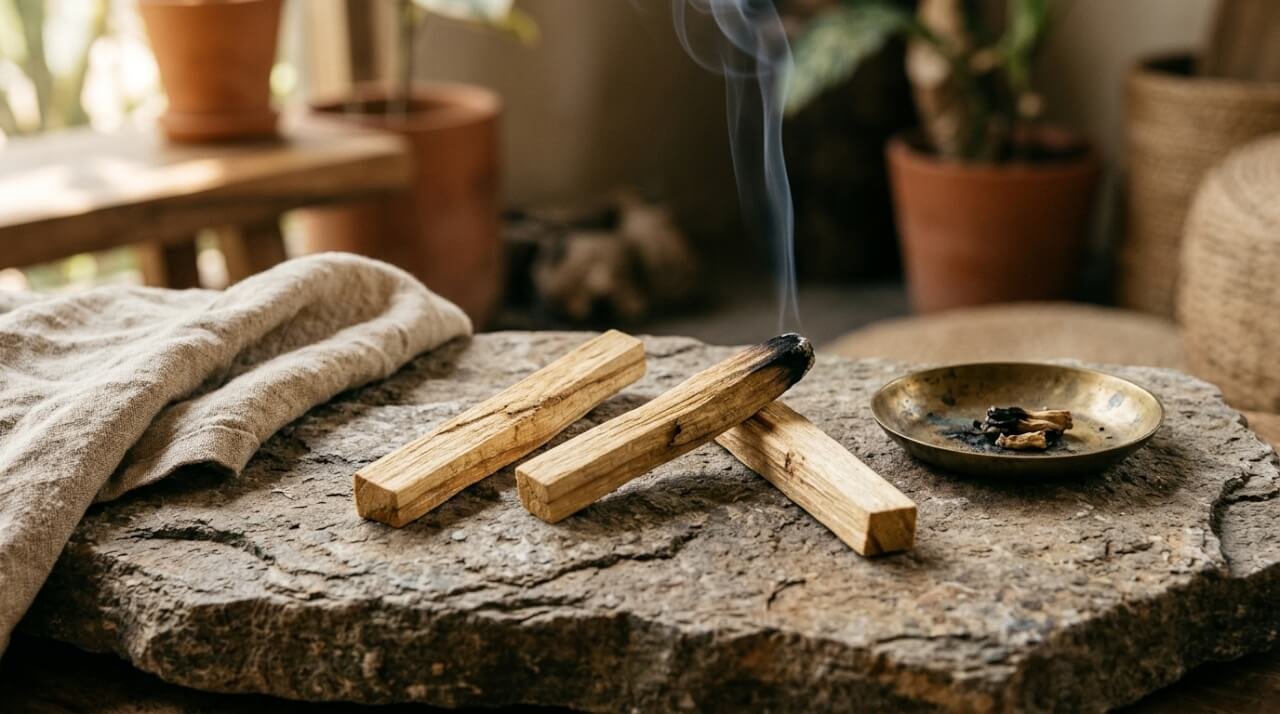
Palo santo does not burn like an incense stick. It is dense, oily wood, so it lights, flares, and then settles into a slow smolder that usually goes out on its own within a minute or two. That short burn is part of its charm. Here is a simple, calm way to work with it.
- Choose your dish first. Use something heatproof: a ceramic bowl, a stone, a shell, or a metal tray. Place it on a stable surface away from curtains, papers, and plants.
- Open a window. Fresh air matters more than any other step (more on that below).
- Light the tip at an angle. Hold the stick at about 45 degrees with the tip down toward a match or candle flame for 30 seconds to a minute, until it catches.
- Let the flame settle. Allow it to burn for a moment, then gently blow or wave it out. A thin ribbon of fragrant smoke should follow.
- Rest it in the dish. Let it smolder and go out naturally. Never leave it burning unattended, and keep it away from children and pets.
- Relight as needed. One stick can be relit many times. When it becomes too short to hold safely, retire it.
Is palo santo smoke bad for your lungs?
It is a fair question, and it deserves a calm, honest answer. Any burning plant material, whether wood, incense, a candle wick, or burnt toast, releases fine particles into the air. Health agencies, including the US Environmental Protection Agency, treat smoke as an indoor air pollutant, and fine particles can irritate airways, especially for people with asthma or other breathing conditions. Palo santo is natural, but natural does not mean smoke-free.
For most healthy adults, a brief burn in a ventilated room is a small exposure. The sensible approach is moderation, not fear: burn a stick for a few minutes rather than all evening, keep a window open, do not lean in to inhale the smoke directly, and skip it altogether around babies, people who are pregnant, anyone with respiratory conditions, and small pets, especially birds. If you love the scent but want no smoke at all, a few drops of essential oil in a diffuser, or an unlit stick on a warm shelf, will give a gentler hint. We compare smoke-free and flame-based home scent options in our honest guide to reed diffusers versus candles.
If you find yourself reaching for palo santo to cover cooking smells or stale air, try opening the house first. Fresh air is the oldest air freshener of all.
Sacred smoke closer to home: what Bali burns
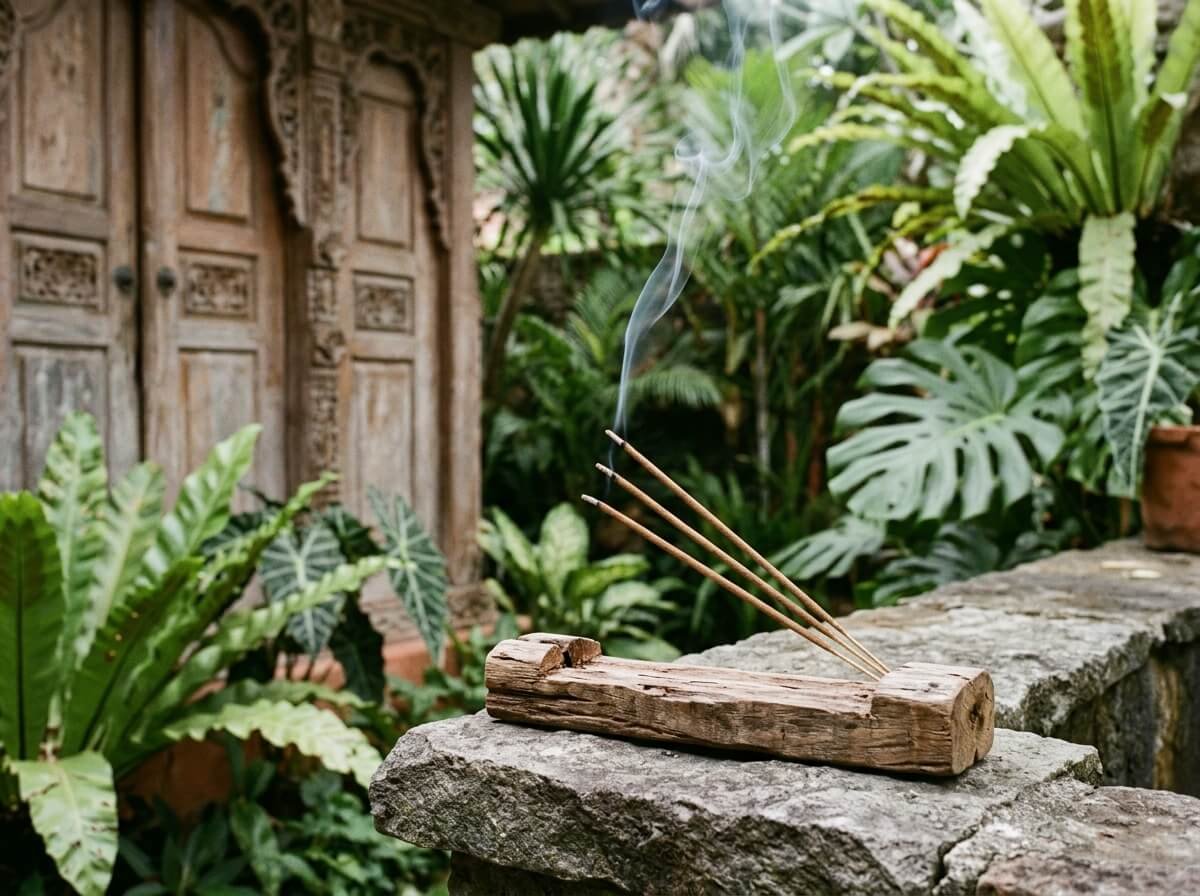
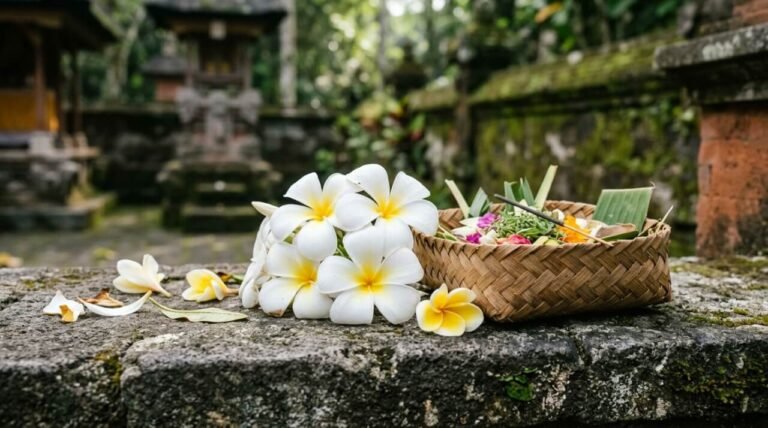
Every morning in Bali, a thin line of smoke rises from doorways, shrines, and shop steps. Balinese Hindu families place small woven offerings, often with a lit stick of dupa (incense), as part of daily devotion. The smoke is understood to carry the prayer upward. It is not decoration, and it is not a trend. It is a quiet, daily act of gratitude, and we live alongside it with deep respect.
Indonesia has its own long history of fragrant woods and roots. Cendana (sandalwood) has been prized across the archipelago for centuries, and we tell part of its story in our cendana ingredient profile. Akar wangi, the “fragrant root” known elsewhere as vetiver, brings an earthy, grounding depth, which we explore in our guide to vetiver essential oil benefits. Cananga, the golden temple flower, lends a soft, green floral note.
How our incense began
Our story started with smoke. The very first product Melanie Templer created in her Ubud kitchen was an incense, the blend we still make today as Temple Spice Incense, with vetiver oil at its heart. Every stick is hand-rolled from locally sourced trees, bark, herbs, oils, nuts, and spices, with no synthetic chemicals or endangered plants, then wrapped in recycled paper.
For a softer, floral mood, Moonflower Incense blends cananga with nutmeg oil for a green, calming scent at the end of the day. We rest ours in a Bali reclaimed wood incense holder, made from repurposed chopsticks, because even the small things deserve a second life. If you want to understand what goes into a well-made stick, our complete guide to natural incense sticks walks through ingredients and how to choose, and how incense is made goes deeper into the craft.
We do not share this to suggest that Balinese incense is a “replacement” for palo santo. Each belongs to its own place. We share it because there is a simple, grounding idea underneath both: the most meaningful sacred smoke is often the one rooted in a landscape you know. Origin over import. Whatever you burn, let it come with a story you can trace.

Temple Spice, our first incense since 1989
Hand-rolled in Bali from locally sourced botanicals with vetiver oil for a warm, grounding scent. No synthetic chemicals, no endangered plants, wrapped in recycled paper.
What is palo santo used for? Common questions, honest answers
What does palo santo mean in Spanish?
It means “holy stick” or “holy wood.” Palo is a stick or piece of wood, and santo means holy or saintly. The name reflects how the wood has been used, not a single species, which is why it applies to more than one tree.
What does it mean when you burn palo santo?
It depends on who is burning it. In its home traditions, people burn it to mark or bless a space, to welcome calm, or to keep insects away. Many people today simply enjoy the scent as a pause in the day. We would describe these as intentions and traditions people hold, rather than proven effects. What science can say is that its main aroma compound, limonene, gives it that bright, uplifting citrus quality many find pleasant.
Is palo santo endangered?
Bursera graveolens, the common palo santo stick, is listed as Least Concern by the IUCN. Bulnesia sarmientoi, a different tree also called palo santo and the source of guaiacwood oil, is listed as Endangered and is regulated under CITES Appendix II. Check the Latin name on the label, and look for fallen or deadwood harvest.
Is palo santo the same as frankincense?
No, but they are related. Both belong to the Burseraceae family. Frankincense comes from the resin of Boswellia trees, while palo santo is the aged wood of Bursera graveolens. Frankincense smells deeper and more balsamic. Palo santo is brighter and more citrusy. Our Frankincense Essential Oil is distilled from Boswellia serrata resin, if you would like to explore the family resemblance in a diffuser.
Palo santo vs white sage: what is the difference?
They are entirely different plants from different continents. Palo santo is a South American wood with a sweet, citrus-resin scent. White sage (Salvia apiana) is a shrub native to southern California and northern Mexico, with a sharp, herbal smoke and deep ceremonial importance to Indigenous peoples there. Each carries its own traditions, so we prefer not to treat them as interchangeable.
Does palo santo repel mosquitoes?
It has a traditional reputation for keeping insects at bay, and its wood is rich in limonene, a compound found in many citrus-based repellents. That said, we have not found strong evidence that a smoldering stick protects you from bites. If insects are your concern, a proven skin repellent is the reliable choice. For outdoor evenings, our Begone Bug Incense is blended with citronella and peppermint oils to help keep insects out of your personal space.
How long does a palo santo stick last?
Because each burn lasts only a minute or two, a single stick can be relit dozens of times over several weeks or months. Store sticks in a cool, dry place away from direct sun, and they will keep their scent for a long time.
Can I use palo santo essential oil instead?
Yes, and it avoids smoke entirely. Look for the same signs of honest sourcing: the Latin name, the country of origin, and confirmation that the oil was distilled from fallen wood. As with any essential oil, dilute it in a carrier before it touches skin and patch-test first. If you enjoy building seasonal scent rituals, our fall essential oil blends offer warm, grounding combinations that sit beautifully alongside resinous notes.
Final thoughts: burn with knowledge, burn with respect
So, what is palo santo, really? It is a fragrant, aged wood from the dry forests of Latin America, a cousin of frankincense, and a living part of South American folk tradition. It is also a name shared by two very different trees, one secure and one in real need of protection. Knowing the difference turns a trend into a conscious choice.
If you choose palo santo, choose it carefully. Look for Bursera graveolens by name, ask for fallen or deadwood harvest, and support sellers who can tell you where and who it came from. Burn it briefly, with a window open, and never treat it as a borrowed ceremony. Those small habits are what respect looks like in practice.
And whatever you burn, whether it is palo santo from the coast of Ecuador or incense rolled by hand in Bali, let it be a moment of attention rather than a habit on autopilot. That is the quiet idea at the center of every sacred smoke tradition we know: pause, breathe, notice. What you give, you get back.