Reed diffuser vs candle: how to scent your home naturally, honestly compared
The reed diffuser vs candle question looks simple. One sits quietly on a shelf for months. The other asks for a match, a flame, and your attention. Most guides stop there, pick a winner, and send you to a shop. We think the honest answer starts somewhere else: with what is actually inside the bottle or the jar, how the scent reaches the air you breathe, and what kind of presence you want fragrance to have in your home.
We have been blending scent in Bali since 1989. Our story began in a kitchen in Ubud with a single incense and a few balms, so the question of how to scent a room has been part of our craft for more than 35 years. In this guide we compare reed diffusers and candles side by side, read the labels most brands hope you skip, look calmly at indoor air quality, and add the two options almost every comparison leaves out: incense and essential oil diffusers. By the end, you will know which method suits each room, each mood, and each household, and how to make any of them a little more circular.
Reed diffuser vs candle: the real question is how you want scent to live in a room
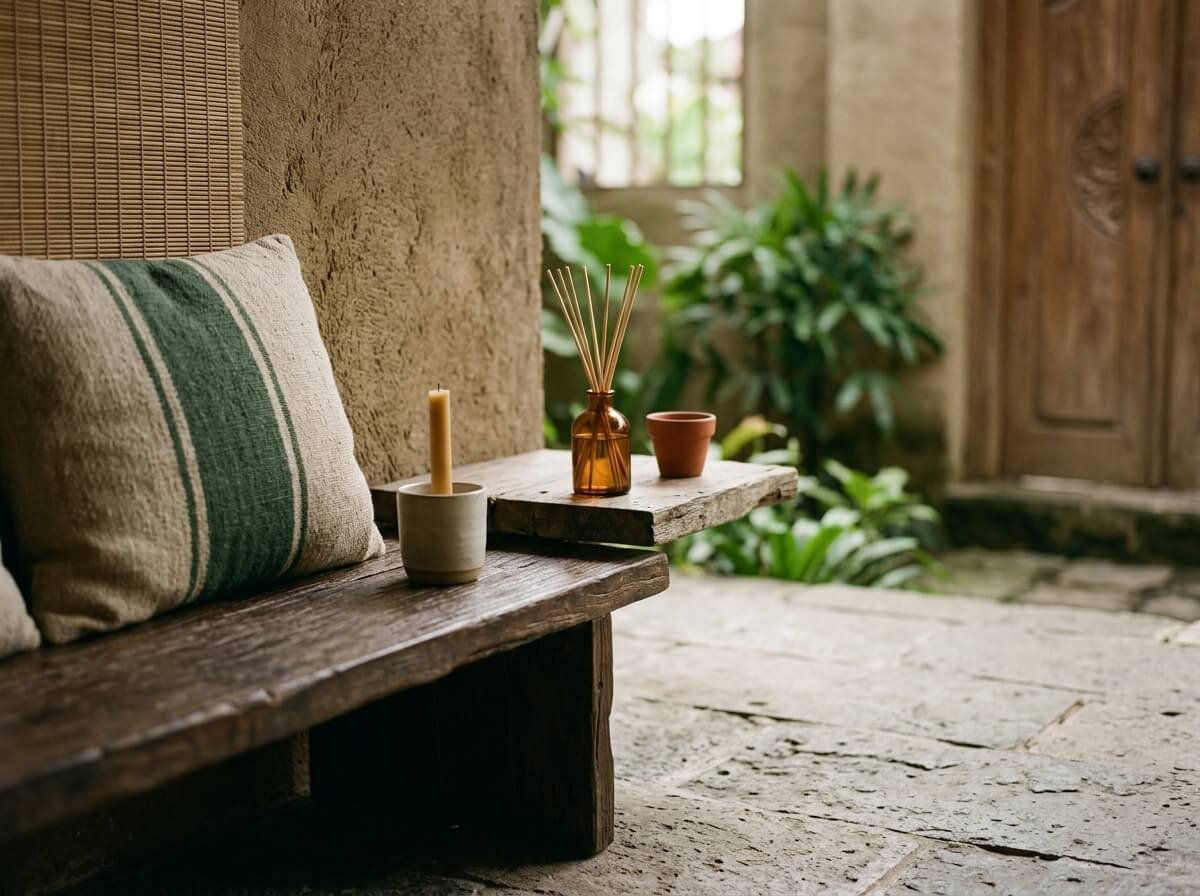
Before comparing wax, wicks, and rattan, it helps to ask a quieter question. Do you want scent as a background presence, or as a moment?
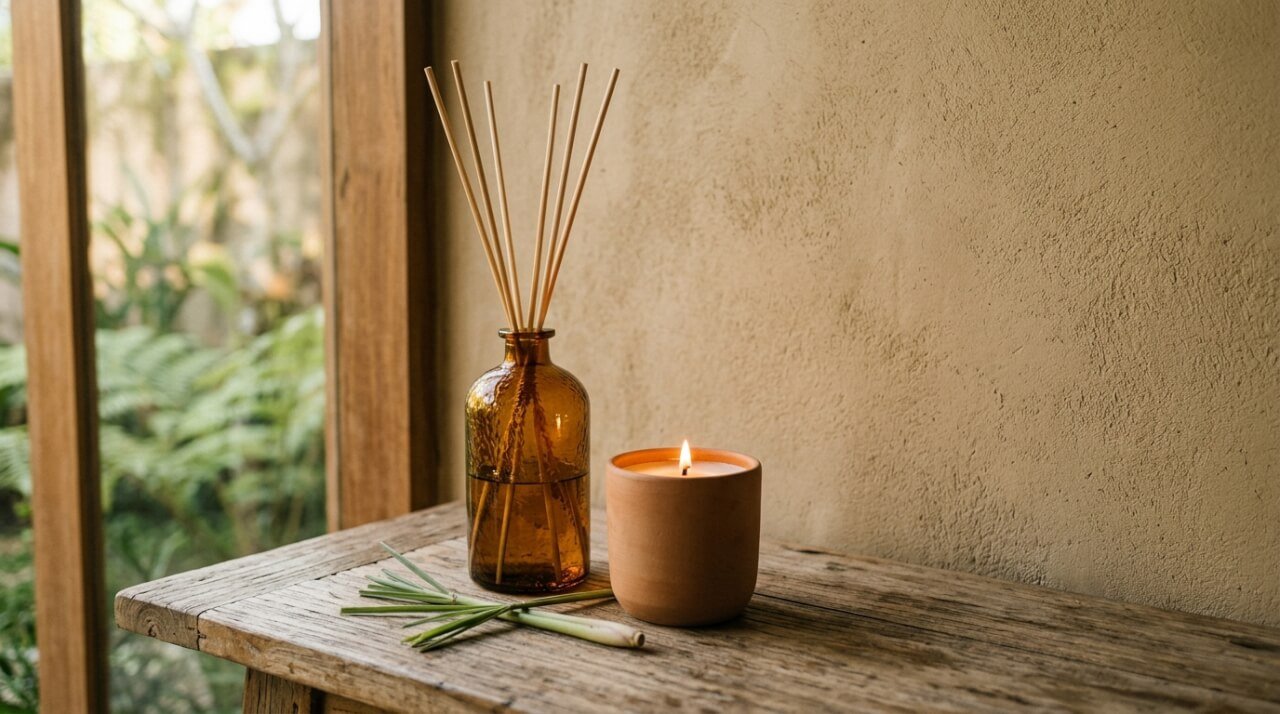
A reed diffuser is ambient. Once the reeds are in the bottle, it works all day and all night without asking anything of you. The scent sits low and steady, more like the smell of a well-loved home than an announcement. It suits hallways, bathrooms, and offices, the places you pass through rather than linger in.
A candle is a ritual. You choose when it begins and when it ends. You strike the match, watch the flame settle, and the room changes around it: light softens, the evening slows, and scent rises with the warmth. When you blow it out, the moment closes. That on and off rhythm is the point.
Many of us end up using both, a diffuser for the always-on hum of a space and a candle for the hour we want to mark. Here is a simple way to think about it:
- Choose a reed diffuser when you want steady, low-effort scent in a room you cannot watch over, or when an open flame is not practical.
- Choose a candle when you want light, warmth, and a defined ritual, such as winding down after work or settling into a bath.
- Choose both when a home has different zones with different jobs, a calm entry and a cosy living room, for example.
How each method actually works
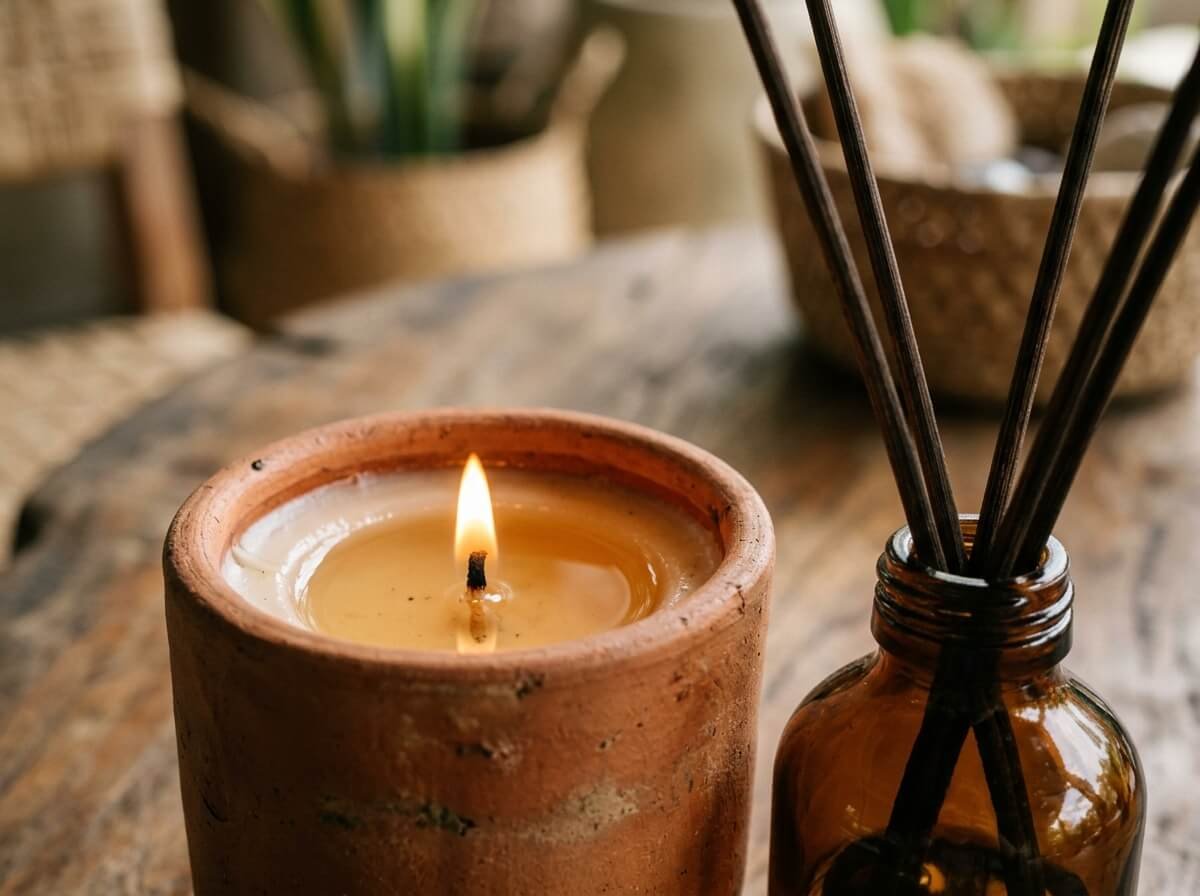
Understanding the mechanics explains almost every difference you will notice day to day: how strong the scent feels, how long it lasts, and why one room smells lovely while another smells of nothing at all.
How a reed diffuser works
A reed diffuser is a bottle of scented liquid with a bundle of porous reeds standing in it. Rattan reeds are full of tiny channels that run their length. The liquid climbs those channels by capillary action, the same quiet force that pulls water up a plant stem. Once it reaches the exposed tips, it evaporates into the room.
The strength of the scent depends on how many reeds you use, how thick they are, how warm and airy the room is, and what the liquid is made of. More reeds and a warmer room mean a stronger throw and a shorter life. Fewer reeds mean subtler scent that lasts longer. Flipping the reeds every week or two refreshes the tips, which slowly clog with dust and dried fragrance.
A typical 100 to 230 ml diffuser lasts somewhere between two and four months in an average room. A dry, warm climate or an air-conditioned draft will shorten that.
How a candle works
A candle is a small, controlled combustion system. When you light the wick, the heat melts the wax near it into a liquid pool. The wick draws that liquid wax up, the flame vaporises it, and the vapour burns. Fragrance or essential oil carried in the wax is released as the pool warms, which is why candle scent grows stronger after the first 20 or 30 minutes.
A few habits shape how any candle performs:
- Trim the wick to about 5 mm before each lighting. A long wick flickers, mushrooms, and produces more soot.
- Let the melt pool reach the edges on the first burn, so the candle does not tunnel down the middle.
- Keep it out of drafts. Moving air makes the flame dance, which wastes wax and creates soot.
- Never leave it unattended, and extinguish it with a snuffer or by dipping the wick, rather than blowing hard.
So, in short: a reed diffuser trades intensity for constancy, and a candle trades constancy for intensity plus light and warmth. Our reed diffuser guide goes deeper on reeds, bottle shape, and placement, and our natural candles guide covers waxes and wicks in detail.
What is really inside most reed diffusers and candles

This is the section most comparisons skip, and it matters more than the format. Two products can both say “lavender” on the front and have almost nothing in common inside.
The usual reed diffuser formula
Most mass-market reed diffusers are mostly solvent. The scent itself is a small share of the bottle. The rest is a carrier that thins the fragrance so it can climb the reeds. Common carriers include dipropylene glycol (often shortened to DPG), isoparaffin solvents, and various alcohols. Some of these are petroleum-derived, and many evaporate as volatile organic compounds, or VOCs, alongside the fragrance.
The fragrance itself is often listed as “fragrance” or “parfum”. That single word can legally stand for dozens of undisclosed synthetic aroma chemicals. Historically, some fragrance blends also used phthalates such as diethyl phthalate to help scent last longer. You usually cannot tell from the label whether they are present, because they hide inside that one word.
The usual candle formula
Most supermarket candles are made from paraffin wax, a by-product of petroleum refining. Paraffin is cheap, holds a lot of fragrance, and gives a strong hot throw, which is why it dominates. Scent again usually comes from synthetic “fragrance” rather than plant oils. Coloured dyes are common, and some candles carry metal-cored wicks to keep them upright.
Alternatives exist, each with honest trade-offs:
- Soy wax is plant-based, burns cooler and slower than paraffin, and holds essential oils well. Its scent throw is softer. Look for 100% soy, since some “soy” candles are blends with paraffin.
- Beeswax burns slowly and brightly, carries its own faint honey note, and needs a well-sized wick. It is more expensive and not suitable for anyone avoiding animal-derived products.
Why “essential oil” on the front does not mean essential oil in the bottle
This is the label trick we see most often. A front panel says “with essential oils” or “essential oil infused,” while the ingredient list reads “fragrance” in first place and a single botanical oil near the end. The essential oil is real, but it is a garnish, not the scent.
A useful habit is to turn the product over and read three things:
- The base: paraffin, soy, beeswax, coconut wax, or for diffusers, the named carrier.
- The scent source: named essential oils with botanical names, or a generic “fragrance” or “parfum”.
- The order: ingredients are generally listed from most to least. Whatever comes first is what you are mostly buying.
Our own candles are a useful example of what a transparent label looks like. The Island Spice Candle lists exactly four ingredients: soy wax, cinnamon oil, clove oil, and lemon oil. Nothing hides behind “fragrance”. If you want the full story of how synthetic fragrance and essential oils differ, our guide to essential oil vs fragrance oil walks through it line by line.
None of this means every conventional product is harmful. It means it is worth knowing what you are breathing, and a label that tells you plainly is a sign of a brand that respects you.
The air-quality question, answered calmly
Any time something releases scent into a room, it changes the air. That is simply what scent is: molecules travelling from a source to your nose. The honest question is not “is this pure,” but “what else comes along with it, and how much.”
Candles and particulate matter
Every flame produces some combustion by-products. Burning candles release fine particulate matter, small amounts of soot, and gases such as carbon dioxide. Paraffin candles, long or untrimmed wicks, drafts, and heavily fragranced or dyed waxes tend to produce more soot. Plant waxes with well-sized cotton wicks generally burn cleaner, but no candle burns with zero emissions. Anything that combusts makes smoke, however little.

For most healthy adults, an occasional well-tended candle in a ventilated room is a modest contribution to indoor air. The picture changes if you burn several candles at once for hours in a small, closed room, or if someone in the home has asthma or another respiratory sensitivity. In those cases, burn for shorter sessions, keep a window cracked, and choose plant waxes with clean ingredient lists.
Lead-cored wicks were once a real concern. Many countries, including the United States, have banned them, but cheap imports occasionally slip through. A cotton or paper-cored wick is the safe default.
Reed diffusers are flameless, not emission-free
Because a reed diffuser has no flame, it produces no soot and no combustion particles. That is a genuine advantage. But flameless is not the same as clean. Everything in the bottle eventually evaporates into the room, including the solvent carrier. If that carrier is a petroleum-based solvent and the scent is a heavy synthetic fragrance, a diffuser releases a slow, steady stream of VOCs around the clock, which is exactly the opposite of a candle’s short burst.
The other common issue is simple over-scenting. A large diffuser with a full bundle of reeds in a small bathroom can become overwhelming and, for some people, headache-inducing. Start with half the reeds and add more only if you need to.
Simple habits for cleaner scented air
- Ventilate. A cracked window or a few minutes of cross breeze each day matters more than any product choice.
- Use less. Scent is meant to be noticed gently, not to fill every corner.
- Read the label first, as described above. Fewer, named ingredients mean fewer surprises.
- Give your nose a rest. Our sense of smell adapts quickly, so we often keep adding scent we have simply stopped noticing.
The third and fourth options: incense and essential oil diffusers
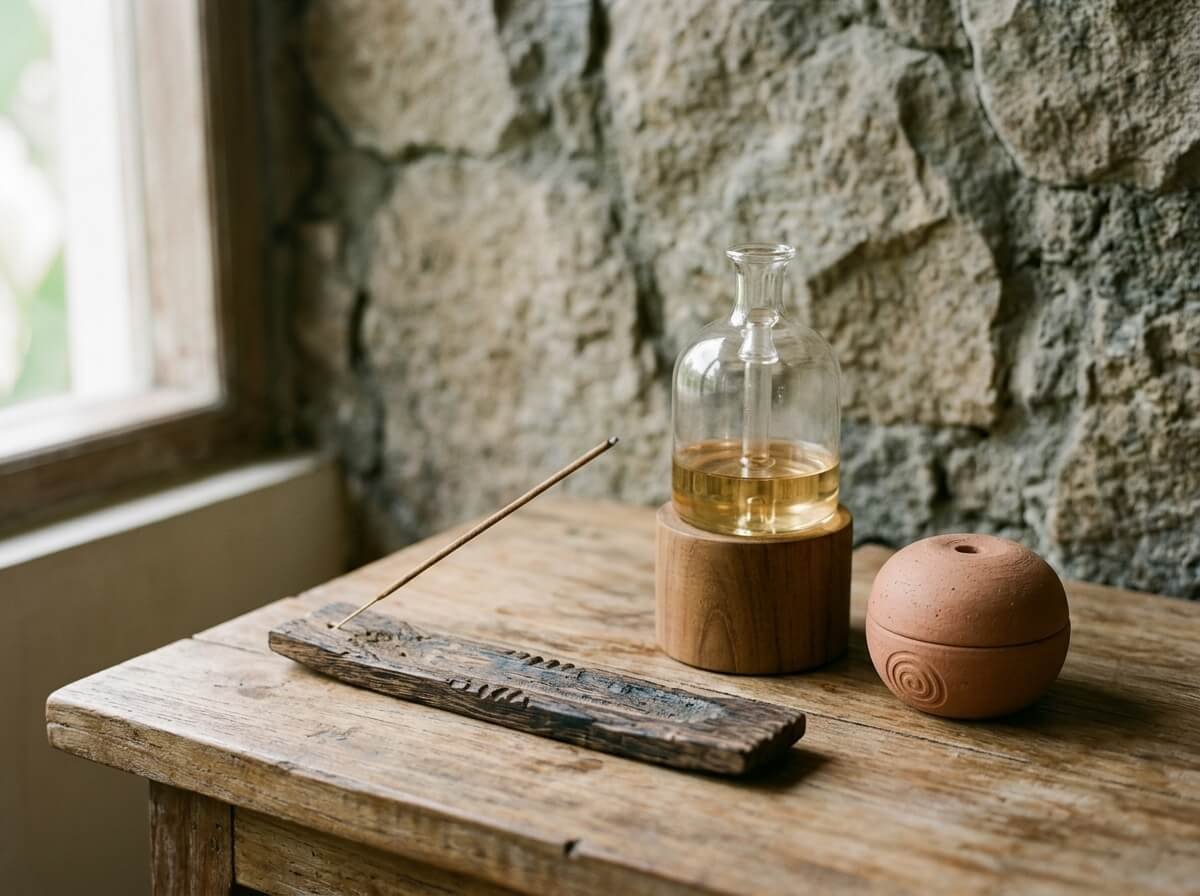
Almost every reed diffuser vs candle article treats the choice as a pair. In real homes, there are at least four ways to bring scent into a room. Two of them, incense and essential oil diffusers, deserve a fair hearing.
Incense: scent as a moment of attention
In Bali, incense, called dupa, is woven into daily life. Each day, Balinese Hindu families place offerings with a burning stick of dupa at shrines, doorways, and crossroads, and the rising smoke carries their prayers. That practice is sacred and belongs to the people who keep it. It is not something we try to reproduce at home. What we can learn from it, respectfully, is the idea that lighting a single stick can be a pause, an intentional moment rather than background noise.
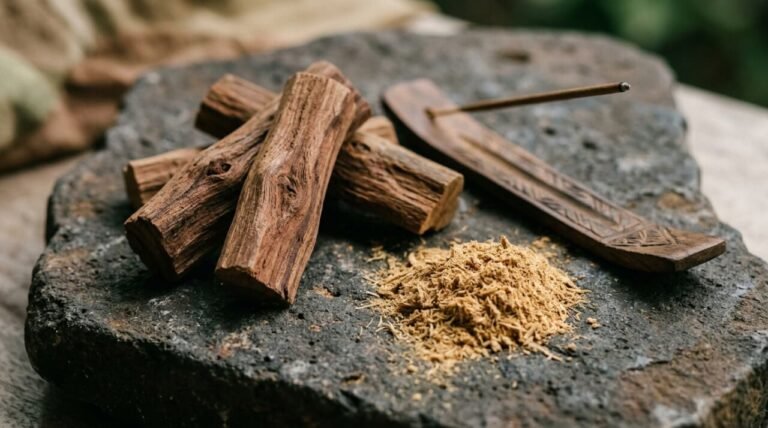
As a home fragrance, incense sits between a candle and a diffuser. One stick burns for roughly 30 to 60 minutes, which makes it a natural fit for a short ritual: a meditation, a morning stretch, or simply clearing the air after cooking. Quality matters a great deal. Hand-rolled sticks made from wood powder, resins, and essential oils behave very differently from cheap sticks dipped in synthetic fragrance. Our natural incense sticks guide explains how to tell them apart.
The honest caveat: incense is combustion, and it makes visible smoke. Burning it in a closed room for long periods adds noticeable particulate matter, more than a candle. One stick at a time, with a window open, is the right rhythm. Our Temple Spice Incense and Moonflower Incense are made for exactly this kind of slow, single-stick use, and a reclaimed wood incense holder catches the ash safely. For a gentle example of this ritual, see our reflection on lighting one stick of incense.
Essential oil diffusers: pure scent, no flame
Essential oil diffusers come in two very different styles, and both answer the main weakness of a conventional reed diffuser: they release essential oil itself, without a solvent carrier.
- Passive ceramic diffusers are unglazed ceramic pieces that absorb a few drops of oil and release it slowly. They are silent, use no water or power, and give a soft, close-range scent, ideal for a bedside or desk.
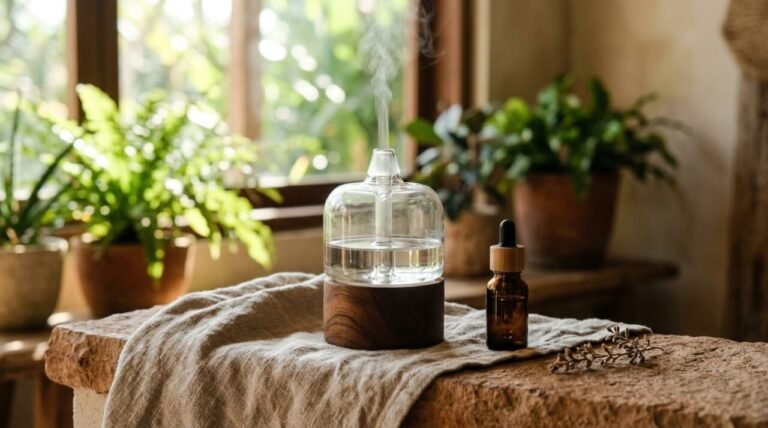
- Nebulizing (atomizing) diffusers use a small pump to break neat essential oil into a fine mist. There is no water and no heat, so the scent is vivid and true to the oil. They cover a bedroom or small office quickly and work best in short sessions.
Ultrasonic diffusers, the familiar ones with a water tank, are a fifth option, but they dilute oils in water and need regular cleaning to prevent mould. We cover the full comparison in our guide to ceramic diffuser vs nebulizing diffuser and a deeper look at how to choose the best essential oil diffuser for your practice.
If you prefer potency without flame, our Danau Satu atomizing diffuser is built from plantation hardwood and hand-blown glass, and diffuses pure oils without water or heat. Pair it with our aromatherapy diffuser blend recipes for a starting point.

A candle with nothing to hide
Our Island Spice Candle is hand-poured in Bali from soy wax with cinnamon, clove, and lemon essential oils. Four ingredients, no synthetic fragrance, no petrochemicals. Warm, grounding, and made for slow evenings.
How to match a method to your space, mood, and household

Once you know how each method works and what is in it, the choice becomes practical. Here is how we think about it, room by room and home by home.
By room
- Entryway and hallway: a reed diffuser. Scent greets you without anyone needing to tend a flame, and moving air from the door helps it travel.
- Bathroom: a reed diffuser with fewer reeds, since small, warm, humid rooms amplify scent. Avoid candles near towels or in tight spaces where they could be knocked.
- Living room: a candle for evenings, perhaps a diffuser on a side table for background warmth. Large open-plan spaces may need a nebulizing diffuser for any noticeable scent.
- Bedroom: a passive ceramic diffuser by the bed, or a short nebulizing session before sleep. Blow out candles well before you close your eyes. Our guide to essential oils for sleep suggests calming blends.
By mood
If you want energy, reach for bright citrus and mint notes. Our Awakening Candle uses bergamot and sweet orange peel oils in soy wax. If you want warmth and comfort, spice notes such as clove, cinnamon, and nutmeg feel grounding in cooler months. If you want a sense of fresh, clear air, herbal and resinous oils like cajeput, cubeb, and ginger work well; our Purifying Candle blends exactly those. For a small, bright beeswax option, the Citrus Fresh Candle is hand-poured with beeswax, coconut oil, and a citrus essential oil blend.
By household
- Homes with young children: flameless options placed out of reach are the safer default. Keep reed diffuser bottles high up, since the liquid is harmful if swallowed and can irritate skin and eyes. Use essential oils in low amounts and ventilate well.
- Homes with cats, dogs, or birds: take extra care. Cats in particular lack certain liver enzymes that help process some essential oil compounds, and birds have very sensitive airways. Use the gentlest methods, in rooms your animals can leave, and always ask your vet before diffusing around pets. Keep reed diffusers where tails and paws cannot tip them.
- People with asthma or scent sensitivity: less is more. Short sessions, open windows, and clean, simple ingredient lists. Incense and heavy candles are usually the first to avoid.
The refill and waste question
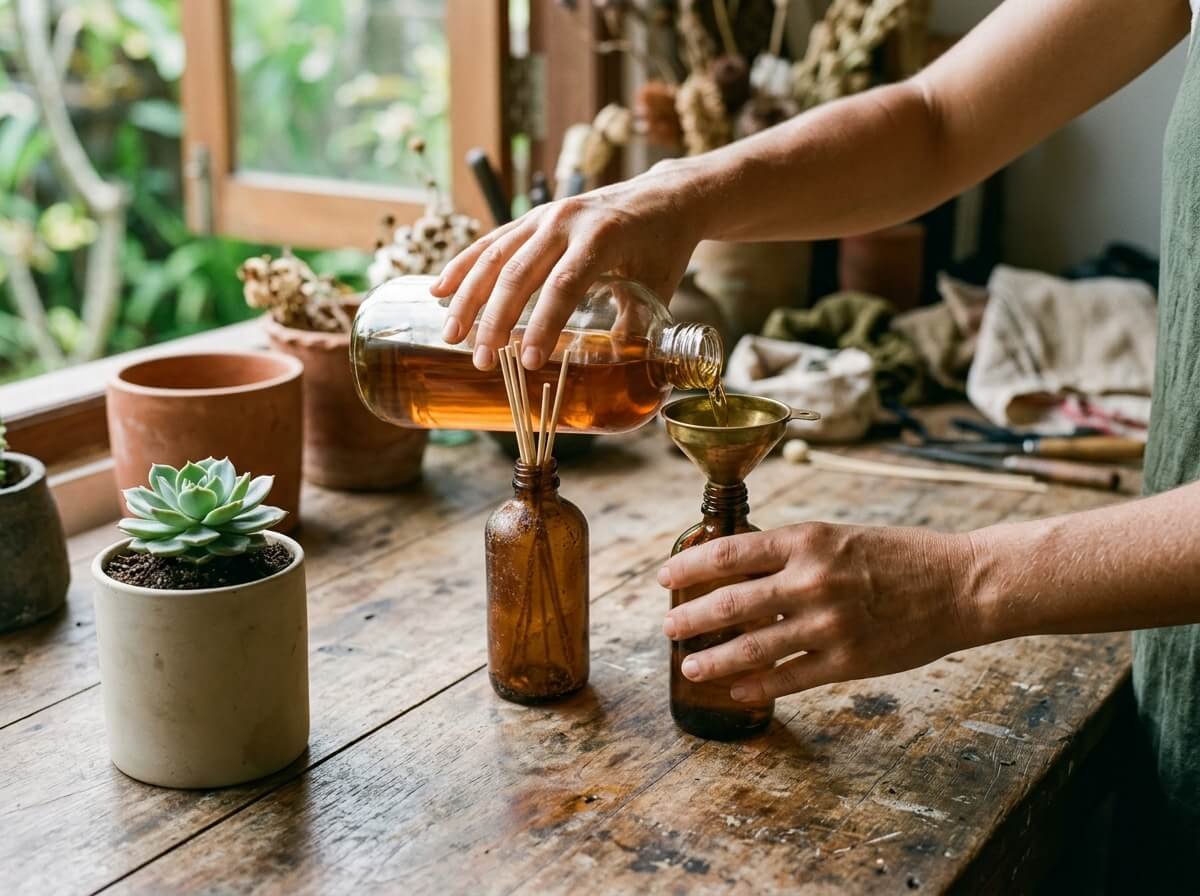
Scenting a home creates a surprising amount of waste over a year: spent glass bottles, dried reeds, burned-out jars, plastic shrink wrap, and gift boxes. Thinking about what remains after the scent is gone is part of choosing well.
Reed diffusers
A reed diffuser is one of the easiest home fragrances to make circular. The glass bottle can be refilled many times. The only parts that wear out are the reeds, which clog over time and should be replaced every refill or two. When you buy a refill bottle of diffuser oil instead of a whole new set, you keep a heavy glass vessel in use and cut packaging dramatically. Wash the bottle with warm soapy water between scents so old and new oils do not muddle.
Candles
Candle jars are often thick, beautiful glass or ceramic, and they deserve a second life. Once a candle is finished, freeze it for a few hours so the leftover wax pops out, or pour in hot water to lift it, then wash the vessel. It becomes a pen pot, a small planter, a home for cotton pads, or a vessel to refill with your own poured wax. Whatever you do, avoid burning a candle all the way to the bottom, since the base can overheat.
Incense and essential oil diffusers
Incense is close to minimal by nature. A box of sticks and a holder you keep for years generate very little waste, especially when the sticks come in paper packaging. Essential oil diffusers are durable devices that use oil by the drop. A single 10 ml bottle can scent many sessions, and the bottle itself can be refilled or reused. Our guide to how to store essential oils helps those bottles last.
Why refill culture matters to us
Refill is not a trend for us. We have offered in-store refills since day one, and in 2025 alone our refill programs saved 2,245 bottles from landfill. The same thinking applies to home fragrance as to body care: keep the vessel, replace only what you use. Our guide to refillable body care explains how to spot a real refill program, and if you are rethinking the rest of your home too, our guide to natural cleaning products applies the same honest label reading to what you clean with. Small choices, repeated, are what add up.
Reed diffuser vs candle: frequently asked questions
Do reed diffusers expire?
Reed diffusers do not spoil, but they fade. Essential oils oxidise slowly once exposed to air, and the top notes evaporate first, so the scent becomes flatter over time. Most diffusers smell their best for two to four months. Keep the bottle out of direct sun and heat, flip the reeds every week or two, and replace the reeds when they stop refreshing the scent.
Are scented candles bad for you?
Not inherently, but some are better than others. All candles produce some combustion by-products. Paraffin candles with synthetic fragrance and long wicks tend to produce more soot. Plant-wax candles with cotton wicks and named essential oils, burned in short sessions in a ventilated room, are a gentler choice for most people. If anyone in your home has asthma, keep candle use light and occasional.
Which lasts longer per dollar, a reed diffuser or a candle?
On pure hours of scent, a reed diffuser usually wins because it works continuously for months. A 100 g candle might give 15 to 25 hours of burn time in total. But the comparison is not quite fair, because a candle’s scent is stronger while lit and comes with light and ritual. Think about cost per moment you actually enjoy, not just cost per hour.
Can you make a reed diffuser refillable?
Yes. Any glass diffuser bottle can be cleaned and refilled with fresh diffuser oil. Replace the reeds at the same time, because old reeds hold the previous scent and dust. If you blend your own, use a carrier designed for diffusers so the oil can climb the reeds, and keep essential oils within safe amounts. Our guide to how to dilute essential oils explains ratios.
So which should you choose?
Choose by ingredients first and format second. A clean, honest candle and a solvent-heavy diffuser are not equal, and neither are a hand-rolled incense stick and a dipped synthetic one. Read the label, match the method to the room, ventilate, and use a little less than you think you need. Scent at home should feel like care, for you, for the people you live with, and for the air you share. What you give, you get back.