Essential oils safe for babies: why the gentlest routine often skips them
Search for essential oils safe for babies and you will find dozens of charts. Lavender here, chamomile there, a drop in this much carrier oil. What almost none of them ask is the question that comes first: does a baby need an essential oil at all? For most babies under two, the gentlest and most honest answer is no. Keep the ritual, keep the warm hands and the plain oil, and leave the concentrated aromatics on a high shelf for now.
This guide explains why. We look at how a baby’s body handles aromatic compounds differently from ours, what a long Indonesian tradition of baby massage can teach us, the standard dilution guidance for parents of older babies and toddlers who still want it, the oils to keep well away from little ones, and how to think about diffusing in a shared home. We are a brand that sells essential oils. We still think this is the right place to begin.
The question every dilution chart skips: are essential oils safe for babies at all
Most guides to essential oils and babies start from an assumption: you are going to use one, so here is how. The cautious ones add warnings. The less cautious ones promise calmer sleep, easier teething, and fewer colds. Either way, the endpoint is the same. A bottle gets opened near a very small person.
We would like to start one step earlier. An essential oil is not a gentle botanical tea. It is a highly concentrated extract. It can take a large amount of plant material to make a single small bottle, and the aromatic compounds in it are powerful enough to have real effects on an adult nervous system, liver, and skin. That potency is exactly why we value them in our own rituals. It is also why the bar for using them on an infant should be high.
So ask yourself what you hope the oil will do. If the answer is “help my baby relax before sleep,” the things that reliably do that are warmth, a dim room, a familiar voice, and slow touch. If the answer is “soothe dry patches,” a plain carrier oil or a fragrance-free balm does the moisturising work on its own. If the answer is “ease a cold,” a baby with a stuffy nose needs saline, rest, fluids, and sometimes a doctor, not a strong vapour. In almost every case, the part that helps is not the essential oil.
This is the same reasoning we followed in our guide to essential oils and breastfeeding: when the benefit is small and the person on the receiving end is tiny, the respectful choice is often to wait. Waiting is not fear. It is a kind of care.
What “safe” really means here
When people ask whether essential oils are safe for babies, they usually mean “will this hurt my baby.” The more useful question is “is the benefit worth the risk at this age.” For a healthy adult, a well-diluted lavender massage oil carries very little risk. For a six-week-old, the same oil carries more risk and offers almost nothing a plain oil cannot. That balance shifts slowly as a child grows, which is why every serious safety reference sets its limits by age.
Why babies are not just small adults
It is tempting to think of a baby as a smaller version of us, so a smaller dose should be fine. Biology does not quite work that way. Three differences matter most.
A liver that is still learning
Our bodies clear aromatic compounds mostly through the liver, using enzyme pathways that break them down and prepare them for removal. In newborns, several of these pathways are still immature. They develop over the first months and years of life. Until they do, a compound that an adult clears quickly can linger longer in a baby’s body.
If this sounds familiar, it may be because we wrote about a similar story in our guide to essential oils and pets. Cats lack one of the key liver pathways altogether, which is why oils that are pleasant for us can be dangerous for them. Babies are not cats, and their pathways do mature. But the principle is the same: how safe an oil is depends on the body that has to process it.
More skin for their size
A newborn has far more skin surface relative to body weight than an adult does, roughly two to three times as much. Spread the same thin layer of oil over a baby’s back and legs, and proportionally more of it can reach their system. Newborn skin is also thinner, and its protective barrier keeps developing through the first year. Premature babies have even more permeable skin, which is why they are a special case in every safety guide.
Small airways and strong reflexes
Some aromatic compounds, especially menthol and 1,8-cineole, feel cooling and “opening” to an adult. In an infant’s small airways, strong vapours from these compounds near the face can trigger a reflex that makes breathing harder, not easier. This is the reason the oils we list later sit firmly on the avoid list.
None of this means a single sniff of a scented room will harm a baby. It means the margin for error is smaller, and the things that help us are not automatically gentle for them. If you want a deeper grounding in how dilution and exposure work for adults first, our guide on how to dilute essential oils explains the arithmetic, and our earlier essential oil safety guide covers storage and patch testing.
The tradition that kept the ritual simple: baby massage with coconut oil
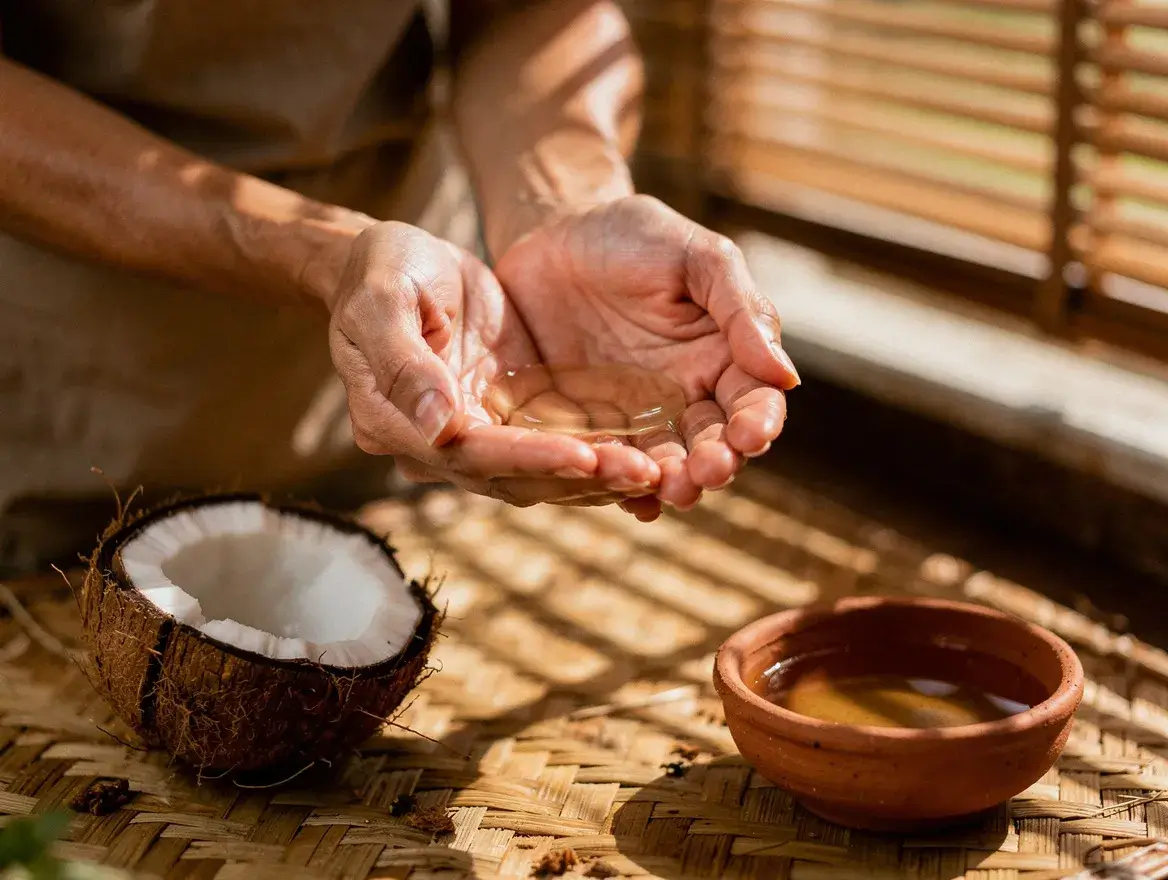
Across Indonesia, including here in Bali, many babies meet the world through warm hands and a little oil. The practice is called pijat bayi, baby massage. For generations it was carried by the dukun bayi, the traditional birth attendant who visited new mothers in the weeks after birth. She would warm oil in her palms and move slowly over the baby’s legs, belly, back, and arms, first while the mother watched and later while the mother did it herself. We told this story recently in a short piece on pijat bayi and the oldest ritual we know.
The oil was usually whatever the household already trusted. In much of the archipelago, that meant coconut. Plain, warm, familiar. One small Indonesian study compared virgin coconut oil with mineral oil for baby massage and found slightly faster weight gain in the coconut group. It is one study, not a promise, but it echoes what grandmothers assumed all along: the value is in the touch, and the oil is there to let the hands glide.
An honest word about minyak telon
It would not be truthful to say Indonesian baby care has never involved aromatic oils. Many families also love minyak telon, a warming baby oil traditionally made from cajuput oil, fennel oil, and coconut oil. Its scent is part of how a baby smells to a whole generation of Indonesians, and it is rubbed on bellies, backs, and feet to keep little ones warm.
Cajuput is rich in 1,8-cineole, the same compound found in eucalyptus, as we explain in our guide to cajeput essential oil benefits. Indonesian parenting advice itself often suggests waiting until a baby is a few months old, using only a thin amount, and keeping it away from the nose and face. We share that view. We respect the tradition, and we think the part of it most worth carrying forward is the slow, attentive massage with a plain oil.
Bringing the ritual home, gently
- Talk to your midwife or doctor first, especially in the first weeks or if eczema runs in the family.
- Choose a single, unscented oil. Patch test a small area on the leg and wait a day.
- Warm a little oil in your palms. You need far less than you think.
- Keep the room warm, the pressure light, and stop whenever your baby turns away or fusses.
- Keep oil away from the eyes, mouth, and hands that will end up in the mouth.
A note on newborn skin: a 2016 UK trial found that olive and sunflower oil, used twice daily on healthy newborns, hydrated the skin but slowed the development of its protective lipid structure compared with no oil. The researchers urged caution with oils on very young skin. That is a good reason to keep massage gentle, occasional, and guided by your health visitor in the first month, whatever oil you choose.
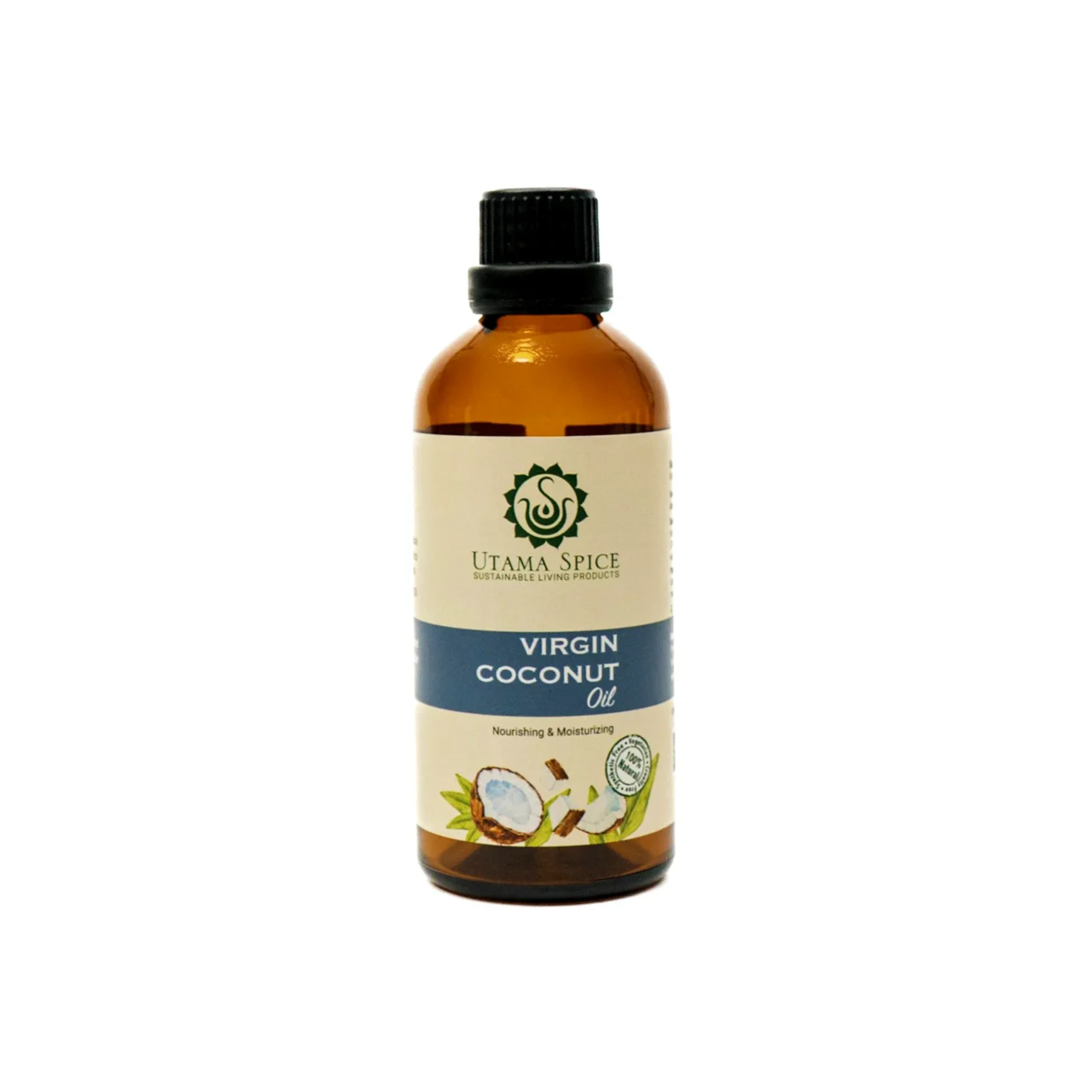
The plain oil, nothing added
Our Virgin Coconut Oil is cold-pressed and single-ingredient, with no scent and no essential oils. Warm a little in your palms and let the ritual do the rest.
If you still want to use one: essential oils safe for babies and toddlers by age

Some parents of older babies and toddlers will still want a gentle scent in a massage oil or bath. That is a reasonable choice when it is made carefully. The guidance below reflects the conservative limits most aromatherapy safety references converge on, including the age bands associated with Robert Tisserand’s work. Treat these numbers as a ceiling, not a target. Less is always fine.
Under three months
No essential oils. Not on the skin, not in the bath, and not diffused in the room the baby sleeps in. Some references allow a 0.1% dilution in rare cases, but for an ordinary home routine there is no reason to go there. Premature babies should not be exposed at all without medical advice, and that guidance extends beyond three months for them.

Three to 24 months
Up to 0.25%, if at all. That is about one drop of essential oil in 20 ml (four teaspoons) of carrier oil. Choose only mild oils, use the blend occasionally rather than daily, and apply it to the legs, feet, or back, never the face or hands. Ask your pediatrician before starting, especially if your baby has eczema, asthma, or any breathing difficulty.
Two to six years
Up to 1%. About one drop in 5 ml (one teaspoon) of carrier. Children in this range can enjoy simple, mild blends in a massage oil, but the same rules about avoiding the face, hands, and the oils listed in the next section still apply.
Which oils are usually considered mild
Most guides suggest true lavender and Roman or German chamomile as the gentlest starting points for children over two. If you choose lavender, use a single, pure oil you can identify, like our Lavender Essential Oil (pure Lavandula angustifolia), rather than a blend whose components you would have to look up. Our guide to lavender essential oil benefits covers what it can and cannot do for adults.
One honest caveat. A small 2007 case report linked repeated use of lavender and tea tree products to breast tissue growth in three young boys, which resolved when the products stopped. Later research has been mixed, and the link is not proven. But it is another reason we prefer “occasional and dilute” over “daily and generous” for young children.
Our blends and rollers, including the ones we love for adult calm, contain several oils at adult-friendly strengths. Some include bergamot or other citrus oils. They are not made for babies, and we would rather say so plainly than let a pretty label suggest otherwise.
Oils to keep away from infants, and why natural does not mean mild
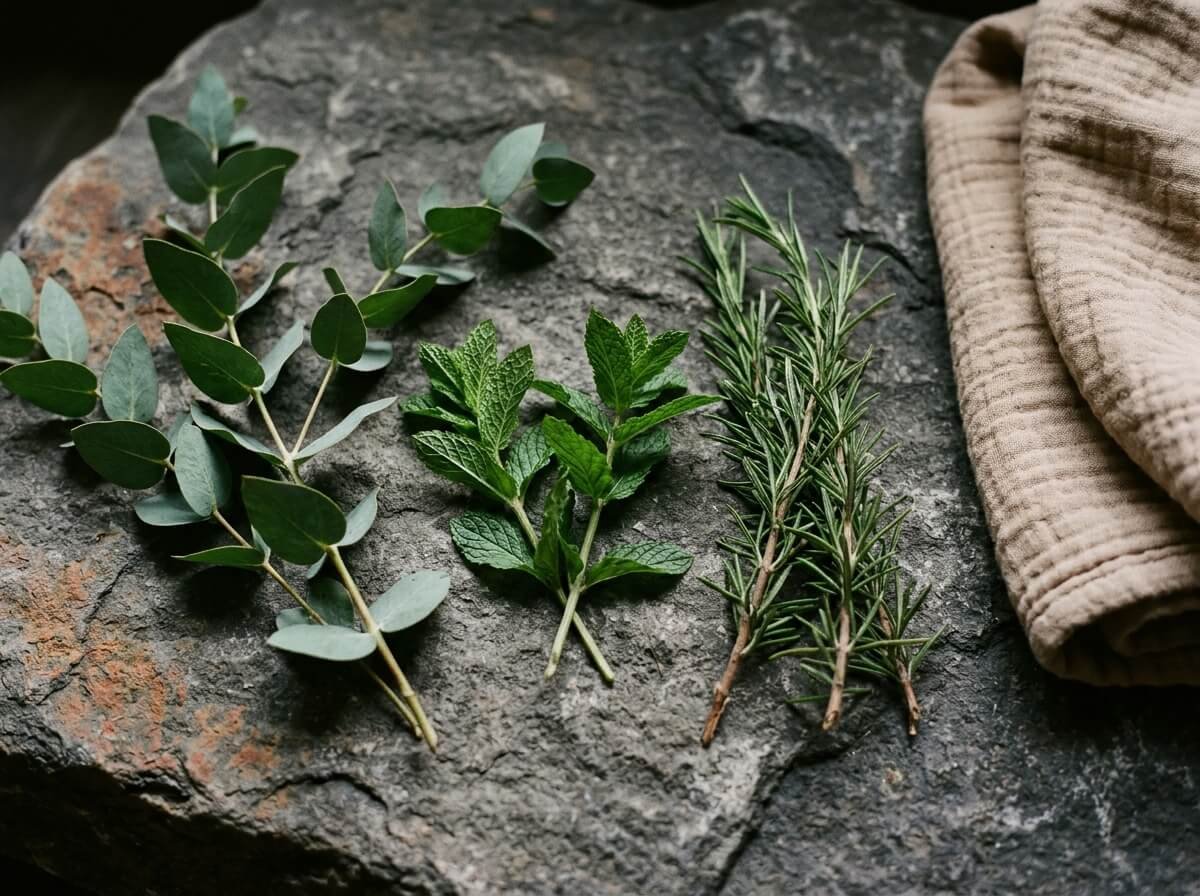
“Natural” describes where something comes from. It says nothing about how strong it is. Some of the most familiar plant oils are the ones safety guides are firmest about.
- Peppermint and other high-menthol oils. Menthol near an infant’s face can trigger breathing reflexes. Common guidance is no peppermint on or near children under six.
- Eucalyptus, rosemary, cajeput, and other high-cineole oils. These are the classic “clear the airways” oils for adults. For young children, many references advise keeping them well away from the face, with some setting the line as high as age 10 for eucalyptus.
- Wintergreen and sweet birch. Both are rich in methyl salicylate, a close relative of aspirin. Even small amounts swallowed can be dangerous for a child.
- Camphor. Found in some rubs and balms. It can cause serious harm if a child swallows it, so keep camphor products out of reach.
- Clove, cinnamon bark, oregano, and thyme. These “hot” oils can irritate even adult skin. There is no place for them on a baby.
- Citrus oils that are cold-pressed, like bergamot. These can cause sun reactions on the skin, which matters for babies who spend time outdoors.
Babies with eczema deserve extra care, because a damaged skin barrier lets more of whatever you apply pass through. Our guide to essential oils for eczema explains why we lean toward fragrance-free care for reactive skin, and the same logic applies even more strongly to infants.
The biggest risk is in the bottle, not the blend
The most serious harm from essential oils in young children usually comes from swallowing them, not from a diluted massage. A toddler who finds an open bottle can take in a large dose in seconds. Store every essential oil with its cap tightly closed, high and out of reach, ideally in a cupboard. Never leave bottles on a bedside table or changing table. If a child swallows any essential oil, call your local poison control service or emergency number straight away. In the United States, Poison Control is 1-800-222-1222.
Diffusing in a home with a baby: room, air, and timing

Many parents never put an oil on their baby’s skin but do run a diffuser in the living room. Diffusing is a softer exposure, but it is still an exposure, and a baby cannot leave the room when the air feels too strong.
- Not in the nursery. Keep diffusers out of the room where the baby sleeps, and never run one overnight near a sleeping baby.
- Not under three months. In the early weeks, skip diffusing in rooms the baby spends time in.
- Ventilate. Diffuse in a large, airy room with a window open, so the scent stays faint.
- Short and intermittent. Run it for about 30 minutes, then switch it off for at least as long. A faint scent is enough.
- Watch your baby, not the diffuser. Coughing, sneezing, fussing, or changes in breathing are signs to switch it off and open the windows.
- Skip it entirely if your baby has asthma, a cold, or any breathing concern.
The type of diffuser matters too. Nebulising diffusers push out undiluted oil and are much stronger than water-based ones. Our comparison of ceramic and nebulizing diffusers explains the difference. In a home with a baby, the gentler the method, the better.
And remember the rest of the household. If you have a cat, the same immature-pathway problem we described earlier applies to them for life, not just for a few years.
When to call a pediatrician instead of reading a blog post

We write to help you make calm, informed choices. We are not your baby’s doctor. Some moments need a medical voice, not an article.
- Your baby has swallowed any amount of essential oil or a product containing one.
- You notice coughing, wheezing, fast breathing, or unusual sleepiness after an oil was used nearby.
- A rash, redness, or swelling appears where an oil was applied and does not settle quickly after washing with a plain oil, then mild soap and water.
- Your baby is under three months and has a fever, or is struggling to feed.
- You are thinking of using any oil to treat colic, a cold, teething, or a skin condition.
If oil gets in your baby’s eye, rinse it gently with clean, lukewarm water and call poison control or your doctor for advice. For skin, a plain oil lifts essential oil better than water alone. Then wash gently.
Common questions about essential oils and babies
Are any essential oils safe for newborns? For babies under three months, the safest choice is no essential oil, either on the skin or diffused nearby. Use plain, unscented care instead.
Can I diffuse lavender in my baby’s room to help them sleep? We would not. Keep diffusers out of the nursery. A dim room, a steady routine, and a few quiet minutes of massage with a plain oil do more for sleep than scent.
Is coconut oil safe for baby massage? Plain virgin coconut oil is a traditional choice across Indonesia and is generally well tolerated. Patch test first, use a small amount, and check with your health visitor in the first month, especially if eczema runs in the family.
What about essential oils for teething or colic? Please do not rub essential oils on gums or bellies to treat these. Talk to your pediatrician, who can suggest safe options.
Is it safe to wear perfume or essential oil rollers while holding my baby? A light scent on your wrists is unlikely to cause harm, but keep it off your chest and neck where your baby rests their face, and wash your hands before touching their face.
Is minyak telon safe? Many families use it happily. Because it contains cineole-rich cajuput, we suggest waiting until your baby is a few months old, using only a thin layer on the back, belly, or feet, and keeping it well away from the nose and face.
The ritual is the gift
There is a quiet freedom in leaving something out. Without the bottle, the dilution maths, and the worry, what remains is the part that mattered from the start: a few minutes of warm hands, a plain oil, and a new parent learning the rhythm of a new person. That is what the dukun bayi taught, and it is what we would pass on.
For the oil itself, choose something single and simple. Our Virgin Coconut Oil is cold-pressed with nothing added. If coconut does not suit your family, plain Argan Oil or Tamanu Oil are other single-ingredient choices to discuss with your pediatrician. For a wider look at gentle routines, our guide to natural baby skin care is a good companion, and our piece on why coconut oil is good for skin explains the carrier itself.
When your child is older, the world of aromatics will still be here, and you can explore it together with care. Until then, the scent of a baby’s skin is the only aromatherapy most homes need.