Essential oils breastfeeding guide: milk supply, safety, and what to skip
Most essential oils breastfeeding advice starts with a list of oils to avoid and stops there. That leaves the question most new parents actually have unanswered: will this oil affect my milk, will it reach my baby, and how do I use it without worrying? The honest answer is calmer than the internet makes it sound. A few oils deserve real caution, a few are gentle in small amounts, and the way you use an oil matters as much as which oil it is.
We have blended botanicals in Bali since 1989, and many of the people in our workshop have raised children while working with these oils every day. This guide is what we would tell a friend: what the evidence says, where it runs out, and a simple routine that keeps care for you and care for your baby in balance. It is not medical advice. If you have a low supply, a premature baby, or a health condition, your midwife, lactation consultant, or doctor should be part of the conversation.
Essential oils breastfeeding basics: why this season is different from pregnancy

People often fold pregnancy and breastfeeding into one warning. They are different seasons with different questions.
In pregnancy, the main concern is what crosses the placenta and whether an oil might stimulate the uterus. That is why guides flag oils traditionally linked to menstruation, and why we added a pregnancy caution to our guide on essential oils for menstrual cramps.
Once your baby is born, the concerns change. There are three of them, and it helps to keep them separate:
- Your supply. A small group of plants has a long reputation for lowering milk production. This is the question most articles skip, and the one with the most practical weight.
- Transfer into milk. Essential oil molecules are small and fat-soluble, so a tiny amount can reach the bloodstream and, in theory, breast milk. At aromatherapy levels, this amount is thought to be very low.
- Your baby’s airways and skin. A newborn’s breathing and skin are far more sensitive than yours. Some oils that feel refreshing to an adult can be risky close to an infant’s face.
Seen this way, the question shifts from “is lavender safe?” to “how much, where, and how close to my baby?” That is a more useful question, and it is one you can answer at home.
There is also a quieter truth here. The early weeks of feeding are tiring, and many parents reach for scent because it helps them feel human again: a calm breath before a night feed, a warm smell in a room that has started to feel like a waiting room. That instinct is sound. Scent is one of the fastest ways the body has to shift its state. The aim of this guide is not to take that comfort away. It is to help you keep it, safely.
The supply question first: oils that may lower milk production
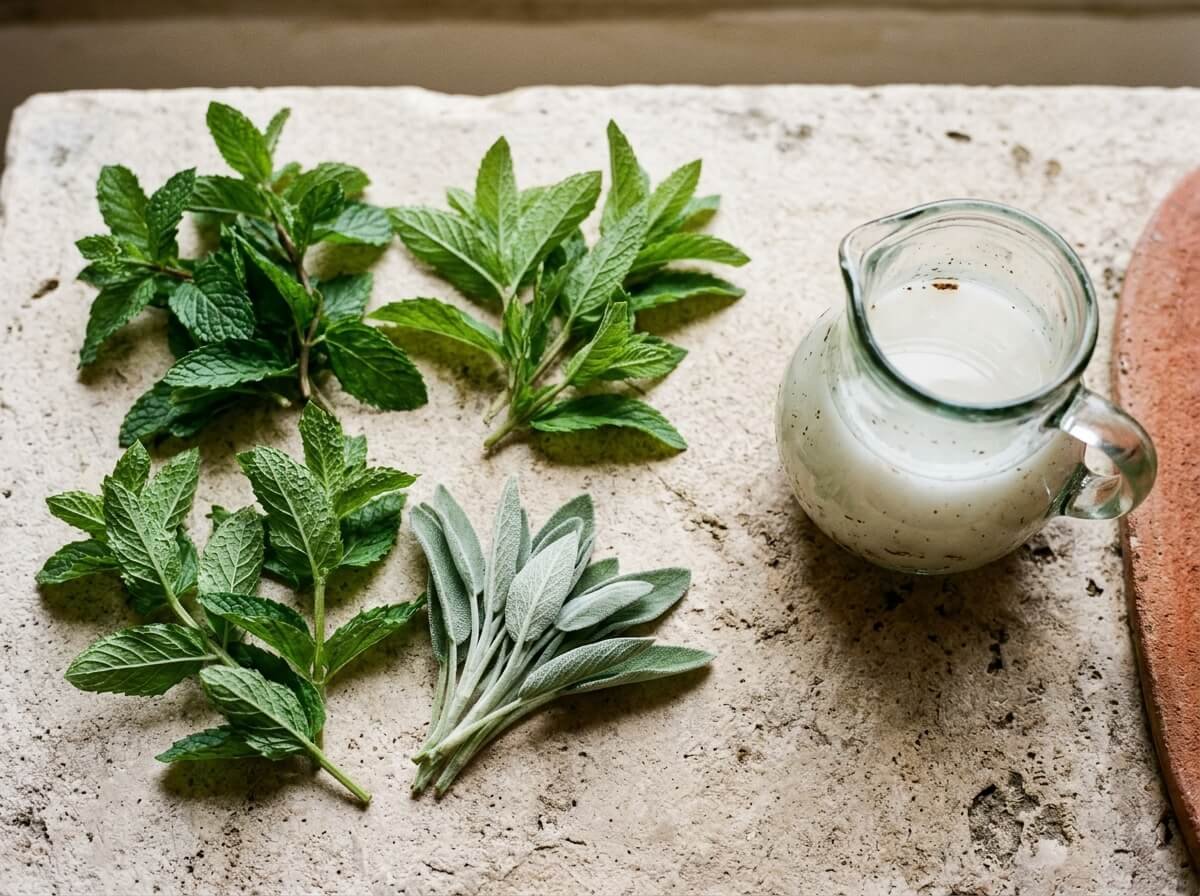
If you only remember one section, make it this one. A few plants have been used for generations to help people wean, and that reputation is worth respecting while you are still feeding.
Peppermint and spearmint
Here is the trap. Peppermint is the oil many new parents reach for first, because it is a familiar remedy for headaches and queasiness. We cover those uses in our guides to essential oils for headaches and essential oils for nausea. Yet mint, and menthol in particular, has a long reputation among lactation consultants and midwives for reducing supply, especially with strong or repeated use.
The research is thin. Most of the warning comes from clinical experience and traditional weaning practice rather than controlled trials, and small amounts of mint tea or a mint sweet are unlikely to matter for most people. But concentrated peppermint oil is many times stronger than a cup of tea. If your supply is still settling, or you are already worried about it, it makes sense to set peppermint and spearmint oil aside for now. Our peppermint essential oil guide will still be there when you wean.
Sage and clary sage
Garden sage is perhaps the best known traditional herb for drying up milk, and it is still suggested to parents who want to wean gently. Clary sage is a different plant, but it is often grouped with sage in breastfeeding cautions because of its hormonal reputation. Neither is a good everyday choice while you are building or protecting a supply.
Jasmine, parsley, and lemon balm
Jasmine has one of the more interesting pieces of evidence. A small, older study in India found that jasmine flowers applied to the breasts after birth lowered prolactin, the hormone that drives milk production, and suppressed lactation in a way comparable to a medication used for that purpose. That was a direct application of fresh flowers, not a whiff of perfume, but it is a reminder that plants can act on these hormones. Parsley in large amounts and lemon balm also appear on traditional anti-supply lists, with even less research behind them.
What this means in practice
None of this means a single exposure will empty your supply. It means that when you are choosing a daily scent for the months you are feeding, you have plenty of options that carry none of these questions. Choose from those, and keep the mints and sages for later.
Essential oils breastfeeding parents often use in gentle amounts

Safety guidance from aromatherapy educators generally treats a short list of oils as reasonable during breastfeeding when they are diffused briefly or diluted well. “Reasonable” is the honest word. There are no large trials proving safety, only a long record of use without clear signs of harm.
Lavender
True lavender (Lavandula angustifolia) is the oil most people know, and it has the deepest research base for calm and sleep. It is gentle on skin at low dilution and has no reputation for affecting supply. Our Lavender Essential Oil is pure angustifolia, the species most studies use. For the science behind it, our lavender essential oil benefits guide goes deeper.
Ginger, or jahe
In Indonesia, ginger is part of how families care for a parent after birth. Warming jamu drinks, spiced compresses, and rubs built on jahe and other rhizomes are traditional ways of restoring heat and strength in the weeks after delivery. We wrote about that heritage in our piece on jamu, Indonesia’s ancient practice.
Modern research supports ginger for nausea, mostly as food or capsules rather than essential oil. A small Thai trial even found that ginger capsules taken in the first days after birth were linked with higher milk volume, though it was one modest study. As an aroma, our Ginger Essential Oil brings a warm, peppery, slightly lemony note to a short diffusion session. It is strong, so a drop or two is enough. Our ginger essential oil benefits guide covers the plant in full.
Roman chamomile and frankincense
Roman chamomile is soft, apple-like, and calming. Frankincense is resinous and grounding. Both are commonly listed as gentle choices for diffusion during this season, and both blend well with lavender.
Citrus oils, with one note
Sweet orange and other citrus oils are bright and widely used. Expressed citrus oils can be phototoxic on skin, bergamot most of all, so keep skin you have applied them to out of strong sun for 12 hours. In a diffuser, this is not a concern.
Oils to keep away from your baby, even if they are fine for you
Eucalyptus, rosemary, cajeput, and camphor are rich in compounds like 1,8-cineole and camphor. Peppermint is rich in menthol. These can trigger breathing problems in young children when used close to the face, and camphor is toxic if swallowed. They may be fine for you in another room. They are not for the nursery, and they are never for a baby’s chest or nose.
How the route changes the risk: diffusing, skin, and swallowing
The same oil can be gentle or risky depending on how it reaches your body. Think of three routes, from lightest to heaviest.
Diffusing: the lightest route
Inhaling a lightly scented room delivers a very small dose. It is the route most aromatherapy safety guidance prefers during breastfeeding. Keep sessions short, around 30 to 60 minutes, then switch off and let the room air out. Use a few drops, not a cloud. Our guide to choosing an essential oil diffuser explains which types give you the most control.
On your skin: diluted, and in the right places
Skin absorbs more than air, so dilution matters. A common guideline during pregnancy and breastfeeding is around 1%, which is roughly five to six drops of essential oil in 30 ml of carrier oil. Our guide on how to dilute essential oils has a simple chart.
Where you apply it matters even more. Never put essential oils on or around the nipple or areola. Your baby’s mouth goes there, and whatever is on your skin goes into your baby. Choose places your baby’s face does not meet: the soles of your feet, your lower legs, or the back of your neck under your hair. If you apply oil to your hands or wrists, wash them before you pick your baby up.

Swallowing: not recommended
Some brands encourage taking essential oils by mouth, including as a supposed milk booster. We do not recommend this for anyone, and certainly not while breastfeeding. Ingestion delivers a much larger dose, can irritate the gut, and is the route most likely to raise the amount that reaches your milk. If you want ginger, fennel, or other traditional galactagogue plants, the food and tea forms are the ones with a history behind them, and even those are worth discussing with your lactation consultant. Our fennel essential oil guide explains why the concentrated oil is a different matter from fennel tea.
Sharing air with a newborn: the proximity question

Even when an oil is fine for you, your baby is breathing the same air. Newborns breathe faster than adults, their airways are narrow, and their skin is thinner. A scent that feels light to you is a larger dose for a small body.
A few simple habits keep shared spaces calm:
- Keep the diffuser out of the room where your baby sleeps, especially in the first three months. Diffuse in the living room or your own space, then let the air clear before your baby comes in.
- Ventilate. An open window does more for safety than any rule about drop counts. Fresh air is always the right companion to scent.
- Short and intermittent beats long and constant. All-night diffusing is not a good habit with an infant in the home.
- Watch your baby, not the clock. Sneezing, coughing, fussiness, or a change in breathing when the diffuser is on are your cue to switch it off and open a window.
- Store bottles out of reach. Small bottles are a choking and poisoning risk once babies start to grab. Our guide on how to store essential oils covers safe storage.
Babies do not need essential oils of their own. Their skin care can be very simple, and our guide to natural baby skin care keeps it that way. The oils in this article are for you, used with a little distance.
The pre-diluted roller, and a simple postpartum ritual
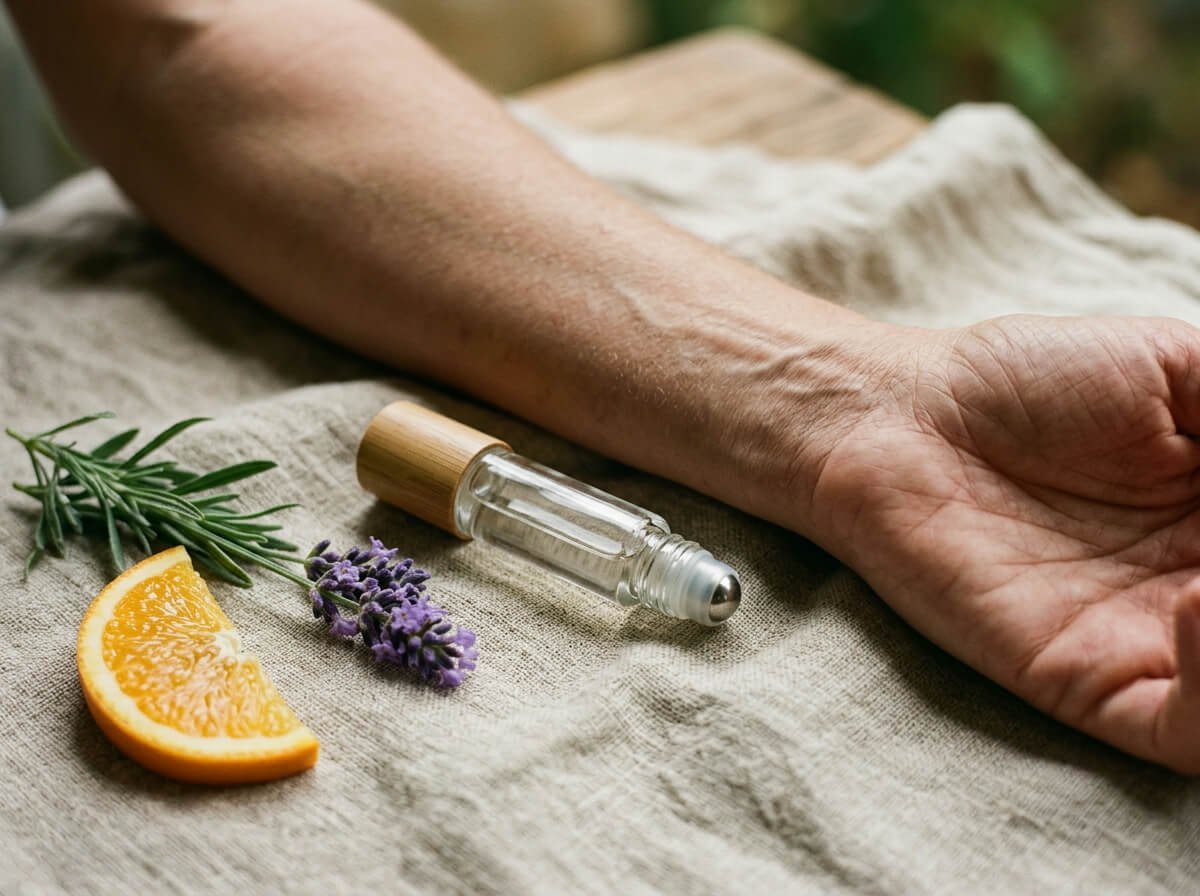
One of the biggest risks with essential oils is human, not botanical. It is 3am, you are exhausted, and you put a drop of neat oil on your temples because measuring a dilution feels impossible. A pre-diluted roller removes that error. The oil is already blended in a carrier, so there is nothing to measure and no way to apply it neat by mistake. We explain more in our guide to essential oil roller benefits.
Our Santi Essential Oil Roller blends lavender, rose geranium, cananga, sweet orange, and bergamot in jojoba. None of those oils is on the traditional anti-supply list. Two honest notes: it contains bergamot, so keep the area you roll it on out of strong sun for 12 hours, and its exact dilution is not printed on the label, so use it as a scent, not a massage oil. The Bliss Essential Oil Roller is a similar calming blend with a touch of patchouli.
A five-minute ritual for a night feed
- Before you settle your baby, roll a single stroke of Santi onto a tissue or a cotton pad, not onto your chest or hands.
- Place it near you, not near your baby. On the arm of your chair or a side table works well.
- Breathe slowly. In through the nose for four counts, out for six. Let the scent do its quiet work while you feed.
- Afterward, put the tissue away and open a window if the room feels close.
If you prefer a room scent, three drops of Deep Calming Essential Oil Blend in a diffuser in the next room for 30 minutes gives a similar softness without bringing the oil close to your baby.
This is the heart of it. Care for the person doing the caring, gently, with a little distance.

A calm scent, already diluted
Santi blends lavender, rose geranium, cananga, sweet orange, and bergamot in jojoba, hand-blended in Bali. No measuring at 3am, no risk of neat oil on tired skin. Roll it onto a tissue and breathe.
What the evidence says, and its honest limits

It would be easy to write this guide with more certainty than the research allows. Here is where things actually stand.
What we know reasonably well. Inhaled lavender has a solid body of small trials for anxiety and sleep. Ginger is well supported for nausea, mainly as food or capsules. Some essential oil components, such as menthol, 1,8-cineole, and camphor, are known risks for young children’s airways. And the dose of any substance that reaches breast milk depends heavily on how much enters your bloodstream, which is why route and dilution matter so much.
What we know only partly. The supply effects of peppermint and sage come mostly from traditional use and clinical observation. The jasmine study was small and old. The ginger milk-volume trial was small. These are signals worth respecting, not settled facts.
What we do not know. There is very little direct measurement of essential oil compounds in breast milk after normal aromatherapy use. When a guide tells you an oil is “proven safe” for breastfeeding, it is claiming more than the research shows. When a guide tells you all essential oils are dangerous, it is also claiming more than the research shows.
The honest position sits between those two. Use fewer oils, in lower amounts, by the gentlest route, with fresh air and a little distance. If you want to check a specific oil or herb, LactMed, the United States National Library of Medicine’s database on drugs and lactation, is a free and careful source. Our older guide to essential oil safety covers the general rules that apply in every season.
We also want to name something plainly. Some companies market essential oil blends as lactation boosters and encourage parents to swallow them. There is no good evidence for this, and the route carries the most risk. A tired parent worried about supply deserves real support from a lactation professional, not a bottle that promises more than it can give.
Essential oils breastfeeding FAQ

Can I use essential oils while breastfeeding?
Many people do, with care. Choose gentle oils such as lavender, Roman chamomile, frankincense, ginger, or sweet orange. Diffuse briefly or dilute to about 1%, keep oils away from your nipples and your baby’s face, and avoid swallowing them.
Which essential oils can decrease milk supply?
Peppermint, spearmint, sage, and clary sage have the strongest traditional reputation for lowering supply. Jasmine flowers lowered prolactin in one small study. Parsley and lemon balm also appear on traditional lists. Evidence is limited, but it is sensible to avoid them while you are feeding.
Do essential oils pass into breast milk?
Small amounts can, in theory, because their molecules are small and fat-soluble. At normal aromatherapy levels the amount is thought to be very low, but there is little direct measurement. Lower doses and gentler routes keep it lower still.
Is it safe to diffuse essential oils around a newborn?
It is better to diffuse in a different room, especially in the first three months, and to let the air clear before your baby comes in. Avoid eucalyptus, rosemary, peppermint, and camphor anywhere near an infant.
Can I use peppermint oil for a headache while breastfeeding?
A single small use is unlikely to matter for most people, but because of its reputation for lowering supply, lavender or a cool compress is a gentler first choice. If your supply is low or still settling, skip peppermint for now.
Can essential oils help with cracked nipples?
Please do not put essential oils on your nipples. Your baby feeds there. For sore or cracked nipples, speak with a lactation consultant about latch and use a product made for nipple care.
Can I use essential oils to increase my milk supply?
There is no good evidence that any essential oil increases supply, and swallowing oils is not safe. Frequent feeding or pumping, a good latch, rest, and support from a lactation consultant are what move supply. Some families find ginger or fennel as food or tea helpful alongside that support.
When can I go back to peppermint and sage?
Once you have weaned, or when your supply is well established and you have checked with your lactation consultant. Some parents use sage deliberately during weaning for exactly the reason they avoided it before.
Breastfeeding is a season, and like every season it asks for a slightly different kind of care. Keep your oils few, your doses small, and your windows open. What you give, you get back.