
Essential oils for nausea: what the evidence really supports, and how to use them safely
When the stomach turns, most of us reach for something before we even think. A window. A cold glass of water. A slow breath. For many people, that reflex also includes a small bottle of oil. Essential oils for nausea are one of the most searched comfort remedies online, and for good reason: two of them carry real, if modest, human evidence. The rest is a mix of tradition, calm, and marketing that rarely gets separated out.
This guide does the separating. We look at what the studies actually measured, why inhaling a scent can settle a queasy stomach at all, which oils have trial data (ginger and peppermint) and which are simply soothing, and how to use them safely, including in pregnancy, on the road, and during cancer treatment. We also say plainly where aromatherapy stops and a doctor’s care begins.
One promise before we start. You will never be asked to swallow an essential oil here. That single rule changes how almost every other guide on this topic should be read.
Why smell settles the stomach: how essential oils for nausea actually work

Nausea is not only a stomach event. It is a brain event. The feeling of queasiness is coordinated by a cluster of nerve centres in the brainstem that take signals from the gut, the inner ear, the bloodstream, and the higher brain, including memory and emotion. That is why motion, a bad smell, anxiety, a medication, or pregnancy hormones can all produce the same sinking sensation.
Smell has a uniquely direct line into that system. Olfactory nerves send signals to the limbic brain (the seat of emotion and memory) without the relay stations the other senses pass through. A scent can shift mood, attention, and breathing within seconds. We explore this pathway more fully in our piece on what aromatherapy actually does to your nervous system.
So when we talk about inhaled essential oils for nausea, at least three honest mechanisms are at work:
- Controlled breathing. To smell something, you slow down and breathe deliberately. Slow, deep breathing calms the nervous system on its own, and several nausea trials suggest the breathing does a share of the work.
- Sensory redirection. A sharp, clean scent gives the brain something else to process. It interrupts the loop of noticing and dreading the next wave.
- Possible aroma-specific effects. Menthol and the compounds in ginger may act on receptors in the nose and airways, and possibly downstream. This part is the least proven, and the studies are small.
One finding from post-operative research is worth knowing. In several hospital trials, patients who sniffed a pad soaked in plain isopropyl alcohol (rubbing alcohol) reported faster relief from nausea than those given nothing. A Cochrane review of aromatherapy for post-operative nausea, updated in 2018, judged the overall evidence to be of low certainty: some benefit, inconsistent trials, small numbers. In other words, the act of inhaling a strong scent seems to help, and specific oils may add a little on top.
That is not a disappointing finding. It is a useful one. It tells us that aromatherapy for nausea is a gentle, low-risk comfort tool that works best when we pair it with slow breathing and stillness, and that we should not expect a single oil to behave like medicine.
There is also a route question that most lists skip entirely. The strongest ginger research is about eating ginger: capsules, tea, or fresh root. Essential oil is a different substance, concentrated and volatile, and it is never swallowed. When a guide cites ginger capsule studies to sell ginger oil, it is borrowing evidence from another route. Throughout this guide, we keep those two worlds apart.
Ginger essential oil (jahe): the evidence, the chemistry, and the jamu heritage
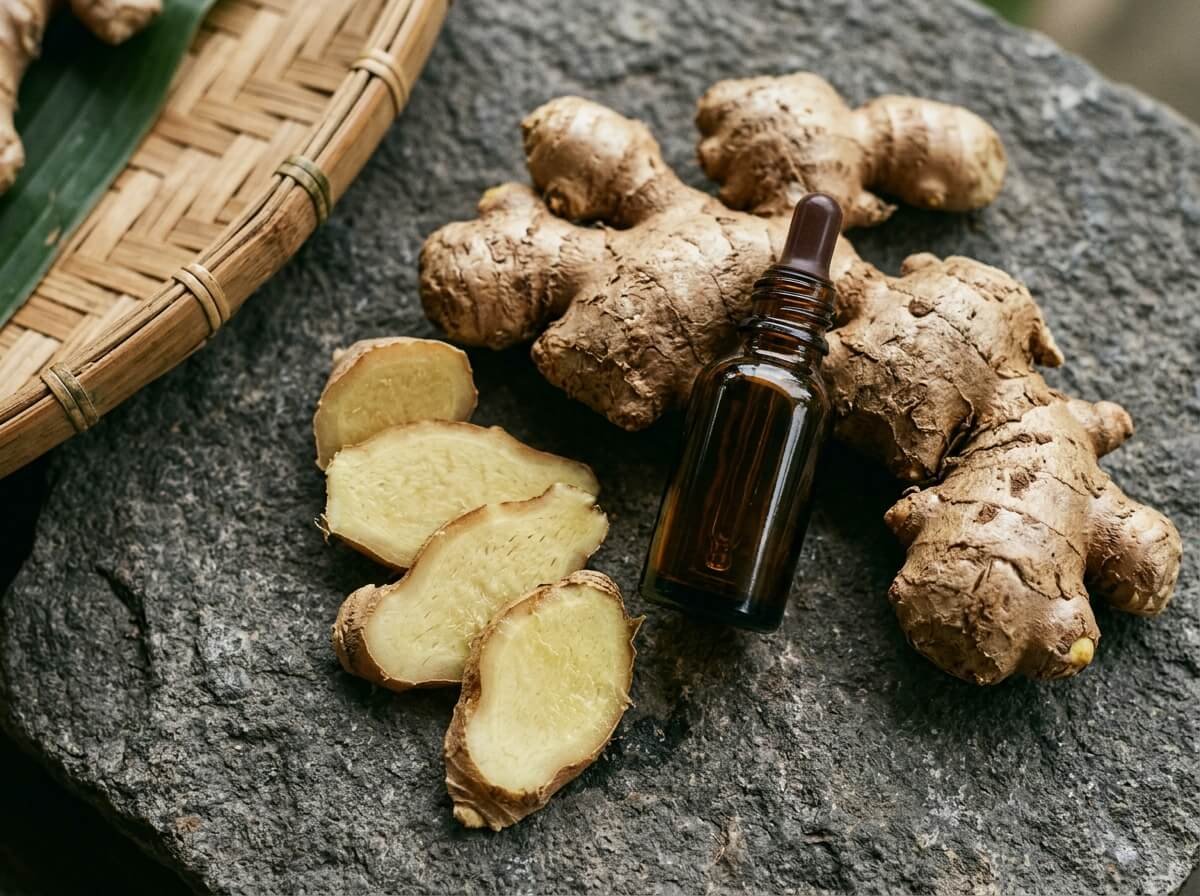
Ginger is the first plant most people think of for an unsettled stomach, and across Indonesia that instinct runs deep. Jahe, as ginger is called here, is a pillar of jamu, the herbal tradition passed down through Javanese and Balinese families for generations. Warm ginger drinks such as wedang jahe are what many households reach for when someone feels masuk angin, a folk description (literally, “wind has entered”) for the chilled, bloated, queasy feeling that comes with travel, rain, or fatigue. That tradition is about ginger as food and drink, and it is centuries old.
What the research says about ginger
Ginger taken by mouth has some of the most consistent evidence of any natural remedy for nausea. Reviews have found benefit for pregnancy-related nausea and some types of post-operative nausea, and many obstetric guidelines list ginger as a reasonable non-drug option. The active compounds in the root, gingerols and shogaols, appear to act partly in the gut itself.
Inhaled ginger essential oil is a separate story. Steam distillation captures the volatile, aromatic part of the root (mostly zingiberene and other sesquiterpenes), while much of the pungent gingerol fraction stays behind. Trials of inhaled ginger oil, including small studies in people receiving chemotherapy and after surgery, have produced mixed results: some report modest improvement in nausea or wellbeing, others find no clear difference from placebo. It is a reasonable oil to try, rooted in long tradition, but it should not borrow the stronger reputation of ginger tea.
Why we still love it for queasy moments
Ginger oil smells warm, peppery, and faintly lemony. For many people, especially those raised with jahe in the kitchen, the scent itself reads as comfort. That emotional association is not trivial; it is part of how scent works. Our ginger essential oil guide goes deeper into its chemistry, skin-safe dilution, and broader uses.
If you would like to keep ginger close for these moments, our Ginger Essential Oil is steam-distilled Zingiber officinale, hand-bottled in Bali. One drop on a tissue is all a queasy moment needs.
A practical pairing many families already use: sip a mild ginger tea for the gut route, and keep ginger oil on a tissue for the scent route. Two forms of the same plant, each used the way it is meant to be used.
Peppermint and mint: the other oil with real trial data

If ginger is the heritage choice, peppermint is the clinical one. More nausea trials have tested peppermint oil than any other essential oil, likely because menthol is so distinctive and easy to deliver by inhalation.
What the studies measured
Peppermint aromatherapy has been studied after surgery, during chemotherapy, and in pregnancy. Some small trials report that patients who inhaled peppermint felt less nauseous, or needed fewer rescue anti-nausea medicines, than those given a placebo scent. Others show no meaningful difference. Several of the positive studies compared peppermint with nothing at all rather than with a neutral scent, which makes it hard to separate the oil from the act of breathing slowly. The honest summary: peppermint may offer a small, short-lived easing of nausea for some people, with very low risk when it is inhaled correctly.
What researchers think happens is fairly intuitive. Menthol activates cold-sensing receptors in the nose and mouth, producing that sharp, clearing coolness. It may also relax smooth muscle, which is why peppermint oil capsules (a medical product, taken under guidance) are used for irritable bowel symptoms. Inhaled, the effect is mostly sensory and calming.
Which mint is in your bottle
Here is a detail most lists never mention. “Peppermint oil” in clinical trials is usually Mentha × piperita. Many oils sold as mint or peppermint in Asia, including ours, are Mentha arvensis, known as field mint or cornmint. It is a close cousin, very rich in menthol, with a slightly sharper, simpler aroma. For inhalation comfort the two behave similarly, but we prefer to be clear about it rather than blur the botany. Our peppermint essential oil guide explains the differences in full.
Our Mint Essential Oil is Mentha arvensis, cool and bright, and it works well on a tissue or blended into a personal inhaler for travel days.
Two cautions specific to mint
- Keep menthol-rich oils well away from the faces of babies and young children. Strong menthol near a small child’s nose can affect their breathing.
- Peppermint can feel harsh for people with reflux, and very strong menthol can trigger headaches in some people. One drop is plenty, and if it feels too sharp, step away from it.
The evidence gap: which “nausea oils” are calming, not proven

Most top-ranking lists for this topic include six to 10 oils. Lavender, spearmint, fennel, cardamom, lemon, and chamomile often sit beside ginger and peppermint as if they carried equal weight. They do not. That does not make them useless; it means we should describe them accurately.
Lavender
Lavender has a reasonable body of evidence for anxiety and sleep, which we cover in our guides to lavender essential oil benefits and essential oils for sleep. Direct anti-nausea data is thin. Where nausea is driven by worry, travel nerves, or a racing mind, lavender’s calming quality may help indirectly. Think of it as calming-adjacent, not an anti-nausea oil.
Lemon and other citrus
Citrus has one interesting data point. A small trial in pregnant women found that inhaling lemon oil reduced nausea and vomiting scores compared with placebo over a few days. It is a single small study, but citrus oils are also widely liked during pregnancy because they smell fresh rather than heavy. Bright citrus such as our sweet orange essential oil is gentle on the nose; just remember that some citrus oils are phototoxic on skin, which we explain in that guide.
Spearmint
Spearmint is milder and sweeter than peppermint, with far less menthol. It appears in a few small studies alongside peppermint, usually in blends, so its solo evidence is limited. A reasonable choice for people who find peppermint too sharp.

Fennel and cardamom
Both have strong traditions as digestive spices, eaten after meals across South Asia and the Middle East. That evidence, again, is about food, not inhaled oil. Fennel essential oil also carries real cautions: it contains estragole and estrogen-like compounds, so it is not one for pregnancy, breastfeeding, or young children. Our fennel essential oil guide sets out who should skip it.
The truthful hierarchy looks like this: ginger and peppermint have trial data with mixed but genuine signals; lemon has one small promising study; lavender, spearmint, fennel, and cardamom are traditional or calming choices without direct proof. A list that ranks all of them equally is selling, not teaching.
How to use essential oils for nausea safely: dose, method, and frequency

Method matters more than the oil. Every study that showed benefit used inhalation, and none asked people to ingest an oil. Here is how we suggest using essential oils for nausea at home, at work, or on the move.
Method one: the tissue or cotton pad
The simplest and often the best.
- Place one drop (two at most) on a tissue, handkerchief, or cotton pad.
- Hold it about 5 cm below your nose. Do not press it to your nostrils.
- Breathe in slowly through the nose for a count of four, out through the mouth for a count of six. Repeat three to five times.
- Set it aside for a few minutes, then repeat if you need to.
That pause matters. Our sense of smell tires quickly, and constant exposure can turn a helpful scent into a headache.
Method two: the personal inhaler
A personal nasal inhaler is a small tube with a cotton wick inside. Add three to five drops to the wick, close it, and uncap it when you need it. It is discreet, travels well, and keeps the oil off your skin. This is the format most often used in hospital studies.
Method three: a pre-diluted roller
A roller bottle with oils already diluted in a carrier is convenient on the go. Roll a little onto the wrist, cup your hands near your nose, and breathe. Read our guide to essential oil rollers for how to read a roller’s label and dilution. Our Pure Energy Essential Oil Roller is a jojoba-based citrus, rosemary, and lemongrass blend; many people find its brightness refreshing when they feel flat and queasy on long workdays. It contains bergamot, so apply it to skin that will stay out of direct sun, or simply breathe from the roller ball.
For a ready-made blend that already pairs the two oils with the most evidence, our Clearing Essential Oil Blend combines ginger and peppermint with cubeb, cajeput, fennel, and nutmeg. We designed it for the airways, but its ginger-and-mint backbone makes it a natural tissue companion on a queasy day (it contains fennel, so it is not one for pregnancy).
What about diffusers
A diffuser can freshen a room where someone is resting, but it is a less precise tool. Nausea often comes with smell sensitivity, and a scent filling the whole room can feel overwhelming. If you do diffuse, use two or three drops, run it for 15 to 30 minutes, keep a window open, and let the person leave the room if they need to. Our guide to aromatherapy diffuser oils covers ventilation and dosing.
The non-negotiables
- Never swallow essential oils. Not in water, not in tea, not in capsules you make at home. Concentrated oils can irritate the mouth and gut and are toxic in larger amounts.
- Never apply neat to skin. For topical use, dilute to around 1% to 2% in a carrier oil (roughly one to two drops per teaspoon), and less for sensitive skin.
- Keep oils capped, cool, and out of reach of children and pets. Oxidised oils irritate more; our guide on how to store essential oils explains why.
- Stop if it makes things worse. For some people in the middle of nausea, any strong scent is the trigger. Trust that signal.

Keep jahe close for queasy days
Our Ginger Essential Oil is steam-distilled Zingiber officinale, hand-bottled in Bali. Warm, peppery, and faintly lemony, it is the scent of the jamu kitchen. One drop on a tissue, a few slow breaths, and a moment of calm.
Nausea in pregnancy, travel, and chemotherapy: honest cautions

Three groups search for essential oils for nausea more than anyone else. Each deserves more than a generic list.
Morning sickness and pregnancy
Nausea in pregnancy is common, especially in the first trimester, and the search for gentle relief is completely understandable. A few principles keep aromatherapy within safe limits:
- Speak with your midwife or doctor before using essential oils, especially in the first trimester.
- Inhalation from a tissue is the gentlest route. Avoid applying oils to the skin in pregnancy unless a qualified practitioner has guided the dilution.
- Ginger, lemon, and peppermint are the oils most often studied for pregnancy nausea, always inhaled and in small amounts.
- Avoid fennel, and avoid blends where you cannot check every ingredient.
- Food-route ginger (a mild tea, small pieces of crystallised ginger) is the option with the most pregnancy research, and your care team can tell you whether it suits you.
Severe, persistent vomiting in pregnancy (hyperemesis gravidarum) is a medical condition, not a matter of comfort. If you cannot keep fluids down, are losing weight, or feel faint, please contact your care provider promptly.
Motion sickness
Motion sickness comes from a mismatch between what the inner ear senses and what the eyes see. Aromatherapy will not fix that mismatch, but a familiar scent and slow breathing can take the edge off. On car rides, boats, and flights, a personal inhaler or a tissue in a pocket is far more practical than a diffuser. Combine it with the basics that help most: look at the horizon, keep air moving, sit facing forward, and avoid reading. We pack ours alongside the essentials in our travel skincare routine.
In Indonesia, many travellers reach for minyak kayu putih, cajeput oil, rubbed on the belly and dabbed under the nose on long journeys. It is a beautiful example of everyday scent ritual, and our cajeput essential oil guide tells its story and its safety notes.
Chemotherapy-related nausea
Cancer treatment can bring nausea that is relentless, and many hospitals now offer aromatherapy as a complementary comfort. Small trials with inhaled peppermint and ginger have shown mixed results. A few important points:
- Always tell your oncology team before adding anything, even a scent.
- Chemotherapy often changes the sense of smell. An oil you once loved may become unbearable, so test with the tiniest amount.
- Aromatherapy sits alongside prescribed anti-nausea medicine, never in place of it.
- Avoid applying oils to skin that is receiving radiotherapy or is fragile.
Across all three groups, the theme is the same. Essential oils can offer a moment of comfort and a sense of control. They are a gentle ally, not the treatment.
Essential oils for nausea FAQ, and when aromatherapy is not enough

What is the best essential oil for nausea?
There is no single best oil. Ginger and peppermint have the most human trial data, both with mixed but genuine signals. Lemon has one small promising pregnancy study. Choose the scent you find comforting, because a smell you dislike will not settle anyone’s stomach.
How fast do essential oils work for nausea?
When they help, it is usually within a few minutes of slow, deliberate inhalation. If you feel no change after two or three short rounds, the oil is unlikely to help this episode.
Can I put peppermint oil in water or tea for nausea?
No. Never ingest essential oils. If you want a drink, use the plant itself: a fresh mint or ginger tea. Peppermint oil capsules exist as a regulated medical product for gut symptoms, which is a different thing from a bottle of aromatherapy oil.
Is it safe to use essential oils for nausea in children?
Be very cautious. Keep menthol-rich oils like peppermint and mint away from babies and young children entirely. For older children, a single drop of a gentle oil on a tissue held at a distance is the most you need, and ask your paediatrician first if your child has asthma.
Can I rub essential oils on my stomach for nausea?
You can apply a properly diluted oil (around 1% in a carrier) to the belly as a comforting massage, and many traditions do exactly this. The scent you breathe in while doing it is likely doing most of the work. Never apply undiluted oil.
Do acupressure bands and essential oils work together?
They can be used side by side. Pressure on the inner wrist point (often called P6) has its own modest evidence for nausea, and pairing it with slow breathing and a familiar scent is a gentle, low-risk combination.
When should I see a doctor instead?
Aromatherapy is comfort for ordinary, passing nausea. Please seek medical care if:
- vomiting lasts more than a day (or a few hours in a child or older adult),
- you cannot keep fluids down, or show signs of dehydration such as dark urine, dizziness, or a dry mouth,
- there is blood in the vomit, or it looks like coffee grounds,
- nausea comes with severe abdominal pain, chest pain, a stiff neck, confusion, or a recent head injury,
- you are pregnant and vomiting repeatedly or losing weight.
A closing thought
Nausea strips us back to the basics: breath, stillness, a cool cloth, a familiar smell. That is exactly where aromatherapy belongs. Used honestly, a drop of ginger or mint on a tissue is a small act of care, rooted in jamu kitchens and backed by a handful of careful studies. It does not need to be oversold. It only needs to be used well. For broader safety guidance, revisit our essential oil safety guide, and if congestion is part of how you feel unwell, our guide to essential oils for congestion follows the same evidence-honest approach.