Essential oils safe for pets: what actually protects cats and dogs
If you share your home with a cat or a dog, you have probably searched for a list of essential oils safe for pets at some point. You will find plenty of lists. Some say lavender is fine, others say it is not. Some say a diffuser is the safe option, others say it is the riskiest of all. The confusion is real, and it is not your fault. Most of those lists start from the wrong question.
Here is the truth we want to start with: your pet is not a small human, and the question is rarely “which oil.” The more useful question is “how does the oil reach them?” Once you understand the route, the rest of the guidance falls into place, and you can enjoy a scented home without guessing.
Below, we walk through the three routes, why cats are most vulnerable, how to diffuse in a shared home, which oils are flagged most often, and when to call your vet.
One note before we begin. We make aromatherapy products, not veterinary products. Nothing here is a treatment plan for your animal. An essential oil is not a pet remedy, and any use on or in an animal belongs with your vet.
Why “essential oils safe for pets” is the wrong question

Search for essential oils safe for pets and the results look tidy. A column of “safe” oils, a column of “toxic” ones, sorted by species. It feels reassuring. It is also incomplete in a way that matters.
The same oil can be low risk in one situation and dangerous in another. A few drops of lavender in a passive ceramic dish, in a large ventilated room the dog can walk out of, is a very different exposure from neat lavender rubbed into a dog’s coat. Tea tree oil diluted to a small percentage in a human shampoo, rinsed off your own scalp, is a very different exposure from a few drops of undiluted tea tree applied to a cat’s skin “for fleas.” The oil is the same. The dose, the concentration, and the route are not.
That is why we ask you to set the list aside for a moment and think like a toxicologist. Three things decide whether an essential oil harms an animal:
- Concentration. Neat oil is many times stronger than a diluted blend or a scented room.
- Route. Breathing a faint aroma, absorbing oil through skin, and swallowing oil are three different exposures with three different risk levels.
- Species. A cat, a dog, a rabbit, and a parrot each process aromatic compounds differently, and some barely process them at all.
Lists flatten all three into a single word, “safe,” and that single word does a lot of damage. It is how well-meaning people end up rubbing “pet-friendly” oils onto animals, or leaving an ultrasonic diffuser running all night beside a cat bed. It is also how “pet-safe aromatherapy” became a marketing category. We would rather be honest with you: there is no oil that is safe for every pet, at every dose, by every route. There are only safer and less safe habits.
If you are newer to essential oils in general, our long-standing guide to essential oil safety covers the human side of the same principles, and our guide on how to dilute essential oils explains why concentration is always the first lever.
Three routes: how an oil actually reaches your pet
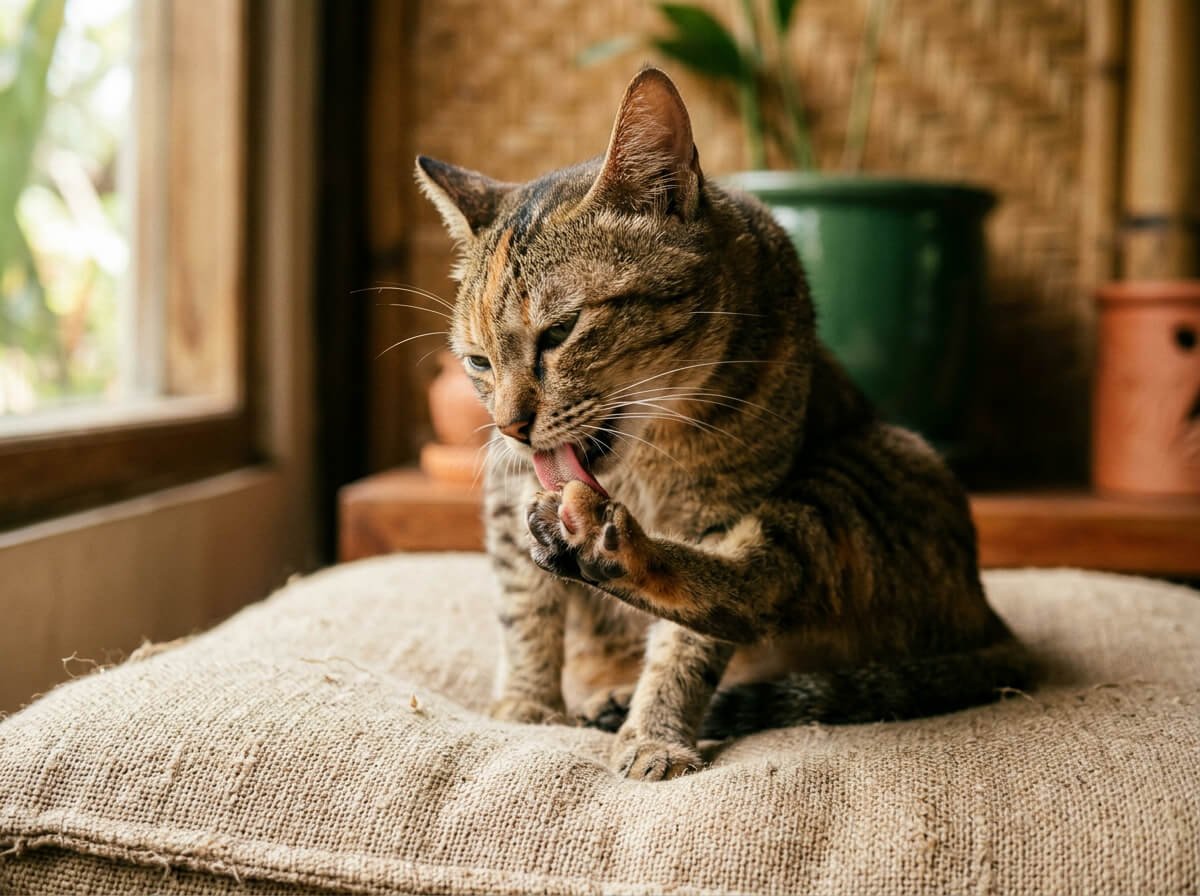
Every essential oil exposure in a home follows one of three routes. Understanding them is the single most useful thing you can do for your animal.
Route one: inhalation
This is the route most people think about. Aromatic molecules evaporate into the air, and your pet breathes them in. At low concentrations in a ventilated room, inhalation is generally the lowest-risk route for a healthy adult dog. It becomes a problem when the air is saturated (a small closed room, a diffuser running for hours) or when the animal has a sensitive respiratory system. Cats with asthma, older animals, puppies and kittens, and birds sit firmly in that sensitive group. Birds deserve a special mention: their respiratory systems are so efficient at drawing air through the body that airborne compounds affect them quickly. If you keep a parrot or any pet bird, we would keep diffusing out of their space entirely.
Route two: skin contact
Oils absorb through skin, and an animal’s skin is not built like ours. Fur traps oil against the skin, and many animals are smaller than us, so the same few drops mean a much larger dose per kilogram. This is the route behind many serious poisoning cases. People apply neat or poorly diluted oil directly to a pet, often to treat fleas, itching, or a hot spot. Veterinary toxicologists have documented hundreds of these cases with concentrated tea tree oil alone. Skin contact also happens indirectly, when a pet brushes against a freshly oiled surface or curls up on a blanket you have just scented.
Route three: ingestion (and why grooming changes everything)
Pets swallow oil in two ways. The obvious way is chewing a bottle, licking a spill, or lapping up a scented product. The less obvious way is grooming, and this is the part most lists leave out.
Active diffusers, especially ultrasonic and nebulizing types, release tiny droplets into the air, not just evaporated scent. Those droplets settle. They settle on furniture, on floors, and on fur. A dog may not notice. A cat, who grooms for a large part of every waking day, licks those droplets straight off its coat. An airborne exposure has quietly become an oral one, repeated many times a day.
This is the heart of what we call the diffuser myth: the idea that diffusing is automatically safe because nothing touches the animal. In a closed room with an active diffuser running for hours, plenty touches the animal. It just arrives slowly, in droplets you cannot see.
Once you see these three routes clearly, the safety habits make sense. Keep oil off your pet (route two). Keep bottles and fresh spills away from mouths (route three). And keep the air light, intermittent, and escapable (route one, and the hidden version of route three).
Why cats are the most vulnerable, and how dogs differ
If you remember one species-specific fact from this guide, make it this one: cats are far more sensitive to essential oils than dogs, and the reason is in their liver.
The missing enzyme, plainly explained
When any mammal absorbs an aromatic compound, the liver works to make it easier to excrete. One of the main tools it uses is a process called glucuronidation, which attaches a sugar-based tag to the compound so the kidneys can flush it out. Humans and dogs do this well. Cats have very limited ability to perform this step for many compounds, because they lack key forms of the enzyme involved (a family called UDP-glucuronosyltransferase).
The practical consequence is simple. Compounds that a dog or a person clears in hours can linger and build up in a cat. Many of the compounds that make essential oils smell the way they do fall into exactly this category: phenols (found in oils like clove, oregano, and thyme), certain monoterpenes (common in citrus, pine, and tea tree), and salicylates (wintergreen and sweet birch). It is the same reason cats react badly to some human medicines that are routine for us.
This is also why “it is natural” offers no comfort here. A plant compound is still a chemical, and a cat’s liver does not care where the compound came from.
How dogs differ
Dogs process most aromatic compounds more efficiently than cats, so they have more margin. More margin is not immunity. Dogs are often larger, more curious, and more likely to chew a bottle or lick a spill, so ingestion accidents are common. Small breeds, puppies, older dogs, and dogs with liver, kidney, or respiratory conditions have far less margin than a healthy adult retriever. And dogs have a sense of smell many thousands of times more sensitive than ours, so a scent we find gentle can be intense for them.
Other animals in the home
Rabbits, guinea pigs, ferrets, and especially birds are all more sensitive than dogs, and there is less research on them. For these animals, we suggest the most conservative approach: no diffusing in the room where they live, and no oils anywhere near their food, water, or bedding.
The takeaway is not that you must give up aromatherapy. It is that the household’s most sensitive animal sets the rules. If a cat lives with you, plan your habits around the cat.
Diffusers in a pet home: the habits that matter

Many of us live in homes where aroma is part of daily ritual. In Bali, homes are often built as open pavilions around a shared courtyard, with air moving freely and animals coming and going through the day. That open, breathing architecture holds a quiet lesson for anyone diffusing oils near animals: scent works best when it can drift away again.
Here are the habits we recommend, ordered from most to least important.
Always leave an exit
Your pet should always be able to leave a scented room. Never diffuse in a closed room with an animal inside, and never diffuse in the room where a cat is shut in for the night, or in a crate area. Animals are good at moving away from smells they dislike, but only if the door is open.
Choose the gentlest method that does the job
Diffuser types differ a lot in how much oil they put into the air, and in what form. A passive method, such as a few drops on a ceramic dish or a reed diffuser, releases only evaporated scent at a low, steady rate, with no droplets. An ultrasonic diffuser releases a fine water mist that carries oil droplets. A nebulizing diffuser, like our Danau Satu atomizing diffuser, breaks neat oil into a very fine aerosol and has the strongest throw of all. That strength is exactly why we love it in a large open room, and exactly why it needs the most care in a pet home. Our guide to ceramic versus nebulizing diffusers explains the differences in detail, and our nebulizing diffuser guide covers how to run one well.

To be clear, a passive method is not “pet safe.” It is simply lower output, which gives you more margin.
Run it intermittently, not all day
Thirty to 60 minutes on, then a long break, is plenty for a room to feel scented. Most quality diffusers have an intermittent setting for this reason. Our Sonoma Yi ultrasonic diffuser has both timer and intermittent mist options. Continuous all-day or all-night diffusing raises the concentration in the air, and with active diffusers it raises the amount of oil settling on fur and surfaces.
Ventilate
Open a window or run a fan. In humid climates, an ultrasonic diffuser also adds moisture to air that is already damp, which is one more reason to keep sessions short. Our piece on the essential oil diffuser as a humidifier explains that trade-off.
Place it high and stable
Put the diffuser where it cannot be knocked over, licked, or used as a perch, and use fewer drops than you think you need. A tipped nebulizer spills neat oil, and a curious cat will investigate.
Watch your animal
Your pet’s behavior is the best feedback you have. If your dog leaves the room every time you diffuse, or your cat starts sneezing, drooling, or pawing at its face, stop and ventilate. Respect the message.
Oils commonly flagged for cats and dogs

We said earlier that lists are incomplete. That is still true. But some oils come up again and again in veterinary poisoning reports, and you deserve to know which ones. Read this section with the route and concentration lessons in mind: these oils are most dangerous neat, on the skin, or swallowed, and they deserve extra caution in the air around cats.
Tea tree (melaleuca)
Tea tree is the oil most often linked to serious poisoning in both cats and dogs, almost always after people apply concentrated oil to an animal’s skin to treat fleas or skin problems. Signs can include drooling, wobbliness, weakness, and tremors. We love tea tree for human skin, and our guide to tea tree essential oil benefits explains why. It simply does not belong on an animal.
Citrus oils (sweet orange, lemon, lime, grapefruit, bergamot)
Citrus oils are rich in d-limonene and related monoterpenes, which cats in particular struggle to clear. They are also skin irritants for animals when concentrated. Our sweet orange essential oil guide and our blends that feature citrus are written for people, so keep the bottles closed and out of reach.
Pine and other conifers
Pine oils are irritating to the skin and mucous membranes and can affect the liver. Cleaning products scented with pine are a common household source.
Peppermint and other mints
Peppermint contains menthol and related compounds that can irritate the mouth and stomach and affect the nervous system in high doses. Our Mint essential oil is distilled from Mentha arvensis, a close cousin of peppermint with a similar menthol-rich profile, and the same caution applies. Our peppermint essential oil benefits guide covers its human uses.
Wintergreen and sweet birch
Both are dominated by methyl salicylate, which is closely related to aspirin. Cats are especially sensitive to salicylates. Keep these oils well away from pets.
Pennyroyal
Pennyroyal has a long folk reputation as a flea repellent and a well-documented record of liver toxicity in animals and people. We do not recommend it in any pet home.
Others worth caution
Cinnamon, clove, oregano, and thyme (rich in phenols), eucalyptus, ylang ylang, and anise also appear on veterinary caution lists, particularly for cats.
And lavender?
Lavender is the oil people most often ask about. It is generally gentler than the oils above, and a lightly scented, ventilated room is usually well tolerated by healthy dogs. It still contains compounds that cats process poorly, and it can still upset a stomach if swallowed. Our Lavender essential oil is a pure single note, and pure means concentrated. Treat it with the same route-first respect as any other oil.

Scent that stays with you, not in the air they breathe
Our Santi essential oil roller blends lavender, rose geranium, bergamot, cananga, and sweet orange in jojoba oil, ready for your wrists. It is made for human skin, not for animals: let it absorb, wash your hands before cuddling, and keep it out of reach.
Signs of trouble and when to call the vet
We hope you never need this section. Read it anyway, because when an exposure happens, calm and quick action matters more than anything else.
Signs to watch for
Signs of essential oil exposure vary with the oil, the dose, and the route, but common ones include:
- Drooling, lip-licking, or pawing at the mouth or face
- Vomiting
- Wobbling, stumbling, or unusual weakness
- Muscle tremors or twitching
- Coughing, wheezing, panting, or breathing with the mouth open (in a cat, open-mouth breathing is always urgent)
- Watery eyes, sneezing, or a runny nose
- Redness, irritation, or a strong oil smell on the skin or coat
- Unusual sleepiness, hiding, or a low body temperature
What to do right away
- Move your pet to fresh air and switch off any diffuser.
- Do not try to treat it yourself. Do not induce vomiting, and do not give milk, oil, or home remedies. Some of these make things worse.
- If oil is on the skin or fur, your vet may advise a gentle wash with a mild dishwashing liquid. Ask first, and keep your pet warm afterward.
- Call your vet or an emergency animal clinic now. In the United States, the ASPCA Animal Poison Control Center is available on (888) 426-4435 (a consultation fee may apply). Elsewhere, your local emergency vet can advise.
- Bring the bottle or product label. The exact oil, the concentration, and how much is missing help the vet decide on treatment.
Do not wait it out
Some reactions start mild and worsen over hours, especially in cats, because the compounds keep building up while the liver struggles to clear them. If you suspect an exposure, call. A vet would far rather hear from you about a false alarm than see a cat a day too late.
Essential oils safe for pets: frequently asked questions
Can I diffuse around my dog?
Many healthy adult dogs tolerate light, intermittent diffusing in a large, ventilated room, as long as they can leave. Keep sessions to 30 to 60 minutes, use fewer drops, place the diffuser out of reach, and watch for signs of discomfort. Skip diffusing near puppies, older dogs, and dogs with breathing, liver, or kidney conditions unless your vet says otherwise.
Can I diffuse around my cat?
This is where we are most cautious. Because of how cats process aromatic compounds, and because grooming turns airborne droplets into swallowed ones, we suggest keeping active diffusers (ultrasonic and nebulizing) out of rooms where your cat spends time. If you diffuse, do it in a room the cat cannot access, with the door closed and the window open, then air the room before your cat returns. Ask your vet first if your cat has asthma or any liver condition.
Are essential oil rollers safe to wear near my pet?
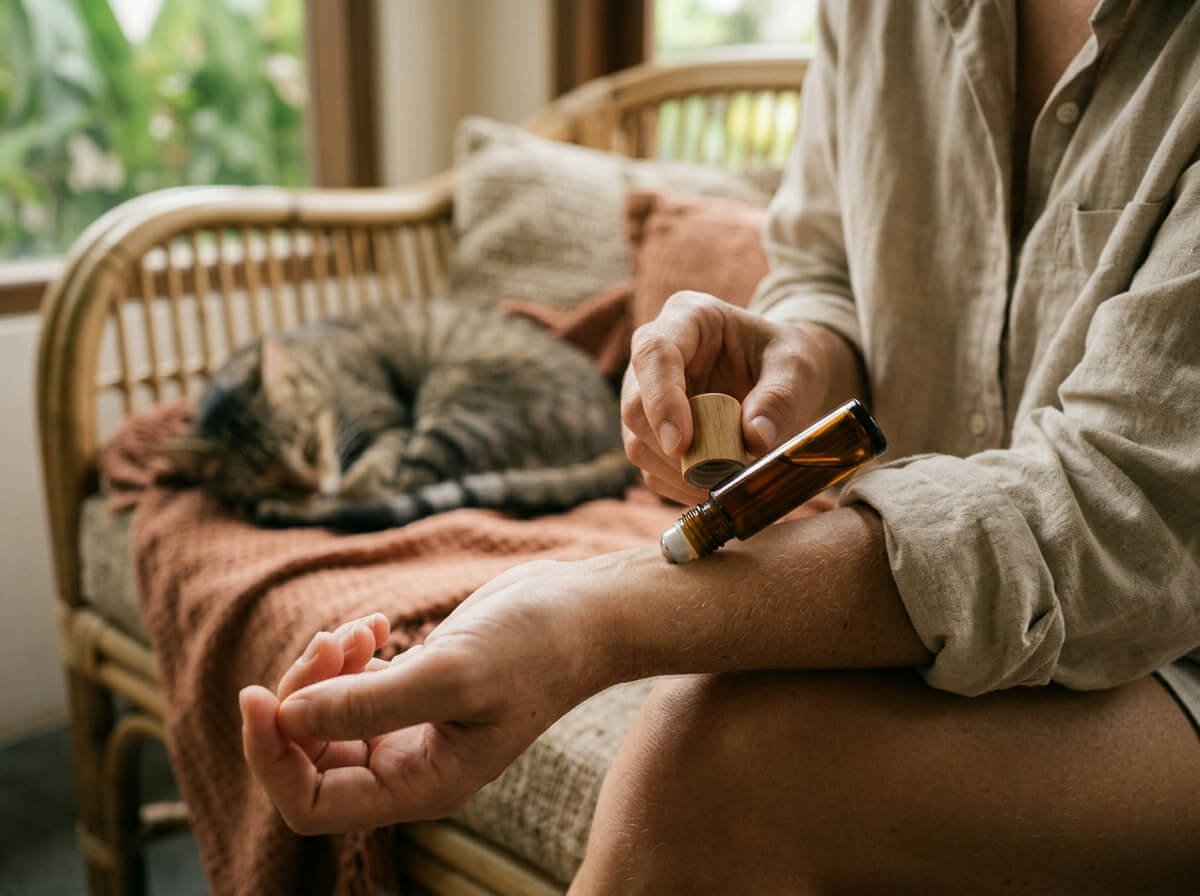
Rollers you wear on your own skin are a lower-exposure way to enjoy aroma, because they do not fill the room. Our Santi essential oil roller and Bliss essential oil roller are pre-diluted in jojoba oil for human skin. They still contain citrus and lavender, so apply them to your wrists or behind your ears, let them absorb, and wash your hands before you stroke, groom, or feed your pet. Do not let a cat or dog lick the area, and never apply a roller to an animal.
Is my finished product a risk, such as a body oil, a candle, or a cleaning spray?
Finished products contain far less essential oil than a bottle of neat oil, so the risk is lower. The same three routes still apply. Let body oils absorb before cuddling your pet. Keep candles high, never leave them burning in an empty room, and remember that a candle scents the air too. Our comparison of reed diffusers and candles covers how each releases scent. Let cleaning sprays dry fully before your pet walks across the floor.
Are there essential oils that repel fleas safely?
We understand the appeal, but we cannot recommend it. Flea treatment is exactly the situation in which most serious essential oil poisonings happen. Please use a flea treatment your vet recommends for your animal’s species and weight. For your own skin outdoors, our guide to essential oils for bug bites is written for humans only.
Is a “pet-friendly” blend safe?
“Pet-friendly” is a marketing phrase, not a regulated standard. A blend can leave out the most notorious oils and still be a problem when it is used neat, on the skin, or in a closed room. Judge any product by the route and the concentration, not the label.
How should I store my oils with pets in the house?
Keep bottles capped, upright, and in a closed cupboard or high shelf, away from chewing dogs and curious cats. Wipe up any spill immediately and ventilate. Our guide on how to store essential oils covers the details, including why glass and a cool, dark place help oils last longer.
Sharing a home, sharing the air
Essential oils and animals can share a home. They simply cannot share it carelessly. The lists online are a starting point, but the deeper wisdom is simpler and more durable. Think in routes, not labels. Keep oil off your pet and out of their mouth. Keep the air light, short, and escapable. Let the most sensitive animal in your home set the rules. And when something looks wrong, call your vet without waiting.
This is what care looks like when it is honest. We make oils because we believe in the quiet power of aroma for people: for sleep, for focus, for the small rituals that mark a day. If you are looking for evening calm, our guide to essential oils for sleep shows how to build a bedtime ritual in a room your pet can leave. That same belief asks us to tell you clearly where our oils do not belong, and that is on, or in, the animals we love.