Cortisol face: what the trend gets wrong, and what facial massage actually does
Scroll through wellness TikTok for long enough and you will meet cortisol face: a puffy, rounded face blamed on stress hormones, usually followed by a test kit, a supplement stack, or a serum that promises to bring it down. We understand the appeal. A swollen face on a tired morning feels like proof that something inside is out of balance. But cortisol face is a social media term, not a medical diagnosis, and most of what is sold to fix it cannot touch cortisol at all.
This guide does three things. It explains what cortisol really does to the face, according to endocrinologists rather than influencers. It names, plainly, what no oil or serum can do. And it offers the one honest tool a skincare brand can stand behind: a slow, five-minute facial massage ritual that works on your nervous system and your morning puffiness, without pretending to be a hormone treatment.
What “cortisol face” means on TikTok, and what it does not
On social media, “cortisol face” usually means some mix of puffiness around the eyes and cheeks, a softer jawline, a slightly rounder face in photos, and a general look of tiredness. The story attached to it is simple: modern life keeps your stress hormone high, high cortisol makes your face swell, and lowering cortisol will give you back your “real” face.
Part of that story is borrowed from real medicine. Doctors have long described a rounded, full face called moon facies, or moon face. It appears in Cushing’s syndrome, a condition where the body is exposed to too much cortisol for a long time. The most common cause is not stress. It is long-term use of corticosteroid medicines such as prednisone, prescribed for asthma, arthritis, autoimmune conditions, and more. Much less often, a tumour drives the adrenal or pituitary glands to overproduce cortisol.
The trend takes that rare, serious picture and stretches it over ordinary tiredness. That is where it goes wrong. Endocrinologists at Ohio State’s Wexner Medical Center have pointed out that neither cortisol face nor moon face is a diagnosis on its own, and that true moon face does not appear one morning and fade by lunch. It builds over months, and it comes with other signs.
So when we talk about cortisol face in this guide, we mean the everyday version most people are actually worried about: a face that looks puffy and drawn during stressful weeks. That is real, and it deserves care. It just is not the same thing as a hormone disorder, and treating it like one sends people toward the wrong solutions.
We have written before about what stress actually does to your skin. Cortisol face is a narrower question, and it needs a narrower, more honest answer.
Is cortisol face real? What the science says about cortisol and puffiness

Cortisol is made by the adrenal glands, two small glands sitting on top of the kidneys. It is not a villain. It helps regulate blood sugar, blood pressure, inflammation, and the sleep and wake cycle. It also follows a daily rhythm: levels rise sharply in the first hour after waking, then drift down through the day to their lowest point around midnight. A cortisol peak in the morning is normal design, not damage.
What very high cortisol does
When cortisol stays very high for months, as in Cushing’s syndrome, it changes how the body stores fat and holds fluid. Fat collects in the face, the back of the neck, and the belly. Skin thins and bruises easily. Wide purple stretch marks can appear. Muscles in the arms and legs weaken, and blood pressure and blood sugar often rise. Endogenous Cushing’s syndrome is rare, affecting roughly 40 to 70 people per million according to figures from the US National Institutes of Health. A round face alone, with none of these other signs, is very unlikely to be Cushing’s.
What everyday stress does
Ordinary stress raises cortisol for a while, then lets it fall again. That short rise does not reshape your face. What stress does change is behaviour, and behaviour shows up on skin. Stressful weeks tend to bring shorter sleep, more salty or convenient food, more alcohol, more caffeine, and less water. Each of those can leave the face looking fuller or more swollen the next morning. Stress can also slow how quickly the skin barrier repairs itself: studies of students during exam periods found that their skin recovered more slowly from mild damage than during calmer weeks. It can nudge flares of acne, eczema, and rosacea too.
So yes, stress can show on your face. But the route is usually indirect, through sleep, food, fluid, and inflammation, rather than a direct cortisol switch that a product can turn off. That distinction matters, because it tells us where the real levers are.
What a serum cannot do: the honest limits

Here is the part the trend tends to skip. No face oil, serum, cream, or mask lowers the cortisol in your blood. Cortisol is released by glands deep in the body and carried in the bloodstream. A botanical oil smoothed onto the cheeks does not reach the adrenal glands, and it does not change what they release. Any product that claims to “lower cortisol” or “detox stress hormones” through the skin is selling a story, not a mechanism.
We make face oils, so we would rather say this clearly than let a bottle carry a promise it cannot keep. Here is what a good face oil can honestly do:
- Support the skin barrier. Plant oils rich in fatty acids help slow water loss, which matters more when stress has already made the barrier slower to recover. Our guide to how to repair your skin barrier goes deeper.
- Give your hands glide. Massage on dry skin drags and tugs. A few drops of oil let your fingers move slowly and evenly, which is the whole point of the ritual below.
- Offer a scent cue. Some oils carry gentle essential oils. Scent will not fix hormones, but a familiar aroma can become a signal to your mind that it is time to slow down.
And here is what it cannot do: it cannot shrink facial fat, reverse a medication side effect, treat a thyroid or kidney problem, or replace sleep. Seeing the limits clearly is not a downer. It frees us to use oils for what they are good at, and to put our real attention on the habits that move the needle.
If you would like a single-ingredient option with nothing extra in it, Tamanu Oil (cold-pressed from the nut of the Calophyllum tree) and our Argan Oil are both simple carriers with good slip. Tamanu comes from a tree nut, so skip it if you have a nut allergy.
What slow touch actually does to your nervous system
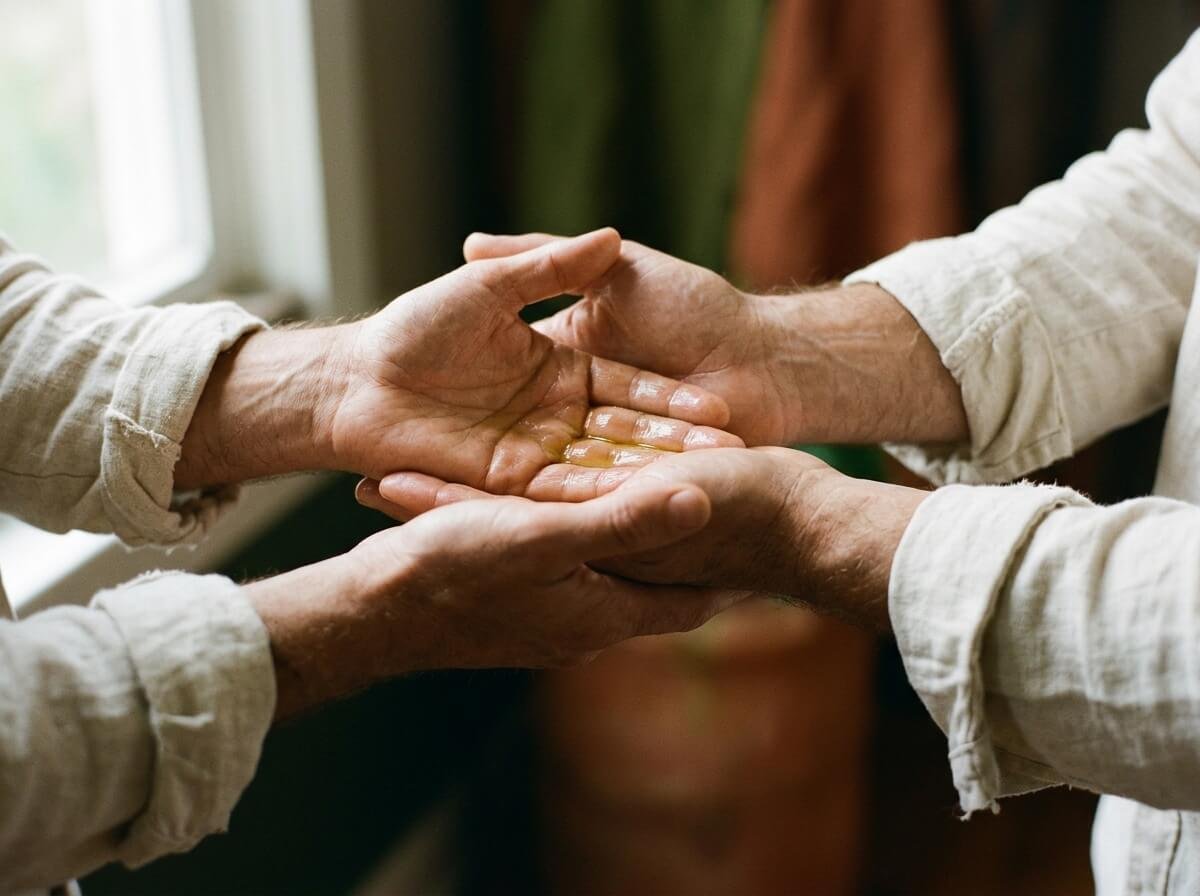
If oils cannot lower cortisol, can massage? This is where it is worth being careful, because the massage world has its own overclaims. Early reviews reported large drops in cortisol after massage. In 2011, researchers led by Christopher Moyer pooled the available studies and found that the effect of massage on cortisol was small, and in most cases not distinguishable from zero. Their conclusion was that massage helps people, but probably not mainly by lowering cortisol.
That does not mean touch does nothing. It means the benefit lives somewhere else:
- Heart rate and calm. In a Swedish study of 22 healthy volunteers, heart rate fell within the first five minutes of slow touch massage, and participants reported feeling calmer. Saliva cortisol also dipped, a small and short-term change.
- Mood and anxiety. A Japanese study gave 32 women a 45-minute facial massage and found their anxiety scores and negative mood dropped afterwards. Interestingly, their heart-rate patterns suggested they felt refreshed and alert, not sleepy. Facial massage seems to settle the mind while waking up the face.
- Touch nerves built for slowness. Our skin holds a class of nerve fibres, called C-tactile afferents, that respond best to slow, gentle stroking at about skin temperature. They are found in hairy skin, which includes most of the face. Neuroscientists link them to the pleasant, emotional side of touch. Fast, hard rubbing does not engage them in the same way.
Put together, the honest claim looks like this: slow touch reliably helps people feel calmer, and it shifts heart rate in a calmer direction within minutes. It is a gentle, repeatable way to step out of a stressed state. It will not rewrite your hormone profile, and that is fine. Feeling calm is reason enough.
We explored this idea in our note on slow touch and the nervous system, and in how aromatherapy speaks to the nervous system. The face is simply one of the easiest, most private places to practise it.
And the puffiness?
Light massage can also move surface fluid toward the lymph nodes around the jaw, ears, and neck, which is why a face can look a little less puffy after a few minutes of gentle strokes. Be honest with yourself about the scale: this is a temporary, visible softening, not a lasting change in face shape. Our short guide to facial massage and lymphatic flow explains the direction of strokes.

The five-minute facial massage ritual for cortisol face, step by step
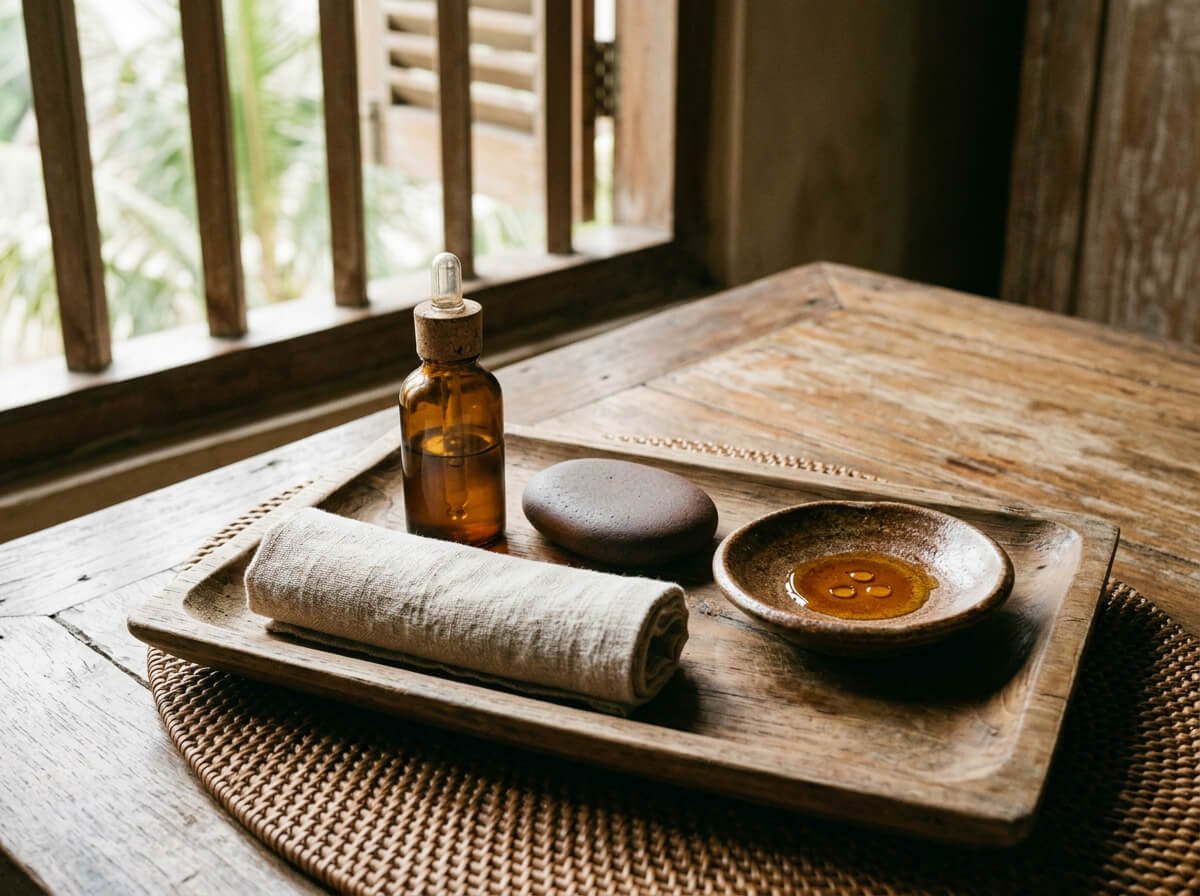
This ritual borrows the pace of Balinese massage, which is slow, warm, and unhurried, rather than any single technique. It takes about five minutes. You need clean hands, three to four drops of face oil, and somewhere quiet to sit. For a fuller technique guide, see our post on facial massage with face oil.
- Arrive (30 seconds). Sit down. Put your phone face down or in another room. Take three slow breaths, making each out-breath a little longer than the in-breath. This is not decoration. Longer exhales are one of the simplest ways to shift toward calm.
- Warm the oil (20 seconds). Place three to four drops in your palms and press them together. Hold for a few breaths so the oil reaches skin temperature, the kind of warmth those slow-touch nerves respond to. Bring your cupped hands toward your face and breathe in the scent once.
- Press, do not rub (40 seconds). Press your palms gently over your cheeks, then forehead, then jaw, holding each for one slow breath. This spreads the oil without tugging.
- Open the drainage points (30 seconds). With flat fingers, stroke slowly from below the ears down the sides of the neck toward the collarbones, five times on each side. Light pressure only: lymph sits just under the skin.
- Jaw release (60 seconds). Place your fingertips on the muscle in front of your ears, where the jaw hinges. Clench briefly to find it, then relax. Make small, slow circles. Many of us carry stress here without noticing. Finish by stroking from the chin out along the jawline to the ears.
- Cheeks and under-eyes (60 seconds). Using your ring fingers, the lightest fingers you have, sweep gently from the inner corner of the eye outward along the bone, then from beside the nose across the cheeks toward the ears. Keep oil out of the eyes themselves. The skin here is thin, so think of the pressure of a feather.
- Forehead and brow (60 seconds). Draw your fingers from the centre of the brow out toward the temples, slowly, one stroke per breath. Rest your fingertips on your temples for a final few breaths.
- Close (20 seconds). Cup your hands over your closed eyes, without pressing, and breathe. Notice how your face feels. That noticing is part of the practice.
Speed matters more than strength. If you count, aim for a stroke that takes about as long as a slow out-breath. If something hurts, ease off. If your skin is reactive, or you are mid-flare with rosacea or eczema, keep the strokes extra light or skip the face entirely and massage the neck and jaw. Our guide to natural skincare for rosacea has more on handling reactive skin with care.
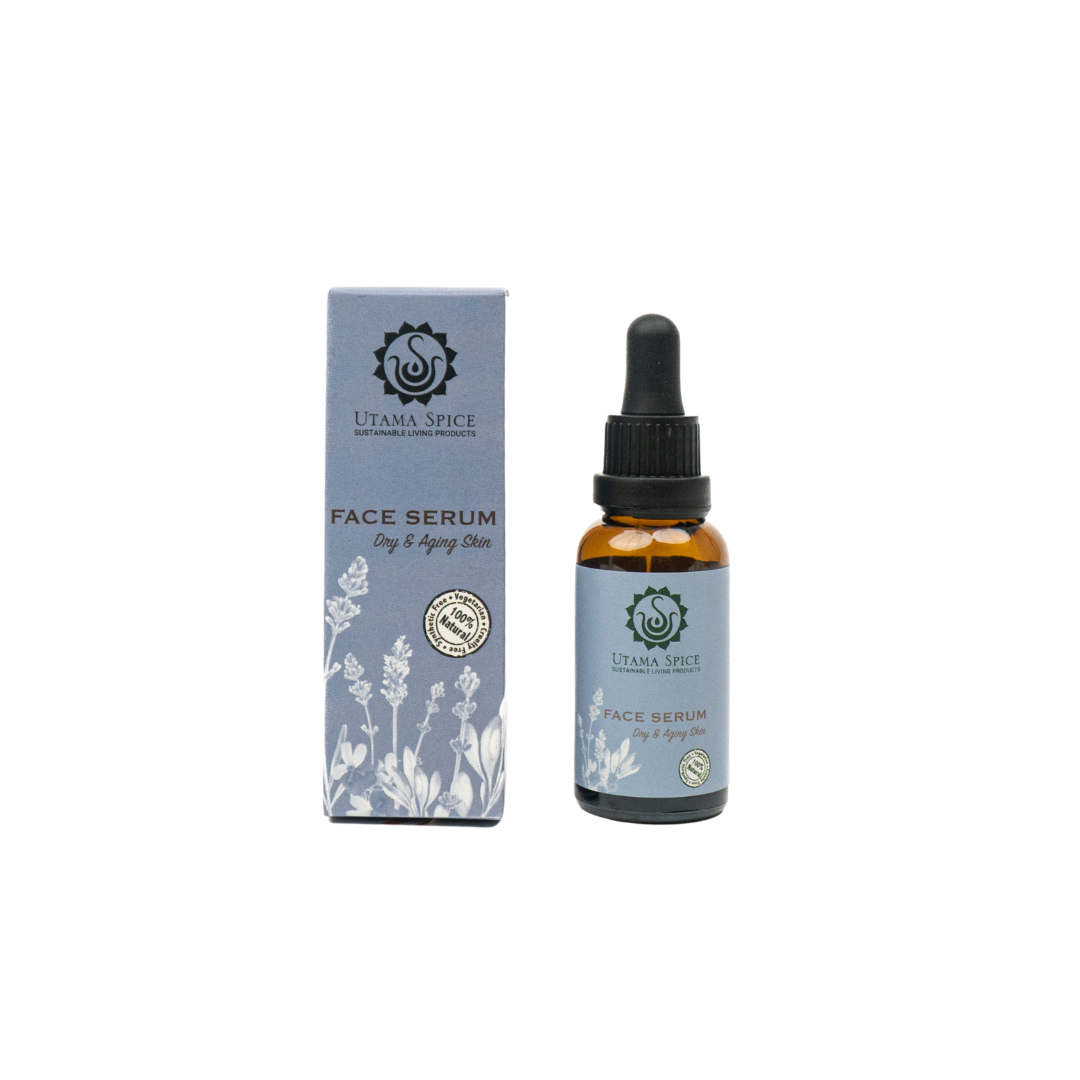
For the oil itself, our Natural Face Serum is the one we reach for. It blends argan, jojoba, and virgin coconut oils with essential oils, so it gives good glide and a soft, grounding scent that can become the cue for slowing down. Because it contains essential oils, keep it well away from the eyes, and patch-test it first if your skin is sensitive. If you prefer no scent at all, a plain carrier works just as well.
A few warm drops for five slow minutes
Our Natural Face Serum blends argan, jojoba, and virgin coconut oils with essential oils, hand-blended in Bali. It gives your fingers the glide a slow massage needs. It will not lower cortisol, and we will never say it does. It simply makes the ritual a pleasure to return to.
When a puffy face is not about stress at all

Before blaming cortisol, it helps to rule out the ordinary, and occasionally the important. Most morning puffiness has a plain explanation:
- Lying flat. Fluid redistributes overnight when we lie down, and gravity drains it again once we are upright. Puffiness that fades by mid-morning is usually just this.
- Short or broken sleep. Even a few nights of poor sleep can show around the eyes. Our guide to essential oils for sleep covers gentle evening support.
- Salt and alcohol. A salty dinner or a few drinks can leave the face fuller the next morning, as the body holds onto water.
- Allergies and sinuses. Hay fever, dust, and sinus congestion often show as swelling under the eyes.
- Crying, heat, and the menstrual cycle. All of these can shift fluid temporarily.
- Weight change. Gaining weight, for any reason, can show in the face first. That is not a hormone emergency.
When to see a doctor
Please talk to a doctor, rather than a feed, if your face has become steadily rounder over weeks or months and it comes with any of the following: easy bruising, wide purple stretch marks, a fatty pad between the shoulders, weakness in the thighs or upper arms, new high blood pressure or blood sugar, or major changes in your period. The same goes for swelling that comes with breathlessness, swelling of the lips or tongue, swollen ankles, or foamy urine, which can point to heart, kidney, thyroid, or allergic problems. If you take steroid medicine and notice your face changing, mention it to your prescriber, and do not stop the medicine on your own.
A doctor can test cortisol properly, using blood, saliva, or urine collected at specific times. A single at-home test bought from an online ad cannot account for cortisol’s daily rhythm, and it is easy to misread.
Building the ritual into a daily practice

The value of facial massage comes from repetition, not intensity. Five slow minutes most days will do more for how you feel than a 30-minute session once a month. Here is how we make it stick.
Pick your anchor
Tie the ritual to something you already do. Morning works well if puffiness is your main concern, since the drainage strokes help most when fluid has gathered overnight. Evening works well if the point is to come down from the day. Our note on warming face oil between your palms is a good, tiny place to start.
Keep the tools where you will see them
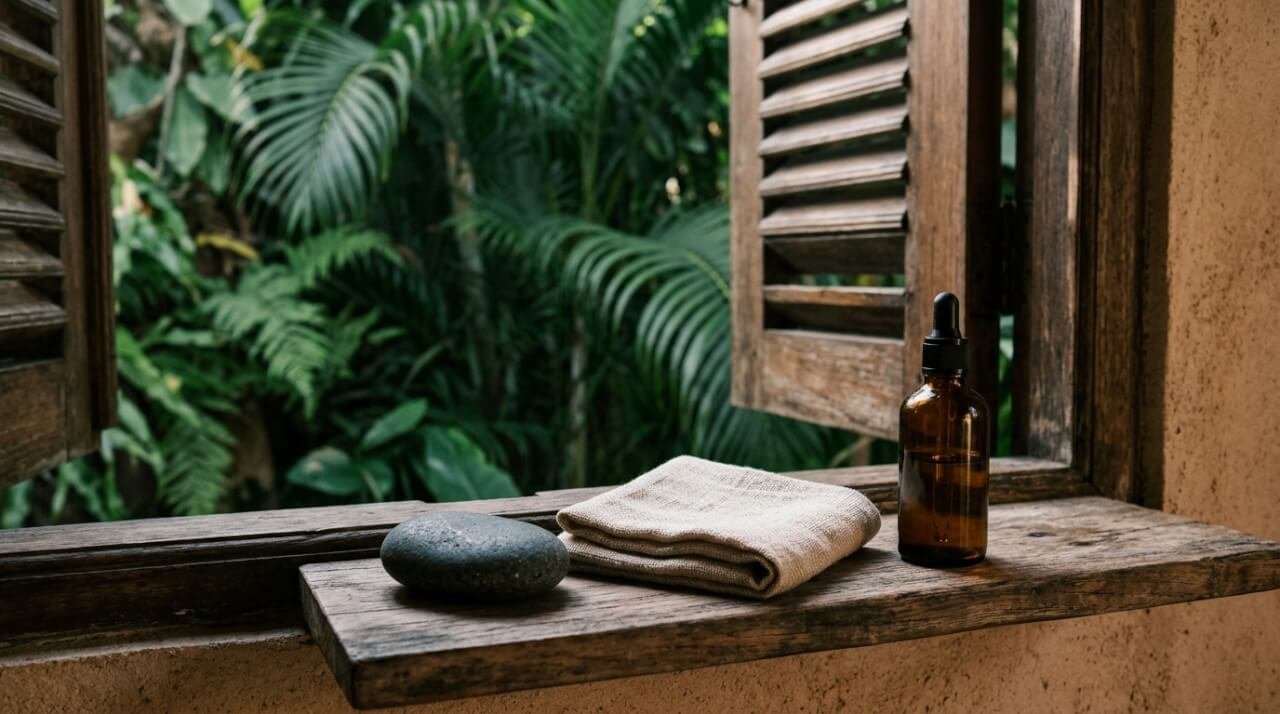
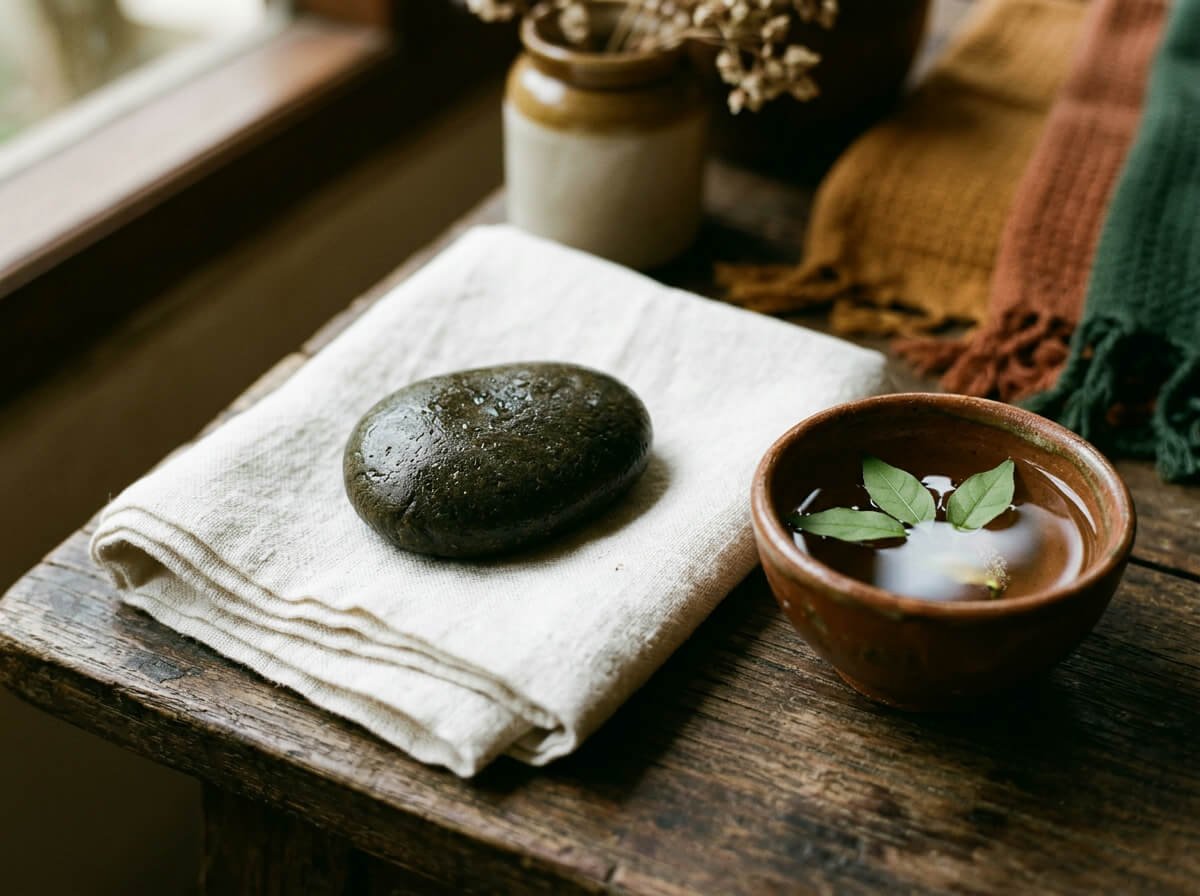
A small tray by the sink or the bed, holding your oil, a linen cloth, and perhaps a smooth stone kept in the fridge for a cool press under the eyes, removes the friction of finding things. A cool stone or a splash of cold water can make morning puffiness look a little calmer for a while, which pairs well with the drainage strokes.
Let scent do the remembering
Over time, a familiar aroma becomes a shortcut to calm. Some of us roll a little Santi Essential Oil Roller, pre-diluted in jojoba, onto the wrists before starting. Others diffuse our Deep Calming Essential Oil Blend of lavender, rose geranium, bergamot, cananga, and orange in the bedroom while they massage. Both contain bergamot, so keep them off skin that will see strong sun. Never put undiluted essential oils on the face. For more on scent and stress, see our guide to essential oils for stress and anxiety.
Look after the rest of the picture
The ritual is one piece of a wider pattern. Sleep, water, a little less salt in the evening, movement, and time outdoors all shape how a stressed face looks. None of them come in a bottle, and none need to. In Bali, care has always been woven into the everyday rather than saved for a spa day, a thread we follow in our guide to Balinese beauty rituals and our note on Balinese massage oil. Five minutes of slow touch is that idea in its smallest form.
Cortisol face: frequently asked questions
Is cortisol face a real medical condition?
No. Cortisol face is a social media term. The medical picture it borrows from, moon facies, is a sign of Cushing’s syndrome, which is rare and usually caused by long-term steroid medicine. Everyday puffiness during stressful weeks is real, but it is not a hormone disorder.
Can stress make my face look puffy?
Yes, mostly indirectly. Stress tends to bring shorter sleep, saltier food, more alcohol, and less water, and each of those can leave the face fuller in the morning. Stress can also slow skin barrier repair and nudge flares of acne, eczema, or rosacea.
Can a serum or face oil lower cortisol?
No. Cortisol is released by the adrenal glands into the blood, and nothing applied to facial skin changes that. A face oil can support the barrier and make massage comfortable. That is its honest role.
Does facial massage lower cortisol?
The evidence for a meaningful drop in cortisol is weak. A large 2011 review found massage’s effect on cortisol was small and mostly not distinguishable from zero. What massage does reliably is help people feel calmer and lower heart rate in the short term, and gentle strokes can make morning puffiness look softer for a while.
How long does it take to see a difference?
The calming effect can be felt within minutes. Any visible softening of puffiness is temporary, usually lasting hours. Lasting change comes from the bigger picture: sleep, food, and stress load over weeks.
Can I use gua sha or a facial roller instead of my hands?
You can, as long as the pressure stays light and the strokes stay slow. Hands have one advantage: warmth. Those slow-touch nerves in the skin respond best to touch at about skin temperature, which a cold tool cannot offer, though a cool tool can feel lovely on puffy eyes.
Should I take a cortisol test?
Only if a doctor suggests it. Cortisol rises and falls through the day, so a single reading means little on its own. If you have the warning signs listed above, a doctor can order proper timed tests. If you do not, your money is better spent on sleep than on a kit.
Cortisol face is a story about wanting to feel like ourselves again. We cannot sell that in a bottle, and we will not pretend to. What we can offer is a few warm drops, five quiet minutes, and the truth about what they do. Sometimes that is exactly the kind of care a stressed face needs. If your eyes are your main concern, our guide to natural eye cream picks up where this leaves off.