How to use incense sticks: lighting, burn time, and the Balinese ritual behind the smoke
Most guides on how to use incense sticks stop at “light it, blow it out, set it down.” That is the right start, and we will cover it properly. But a stick of incense is a small piece of craft, and it behaves differently depending on what it is made of, what it sits in, and the air around it. Learn those few things and the stick burns evenly, the scent stays clean, and the ash lands where it should.
We have some history with this. Utama Spice began in 1989 in Melanie Templer’s kitchen in Ubud, and the very first thing she made was an incense, the blend we still roll today as Temple Spice. So this guide comes from people who have been lighting sticks in Bali’s heat and humidity for more than 35 years. It covers what a stick actually is, how to light one, how to choose a holder, how to match stick length to the moment, what tropical air does to a burn, the Balinese practice behind it all, and how to put a stick out without that harsh, burnt smell.
What an incense stick actually is, and why the type matters
Before you light anything, it helps to know what you are holding. Almost every stick you will find falls into one of three families, and each one burns a little differently.
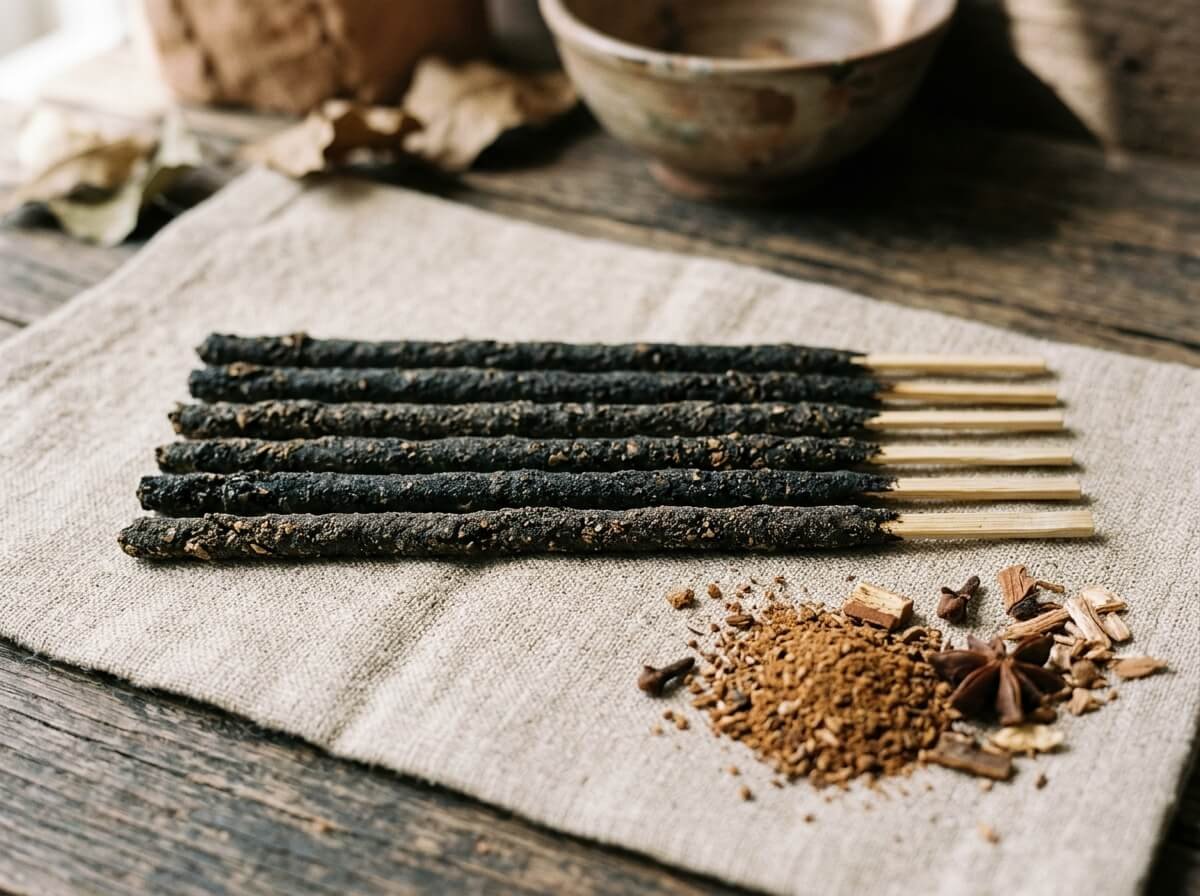
Cored, hand-rolled sticks. A thin bamboo splint is coated in a damp paste of charcoal or wood powder, ground botanicals, resins, and oils, then rolled and dried. The bare bamboo at the base is the handle, and it is meant to sit in the holder. This is the traditional Indonesian and Indian style, and it is how we make ours: bamboo sticks, coconut charcoal, flowers, bark, herbs, oils, nuts, and spices, rolled by hand in Bali. The bamboo gives the stick strength and a steady, predictable burn.
Dipped sticks. These start as plain, unscented “blanks,” a bamboo splint coated in charcoal and binder, which are then dipped into fragrance oil. The base can be anything, and it is often synthetic perfume. Dipped sticks tend to smell strong when cold and harsher once lit, because the fragrance sits on the surface rather than being part of the burning material itself.
Coreless (solid) sticks. Common in Japanese and Tibetan traditions, these are pressed entirely from aromatic paste, with no bamboo inside. They are more fragile, usually thinner, and many people find their smoke softer because there is no wood core burning alongside the aromatics. They need a holder with a small hole or a bowl of sand or ash, since there is no bare handle to grip.
Why does this matter for how you use them? Because the type tells you where to hold the stick, what holder will work, and what kind of smoke to expect. A cored stick has a built-in stopping point: the ember usually goes out when it reaches the bare bamboo. A dipped stick’s scent fades as the surface oil burns off. A coreless stick will burn right down to whatever is holding it. If you want to go deeper into the ingredients themselves, our guide to natural incense sticks walks through resins, woods, herbs, and binders one by one, and how incense is made covers the rolling and drying process.
One honest test: read the ingredient list. If it says “fragrance” or “parfum” and nothing else, you are almost certainly holding a dipped stick. If it names actual plants, woods, and a charcoal source, you are holding something closer to the real tradition.
How to use incense sticks: lighting one properly, step by step
Lighting a stick looks simple, and it is. The small details are what separate a clean, even burn from a stick that goes out after two minutes or smoulders unevenly down one side.
- Set up the holder first. Place it on a flat, heatproof surface, away from curtains, papers, and drafts. Fit the bare bamboo end of the stick into the holder before lighting, so you are not looking for a place to put a burning stick.
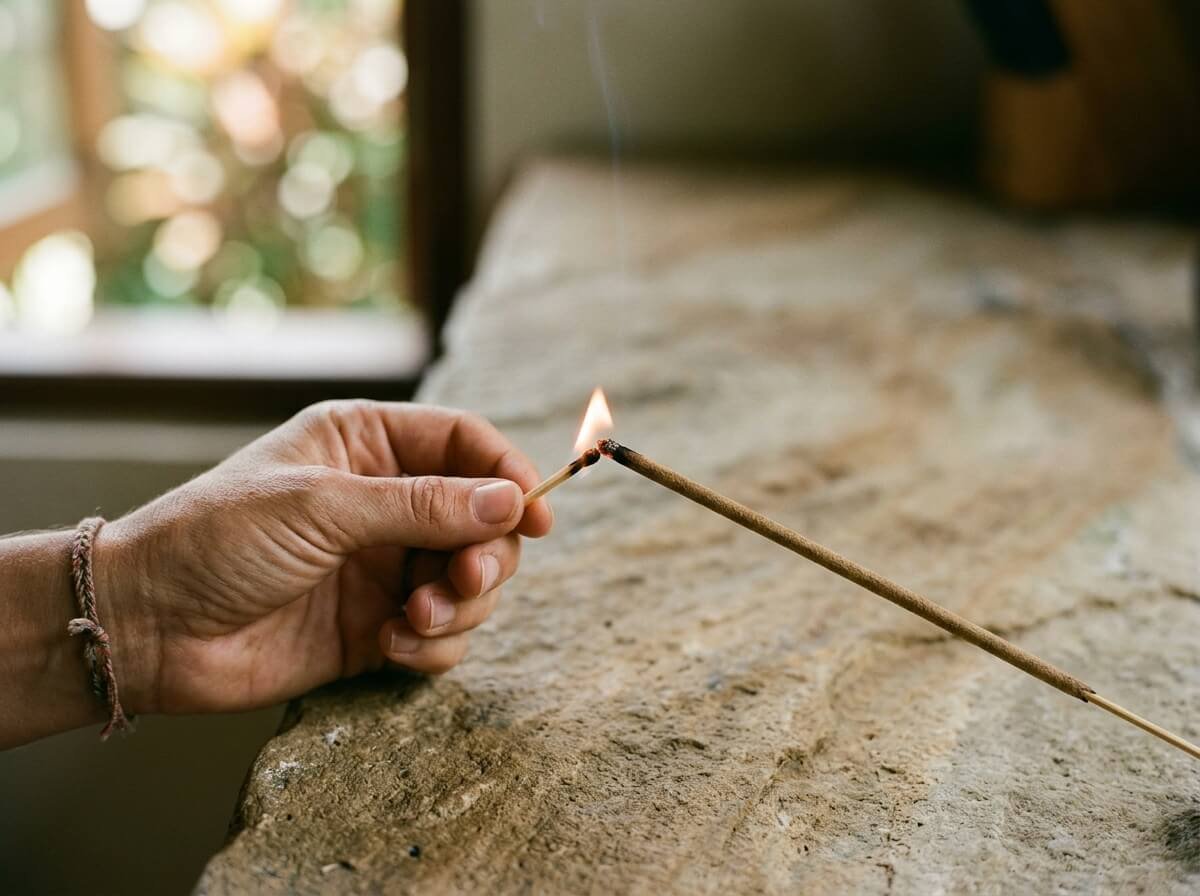
- Hold the flame to the very tip. Tilt the stick slightly downward, tip toward the flame, so the fire can climb onto the paste. A match or a long lighter works well.
- Let it catch for a few seconds. Keep the flame there until the tip is properly alight, usually five to 10 seconds. If you pull away too early, there is no ember underneath and it will go out.
- Put out the flame, not the ember. Wave the stick gently or give it one soft breath. You want the flame gone and an orange glow left behind. A thin, steady thread of smoke tells you the ember has taken.
- Check after a minute. If the smoke has stopped and the tip looks grey with no glow, relight it. This happens more often with damp sticks, which we cover below.
A few common mistakes are worth naming. Leaving the flame burning on the stick for a long time does not help; it simply burns through the paste faster and fills the room with heavier smoke. Blowing hard can scatter hot ash. Lighting the wrong end is easier to do than you might think with dark, uniform sticks, so look for the bare bamboo handle and keep it at the bottom.
We also suggest lighting with your attention, not on autopilot. It takes less than half a minute. Use that time to notice the first wisp of scent before it fills the room. That small moment is where incense stops being air freshener and starts being a ritual, the same idea behind our one-stick pause, where a single stick keeps time instead of a phone.
Choosing a holder: why surface and angle matter more than people think
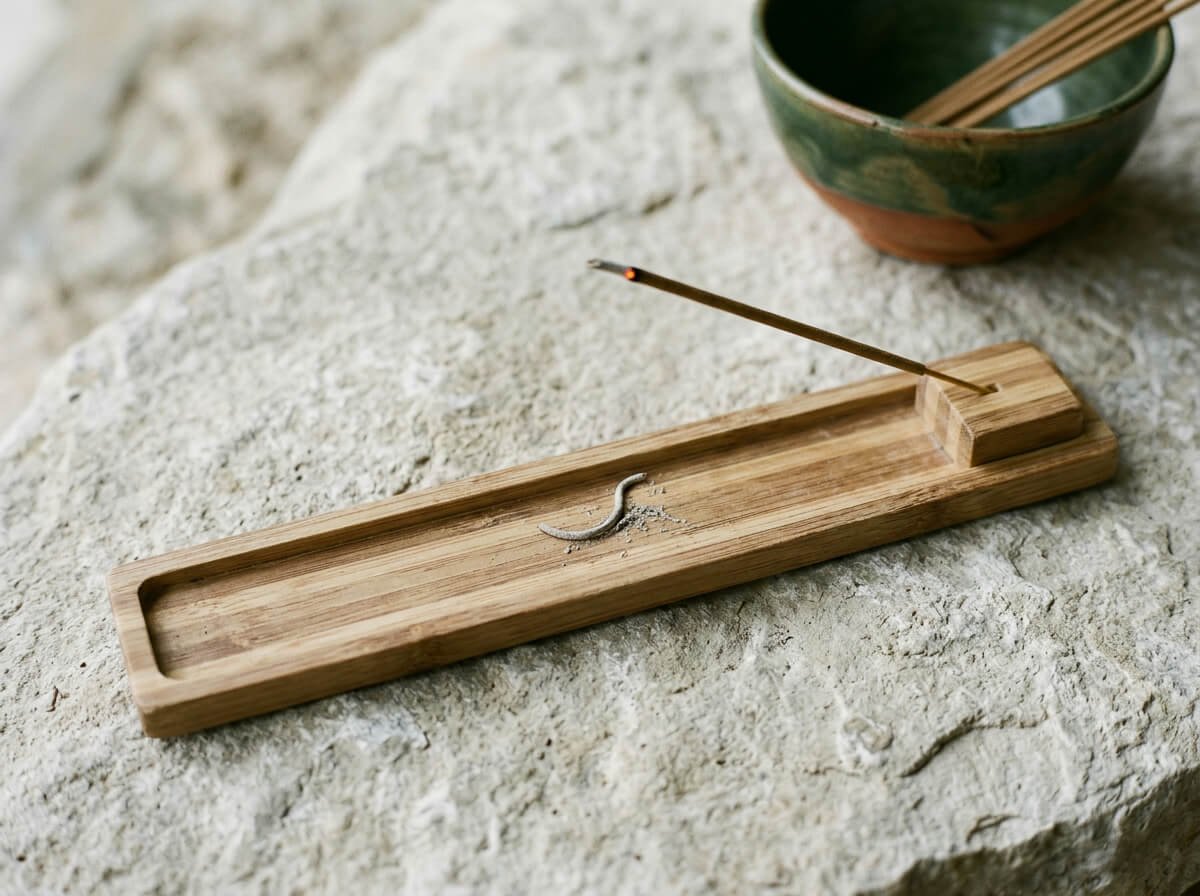
The holder does two jobs. It keeps the stick stable, and it catches the ash. Most problems people have with incense, scorched tables and grey dust on the shelf, come down to a holder that does only one of those jobs well.
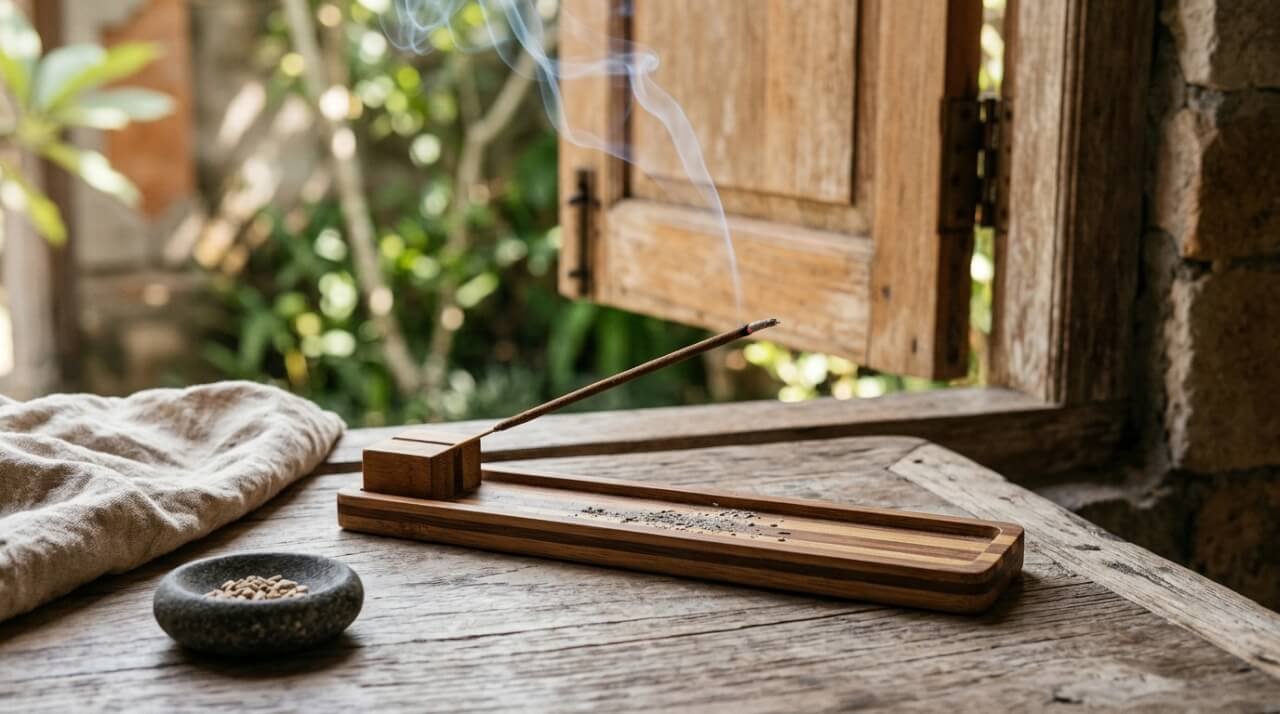
Angle. A cored stick burns best at a low, slanted angle or upright. At an angle, ash drops straight down off the tip. So the tray beneath has to extend under the full length of the stick, or the ash will land past the end. This is why long, narrow “boat” holders exist: their length matches the path the ash will fall. Upright holders keep the stick vertical, so ash falls in a small circle around the base, and they need a wide dish or a bowl of sand beneath them.
Surface. Stone, ceramic, brass, sand, and ash are all heatproof. Wood is beautiful and works well, but only with cored sticks held at an angle, because the ember stays above the tray and goes out before it reaches the bare bamboo in the hole. A coreless stick in a wooden holder will burn down to the wood, so give coreless incense a stone or ceramic home. Whatever the holder, set it on a surface that will not mark if a stray piece of ash lands.
Stability. A light holder on a slick surface can tip if a curtain brushes it or a cat walks past. Choose one with a flat, broad base. If you burn incense near an open window, a heavier holder is worth it.
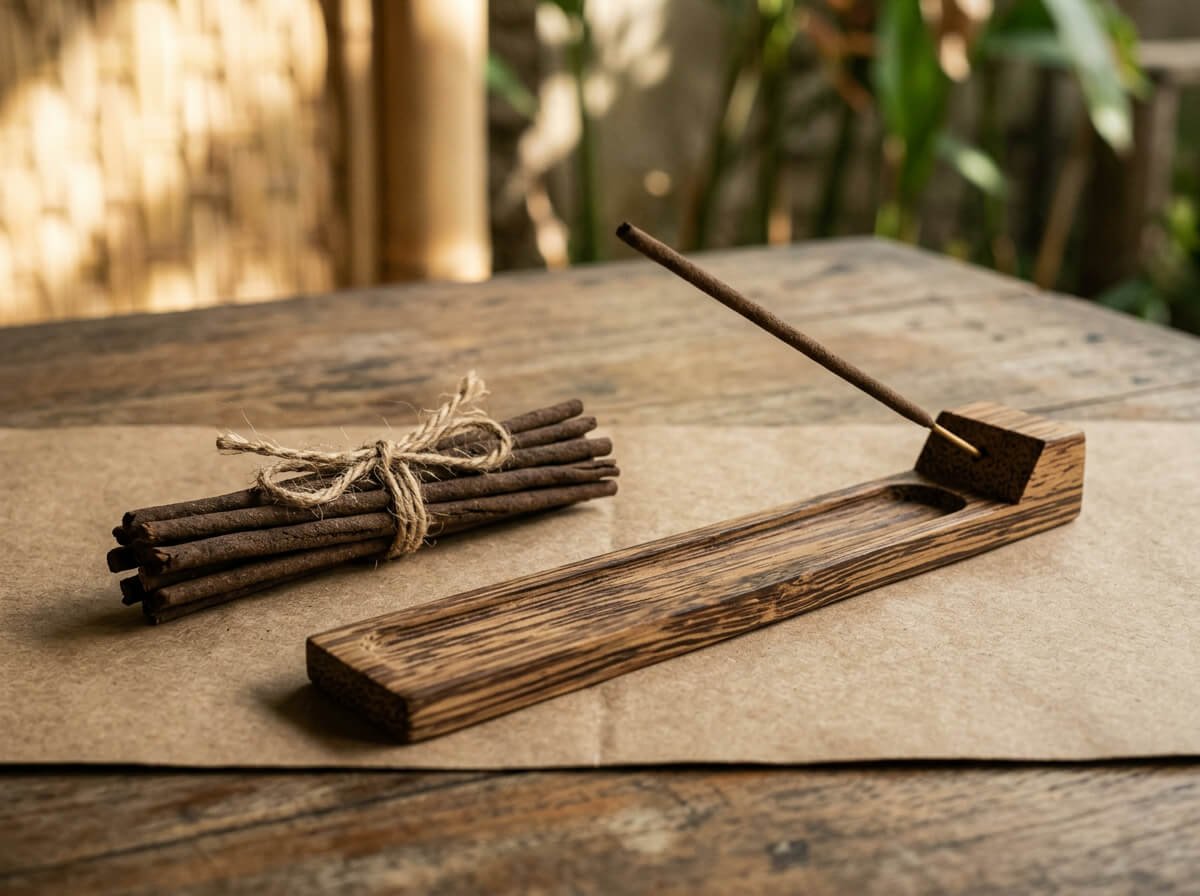
Our own reclaimed wood incense holder is made in Bali from repurposed chopsticks, laminated into a long tray about 29 cm in length, with a raised block at one end that holds the stick at a low angle. It was designed around our hand-rolled, bamboo-cored sticks, so the ash falls along the tray and the ember stops at the bamboo. For more styles, from ash catchers to ceramic bowls, our older guide to choosing an incense holder is a useful companion.
A simple care note: tip the ash out after every few sticks and wipe the tray with a damp cloth. Built-up ash holds moisture and old scent, and it can make the next stick smell stale. For wood, never soak it; a damp cloth is enough.
Regular vs long sticks: matching burn time to the moment
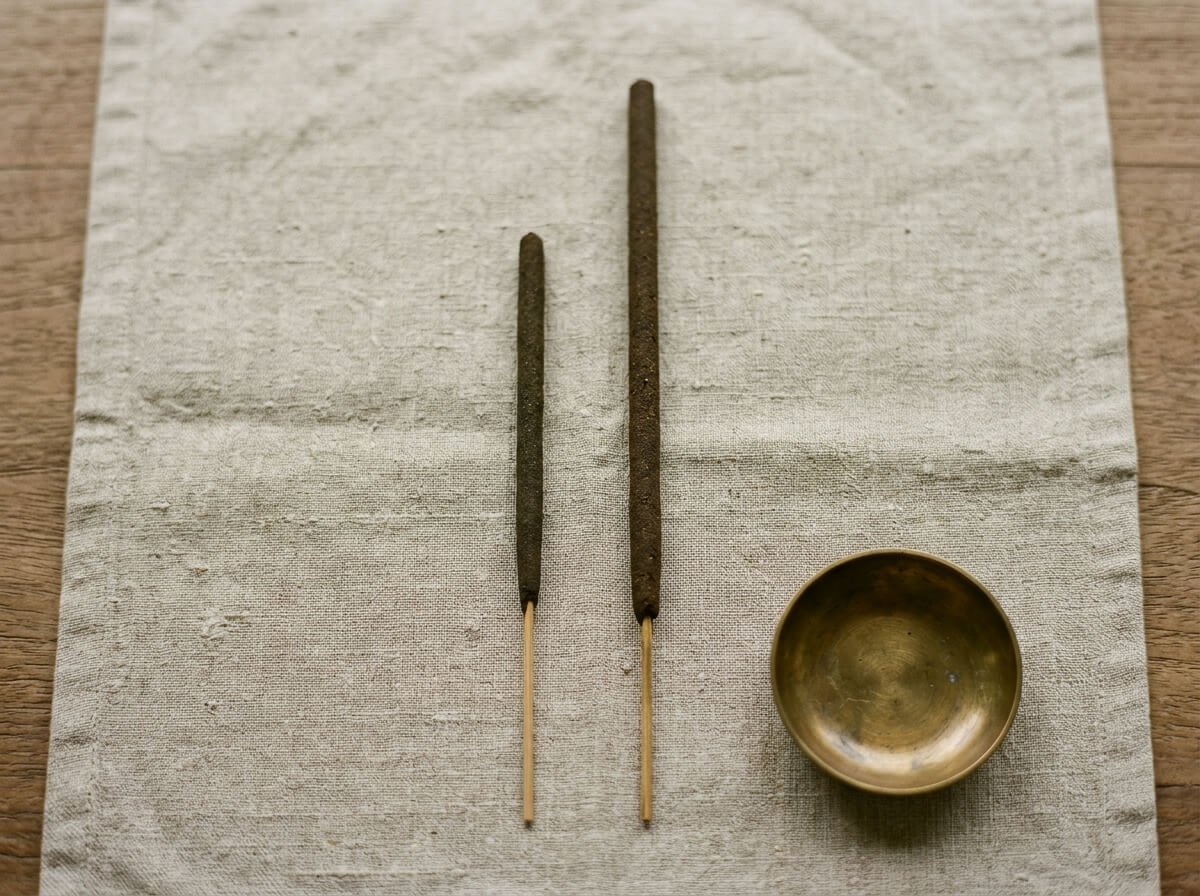
Stick length is not about value for money. It is about how long you want the scent to stay with you. We roll our incense in two sizes: regular sticks of about 15 cm, sold in packs of six, and long sticks of about 30 cm, sold in packs of 12.
Exact burn times depend on the paste, the thickness of the stick, airflow, and humidity, so treat any number as a rough guide rather than a promise. As a general rule, a regular stick suits a shorter moment, and a long stick roughly doubles that. Here is how we tend to match them:
- Regular sticks for a short meditation, a few minutes of stretching, a reset between tasks, or scenting a small room. They are also the kinder choice if you are new to incense or sensitive to smoke, because there is simply less of it. Try Temple Spice regular sticks for a warm, spiced start, or Moonflower regular sticks for something softer.
- Long sticks for a longer practice, a slow evening, a gathering on the terrace, or a larger open room where scent disperses quickly. Moonflower long sticks, made with cananga and nutmeg oils, are our evening choice.
- Outdoor use almost always calls for long sticks. Moving air carries smoke away fast and shortens the burn. Begone Bug long sticks, blended with citronella and peppermint oils, are made for a veranda at dusk.
Scent matters as much as length. Warm, woody, and spiced blends ground a room and suit focus or meditation. Green and floral blends feel calmer and lighter, better for winding down. Fresh, herbal blends belong outside or in the kitchen. If you are drawn to the science of why certain aromas settle us, our guide to aromatherapy oils for anxiety explains the scent and mood connection, and the profiles of cananga and vetiver show what each oil brings.
One more practical point. You do not have to burn a stick to the end. If a long stick is more than you need, put it out partway (see the last section for how) and relight it next time. A partly burned stick relights easily as long as it stays dry.

A holder made for the way we roll our sticks
Our reclaimed wood incense holder is crafted in Bali from repurposed chopsticks. Its long tray catches the ash along the full fall line of a bamboo-cored stick, and the raised block holds it at a steady, low angle. Pair it with a pack of Temple Spice, the first blend Utama Spice ever made.
What humidity does to a burning stick, and the fix
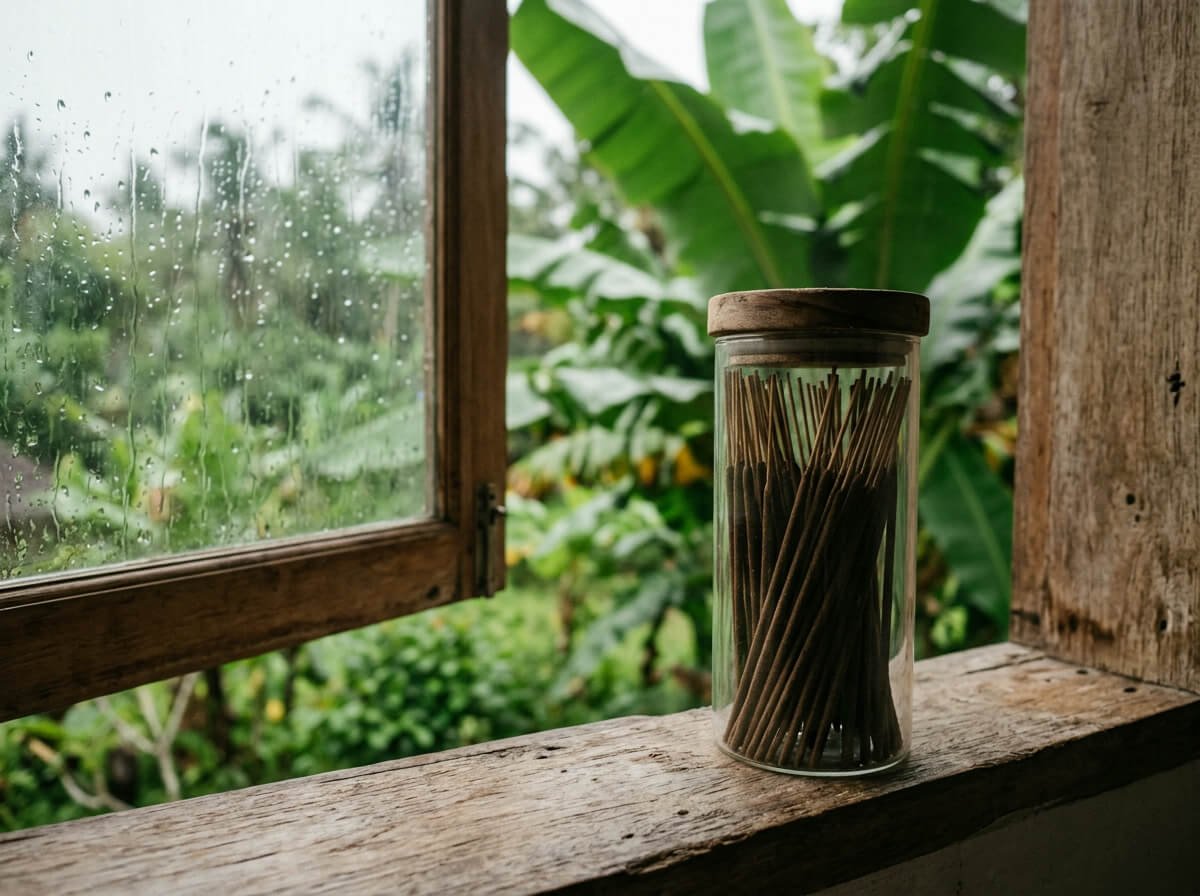
Almost no incense guide mentions the weather. In Bali, we do not have that luxury. For much of the year the air is warm and heavy with moisture, and incense feels it.
Charcoal and dried plant material are both absorbent. Left out in humid air, a stick slowly draws in moisture. The signs are easy to spot once you know them:
- It takes longer to catch, and the flame keeps going out.
- The ember dies halfway down, sometimes more than once.
- It burns unevenly, with one side racing ahead of the other.
- The smoke is heavier and the scent duller, sometimes with a faint musty note.
- In long wet spells, a pale bloom can appear on the surface, which means it is time to discard that stick.
The fix is mostly about storage. Keep sticks in an airtight glass jar or a sealed tin, not in an open box on the bathroom shelf. Store them away from the kitchen, the shower, and any window that catches the rain. A jar with a well-fitting lid in a dry cupboard will keep a pack in good condition through a whole wet season.
If your sticks have already taken on moisture, lay them flat somewhere airy and dry, out of direct sun, for a day or two. Please do not dry them in an oven or microwave. That is a fire risk, and the heat also drives off the aromatic oils you are paying for. When a slightly damp stick will not stay lit, hold the flame on the tip a little longer, then keep it out of drafts for the first minute while the ember settles.
Humidity also changes how the smoke moves. In still, heavy air, smoke tends to hang and linger closer to the ground rather than rising and clearing, so a room can feel smokier than the same stick would make it on a dry day. On those days, a regular stick is often enough, and a cracked window helps. We see the same pattern on our skin, by the way. Humidity changes how oils absorb too. Tropical air shapes everything we make.
Dupa: the Balinese daily practice behind burning scent
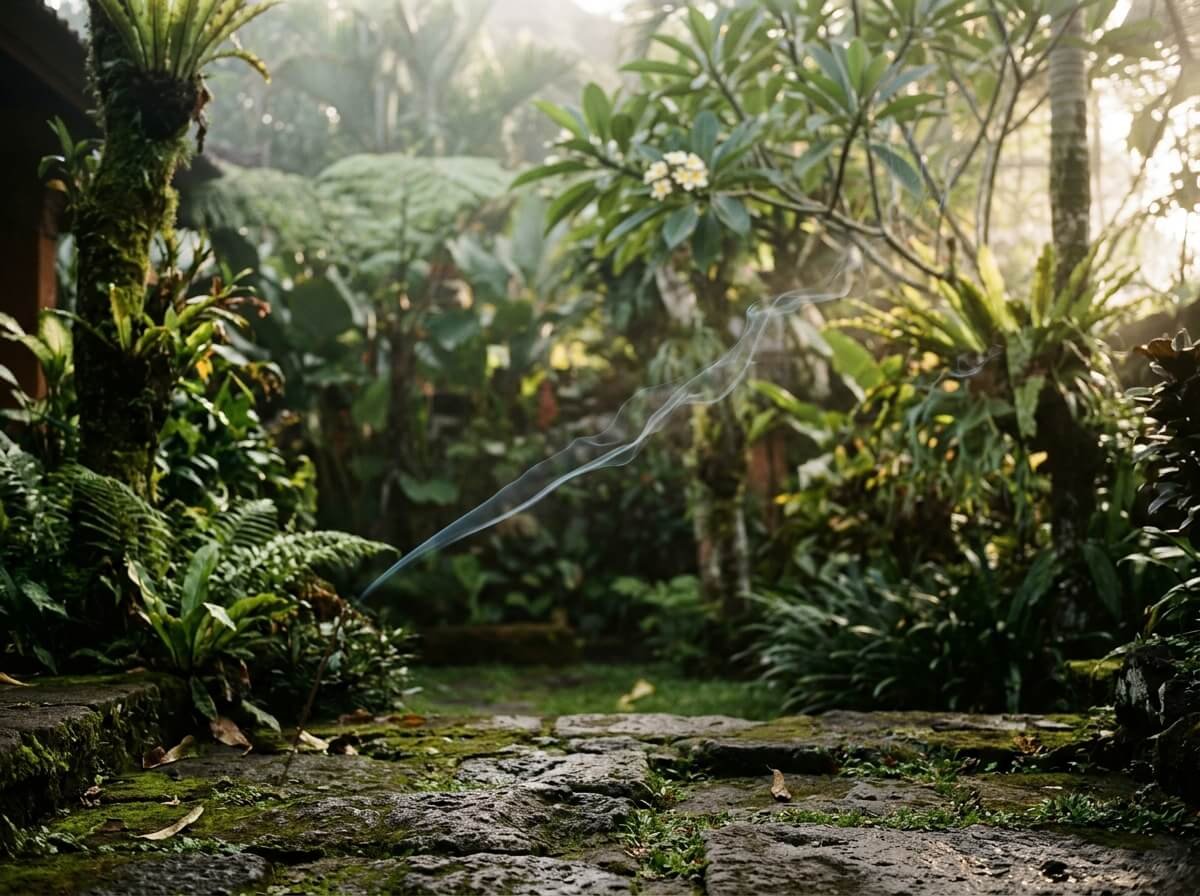
Walk through any Balinese village in the early morning and you will smell it before you see it. In Bali, incense is called dupa, and its smoke is part of daily life. It rises beside the small offerings that families place at household shrines, at temples, at doorways, at shop fronts, and at crossroads. In Balinese Hindu practice, the smoke accompanies the offering, a moving, visible thread between the one who gives and what is honoured. It is lit with care, every day, often by the same hands for decades.
This is a living religious practice, and it belongs to the Balinese Hindu community. We would never suggest anyone copy it at home, and we do not sell incense as a shortcut to it. The offerings, the prayers, and the meaning carried by the smoke are not ours to package.
What we can learn from it, with respect, is a rhythm. Dupa is not lit to cover a smell or to set a mood for guests. It is lit as an act of attention, offered again and again, whether anyone is watching or not. That quality of attention is something any of us can bring to our own daily rituals. Light a stick at the same time each morning. Pause while it catches. Let the first breath of scent mark the start of the day rather than the first glance at a screen. Our guide to Balinese beauty rituals explores this same idea of small, repeated care across skin and body.
The Balinese philosophy of Tri Hita Karana, harmony between people, nature, and the divine, shapes how our makers work too. It is why our incense uses no synthetic fragrance and no endangered plants, why the sticks are wrapped in recycled paper, and why the ingredients are sourced locally. The aromatics in dupa have deep roots on the island as well. Cendana, or sandalwood, has long been prized as a temple wood, which is part of why we take sourcing questions seriously. The same care runs through our look at palo santo, another sacred wood whose popularity has outpaced its supply.
Our Temple Spice blend takes its name from that morning scent of the island. It was Melanie’s first creation, and it took two years to get right. It carries vetiver for its grounding, earthy depth. It is not a ceremonial incense. It is a daily one, made by people who grew up with the smell of dupa in the air.
Safety, ventilation, and how to put a stick out without the burnt smell
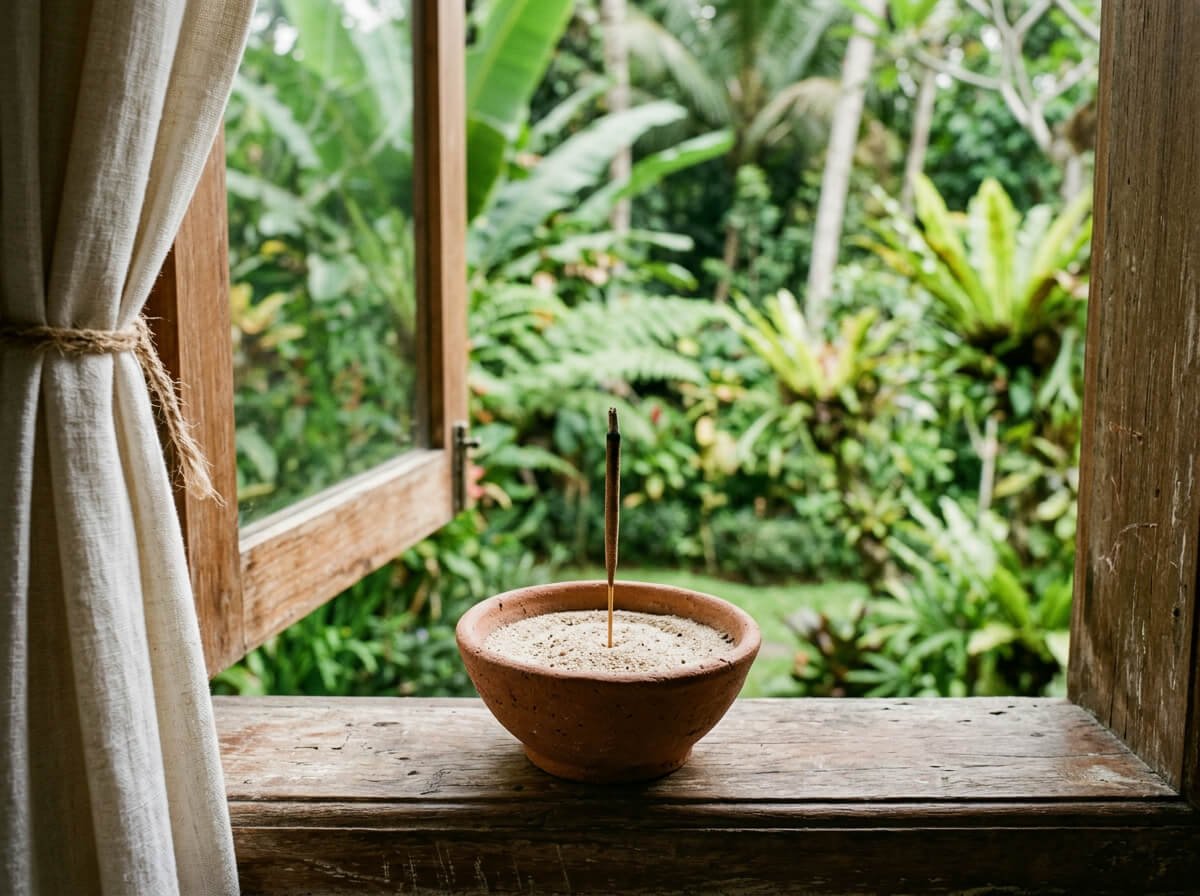
Incense is fire and smoke, so a little honesty is in order. Burning any plant material releases fine particles into the air. Natural ingredients make for a cleaner, better-smelling smoke than synthetic fragrance oils, but they do not make smoke disappear. Good habits let you enjoy incense without overdoing it.
Safety basics
- Never leave a burning stick unattended, and never burn incense while you sleep.
- Keep it well away from curtains, bedding, paper, and anything that can catch a falling ember.
- Place holders out of reach of children and pets. Birds and small animals are especially sensitive to smoke; our guide to essential oils and pets covers this in more detail.
- If you live with asthma or another respiratory condition, or you are pregnant, keep sessions short, ventilate well, and check with your doctor if you have concerns.
Ventilation
A slightly open window is all you need. You want a gentle exchange of air, not a draft blowing across the stick, which makes it burn fast and unevenly. In a small room, one regular stick is plenty. In an open, airy space, a long stick will hold its scent better. If the smoke starts to sting your eyes or the room feels hazy, that is your cue to open up and let it clear. If you prefer scent with no smoke at all, a reed diffuser or diffuser blends offer a different route, and our comparison of reed diffusers and candles weighs the options honestly.
Putting it out cleanly
Most of that harsh, acrid smell people notice at the end comes from the way a stick is put out. Crushing the ember into a dish breaks it apart and leaves it smouldering. Blowing on it often just makes it glow brighter. Dousing it in water leaves a soggy stick that will not relight.
Our preferred method is simple: press the lit tip gently into a small bowl of dry sand, rice, or old incense ash, and hold it there for a few seconds. Without air, the ember goes out quietly, the stick stays whole, and you can relight it another day. Keep the bowl next to your holder so it becomes part of the ritual. Opening the ritual and closing it, both with attention, is the whole point.
Frequently asked questions about how to use incense sticks
Do you light both ends of an incense stick?
No. Light only the coated end. On a cored stick, the bare bamboo end is the handle and goes into the holder. Lighting both ends would leave nothing to hold and nowhere safe for the stick to rest.
Should there be a flame while incense burns?
No. Once it has caught, the flame should be out. What you want is a glowing ember at the tip and a thin, steady line of smoke. A stick with an open flame burns too fast and smokes heavily.
Why does my incense keep going out?
The two most common causes are moisture and lighting too briefly. Hold the flame a few seconds longer so a proper ember forms, and store your sticks in an airtight jar. A draft blowing straight across the stick can also snuff it.
How many sticks should I burn at once?
One is usually enough for a room. Natural incense is meant to be noticed, not to fill every corner. Burning several at once mostly adds smoke, not pleasure.
Can I burn incense every day?
Many people do, in Bali and around the world. Keep the room ventilated, choose natural sticks without synthetic fragrance, and stick to one at a time. If you notice any irritation, give it a break.
How long do incense sticks last in storage?
Kept dry and sealed, natural sticks stay usable for a long time, though the scent gradually softens as the aromatic oils fade. Use them within a year or so for the fullest aroma. Sticks stored in open air in a humid climate lose their quality much faster.
Is incense better than essential oils for scenting a room?
They are different tools. Incense creates a warmer, deeper scent and a visible ritual, but it produces smoke. Essential oils in a diffuser give a cleaner, smoke-free aroma. Our aromatherapy oils guide covers the diffuser side, and many homes use both, depending on the moment.
Learning how to use incense sticks well comes down to a handful of small habits: know what you are burning, light it with patience, give it a holder that catches the ash, keep it dry, and put it out gently. None of it is complicated. All of it adds up to a cleaner burn and a better scent, and, if you let it, a few minutes of quiet attention in your day. That is what a stick of incense has always offered here in Bali. We are glad to share it.