
Citronella essential oil benefits: the Indonesian grass behind natural repellents, honestly explained
Ask most people what citronella is, and they will point to a summer candle. That candle is only a sliver of the story. The real citronella essential oil benefits begin in the tropics, in a tall, fragrant grass that has been grown and distilled across Indonesia and Sri Lanka for generations. In Bali we know it as sereh wangi, the fragrant grass, and it has earned its place in the natural medicine cabinet long before it became a patio accessory. This is an honest guide to what citronella oil actually does, what it does not do, and how to use it with care.
We make no miracle claims here. Citronella is a working oil, not a cure-all. It repels insects, it carries a clean, lemony-green scent that lifts a room, and it has a small body of research behind a handful of its traditional uses. Our aim is to separate the evidence from the marketing, to root the oil back in its place and its people, and to help you decide whether it belongs in your own rituals. If you value truth over trends, this is the citronella guide we would want to read.
What citronella essential oil actually is
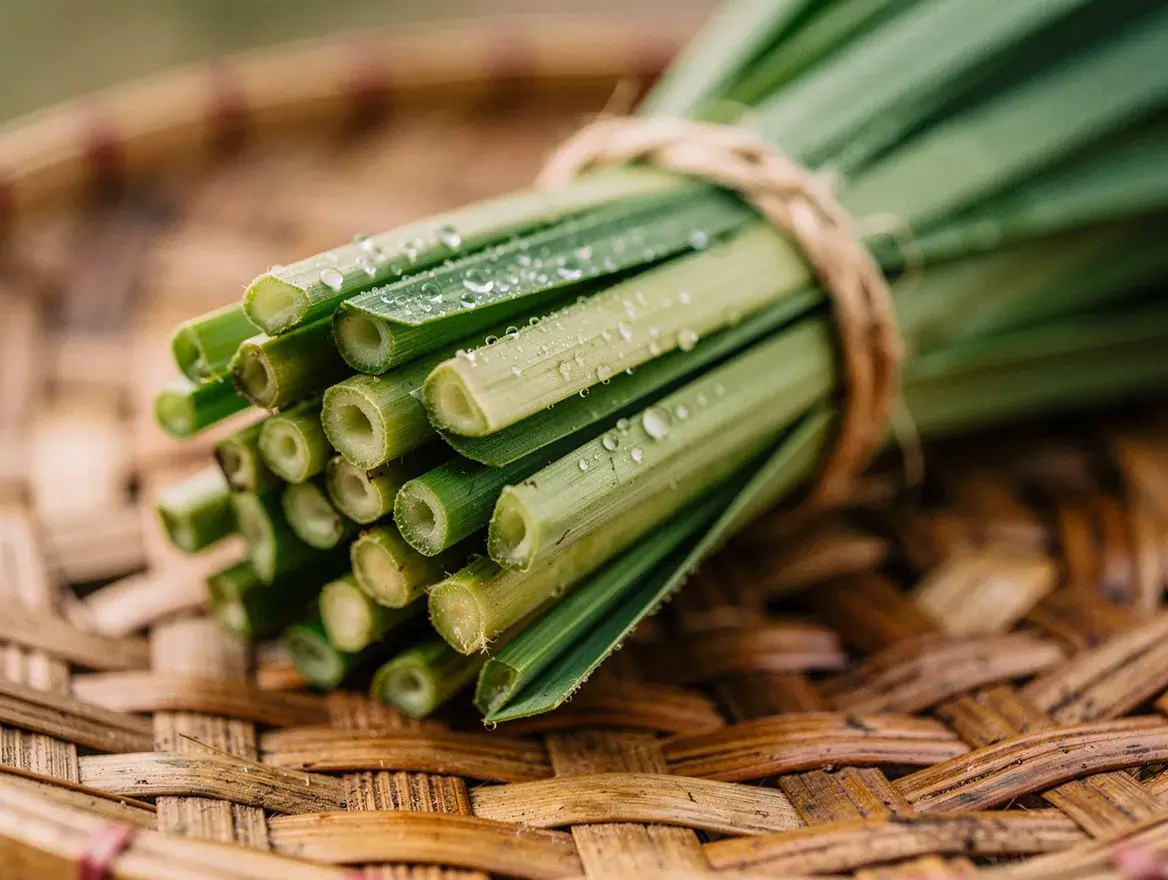
Citronella essential oil is steam-distilled from the leaves and stems of tropical grasses in the Cymbopogon family, the same broad family that gives us lemongrass and palmarosa. The grass grows fast and tall in warm, humid climates, which is why Indonesia and Sri Lanka became its heartlands. Harvesters cut the blades, wilt them briefly, then run them through a still, where heat coaxes out a thin, pale-yellow oil with a bright, grassy, faintly citrus aroma.
There are two commercial types, and the difference matters. Java citronella comes from Cymbopogon winterianus, and it is the richer, deeper oil, higher in the active compounds citronellal and geraniol. Ceylon citronella comes from Cymbopogon nardus, and it is softer, a little more camphorous, with a lower citronellal count. Most of the citronella grown across the Indonesian archipelago is the Java type, prized for its potency and its clean scent. When you read the citronella essential oil benefits on a label, the variety behind the bottle shapes how strong those benefits really are.
The distillation itself is quiet, patient work. Steam rises through the packed grass, lifts the volatile oil, then cools and separates in a slow trickle. It takes a great deal of grass to fill a small bottle, which is part of why a real essential oil is concentrated enough to demand respect. Nothing about the process is high-tech or hurried, and that is the point. This is craft that has changed little in generations, tended by growers who read the weather and the leaves the way their grandparents did.
Knowing all this changes how you read a label. A trustworthy citronella oil names its botanical source, either Cymbopogon winterianus or Cymbopogon nardus, rather than hiding behind the vague word fragrance. It should be a pure, single oil, not a synthetic scent blend dressed up as the real thing. If a bottle will not tell you the plant or the place, it is telling you something anyway.
This is worth slowing down for, because sourcing is where honesty lives. A grass this humble is easy to treat as a commodity, distilled anywhere, bottled anonymously. We prefer to name the place and the hands. Citronella is part of a wider Indonesian aromatic heritage that also gives us lemongrass, kaffir lime, and cajeput, oils that grew up in the same gardens and kitchens. If you want to see how the whole family fits together, our list of essential oils and their uses maps each one to its purpose.
Citronella essential oil benefits, honestly weighed
Here is where we part ways with the louder corners of the internet. Some citronella claims are well supported. Others are thin. We will walk through both, because a benefit you cannot trust is not a benefit at all.
Insect repellent, its strongest evidence
Citronella’s best-documented use is keeping biting insects at bay. It is a registered active in many botanical repellents, and studies show it can reduce mosquito landings meaningfully when applied at the right concentration. The catch, which few product pages mention, is duration. Raw citronella oil evaporates quickly, so its protective window is short, often under an hour, unless it is formulated to slow that release. This is the honest reason a well-made blend outperforms a single oil dabbed on the skin.
Concentration matters as much as choice of oil. Too little citronella and the masking effect is faint, too much and you invite skin irritation. This is the quiet skill inside a good repellent: finding the level that protects without overwhelming, then pairing it with ingredients that hold the scent in place. It is why we treat repellent formulation as care work, not chemistry theatre.
Antifungal and antibacterial action
Laboratory research points to real antifungal and antibacterial activity in citronella oil, driven again by citronellal and geraniol. This is promising for surface cleaning and for keeping damp tropical spaces fresh. It is not a licence to treat an infection. Lab activity in a petri dish is a starting point, not a prescription, and skin conditions deserve a clinician, not a dropper bottle.
Where this shows up usefully is around the home. A few drops of citronella in a natural surface spray can help freshen a bathroom, a mudroom, or the corners of a house that never quite dry out in a humid climate. Used this way, it doubles as a gentle deodoriser and a repellent, discouraging insects from settling while it clears the air. That is a modest, everyday benefit, and modest everyday benefits are exactly what a working oil should offer.
A calming, clearing aroma
Diffused, citronella lifts and clears. Its bright, green-lemon scent can ease a stuffy, humid room and create a sense of freshness that many people find quietly grounding at the end of a long day. Small inhalation studies suggest aromatic use may support a calmer mood, which fits the way we use these oils in ritual, gently, as part of a wind-down, not as a clinical treatment.
There is something fitting about a repellent oil that also happens to feel restorative. The same aroma that clouds a mosquito’s senses reads to us as clean, herbaceous, and awake. Used at dusk, when the insects arrive and the day is winding down, citronella does double duty, marking the shift into evening while it quietly keeps the biters at the edges of the room. That overlap of usefulness and pleasure is what makes an oil worth keeping close rather than tucking away for summer alone.
The claims we will not repeat
You will find pages promising citronella for weight loss, or as a fix for serious illness. The evidence for these is scarce to nonexistent, and repeating them would be exactly the greenwashing we stand against. Citronella is a fine repellent and a lovely diffuser oil. It is not a diet aid, and it is not medicine. Naming that plainly is part of caring for you.
How citronella keeps insects away
Understanding the mechanism explains both the strength and the limits of citronella. Mosquitoes find us mostly by smell, tracking the carbon dioxide we exhale and the particular scent of our skin. Citronella works largely by masking. Its strong, volatile aroma clouds those cues, so the insect struggles to lock onto a target. It is less a force field and more a fog that makes you harder to find.
Because that fog is made of light, fast-evaporating molecules, it thins quickly. This is the single most important thing to understand about botanical repellents, and it is why reapplication matters. A drop of neat oil smells powerful for ten minutes and then fades. A thoughtfully formulated repellent holds the scent steadier, pairing citronella with companion oils and a carrier that slows evaporation. We explore the wider field of botanical actives in our guide to the best natural bug repellent, and how each performs on skin in our piece on natural bug repellent for skin.
This is the thinking behind our Begone Bug Spray, blended in Bali where mosquitoes are a daily fact of life, not a seasonal nuisance. It leans on citronella alongside other tropical aromatics so the protection feels steady rather than fleeting. If you would rather build your own approach, planting matters too, and our notes on natural bug repellent plants show how the garden can do some of the work before the bottle does.

Citronella also works from the air, not only from the skin. A candle or an incense stick carrying citronella creates a scented zone that helps hold insects at the edges of a verandah or garden table. This is why the oil became a fixture of outdoor evenings in the first place. The ambient approach and the on-skin approach are partners, one thinning the crowd, the other protecting you directly, and together they let you spend a warm night outside without reaching for anything harsh.
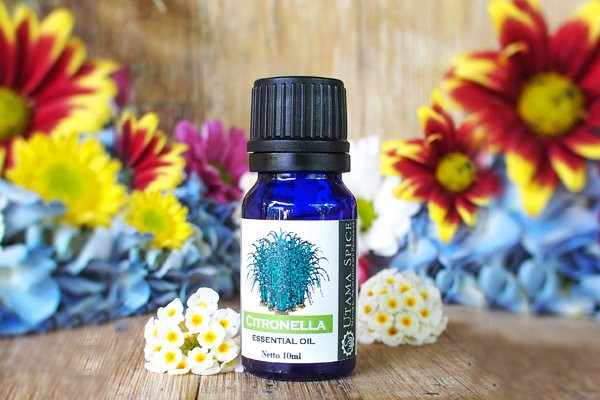
Pure citronella, distilled from Indonesian grass
Our single-origin Citronella Essential Oil is steam-distilled from tropical Cymbopogon and bottled without additives. Diffuse it, blend it into a repellent, or freshen a humid room with a scent that is clean, green, and honestly sourced.
How to use citronella essential oil safely
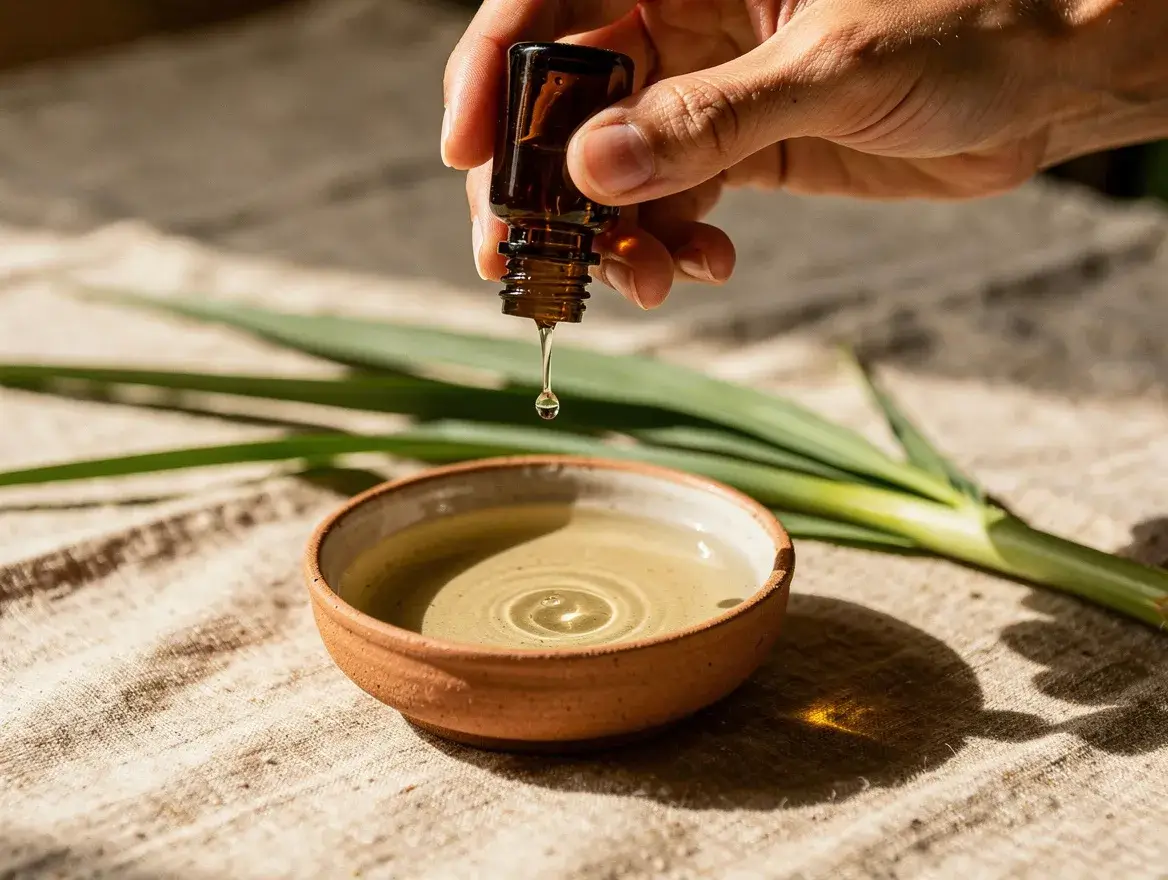
Citronella is generally well tolerated, but potent is not the same as harmless. A few grounded habits keep it that way, and they apply to almost every essential oil you will meet.
Always dilute before skin contact
Neat essential oil on bare skin is the fastest route to irritation. Dilute citronella into a carrier oil, coconut or another light plant oil, before any topical use. A gentle general guide for body use is around 2%, which is roughly 12 drops of essential oil per 30 ml of carrier. Start lower if your skin is reactive, and reduce further for children and older skin.
Patch test, every time
Before you trust a new blend on a larger area, dab a small amount on the inner forearm and wait a full day. Citronella can occasionally cause skin sensitisation, meaning a reaction that builds with repeated exposure. A patch test is a small ritual of care that saves you a larger regret.
Diffusing and ventilation
For most people, diffusing is the easiest way to enjoy citronella. A few drops in water is plenty, in a ventilated room, in sessions rather than all day. If you share your home with pets, this matters more, not less, which brings us to the point that deserves its own line.
Pets, pregnancy, and when to pause
Cats in particular lack an enzyme pathway that helps process certain oil compounds, so strong diffusing around them is best avoided, and direct application is a firm no. Give any animal an easy exit from a diffused room. During pregnancy, and for infants, keep aromatic use light and ventilated, and check with a health professional first. When in doubt, less is the wiser choice. These principles carry across the whole shelf, from citronella to cajeput, the Indonesian minyak kayu putih many households keep close.
Storing citronella so it lasts
Essential oils are alive to light, heat, and air. Keep citronella in its amber glass bottle, tightly capped, somewhere cool and dark, away from a sunny windowsill. Treated well, it holds its character for a year or two. Left open or warm, it oxidises, the scent flattens, and an oxidised oil is also more likely to irritate skin. Good storage is not fussiness, it is simply letting a well-made thing keep being what it is.
Citronella and lemongrass, the mix-up worth untangling
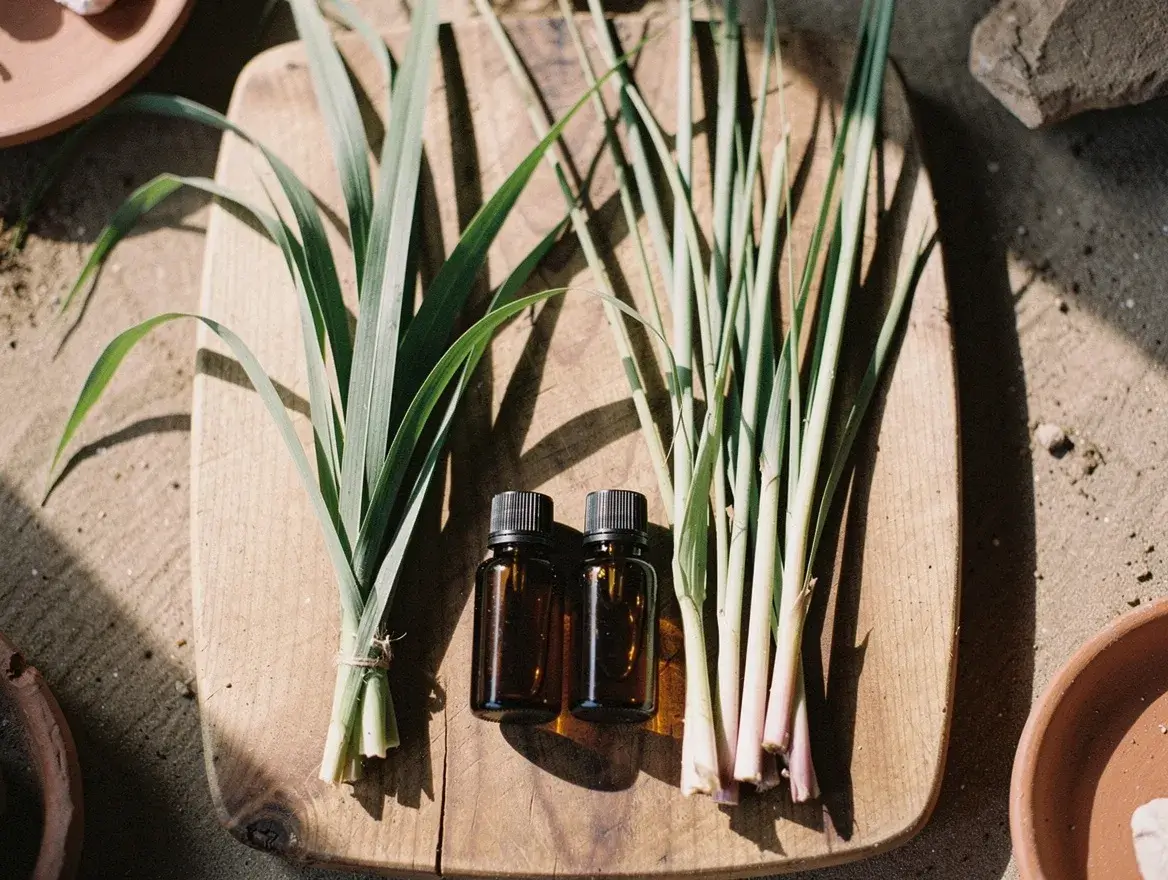
Citronella and lemongrass are cousins, both members of the Cymbopogon family, both tropical grasses, both carrying that lemony brightness. They are constantly confused, and the confusion is understandable, but they are not interchangeable. Lemongrass leans sweeter and softer, and it shines in cooking and in a fresh, uplifting diffuser blend. Citronella is sharper and grassier, and its higher citronellal content is what earns it the repellent reputation lemongrass only partly shares.
In practice, they make good partners. Blended, they round each other out, lemongrass adding sweetness, citronella adding backbone. A simple evening blend might be a few drops of each in a diffuser, or both diluted into a carrier oil for a fresh, green body oil that happens to discourage insects. Neither oil needs to work alone, and often the most pleasant results come from letting them share the task.
If you are drawn to the softer, culinary side of the pair, our guide to lemongrass essential oil benefits covers it in full, and our Lemongrass Essential Oil comes from the same Indonesian gardens as our citronella. For the wider question of what keeps mosquitoes away in a warm climate, our natural mosquito repellent guide brings the whole family together, and the citrusy kaffir lime oil is another Indonesian aromatic worth knowing.
Frequently asked questions about citronella oil
Does citronella oil really keep mosquitoes away?
Yes, within limits. Citronella can meaningfully reduce mosquito landings, but its effect is short-lived on its own because the oil evaporates quickly. For steadier protection, use a formulated blend and reapply, rather than relying on neat oil.
Can I put citronella oil directly on my skin?
Not undiluted. Always blend it into a carrier oil first, at roughly 2% for general body use, and patch test before wider application. Neat oil risks irritation and, with repeated use, sensitisation.
Is citronella safe to diffuse around pets?
Use caution. Cats especially process certain oil compounds poorly, so avoid strong or continuous diffusing around them, never apply it to an animal, and always leave a door open so pets can move away.
What is the difference between citronella and lemongrass oil?
They are botanical cousins with different strengths. Lemongrass is sweeter and softer, better suited to cooking and uplifting blends. Citronella is sharper and higher in citronellal, which makes it the stronger repellent of the two.
Where does the best citronella oil come from?
Indonesia and Sri Lanka are the traditional heartlands. The Java type, grown widely across the Indonesian archipelago, is richer in active compounds and generally considered the more potent of the two commercial varieties.
A grounded place for citronella in your rituals
Citronella earns its keep when you meet it honestly. It is a capable repellent with real evidence behind it, a fresh and grounding oil to diffuse, and a piece of living Indonesian heritage rather than a novelty candle. It is not a miracle, and it never needed to be. Used with a little care, diluted, patch tested, reapplied, and kept away from curious cats, it becomes a quiet, dependable part of tropical living.
That is the way we think about every oil we make: rooted in place, backed by what is true, and offered without the theatrics. What you give, you get back. Choose citronella for what it genuinely does, treat the grass and the hands behind it with respect, and let it take its small, steady place in the rhythm of your days.