Helichrysum oil benefits for skin: what the research actually supports (and what it doesn’t)
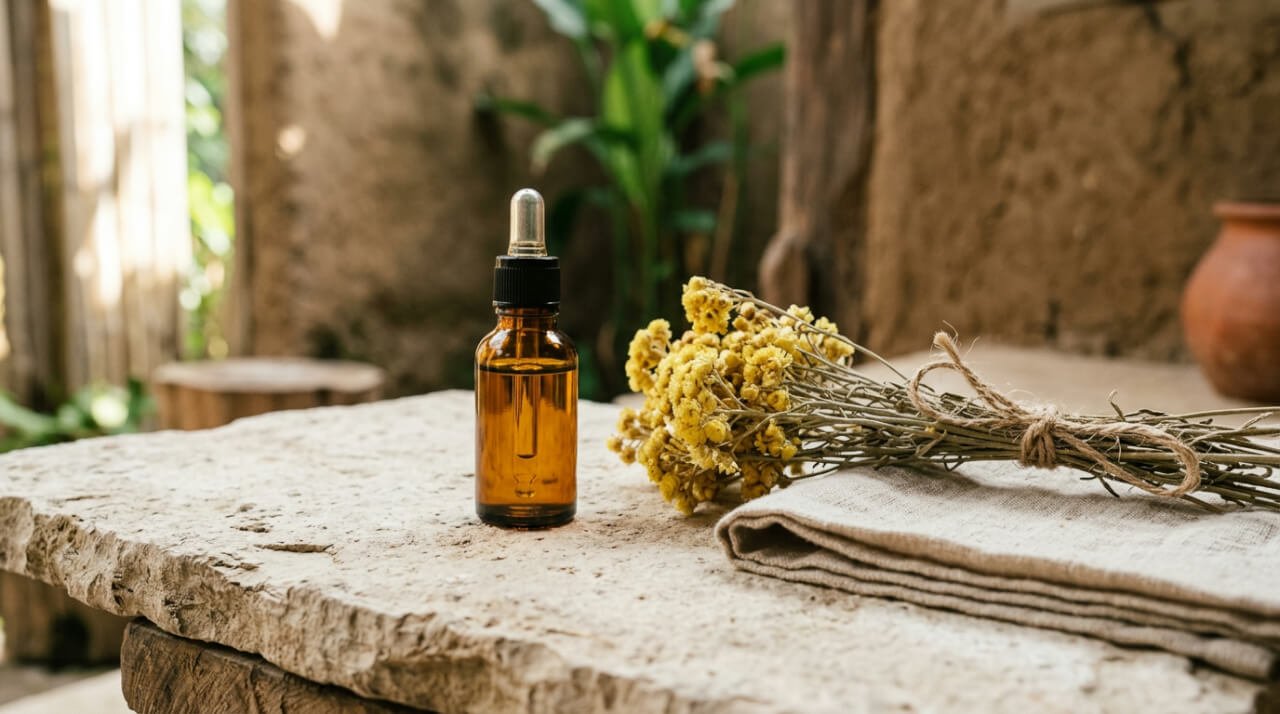
There is a small golden flower that refuses to fade. Pick it, dry it, leave it on a shelf for a year, and it keeps its colour. That flower is Helichrysum italicum, often called immortelle, and the oil distilled from it has become one of the most talked-about ingredients in natural face care. This guide looks at helichrysum oil benefits for skin with a clear eye: what the research supports, what it does not, how to tell a real oil from a weak one, and how to use it safely in a daily ritual.
We make our serums by hand in Bali, and we have worked with helichrysum for years. That experience has taught us respect for the plant and caution about the claims made in its name. So we will tell it straight. Some of what you have read is grounded in good science. Some of it is marketing that has drifted a long way from the evidence. Knowing the difference lets you use this oil well, and spend your money wisely.
What is helichrysum oil, and why is it called immortelle?
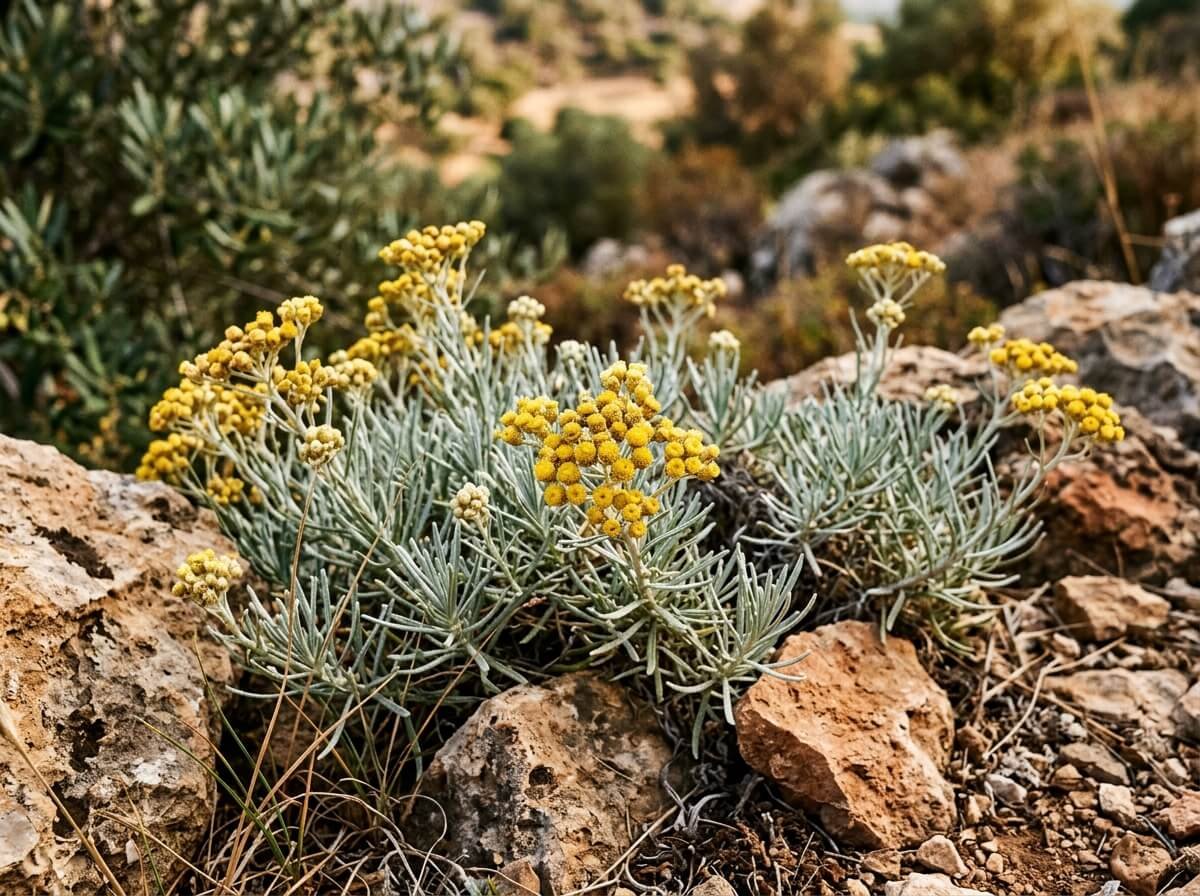
Helichrysum is a genus of flowering plants in the daisy family (Asteraceae). The species that matters for skincare is Helichrysum italicum, a low, silvery shrub native to the dry, rocky hillsides of the Mediterranean. It grows wild in Corsica, Sardinia, mainland Italy, and along the Croatian and Bosnian coast. In summer it carries dense clusters of small, button-like yellow flowers. Brush past it on a hot day and the air smells of honey, hay, and, oddly, a little like curry. That is why gardeners sometimes call it the curry plant.
The name tells its own story. Helios is the Greek word for sun and chrysos means gold. The common names, immortelle and everlasting, come from the way the flowers hold their shape and colour long after picking. For centuries, people in the Mediterranean used the plant in folk medicine for bruises, small wounds, and skin complaints. That long tradition is part of why modern researchers became curious about it.
How the oil is made
Helichrysum essential oil is steam-distilled from the flowering tops of the plant. The yield is low, which means a large harvest of flowers produces only a small amount of oil. That single fact explains a lot: why genuine helichrysum is one of the more expensive oils on any shelf, why it is so often diluted or faked, and why a bottle that seems too cheap usually is.
The finished oil is pale yellow to amber, with a warm, herbaceous, slightly honeyed aroma. Its chemistry varies with origin, but oils from Corsica are typically rich in a compound called neryl acetate, while Balkan oils often carry more alpha-pinene. Helichrysum also contains unusual molecules called italidiones, which researchers think may contribute to its reputation for calming and repair. If you want to see how helichrysum sits among other oils, our list of essential oils and their uses places it alongside its botanical neighbours.
One honest note before we go further. Helichrysum does not grow in Bali. It is a Mediterranean plant, and we would never dress it up as anything else. What we bring to it is the Balinese craft of blending: pairing a precious oil with a gentle base and complementary botanicals so it can be used safely, every day.
What the research actually shows about helichrysum oil benefits for skin
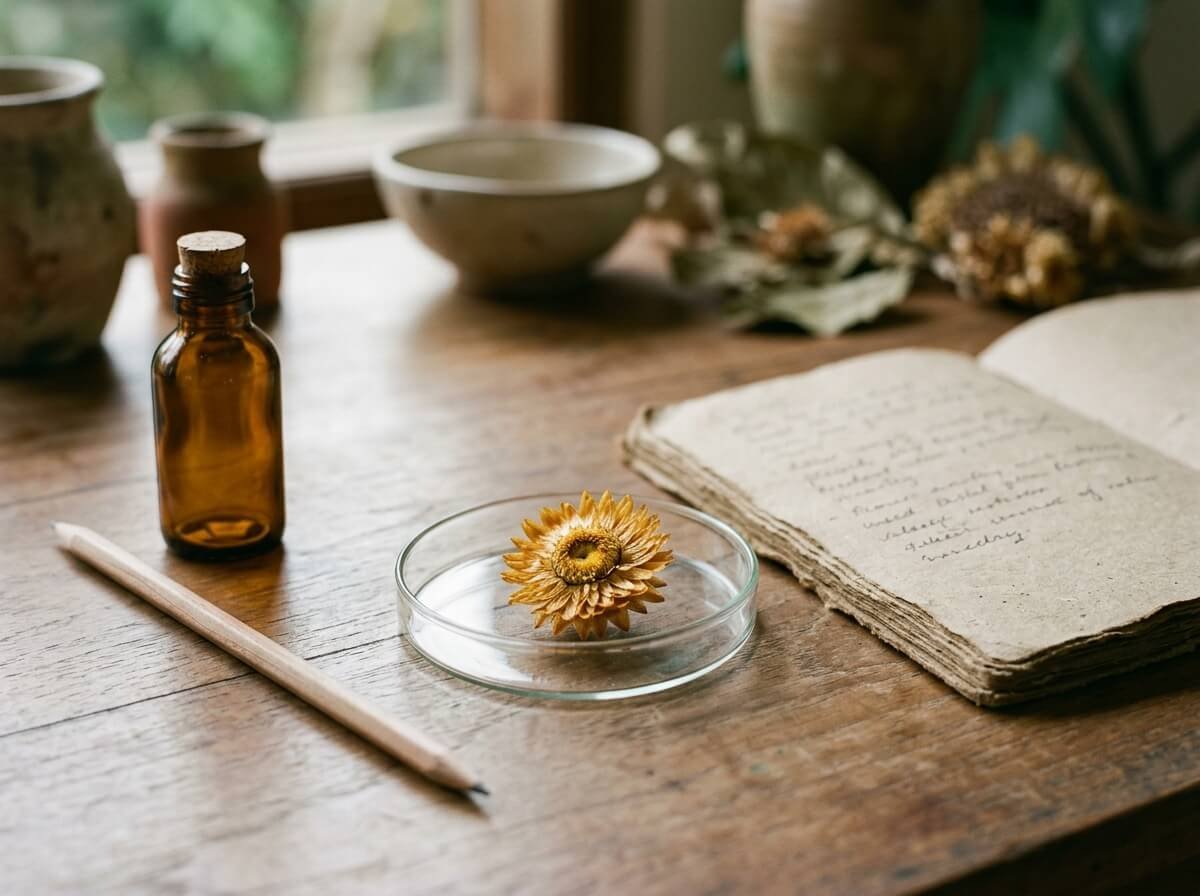
Here is the real picture. Helichrysum has been studied more than many essential oils, and the results are genuinely interesting. Most of the evidence, however, comes from the laboratory and from animal models, with only small human studies so far. That does not make it worthless. It makes it promising, and it means we should speak about it with care.
Antioxidant and calming activity
In lab studies, helichrysum extracts and oil show antioxidant activity, meaning they help neutralise the unstable molecules (free radicals) that sunlight and pollution generate in skin. Researchers have also measured anti-inflammatory effects, where the oil reduces markers of inflammation in cell cultures and in animal models. This is consistent with its traditional use on bruises and irritated skin. It also shows antimicrobial activity against some bacteria and fungi in the lab.
Wound healing and collagen
The most exciting work concerns wound repair. Reviews describe helichrysum influencing several phases of healing: the early inflammatory phase, the phase where new tissue forms, and the later remodelling phase. Studies on skin cells have looked at how the oil affects fibroblasts, the cells that build collagen, and some research has observed increased collagen deposition during tissue repair.
One finding stands out, and it changes how we think about using the oil. In cell studies, the effect was biphasic and dose-dependent. Low to intermediate concentrations supported fibroblast viability and growth. A high concentration did the opposite and harmed the cells. In plain words, a little helps and too much can hurt. Keep that in mind, because it is the scientific case for dilution.
The human evidence, honestly
Human data is thin but encouraging. A small clinical case series treated wounds with helichrysum oil diluted to 10% in virgin coconut oil, applied three times a day, and reported good healing without secondary infection. An older, small, uncontrolled study followed people after facial surgery who used helichrysum blended with rosehip oil, and reported reduced inflammation and bruising. These are useful signals. They are not large, controlled trials, and no one should present them as proof. We wrote more about this careful middle ground in our guide to essential oils for scars.
What helichrysum will not do: separating evidence from hype
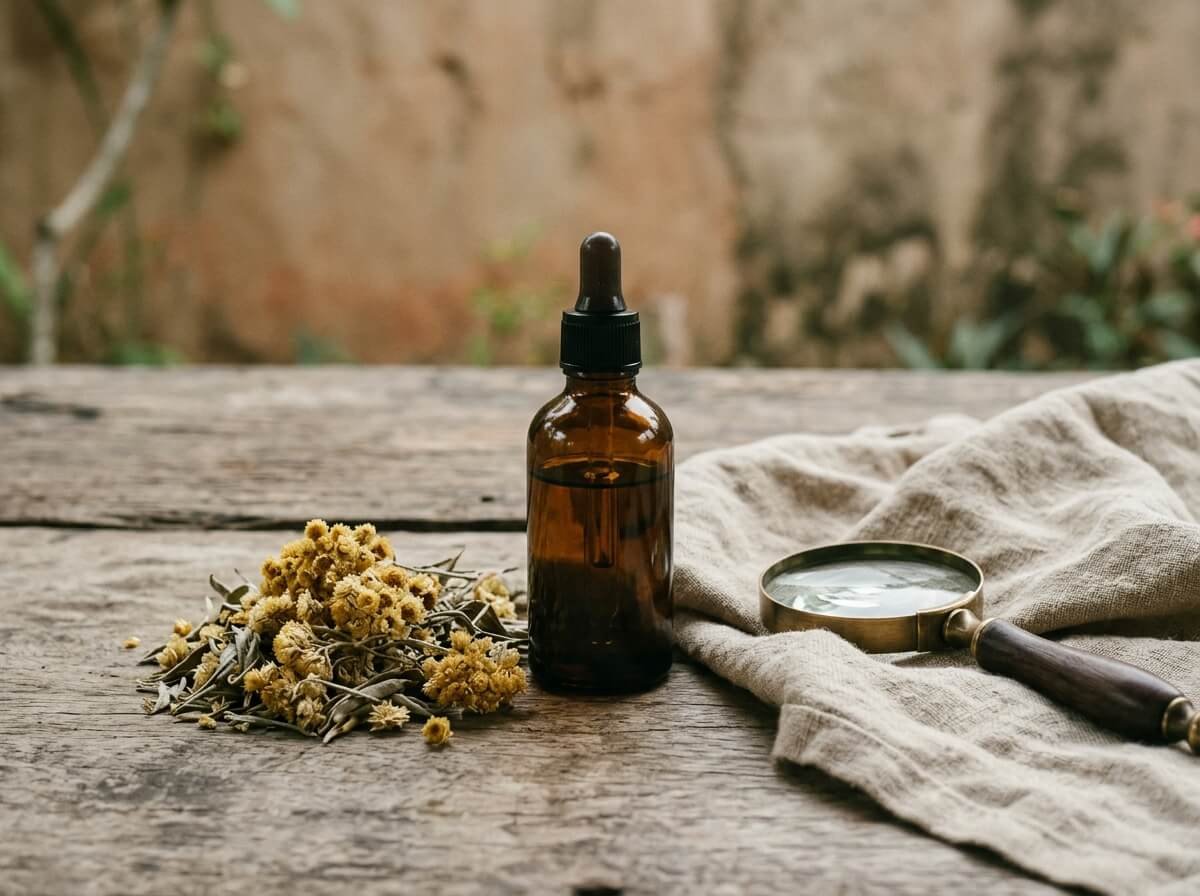
Search for helichrysum and you will find it described as liquid gold, a facelift in a bottle, a reversal of time. We understand the appeal. We also think these claims do real harm. They set expectations no plant can meet, and they push people toward using the oil neat and in large amounts, which, as the cell research shows, can work against the skin.
So let us name the overclaims plainly.
- It will not erase wrinkles. There is no good human evidence that helichrysum reverses visible ageing. Supporting collagen in a lab dish is not the same as removing lines from a face.
- It will not fade deep or old scars overnight. Early studies focus on fresh wounds and recovery after surgery, not on scars that are years old.
- It is not an acne cure. Lab antimicrobial activity does not translate directly into clearer skin, and some sources explicitly describe skin claims as unproven.
- More is not better. Higher concentrations are more likely to irritate, and in cell studies they were harmful.
- It is not a replacement for medical care. Wounds that are deep, infected, or slow to heal need a doctor, not an oil.
What helichrysum can reasonably do, as part of a well-made formula, is support skin that is calm, comfortable, and recovering well. That is a quieter promise, and it is the honest one. If you are drawn to helichrysum because you want to care for skin as it matures, our guide to plant-based skincare for mature skin and our look at a natural retinol alternative set out what plants can and cannot do, without the theatre.
There is a broader lesson here too. The more precious and expensive an ingredient becomes, the more marketing grows around it. Truth in nature means letting the evidence lead, and letting the plant be what it is. Helichrysum does not need exaggeration to be worth using.
How helichrysum works with a stressed skin barrier
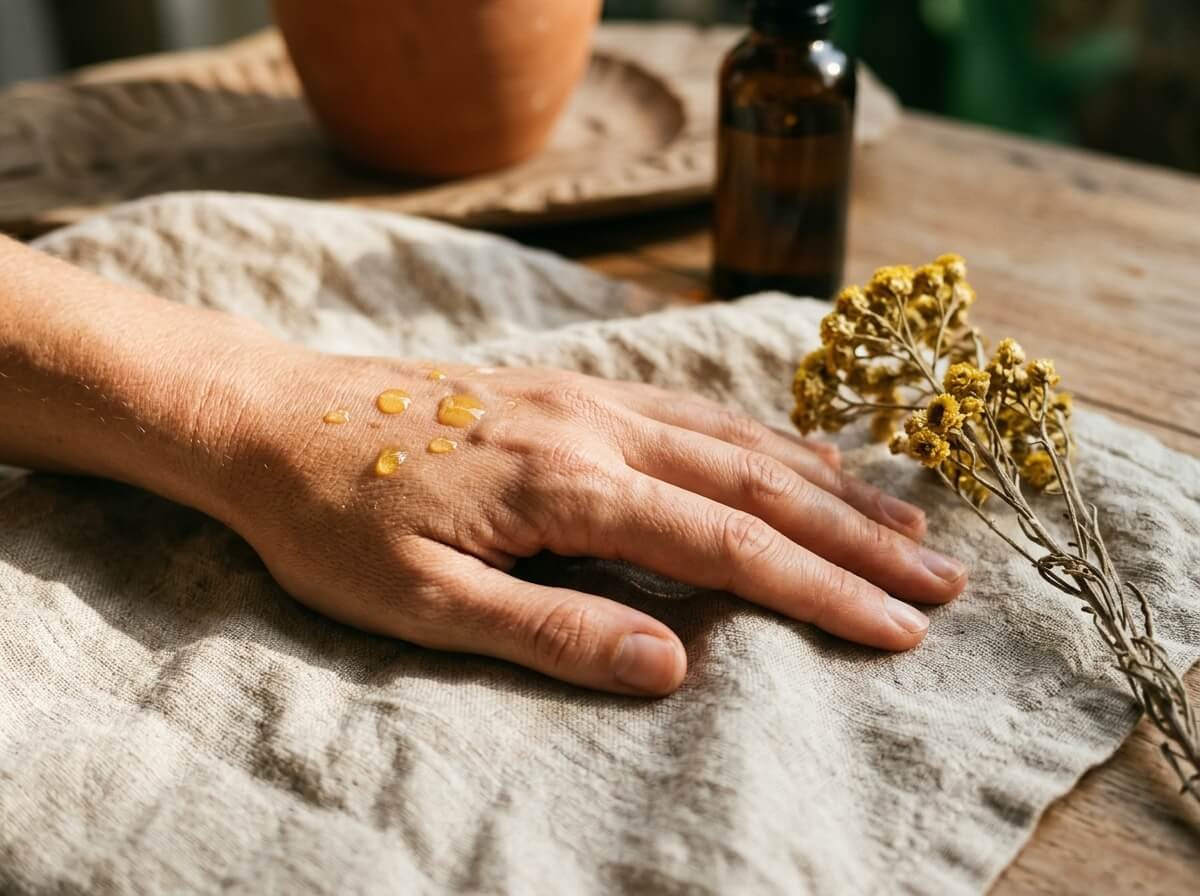
Your skin barrier is the outermost layer of skin, a tight structure of cells held together by lipids (fats). When it is healthy, it keeps water in and irritants out. When it is stressed by harsh cleansers, over-exfoliation, sun, wind, or air conditioning, skin can feel tight, look red, and react to products it once tolerated.
Helichrysum’s calming and antioxidant activity makes it a sensible companion for skin in this state, with one important condition: it has to arrive in a gentle form. An essential oil on its own is concentrated and can itself be a source of stress for compromised skin. In a well-diluted serum, carried by a nourishing plant oil, it can contribute to comfort rather than add to the problem.
The role of the carrier
The carrier often does as much work as the essential oil. Jojoba, for example, is a liquid wax that closely resembles the skin’s own sebum and helps soften and seal without heaviness. Tamanu oil, pressed from the nut of a tree that grows across the Indo-Pacific, has its own long tradition for calming and repair; our Tamanu Oil is a single-ingredient option for people who prefer to keep things simple. Our guide to the Balinese face oil tradition explores how island botanicals have been used this way for generations.
When to hold back
If your barrier is badly compromised, with stinging, cracking, or a rash, pause the actives and essential oils altogether. Use the simplest routine you can: a mild cleanser, a plain moisturiser, and patience. Bring fragranced and essential-oil products back slowly once skin has settled. Our sensitive skin routine walks through that slow return step by step, and our fragrance-light Sensitive Face Serum was formulated for exactly this kind of skin.
One more caution. Helichrysum belongs to the daisy family, the same family as chamomile, calendula, arnica, and ragweed. People with known allergies to these plants are more likely to react. A patch test is always wise, and for this group it is essential.
The adulteration problem: how to tell real helichrysum from a fake
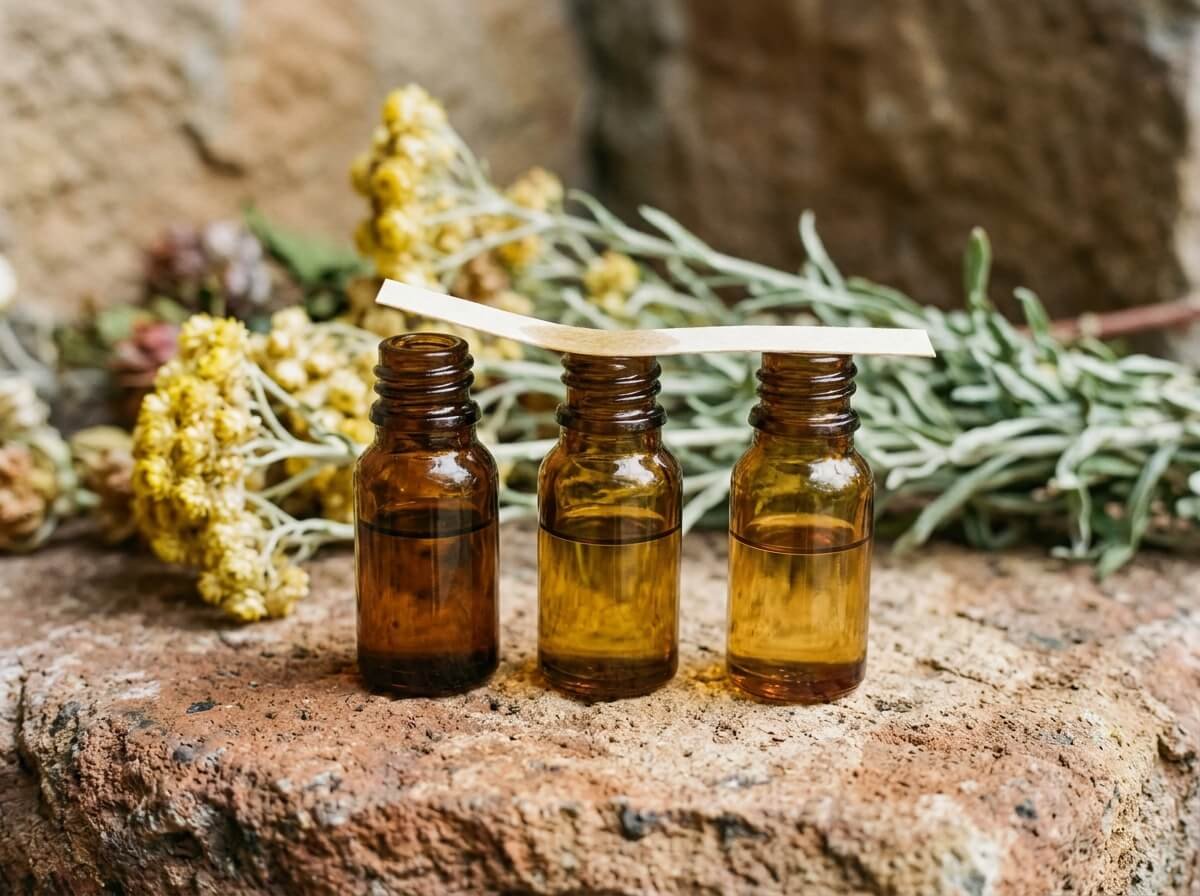
Because helichrysum is costly to produce, it is one of the most commonly adulterated essential oils on the market. Adulteration means the oil has been stretched, swapped, or altered without the buyer being told. It is not a niche problem. It is one of the main reasons people try helichrysum and conclude it does nothing.
The common tricks
- Quiet dilution. The bottle is sold as helichrysum oil, but it is mostly a carrier oil with a small amount of essential oil. Honest sellers label this clearly, for example as a 3% or 5% dilution in jojoba.
- Species swapping. Cheaper helichrysum species, or plants grown and distilled with less care, are sold as if they were Corsican Helichrysum italicum.
- Blending in cheaper oils. Other essential oils or isolated aroma chemicals are added to bulk up the volume and mimic the scent.
- Synthetic additions. Individual molecules, such as synthetic neryl acetate, can be used to make a weak oil test closer to a genuine profile.
What to look for when buying
- The full Latin name, Helichrysum italicum, not just helichrysum.
- The country of origin and the part of the plant distilled (flowering tops).
- Access to a batch-specific GC-MS report. Gas chromatography with mass spectrometry is a lab test that lists the chemical makeup of the oil. Reputable suppliers can share it.
- A price that makes sense. Genuine undiluted helichrysum is expensive. A large bottle at a low price is a warning, not a bargain.
- Honest labelling of dilution. A diluted product is not a fake if it says so. It is only a problem when it hides it.
Aroma helps, but it is not a reliable test on its own. A good helichrysum smells warm, herbaceous, and gently honeyed, with that faint curry note. A skilled adulterator can imitate this. Paper and data tell you more than your nose does. Once you have a genuine oil, look after it: keep it in dark glass, away from heat, and tightly closed. Our guide on how to store essential oils covers why oxidised oils are more likely to irritate.
This is the Outlaw in us speaking for a moment. Greenwashing is not only about packaging. It is also about ingredient lists that promise a precious plant and deliver a trace of it. We believe everyone should know what is actually in the bottle, which is why we publish our full ingredient lists, in order, on every product.
Neat oil or formulated serum: safe dilution and why ready-blended makes sense
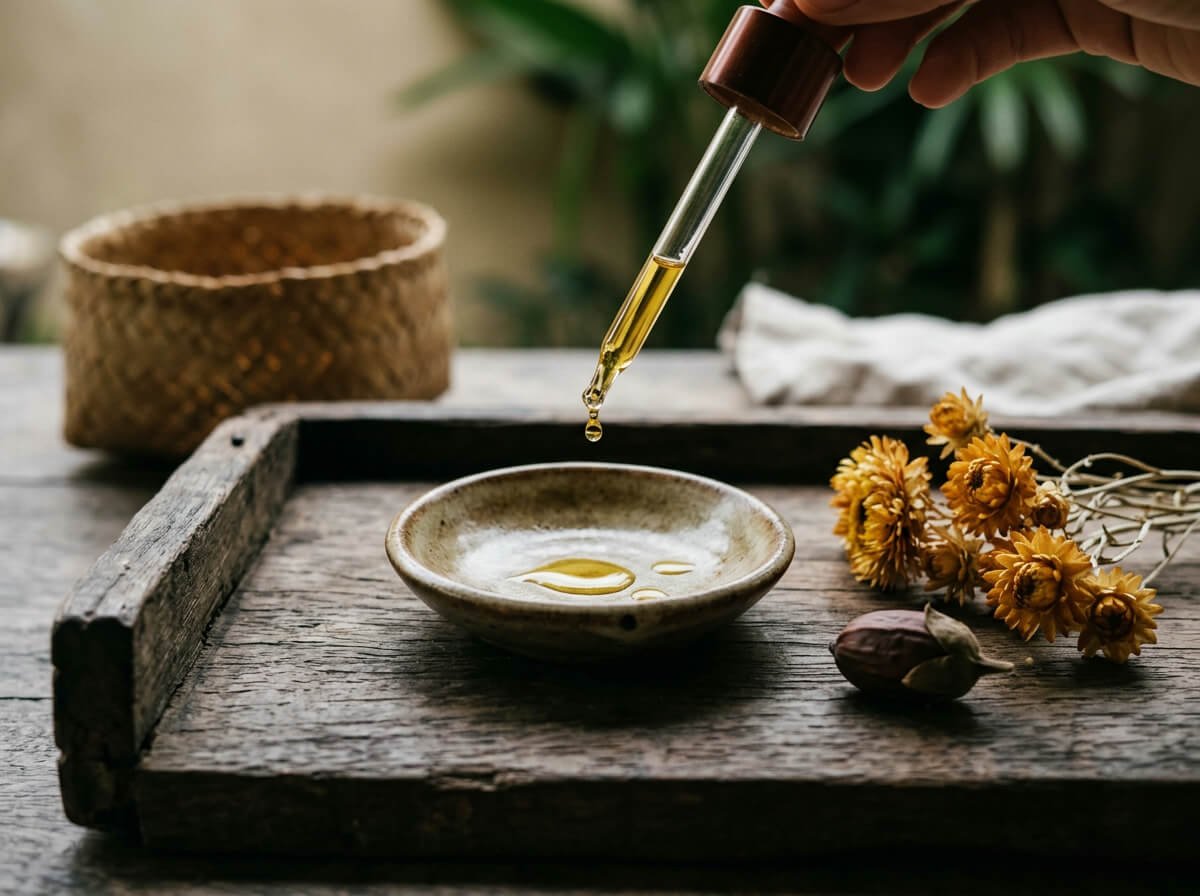
Many sources suggest applying helichrysum oil straight to the skin. We do not recommend it. Essential oils are highly concentrated, and facial skin is thin and reactive. Remember the cell research: helpful at low to moderate levels, harmful at high ones. Dilution is not a compromise. It is how the oil is meant to be used.
General dilution guidance
Professional aromatherapy guidance for facial products usually sits at around 0.5% to 1% total essential oil, rising to around 2% for the body. In practical terms, 1% is about one drop of essential oil in a teaspoon (5 ml) of carrier oil. Short-term, targeted use on a small area may go higher under professional guidance, as in the wound study above, but daily facial use should stay low. Our full guide on how to dilute essential oils includes a simple chart, and if you are choosing a base, our older piece on the best carrier oil to mix with essential oils remains a useful starting point.
Why a formulated serum is the sensible ritual
Blending at home is rewarding, but it asks a lot: sourcing a genuine oil, measuring single drops accurately, choosing a stable carrier, and storing the result well. A formulated serum does that work for you, and it allows helichrysum to sit within a balanced blend rather than carrying the whole load alone.
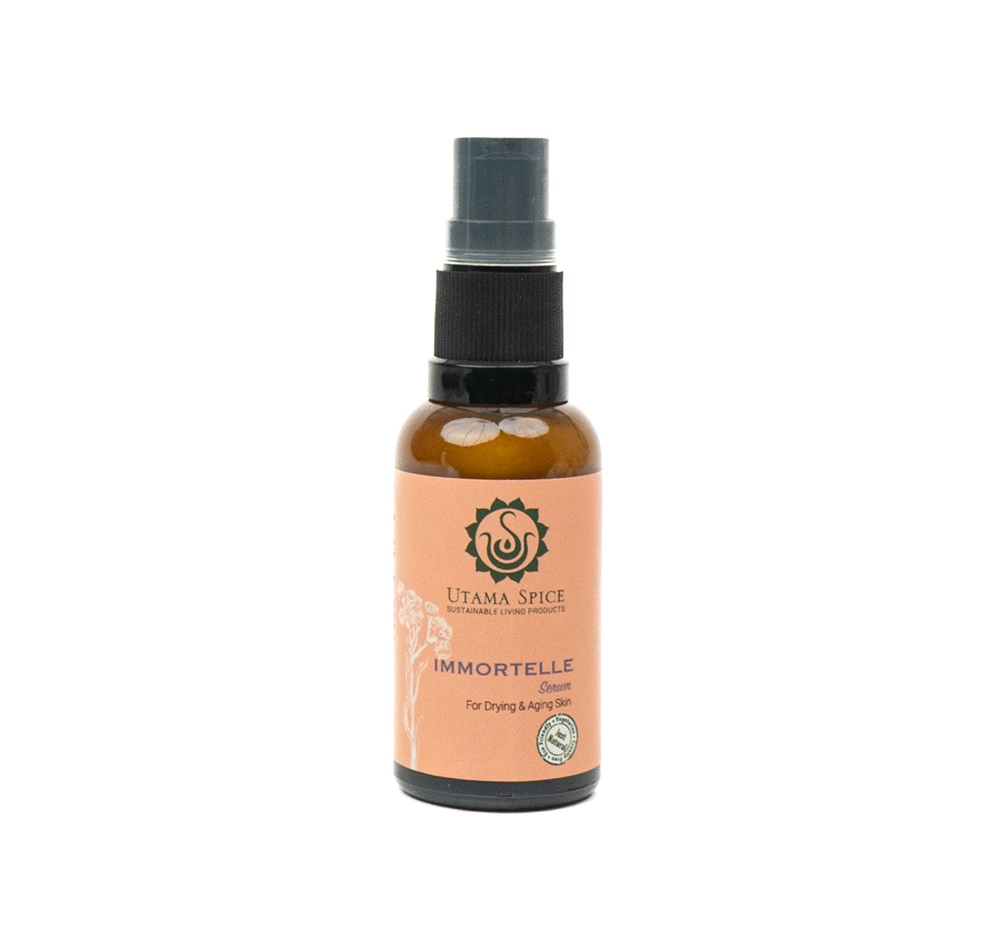
Our Immortelle Helichrysum Face Serum is built this way. It pairs helichrysum with jojoba in a light, water-based serum, alongside frankincense, myrrh, rose geranium, lavender, neroli, patchouli, rose, and ylang-ylang. Because ingredients are listed in order of quantity, you will see helichrysum near the end of the list, which is exactly where an essential oil belongs in a daily facial product. It is there to contribute, gently, not to overwhelm. If you are curious about one of its companions, our Frankincense Essential Oil is available on its own for diffusing or careful home blending.
Helichrysum, gently blended for daily care
Our Immortelle Helichrysum Face Serum pairs helichrysum with jojoba, frankincense, myrrh, rose geranium, and neroli in a light serum, hand-blended in Bali at the low level essential oils belong on facial skin. Two or three drops, pressed in each evening.
If you would like to understand where a serum sits in a wider routine, our comparison of face serum vs face oil explains how the two formats differ, and when each one makes sense.
A simple evening ritual with helichrysum serum
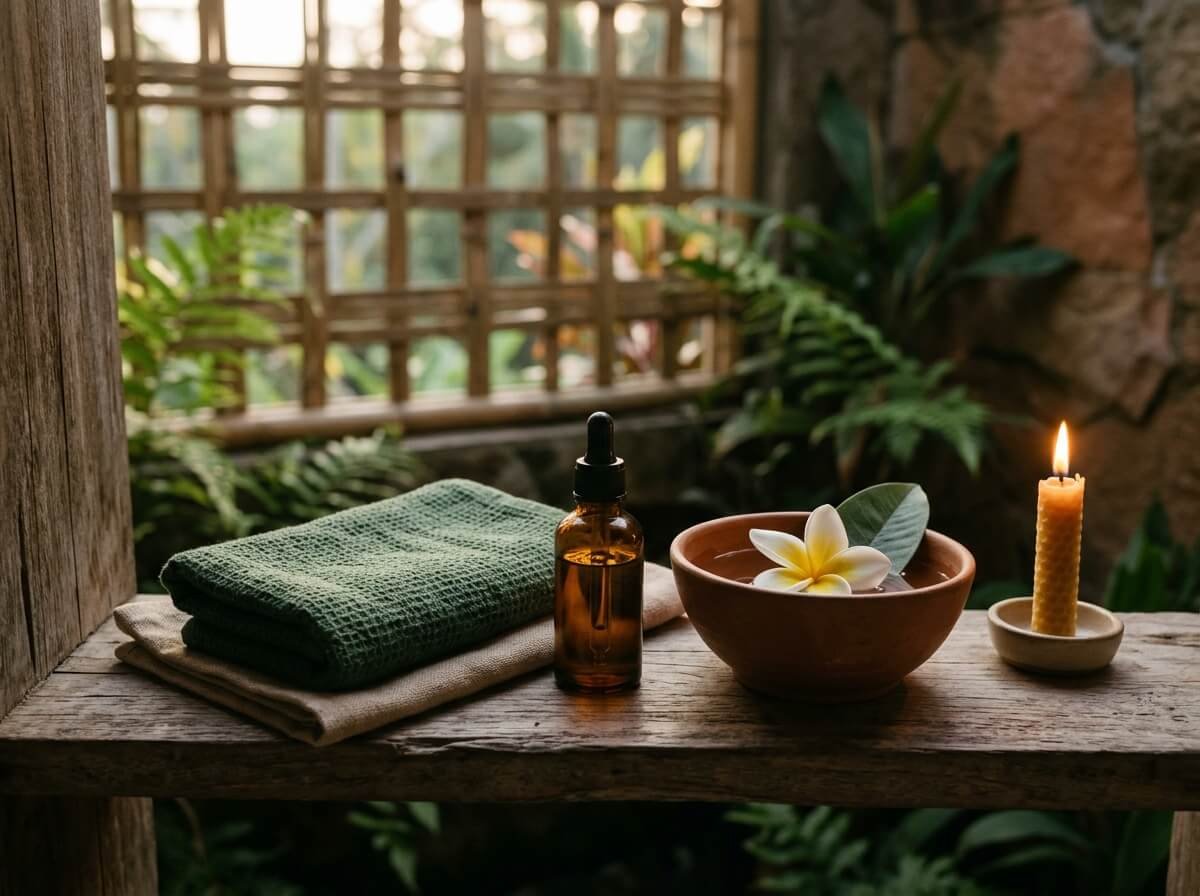
Evening is when skin does much of its quiet repair work, and it is the best time to use a calming serum. A ritual does not need to be long. It needs to be consistent, gentle, and done with attention. Here is how we use ours in Bali, where the evenings are warm and the air is humid.
- Cleanse softly. Use a mild cleanser and lukewarm water, not hot. Pat dry with a clean cotton cloth, leaving the skin very slightly damp.
- Warm the serum. Place two or three drops in your palms and press them together for a few seconds. Warmth helps the serum spread with less pulling on the skin.
- Press, do not rub. Press your palms gently over your cheeks, forehead, jaw, and neck. Hold for a breath at each point. Avoid the eye area.
- Take a moment. Close your eyes and breathe in the aroma: honeyed helichrysum, resinous frankincense, a soft floral lift. This is the part of the ritual for the mind, not just the skin.
- Seal if needed. On dry nights, or in air-conditioned rooms, follow with a light moisturiser. Our HydroBotanic 3-in-1 Hydrating Face Cream layers well over a serum.
If you enjoy a slower ritual, a few minutes of gentle facial massage after applying the serum can feel deeply restorative. Our guide to facial massage with face oil shows simple strokes that work just as well with a serum underneath. For the order of each step, see how to layer natural skincare.
Give it time. Skin renews itself over weeks, not days. Use the serum for at least four to six weeks before judging how your skin feels, and watch for comfort and calm rather than dramatic change. That is what a good botanical serum offers: steady, honest support, night after night.
Frequently asked questions about helichrysum oil for skin
What are the main helichrysum oil benefits for skin?
Research suggests helichrysum has antioxidant, anti-inflammatory, and antimicrobial activity, and early studies point to support for wound repair and collagen formation. Most evidence comes from lab and animal studies, with small human case series. In practice, it is best understood as a calming, supportive ingredient for skin that is recovering or stressed, used well diluted.
Can I put helichrysum oil directly on my face?
We do not recommend it. Undiluted essential oils can irritate facial skin, and cell research shows high concentrations can be harmful. Dilute to around 0.5% to 1% for daily facial use, or choose a formulated serum.
Is helichrysum oil good for scars?
There is early, encouraging evidence for fresh wounds and recovery after surgery, mostly from small studies. There is little evidence for old, established scars. Use it as gentle support, and speak to a doctor about significant scarring.
Is helichrysum the same as immortelle?
Yes. Immortelle and everlasting are common names for Helichrysum italicum, named for flowers that keep their colour after drying. For a look at a much older post on our serum, see our original piece on the helichrysum face serum.
Who should avoid helichrysum oil?
People with known allergies to the daisy family (such as ragweed, chamomile, or arnica) should take extra care. If you are pregnant, breastfeeding, or using medication, speak to a health professional first. Always patch test: apply a small amount of diluted product to the inner arm and wait 24 hours.
Why is real helichrysum oil so expensive?
The plant yields very little oil, and the best oils come from carefully harvested wild or small-farm flowers in specific regions. Low yield and high demand make it costly, and that is also why it is so often diluted or faked.
Can helichrysum be used with other oils?
Yes, and it often works best that way. It blends well with frankincense, rose, lavender, and neroli, and pairs with gentle carriers like jojoba, tamanu, or rosehip. Our natural face oil guide and our piece on Buah Merah oil, a red-fruit oil from Papua, explore other botanicals that sit beautifully alongside it.
The everlasting flower has earned its place in natural skincare, not through hype, but through a long tradition and a growing body of honest research. Use it diluted, buy it with your eyes open, and let it be one quiet part of a ritual that cares for your skin over time. What you give, you get back.